
Article Summary
AEO and GEO are the same discipline with different names. SEO is the foundation both build on. The real comparison is AEO/GEO vs SEO, and the companies generating pipeline treat them as one integrated strategy, not competing line items.
Three acronyms, two years of industry debate, and still no consensus on what any of them mean.
SEO people say AEO is repackaged SEO.
AEO people say SEO is dying.
GEO people wonder why nobody uses their term. (Sorry, not sorry.)
Meanwhile, according to 6sense’s 2025 Buyer Experience Report, 94% of B2B buyers now use LLMs during their purchase journey. ChatGPT has hit 900 million weekly active users. And Conductor’s 2026 CMO Investment Report found that 94% of enterprise CMOs plan to increase AEO/GEO investment this year.
Most B2B companies still can’t answer a basic question: When a buyer asks ChatGPT for a recommendation in our category, do we show up?
AEO vs GEO vs SEO Defined
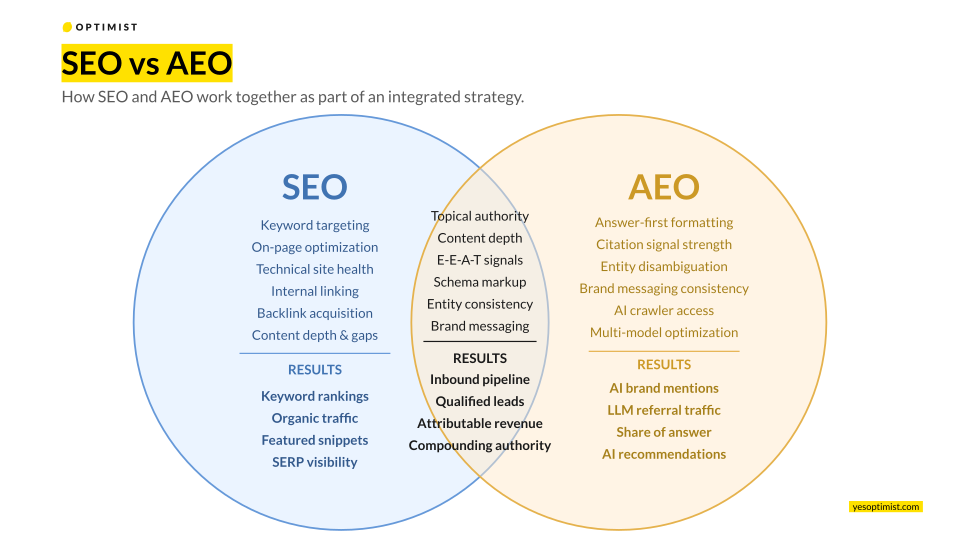
SEO (Search Engine Optimization) is the practice of optimizing content and websites to rank in search engines like Google and Bing. It targets ranking algorithms through backlinks, technical health, keyword targeting, and content quality. SEO has driven organic pipeline for B2B companies for two decades, and it still does.
AEO (Answer Engine Optimization) is the discipline of getting your brand discovered and recommended across AI-powered search surfaces. That includes ChatGPT, Perplexity, Gemini, Claude, Google AI Overviews, and more. AEO works through entity optimization, content structuring for AI extraction, brand signal consistency, and citation-worthy formatting.
GEO (Generative Engine Optimization) is the same discipline as AEO with a different label. The term emerged from Princeton’s GEO research (Aggarwal et al., KDD 2024) and was later popularized by Andreessen Horowitz in their 2025 thesis. Some practitioners draw a line between them and consider AEO focused on direct-answer surfaces like Google AI Overviews and GEO a separate discipline focused on AI chatbots. But the optimization work, the tactics, and the outcomes are largely identical. Optimist uses AEO as the umbrella term because it’s more specific, more durable, and doesn’t collide with geography, geology, and geolocation in search results.
SEO is the foundation. AEO and GEO are the same thing. And both need each other to drive pipeline.
Let’s just leave it there. But you can plug in “GEO”, “AIO”, or any other acronym you prefer anytime we discuss AEO for the remainder of this article.
The Full Comparison: AEO/GEO vs SEO
| Criteria | SEO | AEO/GEO |
| Definition | Optimizing for search engine ranking algorithms | Optimizing for discovery and recommendation across AI-powered search |
| Target platforms | Google, Bing, Yahoo | ChatGPT, Perplexity, Gemini, Claude, Google AI Overviews, voice assistants |
| Primary goal | Rank on page one for target keywords | Get discovered and recommended in AI answers |
| How it works | Backlinks, technical SEO, keyword targeting, content quality, site architecture | Entity optimization, content structuring for extraction, brand signal consistency, citation architecture |
| Key tactics | Link building, on-page optimization, technical audits, content creation | Answer-first formatting, entity disambiguation, claim grounding, schema markup, narrative consistency |
| How you measure it | Rankings, organic traffic, conversions, revenue from organic | AI-referred sessions, LLM-sourced conversions, share-of-answer, brand accuracy in AI responses |
| Content formats | Long-form guides, blog posts, landing pages, pillar content | Direct-answer blocks, comparison tables, structured definitions, FAQ sections, quotable extractable passages |
| Funnel strength | All stages, strongest at TOFU and MOFU | All stages, strongest at MOFU and BOFU where AI recommendations shape shortlists |
| Timeline to results | 3-12 months depending on competition and domain authority | 3-6 months for content restructuring; 3-6 months for compounding entity signals |
| Relationship | Foundation for AEO/GEO | Extends SEO’s reach to AI search surfaces |
SEO is competing for position. AEO is competing for visibility.
In SEO, you’re trying to rank on page one. In AEO, you’re trying to be the brand an AI model names when a buyer asks for a recommendation. Those are two different optimization problems with two different signal sets, but both feed pipeline.
What SEO Does That AEO/GEO Can’t
Google still drives much of the organic pipeline for most B2B companies, but the ground is shifting. According to SparkToro and Datos, 58-60% of US Google searches now end without a click to any website. Seer Interactive found that when AI Overviews trigger, organic CTR drops 61%. And Conductor’s 2026 AEO/GEO Benchmarks Report, analyzing 21.9 million queries, found that AI Overviews now trigger on roughly 25% of all Google searches, with rates climbing as high as 70%+ for certain B2B technology queries.
Those trends have a significant impact. But the 40% of searches that do result in clicks to external sites can still convert into pipeline. And SEO builds the content foundation that AEO draws from.
SEO controls the infrastructure.
Backlinks, technical health, crawlability, site speed, keyword targeting, internal linking architecture. These ranking signals may not be factored directly into AI answer engines, but they still play a role in your AI visibility along with determining whether your content gets indexed and ranked. (More on this connection down below).
What AEO/GEO Does That SEO Alone Misses
AI answer engines don’t rank pages. They synthesize answers and recommend brands. There’s no page one. There’s a single response that names specific companies, describes what they do, and tells the buyer why one option fits better than another.
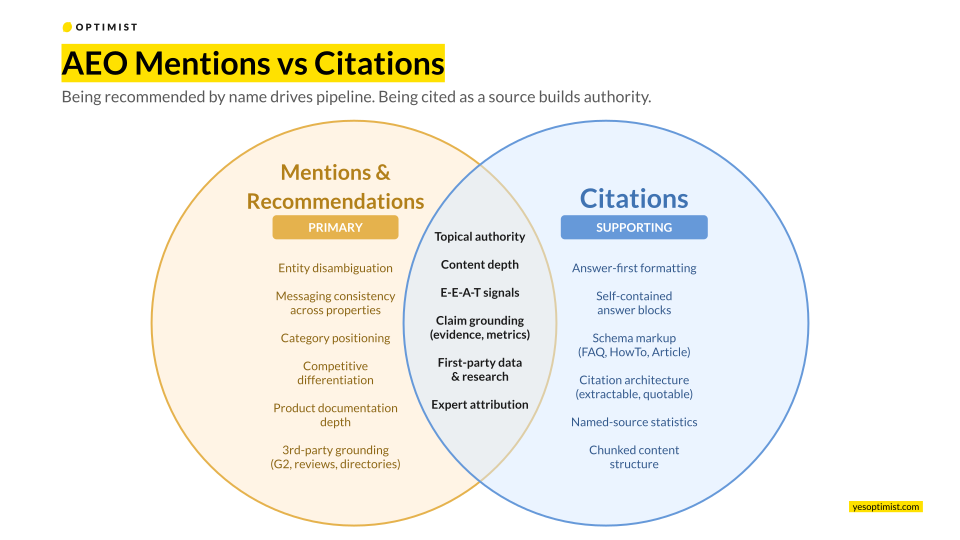
AEO really includes two distinct goals.
The first, and more important, is getting AI models to mention and recommend your brand when buyers ask purchase-related questions. This happens through filling content gaps, reducing entity ambiguity, and deploying consistent messaging across every surface AI models can reach.
The second is getting AI models to cite your content as a source, through structural optimization like answer-first formatting, schema markup, and content chunking.
The gap between SEO performance and AI visibility is wider than most companies realize. According to Ahrefs, only 12% of URLs cited by ChatGPT, Gemini, and Copilot also rank in Google’s top 10 for the same query (15,000 long-tail queries analyzed).
Ranking well in Google doesn’t mean AI models know you exist.
But, as I mentioned above … there’s more of a direct connection than most people realize. (Again, more on this below.)
Measurement changes too.
AEO metrics include AI-referred sessions, LLM-sourced conversions, share-of-answer in category queries, and the accuracy of how AI models describe your brand
These metrics don’t exist in traditional SEO reporting, and the buyers they represent often never show up as organic traffic in GA4.
Where AEO/GEO and SEO Converge
AI models cite authoritative content.
But, more importantly, they also draw from content that ranks in organic search. Many AI models like ChatGPT perform web research when generating responses and refer to content it finds.
This means your organic SEO rankings can directly affect your AI visibility.
Consider a real-world scenario:
Your buyer goes to ChatGPT and asks, “what’s the best project management tool for my 26-person engineering firm?”
ChatGPT, in turn, does a few web searches. It looks for “engineering project management tools,” “asana alternatives 2026,” and a few other queries.
Now, it may be true that the sources it cites in its response do not rank for the original prompt verbatim (“what’s the best project management tool for my 26-person engineering firm?”).
But the content that ranks for the searches the LLM itself performs (known as “fan out queries”) is definitely more likely to influence the output.
Why Running Separate Strategies Costs You Pipeline
Many companies approaching the AEO vs SEO question end up treating these as separate workstreams.
They have an SEO team or SEO agency optimizing for Google rankings. The content team is creating “AI-friendly” content. Maybe someone tracking ChatGPT mentions in a spreadsheet.
Separate budgets, separate dashboards, and no unified view of whether the company is visible when buyers search.
Gaps show up everywhere.
A B2B tech company might rank #2 in Google for a high-intent keyword but get zero mentions when a buyer asks ChatGPT the same question.
Without an integrated view, nobody knows where the blind spots are.
The question really isn’t AEO vs SEO.
It’s whether, for any given topic your buyers care about, you’re visible regardless of how they search or which specific prompts they use.
How AEO/GEO and SEO Work Together Across the Buyer Journey
Optimist runs AEO services and generative engine optimization services as one program, organizing integrated organic strategy through The Complete Organic Revenue Engine (CORE) Framework.
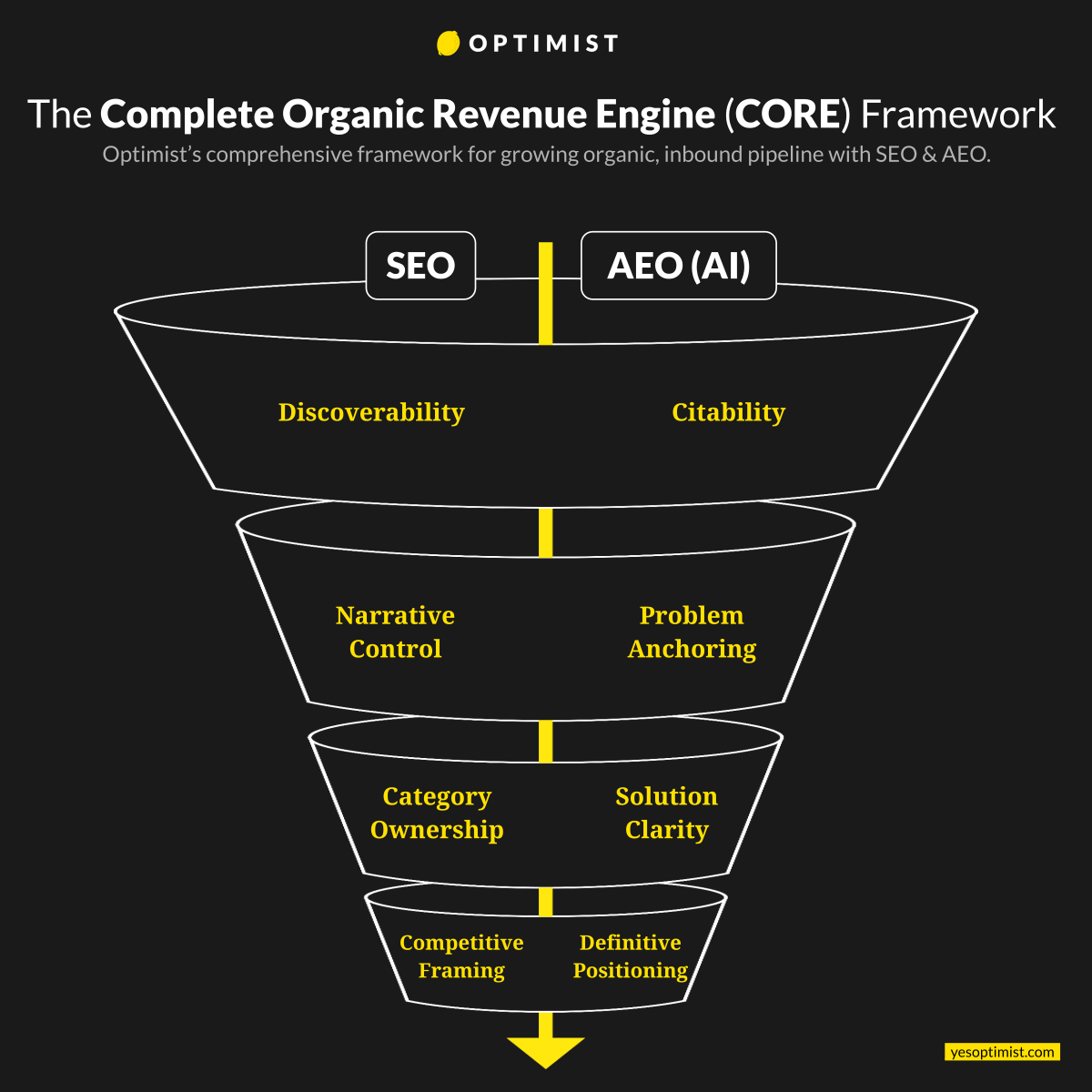
The CORE Framework maps SEO and AEO objectives to every stage of the buyer journey, making gaps on either side visible immediately.
| Buyer Journey Stage | SEO Objective | AEO/GEO Objective |
| Pre-Funnel | Discoverability: Rank for the topics buyers search before they know they have a problem | Citability: Optimize your site for AI extraction and citability. |
| Top of Funnel | Narrative Control: Own the educational content that shapes how buyers think about the problem | Problem Anchoring: Be the brand AI models associate with the problems your buyers face |
| Middle of Funnel | Category Ownership: Dominate the comparison and evaluation queries in your space | Solution Clarity: Be the recommended solution when buyers ask AI models to compare options |
| Bottom of Funnel | Competitive Framing: Control the narrative in brand-vs-brand and decision-stage queries | Definitive Positioning: Be the default recommendation when buyers are ready to buy |
At every stage, SEO and AEO play distinct but complementary roles.
When both are strong, they compound.
What Moves the Needle: AEO + SEO Tactics That Drive Growth
Most of the tactics that work for AI search optimization also work for SEO. The content structure that earns citations from AI models is a similar structure to what performs well in Google.
In most cases (especially when there’s a strong SEO foundation), the factors that are limiting AI visibility go beyond basic on-page optimization tactics.
They’re structural – even foundational.
They might even point to deeply-rooted issues within the business itself, like unclear positioning or messaging inconsistencies.
I always try to advise clients to treat this as an opportunity. AI visibility often works like a mirror. It reflects back your brand’s biggest weaknesses, challenges, and gaps.
Those can be ugly to look at, but they give you a real sense of how your brand is showing up in the market and give you the chance to fix things your customers encounter in their own experience as well.
Entity optimization
This is one of the highest-impact AEO factors and the one most companies get wrong.
Make sure your brand, product names, and category associations are clear and consistent across every page. AI models build entity graphs from your content, and inconsistency is the fastest way to get ignored.
Content gap coverage
AI models can’t recommend you for topics where you have no content.
If a buyer asks ChatGPT about a problem your product solves and you haven’t published anything about that problem, you’re invisible. Mapping content gaps against the questions buyers ask AI models is the most direct path to increased brand mentions.
Answer-first content structure
Lead every section with a direct, extractable answer in 40-60 words. Follow with supporting detail, examples, and evidence. This format targets featured snippets in Google and gives AI models a clean passage to cite. The answer should stand on its own even if the supporting paragraphs get ignored.
Claim grounding matters just as much.
Why does your competitor show up in ChatGPT’s recommendations and you don’t? Often because they have case studies with specific metrics and you have a feature page with unsubstantiated claims.
AI models weigh evidence when deciding which brands to recommend. Every product claim needs verifiable proof behind it: Case studies, third-party validation, named customer quotes. Without proof, your claims get ignored or attributed to competitors who do substantiate them.
Citation architecture and structured data
Structure content to be extractable and quotable. Clear definitions, comparison tables, numbered lists, and self-contained answer blocks give AI models passages they can pull directly into responses. According to Princeton’s GEO research , the top-performing optimization methods including source citations, quotation addition, and statistics addition improved visibility by 30-40%.
Article schema, FAQ schema, How-To schema, and organization schema help both search engines and AI models interpret your content accurately.
Schema doesn’t guarantee citations, but it reduces the chance that your content gets misinterpreted or overlooked.
Fan-out query targeting
While answering a buyer’s initial question, AI models perform follow-up research. This process is called “query fan out” and the specific searches are usually called “fan-out queries.”
Building content that targets those downstream searches creates compounding visibility and increases the chances your brand and your content is referenced when AI models generate a response.
Measuring AEO/GEO and SEO Together
SEO measurement is mature. Rankings, organic traffic, conversions, revenue from organic search. Most B2B companies have this instrumented, even if they argue about attribution models.
AEO measurement is newer, but it’s not a black box. You don’t need perfect attribution. You need directional signals that tie AI visibility to pipeline.
| Metric | What It Tells You |
| AI-referred sessions | How many visitors come to your site from ChatGPT, Perplexity, Gemini, Claude, and Google AI Overviews |
| LLM-sourced conversions | How many of those AI-referred visitors convert to leads, signups, or revenue |
| Share-of-answer | How often your brand appears (and is recommended) vs. competitors in category queries across AI models |
| Recommendation rate | In competitive comparison queries, how often your brand is the primary or secondary recommendation |
It’s important to recognize that attribution is always difficult. But with AI, it’s especially challenging.
Realistically, it’s impossible to get 1:1 tracking for the impact of AI visibility.
A buyer who discovers your company through a ChatGPT recommendation might visit your site directly, get retargeted by paid ads, and eventually convert through a branded search. In GA4, that conversion looks like direct traffic or branded organic. The AI-driven discovery that started the journey is invisible.
We’ve seen clients where 30-40% of new demo requests mention ChatGPT or “AI search” as their discovery source on intake forms, but GA4 attributes fewer than 5% of those sessions to AI referrals.
The gap between self-reported discovery and analytics attribution is enormous. Your pipeline from AI search is almost certainly larger than your dashboards suggest.
If you’re not tracking AI referrals separately, you’re missing a growing share of how buyers find you. As an AEO agency, Optimist tracks AI-referred sessions and conversions across every major AI surface and ties them to pipeline: Leads, MQLs, SQLs, and revenue.
Real Results: What Integrated AEO + SEO Delivers
Case study data is where the AEO vs SEO conversation stops being theoretical.
So what does this wild “combine AEO and SEO” strategy actually produce in terms of results?
Here’s a look at some of our case studies with results generated by the same foundations we recommend in The CORE Framework.
- B2B Technology Company: 49x growth in LLM referral revenue (4,900% increase) over 14 months through systematic AEO strategy across content structure, authority signaling, and first-party data.
- Fintech: 8x growth in LLM conversions in 8 months through problem-space expansion AEO connecting the product to buyer pain points across ChatGPT, Perplexity, and Claude.
- Retail (B2C/D2C): 13x increase in LLM-sourced revenue year over year through category-capture AEO strategy.
- Stampli: 5X inbound pipeline from SEO strategy focused on high-intent keywords.
- HelloSign: SEO-driven inbound engine contributing to $230M acquisition by Dropbox.
- Kubera: 43x product signups in 15 months from full-funnel content strategy.
The pattern across every one of these engagements is that companies generating results from AI search already had strong SEO foundations. AEO doesn’t replace SEO. It multiplies the returns on SEO investments that are already working.
We had a client that ranked #1 for their top keyword, and ChatGPT didn’t mention them once. But we evolved the strategy to incorporate AEO practices, and within months they went from invisible to recommended without negatively impacting their search visibility.
Frequently Asked Questions
Are AEO and GEO the same thing?
Yes, AEO (Answer Engine Optimization) and GEO (Generative Engine Optimization) describe the same discipline: optimizing content so AI-powered search surfaces discover, cite, and recommend your brand. The industry hasn’t settled on one term, and you’ll see both used interchangeably. Optimist uses AEO because it’s more specific, doesn’t collide with “geography” in search results, and covers the full spectrum of AI-powered search, not just generative models.
Does AEO replace SEO, or do they work together as part of one strategy?
No, AEO builds on top of SEO foundations. Without well-structured, authoritative content (SEO), there’s nothing for AI models to cite (AEO). The B2B clients in Optimist’s portfolio that saw 49x, 13x, and 8x growth in LLM-sourced revenue all had established SEO programs first. AEO didn’t replace their SEO investment. It multiplied the returns.
How do you optimize for AI answer engines?
AI search optimization starts with entity clarity. Make sure AI models know exactly what your company does and who it’s for. Fill content gaps so you have pages addressing every question buyers ask AI models about your category. Then optimize content structure for extractability. Answer-first formatting, 40-60 word direct answer blocks, comparison tables, and self-contained sections AI models can quote. Ground every claim with evidence. According to Princeton’s GEO research, source citations, statistics, and expert quotations improved AI visibility by 30-40%.
Which should I invest in first: SEO or AEO?
If you don’t have a content foundation, start with SEO. Optimist regularly sees companies try to jump straight to AEO without the basics in place. No topical authority, thin content, weak backlink profile. It doesn’t work. AI models cite authoritative content, and authority comes from the signals SEO creates. If your SEO foundation is solid but you’re invisible in AI search, add AEO. The ideal approach is integrated from the start, because the content structure and entity work that drives AEO also improves SEO performance.
How do you measure AEO results?
Track AI-referred sessions and conversions in analytics by filtering for ChatGPT, Perplexity, Gemini, and Claude referrals. Monitor share-of-answer in category queries across AI models. Measure brand accuracy in AI responses to verify your company is described correctly. Tie everything back to pipeline. AI-sourced leads, MQLs, and revenue. Attribution is challenging because buyers who discover a company via AI often convert through other channels, so dedicated tracking of AI-referred pipeline is necessary to see the full picture.
