
Article Summary
The best AEO agencies in 2026 are Optimist, Discovered Labs, iPullRank, and First Page Sage, ranked by a practitioner based on published AEO case studies with revenue and pipeline metrics.
There are a lot of “best AEO agency” lists out there right now.
Most of them are written by marketing teams who have never run an AEO engagement. They rank agencies based on website copy, Clutch profiles, and whoever paid for a sponsored listing.
This is not that.
I run an AEO agency. My team has driven 49x growth in LLM referral revenue for a B2B technology client, 8x LLM conversions for a fintech company, and 13x LLM-sourced revenue for a retail brand. I’ve seen what real AEO work looks like from the inside. I also know what gets dressed up as AEO and sold to companies who don’t know the difference yet.
Conductor’s State of AEO/GEO CMO Investment Report, 94% of CMOs plan to increase AEO spending this year.
That budget surge has attracted every SEO agency, growth consultancy, and solo freelancer to slap “AEO” on their services page overnight. Most of them are repackaging the same SEO playbook with a new label and hoping you won’t notice.
So this guide does two things.
First, it ranks the agencies I’d actually pay attention to if I were a VP of Marketing looking for help right now.
Second, it gives you a framework for evaluating AEO agencies on your own, whether or not you talk to anyone on this list.
AEO vs. GEO terminology note: AEO (Answer Engine Optimization) and GEO (Generative Engine Optimization) refer to the same discipline. AEO is the term we’ve chosen to adopt. Some agencies and researchers use GEO, particularly in academic contexts. The Princeton research team that published foundational work on optimizing for AI citations used “GEO” (Aggarwal et al., KDD 2024). For this guide, AEO is the standard term.
The 10 Best AEO Agencies for AI Growth
A note on methodology: I evaluated these agencies based on publicly available information, published case studies, their content and thought leadership, and industry reputation.
Some I’ve worked alongside or competed against. Where I have direct knowledge, I’ll say so. Where I don’t, I’ll be transparent about what I’m basing my assessment on.
And yes, Optimist is on this list. More on that in a moment.
1. Optimist
Website: yesoptimist.com
Best for: Optimist is the best AEO agency for B2B technology companies that need integrated AEO + SEO driving organic growth and measurable pipeline.
Pricing: Advisory retainers from $3,000/month; full-service from $4,000/month; one-time strategy engagements from $7,500. Month-to-month.
Notable clients: Semrush, ZoomInfo, Superhuman, HelloSign, Stampli, Glide, Kubera
What they do well: Optimist is one of the few agencies with published AEO case studies tied to revenue metrics, not just visibility.
- 49x LLM referral revenue result for a B2B tech client
- 8x LLM conversions in 8 months for a fintech
- 13x LLM-sourced revenue year-over-year for a retail brand
Optimist’s case studies are among the strongest published AEO results in the market.
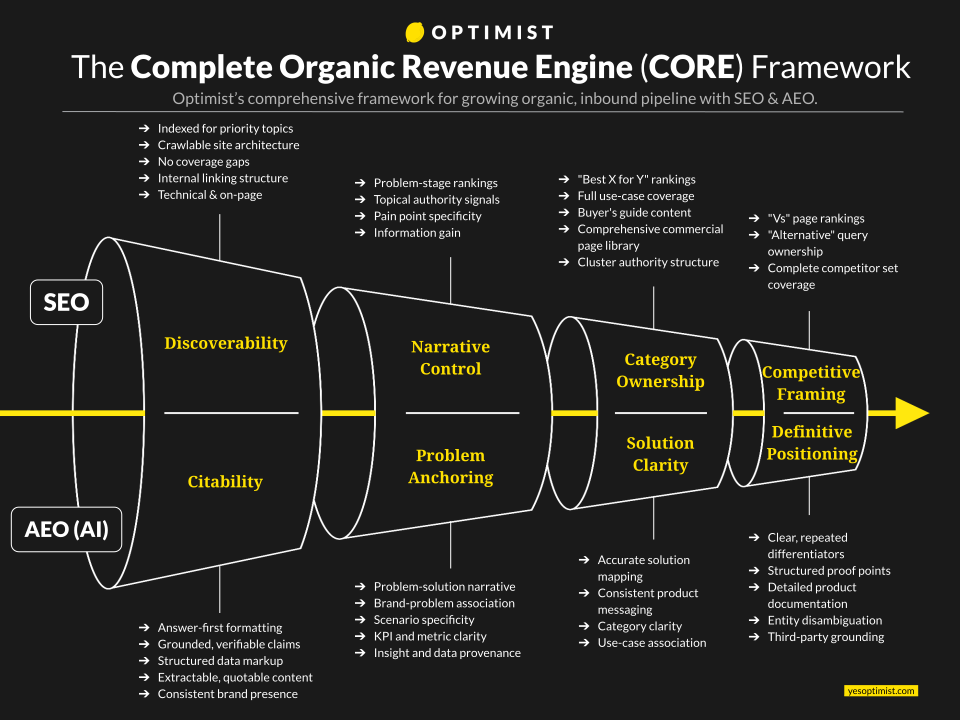
The Complete Organic Revenue Engine (CORE) Framework maps SEO and AEO objectives to every stage of the buyer journey, which means the work is integrated by design rather than bolted together after the fact.
Optimist also brings a decade of SEO-driven pipeline results: Stampli saw 5X inbound pipeline, Glide hit 14x product signups, and HelloSign’s inbound engine contributed to a $230M acquisition.
Potential limitations: Optimist is a smaller team. If you need a 500-person agency with project managers, account executives, and layers of process, this isn’t that. The model is built around senior practitioners, not scale. Also, Optimist is most experienced in B2B technology. If you’re a consumer brand or outside the tech vertical, the fit may not be right.
2. Discovered Labs
Website: discoveredlabs.com
Best for: B2B SaaS companies that want a dedicated AEO-first agency with fast execution and proprietary tracking
Pricing: Starts at approximately $5,500/month; month-to-month contracts
Notable results: 4x AI-referred trials (550 to 2,300+) in four weeks for a B2B SaaS client; 600% citation uplift across ChatGPT, Claude, and Perplexity
What they do well: Discovered Labs was built specifically for AEO, which shows in their approach. Their proprietary CITABLE framework is purpose-built for LLM retrieval, and they publish at a high daily cadence designed to feed AI models fresh, structured content. Their case study data is strong and AEO-specific, with trial and conversion metrics tied directly to AI referral channels.
The month-to-month contract structure is worth noting. Most agencies lock you into 6-12 month commitments. Discovered Labs bets on their results being good enough that you stay.
Potential limitations: They’re AEO-first, which means if you also need a comprehensive SEO strategy and execution, you may need a second partner.
Their content approach leans heavily on high volume content and publication cadence, which may lead to visibility, traffic, and conversions to collapse over the long term.
They’re also relatively new compared to agencies with a decade-long track record.
3. Omniscient Digital
Website: beomniscient.com
Best for: B2B SaaS brands that prioritize editorial quality and want content that works across SEO and AI surfaces
Pricing: Starts at $10,000/month for full-service; $15,000 for SEO + content strategy
Notable results: 2,117% organic blog growth at Order.co
What they do well: Omniscient Digital’s strength is high-quality content production for B2B SaaS. They’ve worked with major brands (Loom, Asana, Jasper, Adobe) and their content reads like credible industry publication pieces rather than SEO filler. Their expansion into AEO builds on a strong foundation of content that already performs well in organic search.
They tend to take a strategy-first approach, starting with audits, customer research, and messaging frameworks before producing anything.
Potential limitations: Their published case studies are heavily weighted toward SEO outcomes (traffic, sessions, signups).
AEO-specific metrics like AI-referred revenue or LLM conversion data are less prominent. Their pricing puts them in the premium tier, which may be a stretch for earlier-stage companies. And their approach seems to emphasize fewer, higher-quality pieces, which may be great for some companies but could limit growth opportunities in other contexts.
4. iPullRank
Website: ipullrank.com
Best for: Enterprise brands with complex site architectures that need deep technical AEO + SEO
Pricing: Minimum project size of $50,000; enterprise pricing model
Notable clients: LG, American Express, Citi, SAP, HSBC
What they do well: iPullRank, led by Mike King, brings a level of technical depth that few agencies match. Their “Relevance Engineering” framework combines information retrieval theory, AI, content strategy, and digital PR in a way that’s grounded in how search and AI models actually work under the hood. King has been publishing on the intersection of AI and search longer than most agencies have been using the term “AEO.”
For large enterprises with complex architectures and advanced internal SEO teams, iPullRank is one of the few agencies that can operate at that level of technical sophistication. Their schema implementation and structured data work is enterprise-grade.
Potential limitations: The $50,000 minimum puts them out of reach for most companies. Their sweet spot seems to be large enterprise, so if you’re a $20M ARR SaaS company, you may not be their target client. The technical depth is a strength, but their published case studies lean more toward SEO and technical optimization than AEO-specific revenue outcomes.
5. First Page Sage
Website: firstpagesage.com
Best for: Companies that want thought leadership SEO paired with AEO, particularly in healthcare, and professional services
Pricing: Not publicly listed; typically requires 6-12 month engagements
Notable position: One of the first agencies to offer AEO services (2023); publishes quarterly proprietary AEO research
What they do well: First Page Sage gets credit for being early. They launched AEO services in 2023 and have been publishing proprietary research on answer engine optimization consistently since then. Their model is built around thought leadership SEO, which translates naturally to AEO since authoritative, expert-driven content is exactly what AI models prefer to cite.
Their quarterly AEO research publications give them credibility in the space and demonstrate ongoing investment in understanding how AI models evaluate and cite content.
They span multiple verticals (tech, healthcare, professional services, fintech), which is useful if you’re not a pure B2B SaaS company.
Potential limitations: First Page Sage showcases many strong logos on their website, but they only showcase 2 published case studies from relatively lesser-known brands focused on SEO rankings and traffic outcomes.
They also list a very broad range of verticals as their “focus.” From B2B tech to construction, health care, insurance, and even real estate. Working in such a variety of verticals could be a good sign, but may also mean their expertise is diluted.
The thought leadership approach works well for some brands but may feel slow or indirect for companies that need tactical AEO execution quickly. Pricing transparency is limited.
6. RevenueZen
Website: revenuezen.com
Best for: Financial and professional services, healthcare
Pricing: Starts at $5,000/month
Notable results: 500%+ increase in organic leads for StockIQ; 10x traffic growth for Lightyear
What they do well: RevenueZen positions around pipeline and revenue, not rankings or traffic, which immediately sets them apart from agencies that report on vanity metrics. They tie their methodology to CRM tracking of closed deals, which is the right measurement approach. Their expansion into GEO/AEO builds on an established B2B SEO foundation.
Their engagement structure is practical: analytics setup, content audits (150-250 pages), SME interview-led content creation, link building, and AI brand visibility monitoring. For mid-market companies that need a full-service organic partner with growing AEO capability, the price-to-value is competitive.
Potential limitations: Published results lean heavily toward traditional SEO metrics (organic leads, traffic growth) rather than AEO-specific metrics.
RevenueZen’s stated target industries also tend to lean more toward service-based businesses (financial services, professional services, healthcare).
7. Animalz
Website: animalz.co
Best for: B2B SaaS companies looking for SME-driven content
Pricing: Premium; typically $10,000+/month
What they do well: Animalz has been one of the top B2B content marketing agencies for years. Their strength is deep SME interviews that produce authoritative, original content. They’ve adapted their production process to optimize for traditional search and AI-generated answers.
Potential limitations: Animalz is a content agency expanding into AEO, not an AEO agency.
Historically, their core competency is content production. If you need technical AEO (entity optimization, schema implementation, citation architecture design), you may need additional support. Their AEO-specific case studies and metrics are still developing.
8. Siege Media
Website: siegemedia.com
Best for: Enterprise and large B2B/B2C brands that need visually compelling, link-worthy content that performs across search and AI
Pricing: Enterprise pricing; not publicly listed
What they do well: Siege Media is known for content marketing and link building at scale, particularly for enterprise brands. They have a strong track record building data-backed PR and linkbuilding campaigns, which can help drive AI visibility and brand growth.
For brands that need to earns links and grow their authority, Siege Media’s integrated approach to content quality and distribution is a genuine differentiator.
Potential limitations: Their case studies and methodology lean heavily toward SEO and digital PR metrics. If your primary objective is AEO-specific results (AI-referred revenue, LLM conversion growth), their track record in that specific area is still being built.
Enterprise pricing may put them out of reach for smaller companies.
9. Graphite
Website: graphite.io
Best for: Growth-stage and enterprise companies that want an AI-powered, data-heavy approach to SEO and AEO
Pricing: Not publicly listed; enterprise focus
What they do well: Graphite takes an AI-powered approach to growth and SEO. They focus on the intersection of SEO, content strategy, and answer engine optimization, helping brands build presence across both Google and AI platforms like ChatGPT, Perplexity, and Gemini. Their data-driven methodology appeals to teams that want quantitative rigor behind their organic strategy.
Potential limitations: Their positioning spans a wide range of services (SEO, AEO, growth marketing), which can mean AEO is one capability among many rather than a deep specialty.
Published AEO-specific case studies with revenue metrics are limited.
10. NoGood
Website: nogood.io
Best for: Companies that want a clearly packaged, tactical AEO work focused on appearing in AI-generated answers
Pricing: Not publicly listed
What they do well: NoGood positions AEO as a dedicated service rather than an add-on to their existing offerings. Their framing focuses on the authority and credibility signals that answer engines rely on, which demonstrates an understanding of what actually drives AI citation.
They’ve published thought leadership on the AEO space that shows genuine engagement with the discipline.
Potential limitations: NoGood is primarily known as a growth marketing agency, and AEO is one service among many (paid media, social, CRO). From the information available online, it also seems like NoGood approaches AEO primarily through the lens of on-page and technical optimization. It’s not clear how well this work is integrated into a broader organic growth strategy.
For companies that want an agency where AEO is the core competency rather than a service line, this breadth of focus may be a concern.
Published AEO case studies with pipeline metrics are limited.
How to Evaluate an AEO Agency (Before You Make a Short List)
Before you start to whittle down your list of answer engine optimization agencies, you need to know what you’re looking for. AEO is a new enough discipline that most buyers have no framework for telling a genuine AEO agency from an SEO shop that added “AEO” to its services page last quarter. If you’re trying to figure out how to choose an agency for AEO visibility when every SEO shop now claims the skill set, these four questions will separate the real practitioners from the pretenders.
Do they have AEO-specific methodology, or just “we’ll optimize your content”?
A real AEO agency should be able to walk you through their process in concrete terms.
- What does their diagnostic look like?
- How do they map the prompt space your buyers are searching?
- How do they measure brand recommendation and citation rates across different AI models?
If the answer is vague (“we optimize your content for AI search”), that’s a red flag. AEO requires a specific set of disciplines: Entity management, citation architecture, prompt-space mapping, content structure for AI extraction, and brand signal consistency across the web.
The agency should be able to name these and explain how they approach each one.
Can they show AEO-specific metrics?
This is the single fastest way to separate real AEO agencies from pretenders. Ask for case studies with AEO-specific metrics: LLM referral traffic, AI-sourced conversions, AI-referred revenue, citation rates across ChatGPT, Perplexity, and Gemini.
Based on most available data (and what we’ve seen with our clients), it’s clear that while LLMs drive fewer measurable sessions than organic search, that traffic tends to convert at significantly higher rates. Seer Interactive case study found ChatGPT referral traffic converting at 15.9% compared to 1.76% for Google organic. That conversion advantage means AEO should translate directly to pipeline, and the best agencies can prove it does with their own client data.
If their case studies only show traditional SEO numbers (rankings, organic traffic, backlinks), they’re doing SEO with an AEO label on it. That’s fine if you need SEO. But it’s not if you’re looking for an integrated and cohesive organic strategy built for 2026 and beyond.
Do they understand the AEO + SEO relationship?
AEO doesn’t replace SEO. Google still drives the majority of organic pipeline for most B2B companies. Any agency that positions AEO as a replacement for SEO or treats them as completely separate workstreams is missing the bigger picture.
The best AEO work happens when someone understands how content structure, authority signals, and entity consistency serve both channels simultaneously. The content that ranks well in Google is increasingly the same content that AI models cite. One strategy should drive both.
Do they have B2B experience?
AEO for B2B is a different animal than AEO for consumer brands.
B2B buying cycles are longer. Multiple stakeholders are involved. The queries that matter are niche, specific, and tied to complex evaluation processes. An agency that learned AEO optimizing recipe blogs or e-commerce product pages won’t understand how a CFO evaluates AP automation software through an AI assistant. Ask for examples in your vertical, too — AEO for a fintech or financial services brand looks different from AEO for healthcare, cybersecurity, or industrial manufacturing, because the prompt space and the trust signals buyers rely on differ in each.
Red flags to watch for when choosing an AEO agency
Schema-only approaches. If someone’s selling you “AEO” and the primary deliverable is schema markup implementation, that’s technical SEO. Schema helps AI models parse your content, but it’s one piece of a much larger puzzle. Schema alone doesn’t make you citable or increase your brand recommendations in AI engines.
Visibility-only reporting. “Your brand appeared in X% of AI responses” is a starting point, not a success metric. If an agency can’t connect AI visibility to pipeline, they’re measuring the wrong things.
No pipeline attribution. AEO is a revenue channel. The agency should be able to track AI-referred leads, conversions, and revenue back to specific strategies. If their reporting stops at “mentions” and “citations,” ask how they connect that to your pipeline.
Guaranteed results in 30 days. AEO can move faster than SEO, but “fast” still means months of sustained work. Anyone promising AI visibility in a few weeks either doesn’t understand how LLMs build confidence in brands over time, or they’re selling something else entirely.
Keep in mind: AI visibility is probabilistic. While we know a lot about the factors that influence visibility, it’s impossible for any vendor to promise results in a system that isn’t defined by clear 1:1 “ranking factors”.
What a Real AEO Engagement Looks Like
If you’ve never hired an AEO agency before, here’s what a serious engagement typically looks like, stage by stage — a realistic 12-month rollout that runs from first diagnostic to compounding returns.
Month 1: Diagnostic, prompt-space mapping, roadmapping
The agency audits your current AI visibility across ChatGPT, Perplexity, Gemini, Claude, and Google AI Overviews.
They map the prompt space (the actual questions your buyers ask AI models) and benchmark your brand against competitors. They assess content structure, entity consistency, citation patterns, and the gaps between how AI describes your brand and how you want to be described.
This phase is where you separate serious agencies from the rest.
A good diagnostic doesn’t just tell you “you’re invisible in AI search.” It tells you exactly which topics you’re missing, which competitors are being recommended instead, and what specific content and structural changes will close the gap.
Critically, this AI visibility analysis should not happen in isolation.
It must include traditional SEO diagnostics, because the two channels share the same underlying content.
The output is a prioritized roadmap that maps every recommendation to pipeline impact.
Month 2: Content production, restructuring, and entity optimization
The team begins executing against the roadmap.
This means restructuring existing content for AI extraction (answer-first formatting, claim grounding, entity disambiguation), building new content targeting prompt-space gaps, implementing schema markup, and aligning brand signals across owned properties.
The work is tactical and specific, not a vague “content refresh.”
Month 3-4: First measurable results in AI referrals
AI models don’t update instantly, but they do incorporate changes faster than Google typically rewards SEO improvements.
Most serious AEO programs start seeing measurable increases in AI-referred traffic and citations within this window. You should see your brand appearing in AI responses where it wasn’t before, and early conversion data from AI-referred visitors.
Month 6-12: Compounding returns
This is where AEO starts to look like a real channel
As AI models build confidence in your brand as a trusted source, citation rates increase.
As your content library expands with AI-optimized material, the prompt space you cover widens.
First-party data and proprietary research programs (if part of the strategy) start generating the unique insights that AI models preferentially cite. The results compound because each piece of work strengthens the signals that drive all the other pieces.
AEO Agency vs. AEO Consultant: Which Do You Need?
Not every company needs a full-service AEO agency.
Hire an agency when you need both strategy and execution.
Your team doesn’t have the bandwidth or expertise to restructure content, implement technical AEO, and build an ongoing optimization program. You want one partner who owns the entire AEO + SEO workstream and reports on pipeline outcomes. Most companies in the $10M-$500M ARR range fall here.
Hire an AEO consultant when you have a strong internal content and marketing team that can execute but needs strategic direction.
A good AEO consultant will build your diagnostic, map your prompt space, create your roadmap, and advise your team on execution. They’ll review your team’s work and course-correct as needed. This model works when you have the people but not the playbook.
Do it in-house when you have a seasoned content strategist who already understands AEO principles and you’re willing to invest in building internal tooling and measurement infrastructure.
This is rare in 2026.
The discipline is still new enough that most in-house teams don’t have the specialized knowledge, and the measurement stack isn’t off-the-shelf yet. The companies doing AEO well in-house typically have dedicated growth teams with 3+ marketers and an existing culture of content experimentation. If that’s you, a consultant engagement to get the initial strategy right followed by in-house execution can be the most cost-effective path.
Why AEO + SEO Should Be One Engagement
If you take one thing from this guide beyond the agency list, let it be this:
Don’t split AEO and SEO across two different agencies. (Or two different teams. Or two different budgets with separate reporting.) One combined AEO/SEO agency owning both workstreams beats two specialists pulling in different directions.
AEO and SEO share the same underlying foundation.
The content that ranks in Google is increasingly the content that AI models cite. The site architecture that helps search engines crawl your site also helps AI models understand your entity relationships. The brand signals that build search authority are the same signals that AI models use to decide whether to recommend you.
When you split these across two providers, you get conflicting recommendations.
The SEO team optimizes content structure one way. The AEO team wants it another way. Your internal team is stuck mediating between two vendors who both think they’re right.
Measurement gets fragmented because each team reports on their own channel in isolation.
Nobody can answer the most basic question: For a given topic, are we visible to buyers regardless of how they search?
Eighty percent (80%) of global B2B buyers in the tech industry say they use generative AI, according to a Responsive research report. At the same time, Gartner projected traditional search volume would drop 25% in 2026 as AI agents replace Google for product research.
The two channels are converging.
Your strategy should be converging too.
This is the premise of Optimist’s CORE Framework for integrated AEO & SEO strategy.
Map SEO and AEO objectives to every stage of the buyer journey. Optimize for both simultaneously. Measure the compounding effect on pipeline.
The brands that invest in integrated AEO + SEO today will shape how AI describes and recommends them for the next cycle of B2B buying.
Ready to Evaluate Your AEO Options?
You now have the framework. You know what to look for, what to avoid, and which agencies are doing the most credible work in B2B AEO right now.
If you want to see how Optimist approaches AEO for B2B companies, including the CORE Framework, our AEO diagnostic process, and published case studies with revenue metrics, start with a strategy session.
We’ll give you a clear-eyed assessment of your AI visibility, where the pipeline opportunity is, and whether we’re the right fit. And if we’re not, this guide should help you find who is.
FAQs on Selecting an AEO Agency
How much does an AEO agency cost?
It depends on what you’re buying.
A tactical AEO agency like Discovered Labs starts around $5,500/month. Integrated AEO + SEO specialists like Optimist start lower: Optimist runs a free analysis first, then a one-time roadmap from $7,500, with month-to-month retainers from $3,000/month for advisory or $4,000/month for full-service. Enterprise firms like iPullRank charge $50,000+ per project. Most agencies want a 6-month minimum — the typical AEO engagement length runs 6–12 months, though some go month-to-month. If you’re a smaller company looking for affordable AEO services, a tactical engagement or a fractional consultant is the usual entry point, and any agency worth hiring will give you transparent pricing before you commit.
How long before AEO drives results?
AEO is generally faster to show results than SEO, but it doesn’t happen overnight. You’ll see early signals like increased AI mentions and citations within 3-4 months.
Measurable pipeline impact (AI-referred leads and revenue tied to specific strategies) usually shows up between month 4-6, and it compounds from there. The key variable is your starting position. Companies with strong existing content see results faster because AEO restructures and unlocks what you already have.
What metrics should an AEO agency report on?
The same things you’d want from any channel: Leads, conversions, and revenue.
Specifically, look for AI-referred traffic broken out by source (ChatGPT, Perplexity, Gemini, Claude, AI Overviews), AI-sourced conversions, AI-referred revenue, and citation share-of-voice against competitors. The best agencies tie all of this to pipeline — AI-referred MQLs, SQLs, and attributed revenue.
If your agency is only showing you “visibility scores” without connecting to pipeline, push for more. Ask to see a sample reporting dashboard before you sign — the best AEO reporting pairs model-level visibility data with pipeline numbers in one view.
Can my SEO agency just “add AEO”?
Maybe. But ask one question first: can they show you AEO-specific case studies with AI-referred revenue metrics? If the answer is no, their AEO offering is probably SEO with a new label.
AEO requires skills most SEO agencies haven’t built yet — prompt-space mapping, entity management, citation architecture, AI-referred pipeline attribution. Adding “AEO” to a services page without changing methodology, tooling, and measurement doesn’t make it real. That said, some established SEO agencies are making genuine investments. Look at the methodology, not the marketing.
Where are the best AEO agencies located?
Most of the agencies on this list are headquartered in the United States, and all of them work with US-based B2B companies. Location matters less than model coverage — your buyers ask ChatGPT the same questions from anywhere — but US agencies tend to have deeper benchmark data for US-market prompts.
Do I need an AEO platform or an AEO agency?
They solve different problems. AEO platforms like Profound and Peec are monitoring software — they track how often AI models mention and cite your brand. An agency changes the numbers that the platform reports. If you have a strong in-house team, pairing an AI visibility tool with a consultant is an affordable way to run AEO. If you need strategy and execution, hire an agency and ask which tools they use for tracking.
What’s the difference between AEO and GEO?
AEO and GEO generally refer to the same thing. AEO (Answer Engine Optimization) focuses on AI answer engines like ChatGPT, Perplexity, and Gemini. GEO (Generative Engine Optimization) casts a slightly wider net that includes AI Overviews in Google.
In practice, the strategies overlap almost entirely. Don’t get hung up on which term an agency uses. An agency that calls it “GEO” but has strong AI-referred pipeline data is a better bet than one that calls it “AEO” but can only show you visibility reports.
