
Case Study SummaryOptimist worked with a large B2B technology company to design and execute a comprehensive AEO strategy that would increase the brand’s visibility and revenue attribution from AI-driven discovery surfaces. Focus: Answer Engine Optimization (AEO) |
A note on AEO results: AI visibility is influenced by many factors beyond any single strategy. Increasing tool adoption, evolving user behavior, and the probabilistic nature of LLMs are just a few important variables. We’re proud of the work we’ve done with these clients, and we believe it contributed meaningfully to these outcomes. But we also want to be honest: AEO is an opaque system and directly attributing any specific action to any specific result isn’t something we — or anyone — can do with certainty.
The company had a mature content operation and strong organic search presence. But the discovery landscape is shifting.
AI answer engines like ChatGPT, Perplexity, Gemini are becoming a primary research channel for B2B buyers, and the company’s existing content was not structured or positioned to earn citations in these environments.
The objective was to build a systematic AEO capability that would make the brand visible, citable, and revenue-generating across AI search surfaces.
Problem
The company faced a challenge increasingly common among established B2B technology brands:
- Strong traditional SEO presence, but content was optimized for rankings, not citations
- Existing content lacked the structural and editorial qualities that AI models prioritize when selecting sources
- No framework for identifying which content was being cited or why
- Internal expertise existed but was not surfaced in content in ways AI models could recognize and attribute
- No systematic approach to producing the kind of unique, first-party data that earns preferential citation
- The gap between “ranking on Google” and “being recommended by ChatGPT” was widening with every model update
Solution
We designed a multi-layered AEO strategy that addressed content structure, editorial authority, and data differentiation simultaneously, treating AEO not as a bolt-on optimization, but as a fundamental rethinking of how content earns visibility.
Content Structure & Citability Overhaul
- Redesigned content architecture to align with AEO best practices for citability such as clear claims, structured answers, and source-worthy formatting
- Built a systematic refresh program to retroactively apply new standards across the existing content catalog
- Prioritized high-value content assets where citation potential and revenue alignment were highest
Authority & Expertise Signaling
- Incorporated subject matter expert input and bylines across key content, shifting from generic editorial voice to identifiable, attributable expertise
- Structured content to surface credentials, experience, and topical authority in ways AI models weight during source selection
First-Party Data & Proprietary Research
- Launched an internal first-party data program to collect and deploy unique data assets across the content strategy
- Designed and executed multiple proprietary data studies to increase brand visibility and build a differentiated citation profile
- Positioned the brand as a primary source—not a secondary reference—for category-defining insights and data points
Outcomes
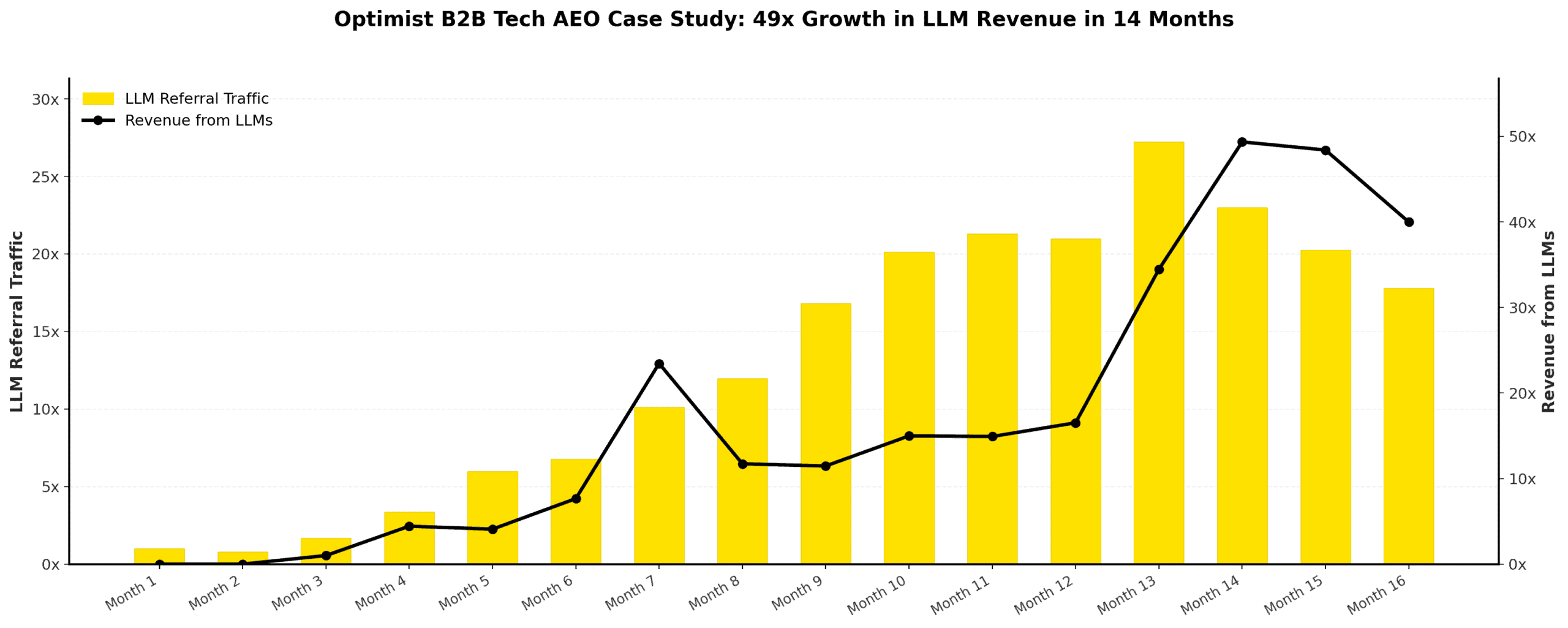
- 4,900% increase in LLM referral revenue over 14 months (ChatGPT, Perplexity, Claude)
- 2,622% growth in LLM referral traffic over 14 months (ChatGPT, Perplexity, Claude)
- Systematic transformation of the full content catalog for AEO citability
- Brand shifted from just ranking in search results to being cited and recommended by AI answer engines
- Established a repeatable first-party data pipeline that continuously strengthens the citation profile
This strategy proved that AEO is not a surface-level optimization.
It requires rethinking content structure, editorial authority, and data strategy in tandem.
By building all three simultaneously, the brand moved from just being indexed by search engines to being trusted and cited by AI, turning a new discovery channel into a measurable revenue driver.
