
Case Study SummaryOptimist worked with a financial software company and helped rapidly increase AI-driven conversions through a targeted SEO + AEO strategy focused on clear content structure, on-page and technical best practices, and connecting the product to the broadest possible problem space its buyers navigate. Industry: Financial software |
A note on AEO results: AI visibility is influenced by many factors beyond any single strategy. Increasing tool adoption, evolving user behavior, and the probabilistic nature of LLMs are just a few important variables. We’re proud of the work we’ve done with these clients, and we believe it contributed meaningfully to these outcomes. But we also want to be honest: AEO is an opaque system and directly attributing any specific action to any specific result isn’t something we — or anyone — can do with certainty.
This fintech offered a strong product in a competitive financial software category, but they weren’t showing up in AI answer engines early in the journey when prospects were asking about the problems the product solves. The gap between how the company talked about itself and how buyers described their own challenges meant the brand was invisible in the AI-driven moments that matter most.
The objective was to connect the product to the full breadth of its buyers’ problem space, and to do it in a way that AI models could follow from problem to solution to product.
Problem
The company faced a challenge common to B2B software brands with strong products but narrow content positioning:
- Content was product-focused and solution-aware, but missed the upstream problems buyers were actually searching for
- Top-of-funnel pain points and specific, urgent jobs buyers needed to get done were not represented in the content catalog
- No clear connective thread from problem discovery to solution framing to product recommendation
- AI models had no structured path to understand how their product ultimately mapped back to solution categories and problems, JTBD, and use cases
- Competitors with broader content footprints were capturing the early-stage queries that shape buyer shortlists
Solution
Optimist designed and worked with this fintech client to implement a problem-first, integrated SEO and AEO strategy designed to meet buyers at their earliest moment of need, rank for targeted keywords in traditional search, and guide AI models through a clear path from pain point to product.
Problem-Space Expansion
- Mapped the broadest possible set of jobs to be done that the product ultimately addresses
- Identified highly specific, top-of-funnel pain points that the target audience actively seeks to solve
- Built content around these pain points, not as generic awareness pieces, but as precise, answer-ready resources tied to real buyer urgency
Problem-to-Product Connective Architecture
- Designed each piece of content with a deliberate throughline: specific pain point → solution framework → product as the best path to resolution
- Structured content so AI models could trace a clear, logical connection from the initial job to be done through to the product recommendation
- Ensured the product appeared not as a sales pitch, but as the natural conclusion of the buyer’s own problem-solving process
Technical & On-Page AEO Implementation
- Applied structured formatting, clear content structure, and on-page SEO + AEO best practices to maximize citability across AI surfaces
- Optimized content architecture for the way AI models parse, summarize, and recommend sources
- Prioritized pages with the highest conversion potential for technical implementation
Outcomes
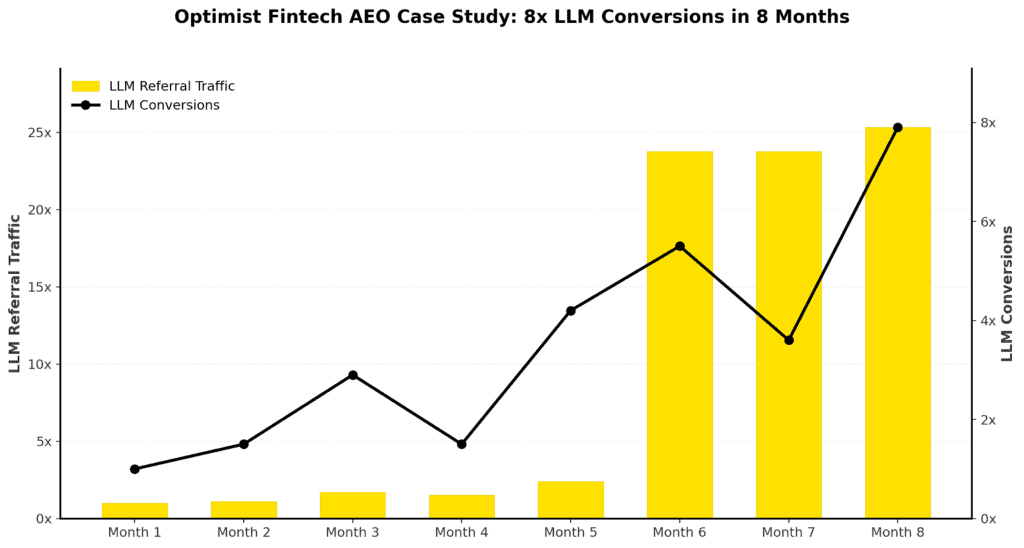
- 8x growth in conversions from LLM referrals within 8 months (ChatGPT, Perplexity, Claude)
- 25x growth in LLM referral traffic within 8 months (ChatGPT, Perplexity, Claude)
- Established the brand’s AI visibility for the full upstream problem space
- Created a clear, AI-traversable path from buyer pain points to product recommendation
- Established a repeatable content model for connecting new problem areas to the product over time
The strategy worked because it aligned content with how buyers actually think, not how the company talks about itself.
By mapping the full problem space and building structured paths from pain point to product, the brand became the answer AI models surface when buyers describe what they need, not just when they search for what the company sells.
