
Article Summary
Optimist’s Complete Organic Revenue Engine (CORE) Framework unifies SEO and AEO (answer engine optimization) into a single, comprehensive strategy for B2B technology and SaaS companies. B2B buyers now research across both traditional search engines (Google) and AI models (like ChatGPT and Gemini), a unified approach is necessary to maximize organic growth and pipeline.
The framework provides a diagnostic and optimization methodology that maps SEO and AEO objectives to every stage of the buyer journey, creating a prioritized roadmap of actions ranked by their estimated revenue impact. The core principle is integration: Optimizing content from a single dataset to improve visibility in both search rankings and AI brand recommendations and citations simultaneously.
B2B buyers now research across both Google and AI models, but most organic strategies only cover one side of that equation.
Or worse, there are two separate strategies – one focused on search and one focused on LLMs.
They conflict and cannibalize performance.
Buyers still search Google. A 2025 Google/NRG study found that 94% of B2B buyers use Google Search to find products and research purchases.
But they also ask ChatGPT for vendor recommendations, have Perplexity compare options, and read AI Overviews before they ever click a link.
As far back as 2024, Forrester found that 89% of B2B buyers adopted generative AI and named it as one of their top sources for self-guided information throughout the buying journey. (Google’s survey also found that 63% of AI users use Google Search to validate or cross-check AI-generated information.)
In other words:
To maximize organic growth for your business, you need to rank in search. And you need to show up, accurately, when AI models mention and recommend brands to buyers.
But AEO is an emerging discipline and very few “experts” truly have a clear process and strategy for improving AI visibility while continuing to grow or defend Google rankings and organic traffic.
Companies hear “you need to be in ChatGPT” and respond by flooding the internet with thin pages, AI-generated content, and shallow answer-bait, hoping to game citations.
Short-term, some of it works. Long-term, it destroys domain authority, dilutes the brand, and erodes the SEO foundation that actually compounds over years.
You end up with a thousand pages that rank for nothing and don’t get cited at all.
The companies and AEO agencies building durable organic growth engines are optimizing for both simultaneously, from a single dataset, with a unified view of what’s working and what’s not.
The CORE Framework: SEO + AEO Across the Buyer Journey
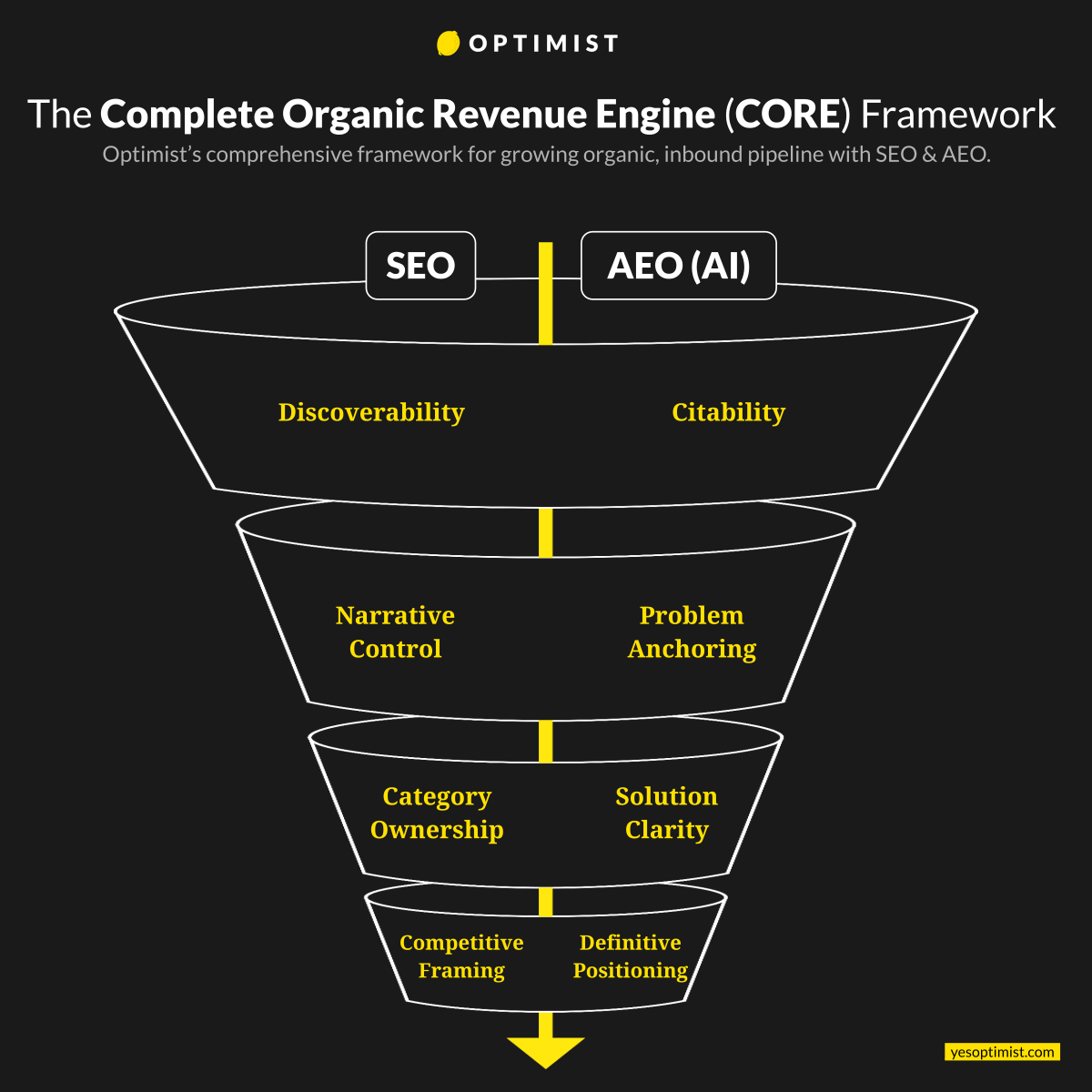
Optimist’s CORE (Complete Organic Revenue Engine) Framework helps companies grow their organic visibility, traffic, and pipeline through search, LLMs, and AI surfaces.
It combines SEO and answer engine optimization (AEO, also known as GEO or AIO) into a single diagnostic and optimization methodology to maximize inbound pipeline and revenue.
The framework addresses key problems faced by marketing leaders at B2B technology and SaaS companies with an existing product and established market:
- Your organic traffic is flat, but your board wants pipeline growth
- You rank for keywords, but AI models recommend your competitors
- You have 200+ blog posts, and your sales team can’t remember the last lead that came from one
- Your SEO team and your “AI strategy” are in separate meetings with separate dashboards
- You’re starting from scratch and aren’t how to pursue visibility across all the different surfaces where buyers are searching
- Your CEO is angry because you don’t show up in LLMs like ChatGPT
- ChatGPT describes your company using a competitor’s positioning language
The Integrated Framework for Compound Growth
The core principle behind The CORE Framework is deceptively simple:
- Build one unified dataset of every topic your buyers care about
- Analyze it through both the SEO lens and the AEO lens
- Optimize website and content for both SEO and AEO
Integration is the strategy.
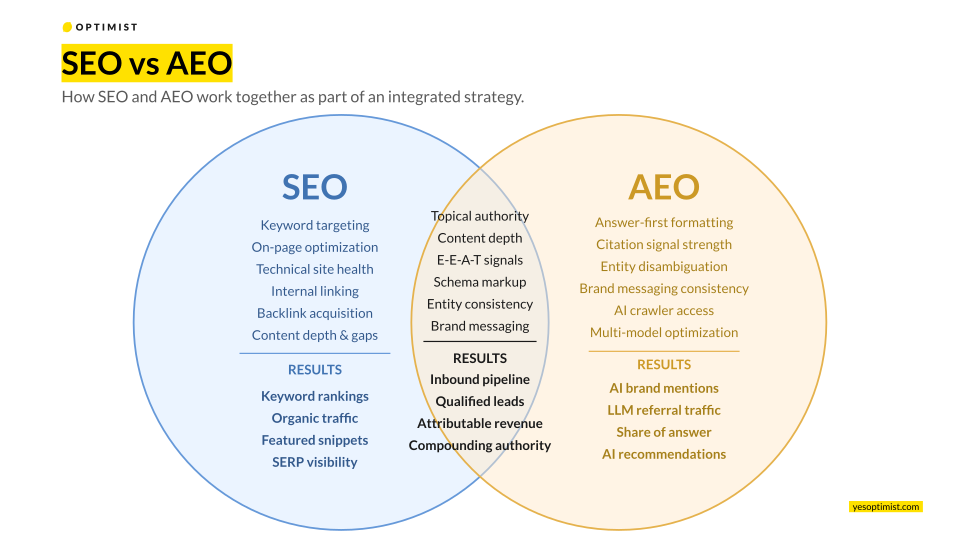
When SEO and AEO share the same topic universe, the same funnel-stage mapping, and the same pipeline-value scoring, every optimization you make is designed to improve visibility in both channels simultaneously.
Tactically, AEO is essentially an additional lens or layer that we add to existing SEO practices to evolve the content strategy for how AI models understand, source, and cite content in its responses.
While these two disciplines are not exactly the same, they share many characteristics.
But, most importantly, we want to apply a unified strategy that accounts for both SEO and AI to avoid conflict, cannibalization, and long-term brand damage that can happen if these two strategies are pursued in isolation.
Here’s how the compounding actually works:
- Content structured for AI extraction also satisfies search intent better. Answer-first formatting, self-contained answer blocks, and clear definitions (the structural patterns AI models look for when selecting citation sources) also improve dwell time, featured snippet capture, and user satisfaction in search.
- Authority signals that earn AI citations also improve search rankings. Named-source statistics, expert quotes, grounded claims backed by evidence: these are the signals AI models use to decide what’s trustworthy enough to cite. They’re also the signals Google uses to assess E-E-A-T.
- Schema that feeds AI models also creates rich snippets in search. One investment in structured data, two channels of return.
- Consistent messaging across properties builds trust in both channels. When your homepage, G2 profile, LinkedIn page, and blog all describe your company the same way, search engines and AI models both get a clean signal. When they don’t, both channels get confused, and the confusion shows up in your rankings and your AI representation.
For example, Ahrefs data shows that between 38% and 76% of AI Overviews citations are pulled from the top 10 search results for the same query.
But even this analysis understates the full impact.
Since most models now perform their own web research before responding, citations and information are often pulled from these related follow-up questions (known as “fan-out queries”) performed by LLMs. This means targeting these queries with structured responses and content can improve visibility for the analyzed prompts.
Companies that invest in this integrated approach will shape how models describe them for years. Companies that wait will be playing catch-up against competitors who already occupy the position.
Organic Growth Through Each Stage of the Buyer Journey
The CORE Framework maps SEO and AEO objectives to four stages of the buyer journey. At every stage, SEO and AEO play distinct but complementary roles.
Pre-Funnel: Discoverability + Citability
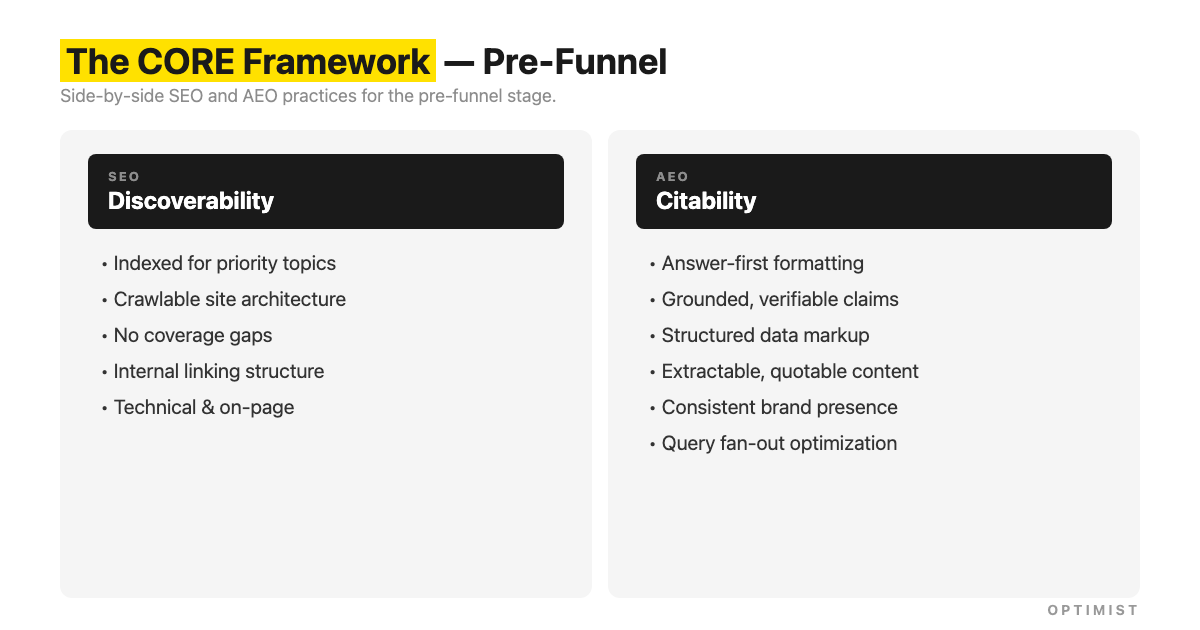
For your brand to reach the maximum number of buyers as they navigate their purchase journey, two conditions must be true.
Your content has to be findable, and it has to be citable.
Discoverability
Discoverability is the SEO foundation. Indexed pages targeting priority topics, crawlable architecture, internal linking that connects related content, no coverage gaps.
Citability
Citability is the AEO foundation. Answer-first formatting, grounded and verifiable claims, structured data, extractable passages, consistent brand presence, and optimization for the follow-up queries AI models generate.
Most companies have the first and not the second.
They’ve spent years building SEO foundations but have never asked the question: “Can an AI model actually extract and cite anything useful from this page?”
But, more importantly, AEO and citability aren’t just a technical optimization you can add to your website. AI answer engines rely on many different signals when generating responses to a prompt.
This means there’s a strategy-level shift in how your website and content are engineered to optimize your brand’s presence.
TOFU: Narrative Control + Problem Anchoring
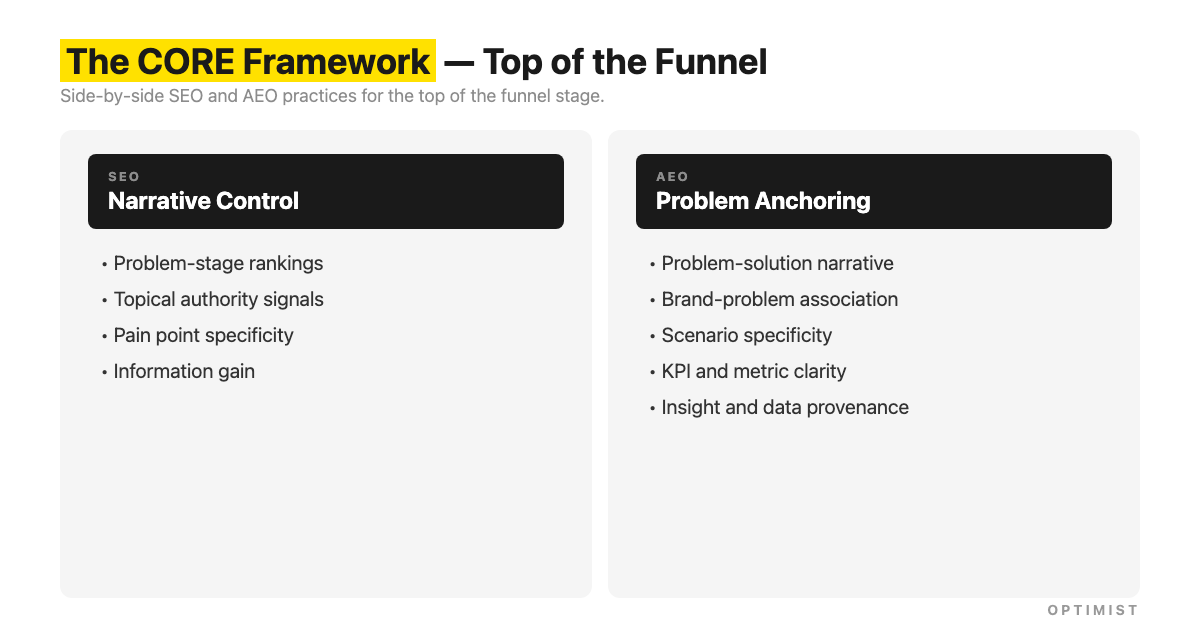
At the top of the funnel, buyers are trying to understand their problem.
The company that helps them frame it has a structural advantage in every conversation that follows.
We help clients optimize for this stage in the journey by focusing on two elements:
Narrative control
Narrative control means creating content targeting problem-stage queries and ranking well enough to shape how buyers think about the challenge.
This requires:
- Topical authority – Complete coverage, not one thin post
- Pain point specificity – Writing about the problem the way your actual buyers describe it, not the generic version
- Information gain – Every page needs to tell the reader something they didn’t already know
Problem anchoring
Problem anchoring is the AEO counterpart. When a buyer asks an AI model “why is [problem] so hard?” or “what’s causing [pain point]?,” your brand and perspective should be part of the answer.
This requires:
- Clear problem-to-solution narrative in your content
- Consistent brand-problem association across properties,
- Scenario specificity (real situations, not abstract descriptions)
- Clarity around the KPIs and metrics affected
- Credible insight provenance: named sources, first-party data, expert attribution
Together, narrative control and problem anchoring mean you’re visible at the problem stage and actively shaping the conversation around how to think about solutions.
MOFU: Category Ownership + Solution Clarity
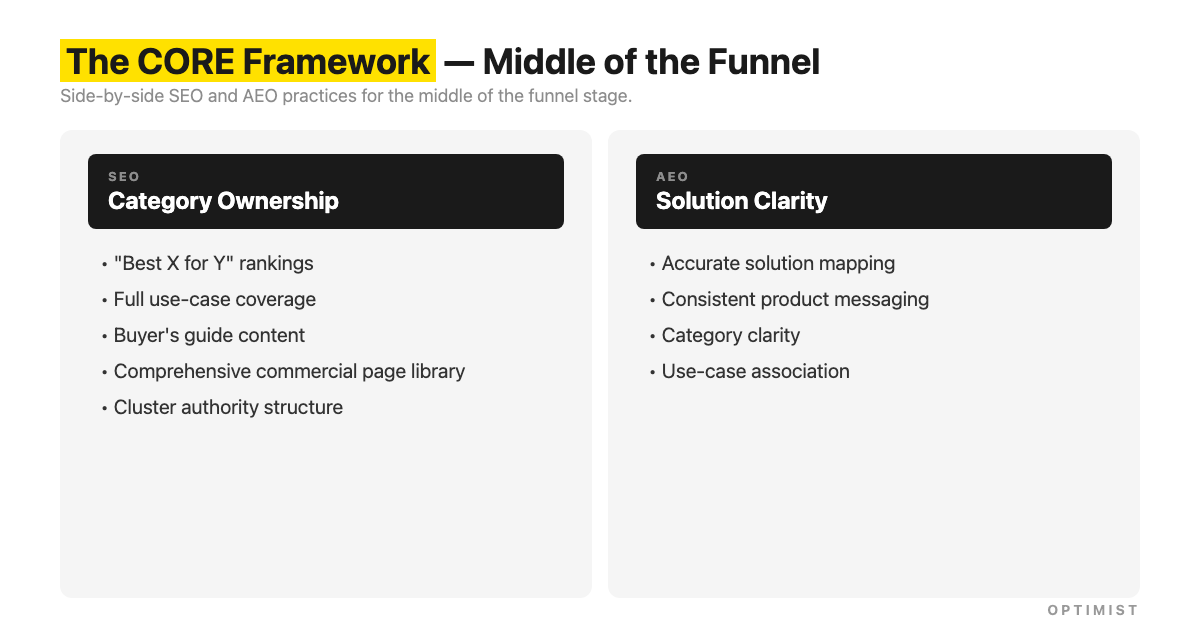
This is the stage where the biggest surprises show up in the diagnostic.
In Optimist’s work with B2B clients, the pattern is often the same: Companies have strong TOFU content, strong BOFU comparison pages, and almost nothing in between.
Buyers searching “best [category] for [use case]” or “how to evaluate [solution type],” hit a wall of competitor content, they’re absent from context-heavy AI prompts, and they basically fall out of the short list during this critical stage in vendor evaluation.
Companies in this situation are missing a critical chance to influence buying decisions.
Category ownership
Category ownership starts by filling that gap.
- “Best X for Y” rankings
- Full use-case coverage
- Buyer’s guide content
A thorough commercial page library that covers every angle a buyer would research. Cluster authority structure that signals to search engines, “this company owns this topic.”
Solution clarity
Solution clarity is the AEO counterpart, and it’s where fragmented messaging does the most damage. AI models need a consistent, clearly defined narrative connecting the buyer’s problem to your solution category.
- Accurate solution mapping (the AI describes what you actually do, not a hallucinated version)
- Consistent product messaging across every property models draw from
- Category clarity (the AI puts you in the right competitive set)
- Use-case association (when a buyer describes their situation, the AI maps it to your product)
If your homepage says “platform” and your G2 listing says “tool” and your LinkedIn says “solution,” AI hedges on all three.
BOFU: Competitive Framing + Definitive Positioning
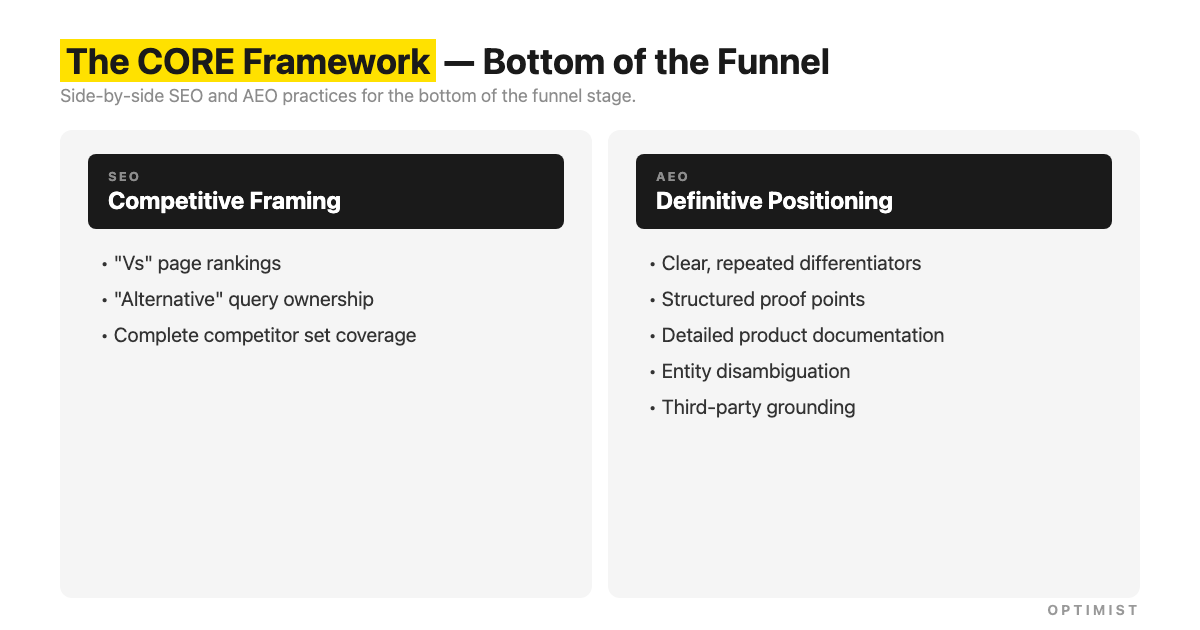
At the bottom of the funnel, the buyer is choosing between you and the alternatives. This is where pipeline is often won or lost.
Competitive framing
Competitive framing means owning the comparison and decision-stage search results.
- “Vs” page rankings
- “Alternative” query ownership
- Complete competitor set coverage
So when buyers evaluate options, the frame of comparison works in your favor.
If a buyer searches “[your competitor] vs [you]” and the top result is your competitor’s page, they control the narrative.
Definitive positioning
Definitive positioning is the AEO equivalent.
AI models need enough detailed, specific, and differentiated information to accurately articulate what you do, how you’re different, and why you win. When it comes to AI visibility and winning brand recommendations, simply ranking for keywords isn’t enough.
If your brand’s positioning, messaging, and features are different across 20 competitor comparison pages, AI won’t have a clear frame of reference to recommend your brand.
Or worse – it will hallucinate.
Definitive positioning is about repetition and clarity in your messaging, specifically in BOFU and competitive contexts.
This requires:
- Clear and repeated differentiators (not buried in one paragraph on your homepage)
- Structured proof points (case studies, metrics, third-party validation)
- Detailed product documentation
- Entity disambiguation (the AI knows exactly what your product is and isn’t)
- Third-party grounding (independent sources confirming your claims)
If those details don’t exist or aren’t consistent across the web, AI can’t advocate for you at the moment of decision. Someone else’s positioning fills the gap.
Applying The Framework: The CORE Analysis
The CORE Analysis builds the unified dataset the entire methodology runs on.
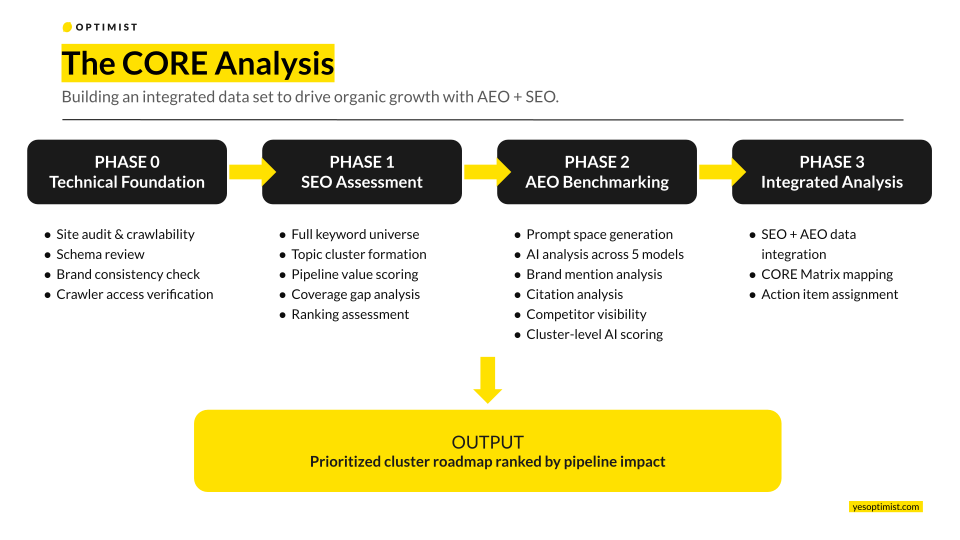
It starts with a technical foundation check, then moves through three phases of data collection and analysis.
The output: Every topic that matters to your business (the “Topic Universe”), scored by both search opportunity and AI visibility, prioritized by pipeline value.
Phase 0: Technical Foundation
Before we collect data, we verify the infrastructure.
A site audit checks crawlability, Core Web Vitals, and indexation (the basics that determine whether search engines and AI models can even access your content). We audit existing schema markup and structured data.
And we run a brand consistency check across owned and third-party properties (website, G2, LinkedIn, Crunchbase) to establish a messaging baseline.
This phase surfaces the issues that would undermine everything else.
If AI crawlers are blocked in `robots.txt`, no amount of content optimization will make you citable. If your homepage, G2 profile, and LinkedIn page describe your company in three different categories, AI models will hedge when they mention you, and no page-level fix will change that. We must address the technical foundations to maximize the impact of downstream work.
Phase 1: SEO Analysis
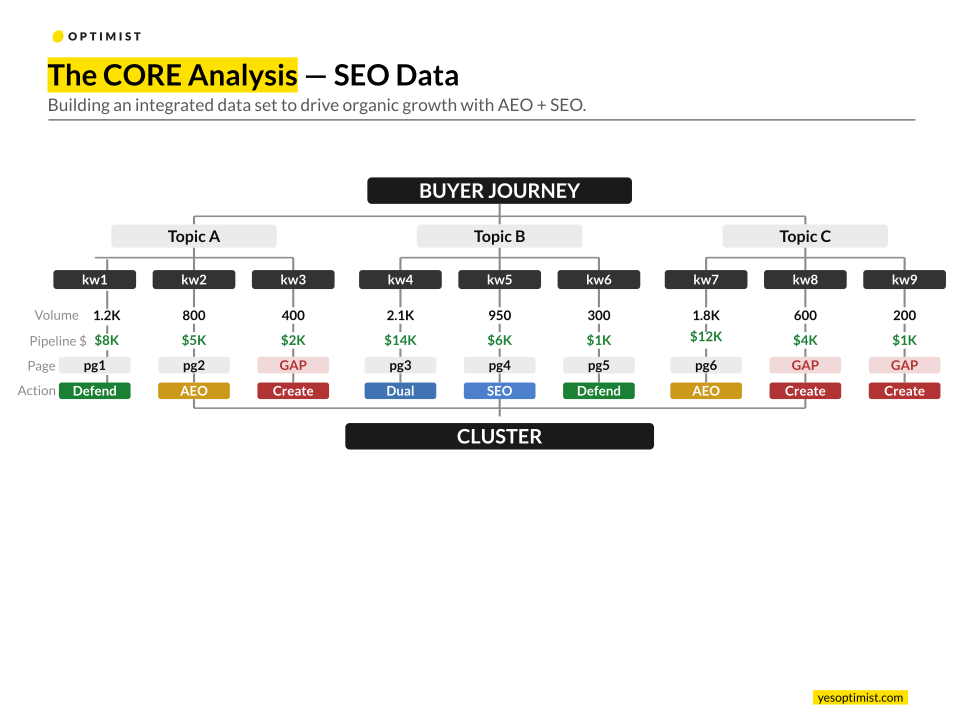
We build a complete topical universe from the ground up.
Beginning by mapping out all of the topics that are relevant to your buyers throughout the journey. Then, we translate these topics into keywords and variations to form the SEO strategy.
From there, we map each keyword to search volume, difficulty, funnel stage, and SERP data along with the relevant existing page on your website (or flagged as a gap).
Then we group together the topics into clusters of related pages.
Each cluster is scored by aggregate pipeline value based on search volume, realistic ranking potential, and conversion rates by funnel stage.
The output of Phase 1 is a topic and keyword universe, where each cluster has a pipeline value estimate, a picture of current SEO performance across its pages, and a clear view of coverage gaps.
It tells you which topic areas to invest in, which to fix, and which to leave alone, ranked by revenue impact.
Phase 2: AEO Benchmarking
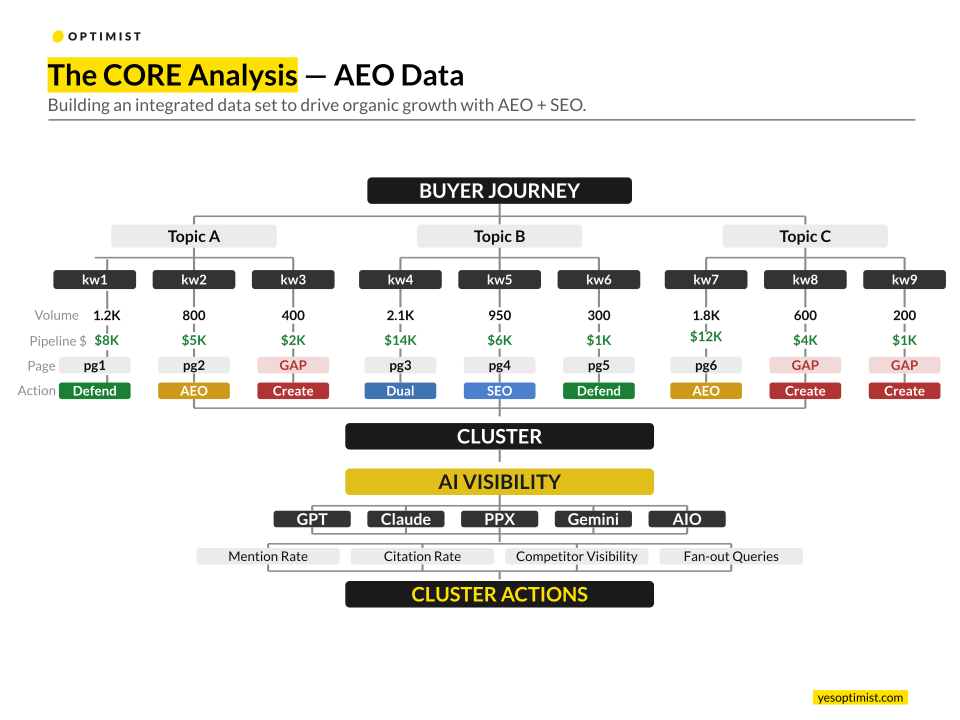
With the topic map built, we layer on AI visibility data and action items.
The same topics that buyers search for in Google are the topics they ask AI models about (albeit with different language and contexts).
The question is whether the company shows up in those answers, and how accurately.
First, we generate a library of 200+ realistic buyer prompts (“the Prompt Space”) from the topic clusters in our previous research. They’re not reformatted keywords, but the kind of questions a real buyer would type into ChatGPT or Perplexity based on defined buyer personas, needs, pain points, and specific use cases.
Then we run each prompt through five AI models (ChatGPT, Claude, Perplexity, Gemini, and Google AI Overviews).
We capture the output from each model and analyze them to capture brand mention rates, brand positioning language, citation frequency, competitor visibility, and what research the AI performs before responding (fan-out queries).
Phase 3: Integrated Analysis
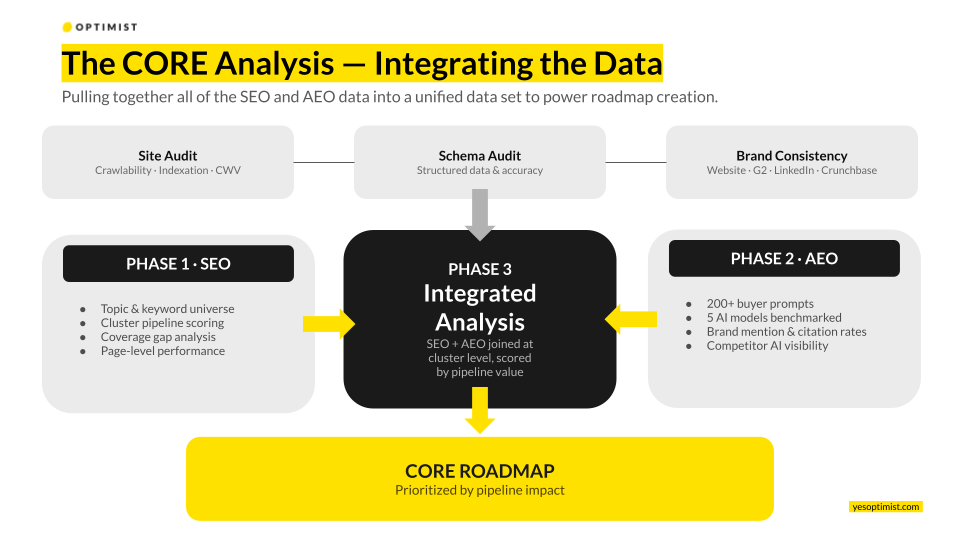
This is where CORE earns its name.
We roll AEO visibility data up to the topic cluster level and join it to the SEO keyword universe.
Now every topic cluster has both a search opportunity score and an AI visibility score, and both are tied to a pipeline value estimate.
Based on the combined data sets, we can prescribe specific actions for each page within the cluster to improve performance across both search and AI.
The result is a prioritized roadmap by topic cluster, ranked by pipeline impact and ready to action.
The goal of the diagnostic is to answer two questions:
What should we work on next, and how much pipeline is it worth?
Building a Clear Plan: The CORE Roadmap
Pulling together all of this data, we’re able to create a clear plan of action for improving visibility across both SEO and AEO.
Our free CORE Analysis provides you with an initial snapshot of your visibility across search and AI surfaces. We analyze a sample of queries, prompts, and content across your website to see where you currently stand vs competitors, and a sequenced list of key opportunities to improve your organic performance.
The CORE Roadmap provides a complete, execution-ready strategy:
- Topic Universe: Your complete topic landscape. Every topic, keyword, & cluster mapped to search volume, difficulty, and estimated pipeline value.
- AEO Benchmarks: How visible you are across ChatGPT, Claude, Perplexity, Gemini, and AI Overviews for real buyer prompts and how you compare to competitors.
- Content Audit: Every existing page scored by quality, funnel stage, AEO readiness, and optimization opportunity. Shows what to keep, refresh, or retire.
- Foundational Action Items: Page-level AEO & SEO implementation checklist
- CORE Opportunity Matrix: Each topic cluster classified by action type with a priority score.
- Structured questions: Page-level fan-out query mappings.
- Pipeline Forecast: Revenue-impact estimates per cluster based on search volume, AI visibility, conversion rates, and your ACV. Connects visibility gaps to dollars.
- CORE Roadmap: The sequenced execution plan. What to do, in what order, and why — prioritized by pipeline impact.
Want to see what this looks like for your company? Request a CORE Analysis.
With these deliverables, we can move from strategy and planning into execution.
We guide implementation for clients using a comprehensive set of site-level, strategy-level, and page-level best practices.
Implementing The CORE Roadmap
There’s one key insight you must understand about AEO that is critical to implementing the CORE Framework.
Increasing brand mentions and recommendations (i.e., brand visibility or Share of Voice) and increasing citations are actually separate goals.
A lot of times, these two aims get lumped together into “AI visibility” broadly.
But the patterns that determine which sources get cited and the patterns that determine which brands get recommended are fundamentally different.
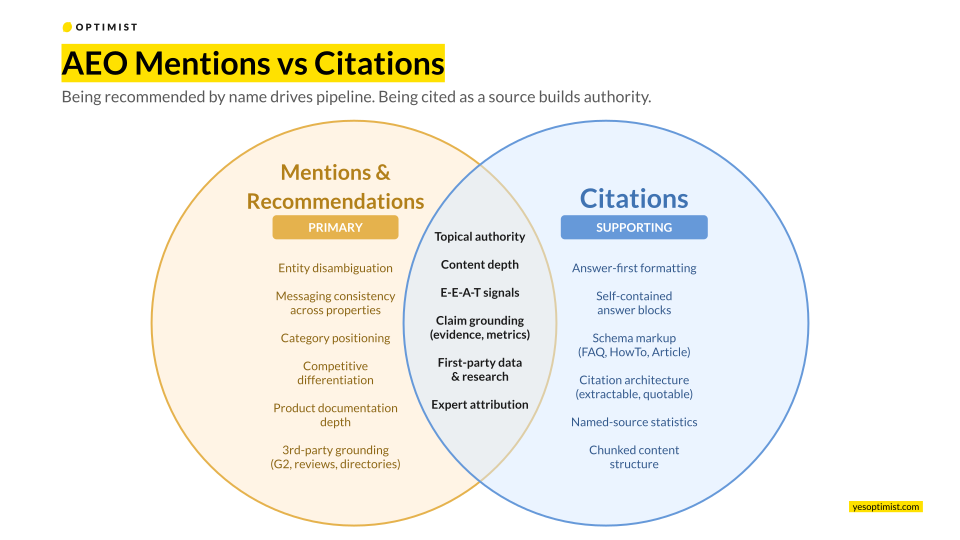
They are related and they do overlap – like how SEO practices overlap with AEO practices.
But, tactically and strategically, it’s helpful to frame AI search optimization as two separate aims so we can make it easier to understand where and how we are influencing AI model outputs.
This framework is designed to increase AI visibility in both contexts while simultaneously improving SEO performance. But, for our purposes, we’ll parse two goals into separate buckets as a way to break down how the practices are implemented.
To reiterate:
This isn’t a checklist of tactics or a targeted set of practices to be deployed in isolation.
They’re all part of an integrated approach to optimizing content for traditional SEO rankings, AI brand visibility, and AI citation and referrals. We’re breaking them down into two separate buckets only to highlight that AI search optimization is really two integrated strategies and those two strategies are also deeply integrated with SEO practices.
The factors that influence brand mentions also play a role in optimizing for citations.
SEO factors affect AI visibility.
Citability factors influence search rankings and brand recommendations.
Now, onto implementation…
Increasing Brand Mentions and Recommendations
Almost every CORE Analysis Optimist has run for clients, the same priority emerges.
The brand is not being recommended as frequently as competitors or is completely absent from critical vendor-evaluation conversations.
So our first goal is to increase brand visibility (brand mention or recommendation rates).
This work includes several areas of focus that can be grouped together into a top-priority tier that we want to execute before we move onto the remainder of the roadmap.
1. Entity & Brand Consistency
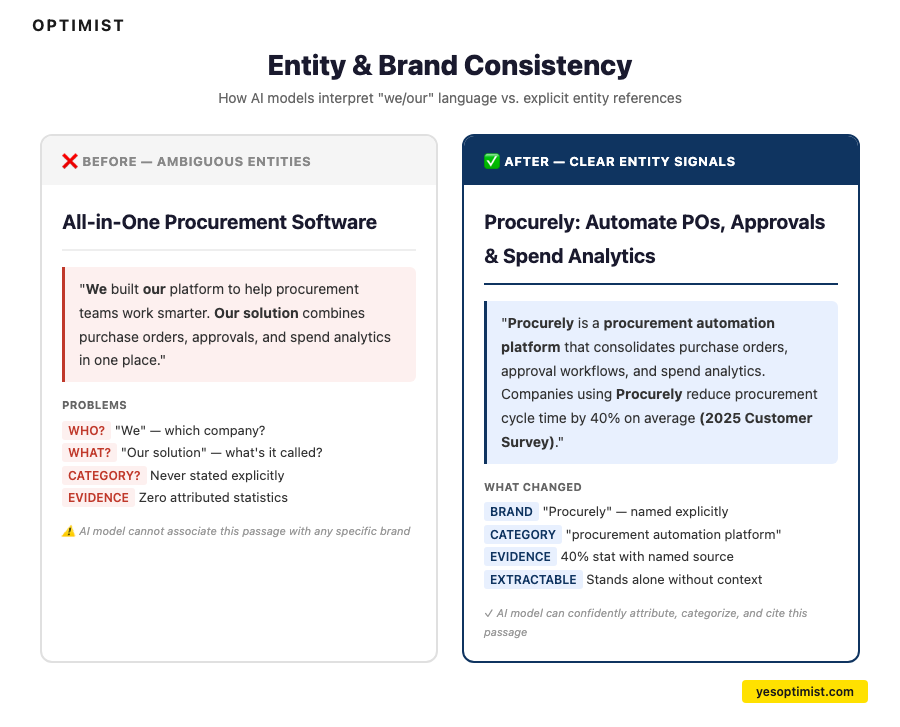
The foundation everything else builds on. If AI models can’t confidently identify and categorize the brand, no amount of content optimization will produce accurate representation.
This includes:
- Entity disambiguation (third-person brand references, consistent naming, explicit category claims)
- Cross-property messaging alignment (same positioning language on the website, G2, LinkedIn, and directories)
- Third-party grounding (presence on high-authority sites LLMs commonly cite)
- E-E-A-T signals (author credentials, experience demonstrated, claims properly sourced)
2. Content Coverage
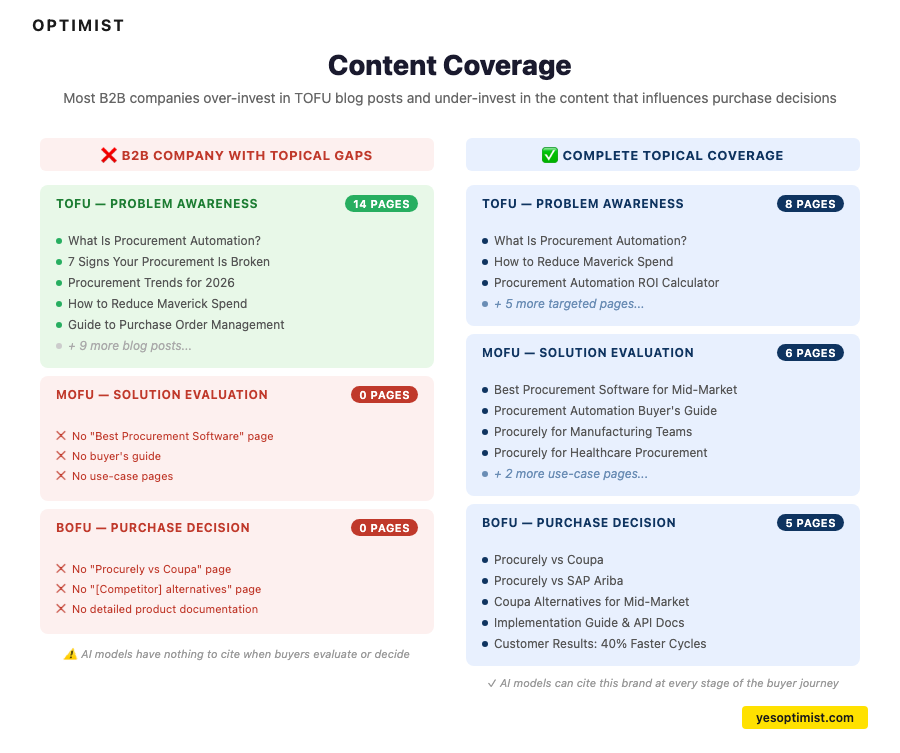
Gaps in coverage mean gaps in visibility. If you don’t have a page for a topic your buyers care about, you can’t rank for it and AI models have nothing to reference or cite.
It also creates an information vacuum where competitors or other sources can influence how AI models frame specific problems, which vendors they include in recommendations, or how they position your brand versus competitors.
It’s critical to fill these gaps.
That means:
- Creating content for every priority topic cluster
- Full use-case coverage
- Commercial and comparison content (best-of pages, vs pages, alternative pages)
- Detailed product documentation
- Page-level content targeting fan-out queries
3. Narrative Clarity
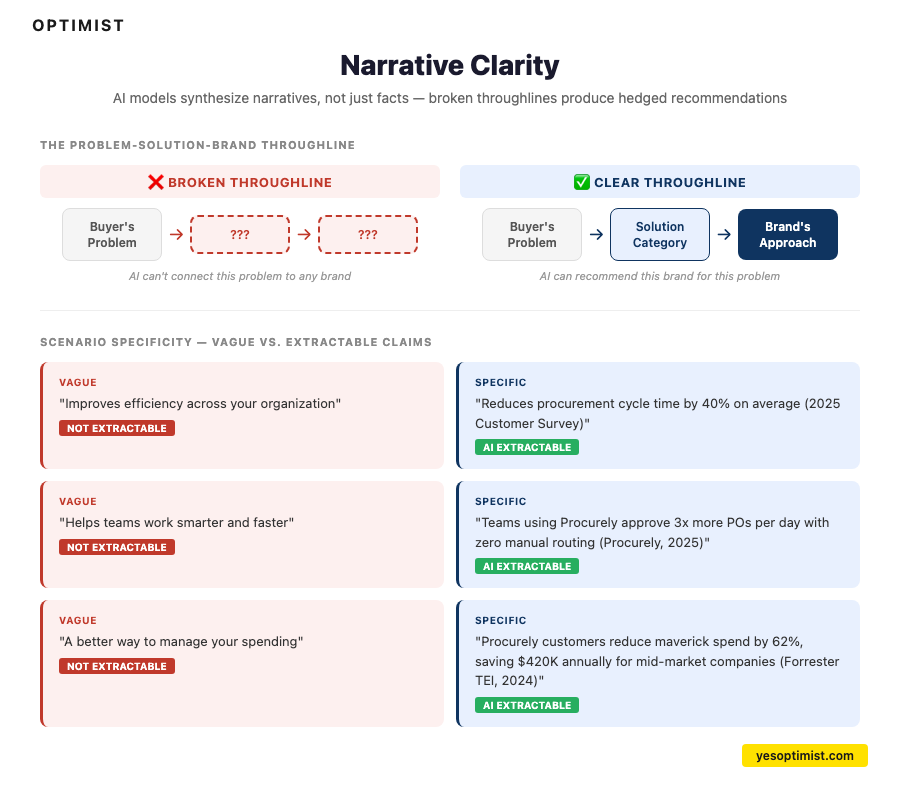
AI models don’t just extract facts. They synthesize narratives.
If your content doesn’t connect the buyer’s problem to your solution clearly and specifically, AI models can’t make that connection for you.
Every page and piece of content should be evaluated for:
- Clear problem-solution throughline
- Explicit brand-problem association
- Scenario specificity
- Information gain to establish authority
4. Content & Cluster Architecture
How content is connected and organized across the site affects both search crawlability and how AI models map a brand’s topical authority.
- Internal linking within topic clusters
- Contextual links to high-value commercial pages (service pages, case studies, pricing)
- Cub-and-spoke pillar structures
- Clean site architecture with semantic HTML
As a quick rule, every page needs to be reachable within three clicks and linked from at least two related pages.
5. On-Page Foundations
The structural and technical elements that make individual pages discoverable and rankable.
In turn, they also play a role in AI visibility.
- Title tags
- Meta descriptions
- Heading hierarchy
- Content depth
- Keyword targeting aligned with both search queries and AI prompts
- Image optimization
- Technical fundamentals (crawlability, indexation, page speed, mobile responsiveness, AI bot accessibility)
Increasing Citations and Referrals
In addition to the foundational visibility work, we apply additional optimization work across the website.
(Remember, again, this is not sequential, it’s a series of integrated practices.)
6. Content Structure & Extractability
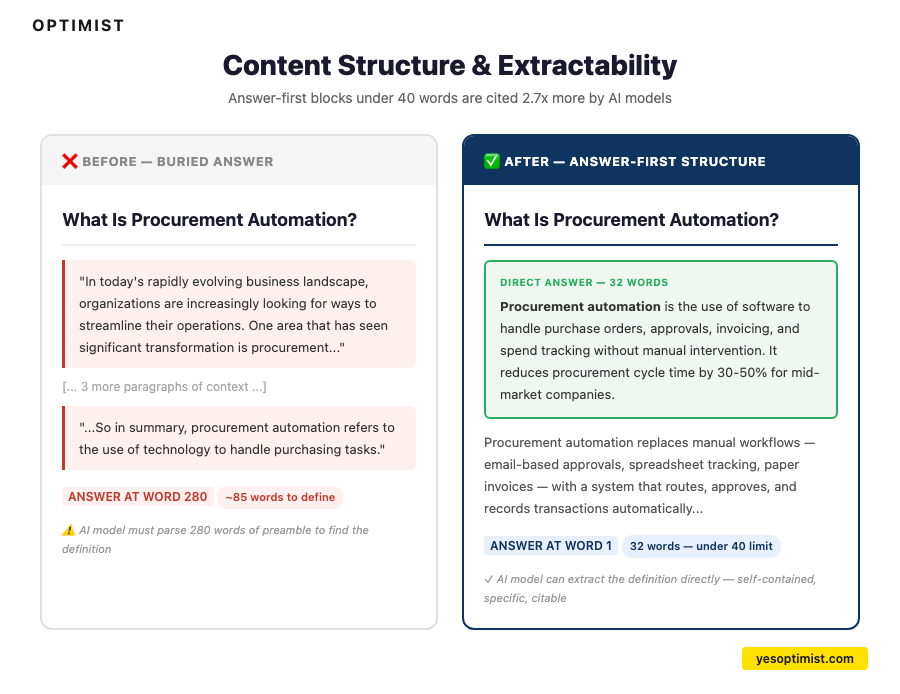
The structural patterns that make content extractable and citable by AI models:
- Answer-first formatting
- Self-contained answer blocks that make sense if pulled out of context
- Definition blocks, step-by-step blocks, comparison tables, pros/cons, FAQ sections
- Content “chunking” and structure clarity
7. Evidence & Citation Signals
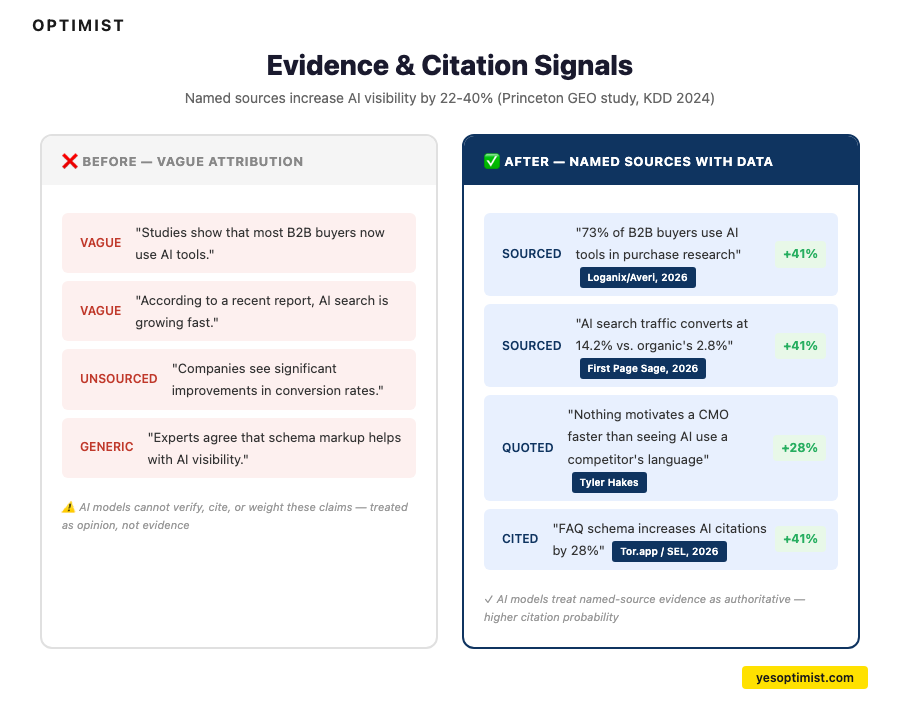
The elements that measurably increase AI citation probability. Research from Princeton found that adding statistics improved AI visibility by 30-40%, expert quotations and authoritative source citations produced similar lifts.
We focus on implementing this consistently across the website:
- Named-source statistics with hyperlinks
- Expert quotes with full attribution
- Case study references with specific metrics
- Original data and first-party research
- Authoritative source citations throughout
- Claim grounding and substantiation
8. Schema & Structured Data
Machine-readable signals that help both search engines and AI models understand page content accurately.
- JSON-LD markup matched to page type
- Consistent entity markup across the site
- Visible freshness signals (dateModified in schema, “Last Updated” date on page)
- Validated structured data monitored post-publish
To reiterate at the risk of being repetitive: These eight areas compound.
Entity consistency makes content structure more effective because AI models trust the source.
Evidence signals make narrative clarity more persuasive because claims are grounded.
Schema makes everything else more machine-readable.
The integrated approach treats them as one system, not eight separate optimizations.
From Roadmap to Page-Level Action
Ultimately, we end up with clarity about what action to take on each page of the website.
Each cluster has a pipeline value estimate and a combined SEO + AEO gap assessment from the diagnostic. The clusters with the largest pipeline opportunity get worked first.
The cluster’s AEO visibility tells you how the topic area is performing in AI. The page-level SEO data tells you which pages rank, which are thin, which keywords have no page at all.
Together, they determine what each page needs and we can apply the practices above when building new content or optimizing existing pages.
Every page in a cluster gets assessed against both signals and classified into one of six action categories:
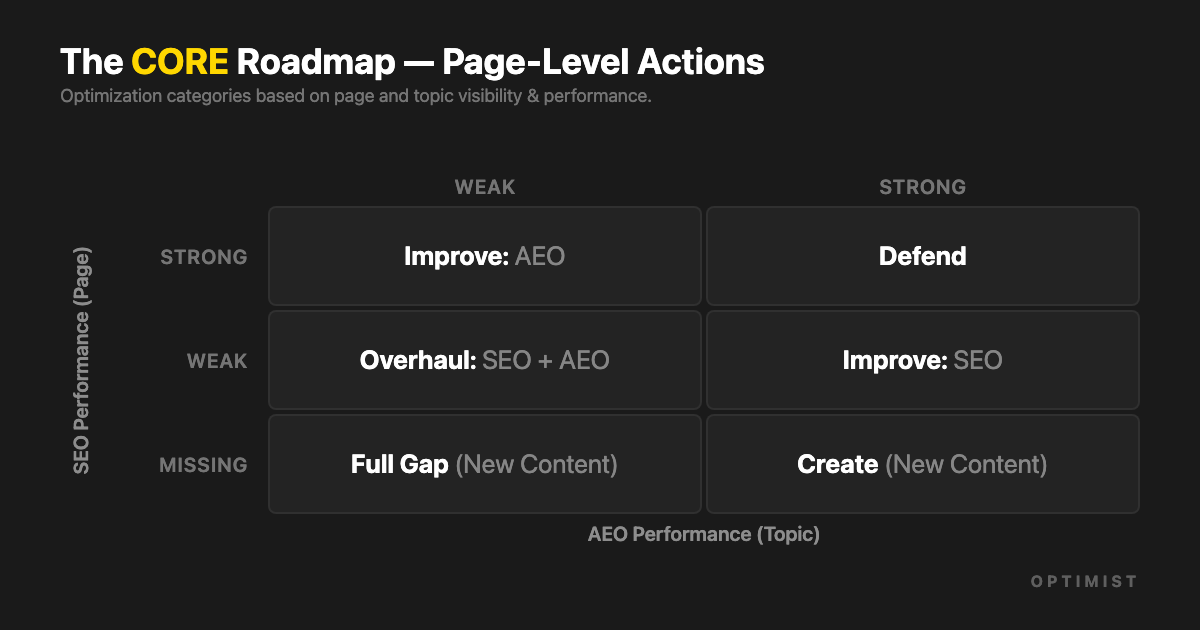
This isn’t a one-time classification. Pages move between categories as optimization takes effect. The diagnostic establishes the baseline; ongoing measurement tracks the movement.
Our goal at this stage is to work through the roadmap.
We begin with site-level and structural issues that need to be addressed.
Then we work through the site in pipeline-priority order. For each page and each topic cluster, we execute page-level optimization work, create new pages, and deploy improvements to increase SEO and AEO performance.
Depending on the budget and scope of the engagement, this could take months or even years.
But, critically, the most important work (that often has the greatest immediate impact) is usually done within 1-2 quarters.
The Complete Effect: Case Studies from The CORE Framework
The framework is only as good as the results it produces.
Here’s what The CORE Framework has delivered across Optimist’s client portfolio:
AEO results
- 49x growth in LLM referral revenue (4,900% increase over 14 months), B2B technology company
- 13x increase in LLM-sourced revenue year over year, retail company
- 8x growth in LLM conversions in 8 months, fintech company
SEO pipeline results
- Stampli: 5X inbound pipeline growth
- Glide: 14x product signups in 1 year
- Kubera: 43x product signups in 15 months
- HelloSign: inbound engine contributed to $230M acquisition by Dropbox
- Plytix: content became the #1 driver of leads and pipeline
These results come from a process built on the same foundations. For years, we applied the SEO-focused version to client work. Now we’ve added AEO to create a complete and comprehensive strategy for driving organic growth.
The SEO results built the authority foundation.
The AEO results are what happens when that foundation is optimized for the world of AI.
See how we work with B2B companies.
Organic Growth Starts With The CORE
If your organic growth has stalled it’s because you’re optimizing for one channel when B2B buyers are actively making decisions across two or three dimensions.
But that disconnect is also an opportunity.
With the right data, the right structure, and the right strategy, you can build on our existing foundations to kickstart growth again.
That’s why we built The CORE Framework.
The CORE Analysis & Roadmap process cuts through the noise, the hype, and the mountain of data to create a clear, actionable plan to hit your organic pipeline goals.
It answers the question: What steps should I take right now to increase our performance?
Optimist is as an SEO and AI Search (AEO and GEO) consulting firm. We help clients growth search and AI visibility as one system.
For consulting engagements, we develop and deliver the roadmap and then provide page-level briefs for your team to implement internally.
If you’re ready for a proven system for building scalable and sustainable organic visibility across search and AI, let’s schedule a time to talk.
Request a Strategy Call with us today.
Frequently Asked Questions About The CORE Framework
What is The CORE Framework?
The CORE (Complete Organic Revenue Engine) Framework is Optimist’s proprietary methodology for unifying SEO and AEO (answer engine optimization) into a single diagnostic and optimization strategy.
It maps SEO and AEO objectives to every stage of the buyer journey, identifies gaps where pipeline is missing, and prioritizes recommendations by revenue impact.
The framework produces a unified keyword universe, opportunity matrix, and prioritized roadmap, all prioritized by pipeline opportunity, not traffic.
Why do B2B companies need both SEO and AEO?
B2B companies need both SEO and AEO because buyers research in both channels and form opinions based on information found in both places.
A company that ranks #1 in Google but gets misrepresented in ChatGPT is losing pipeline to competitors with better AI visibility. A company that chases AI citations with thin content is eroding the SEO foundation that compounds over years. The companies building durable inbound engines optimize both simultaneously.
How does AEO help SEO?
The structural patterns AI models look for when selecting citation sources (answer-first formatting, grounded claims, named-source statistics, self-contained answer blocks) are the same patterns that improve search performance.
Content structured for AI extraction earns better engagement metrics, more featured snippets, and higher E-E-A-T signals. Schema markup that feeds AI models also creates rich snippets in search. One set of optimizations, two channels of return.
What does an AEO + SEO diagnostic include?
It starts with a technical foundation check (crawlability, schema, brand consistency), then moves through three phases: (1) SEO analysis, building a complete keyword universe with topic clusters, current performance, and pipeline value estimates; (2) AEO benchmarking, testing brand visibility across five AI models with realistic buyer prompts at each funnel stage; (3) Integrated analysis, combining both datasets at the topic cluster level into a prioritized roadmap ranked by pipeline impact. The output: unified keyword universe, stage-by-stage CORE assessment, competitive positioning assessment, and a prioritized cluster roadmap.
What size company benefits from Optimist’s CORE Framework?
The CORE Framework is designed for B2B technology and SaaS companies with an established product, existing content, and a sales team to close inbound leads.
Companies earlier in their lifecycle typically need to establish product-market fit before an integrated organic strategy delivers meaningful pipeline.
B2C companies with fundamentally different buyer journeys are better served by other approaches.
Does AEO replace SEO?
No, AEO doesn’t replace SEO. And be skeptical of anyone who says it does. AEO builds on top of SEO foundations. Without well-structured, authoritative content (SEO), there’s nothing for AI models to cite (AEO). Companies that treat them as complementary see compounding returns across both channels. The companies trying to “skip SEO and go straight to AEO” are building on air.
