
Case Study SummaryOptimist worked with a retail technology company to dramatically increase AI-sourced revenue by building category-level visibility and structured product content designed for AI-driven discovery. Industry: Retail technology |
A note on AEO results: AI visibility is influenced by many factors beyond any single strategy. Increasing tool adoption, evolving user behavior, and the probabilistic nature of LLMs are just a few important variables. We’re proud of the work we’ve done with these clients, and we believe it contributed meaningfully to these outcomes. But we also want to be honest: AEO is an opaque system and directly attributing any specific action to any specific result isn’t something we — or anyone — can do with certainty.
This company operated in a competitive retail market where buyers increasingly rely on AI answer engines to research, compare, and shortlist vendors. The product had strong category fit across multiple buyer segments, but the brand lacked visibility in the AI-driven queries where purchase decisions were being shaped.
The objective was to capture visibility across the key categories, topics, and queries where the product competes and to ensure AI models could clearly understand how the product meets the specific needs of buyers searching within those categories.
Problem
The company faced a visibility gap that was costing it AI-driven revenue:
- Competitors were being cited and recommended in category-level AI responses where the product should have appeared
- Existing content did not clearly map the product’s specific categories and use cases buyers search for
- No structured content addressing the detailed questions buyers and AI models ask about product fit, features, and differentiation
- AI models lacked the clear, structured inputs needed to confidently recommend the product in relevant contexts
Solution
Optimist built a category-capture SEO + AEO strategy focused on two priorities: owning the category-level queries where buyers discover solutions, and giving AI models the structured detail they need to recommend the product with confidence.
Category & Topic Visibility
- Identified the key categories, topics, and queries where the product competes for buyer attention
- Created pages and content designed to capture visibility across these high-value category terms
- Focused on the specific language, framing, and comparisons buyers use when evaluating solutions in the category
- Built content that positioned the product within the broader category landscape
Structured Q&A & Schema Implementation
- Developed clear, structured Q&A content addressing the specific questions and prompts buyers use when evaluating product fit
- Implemented schema markup to help AI models parse product details, capabilities, and category alignment
- Mapped content to the detailed, feature-level queries that AI models surface when buyers ask how a product meets their specific needs
- Ensured every key category page gave AI models structured, confident answers about what the product does and who it serves
Outcomes
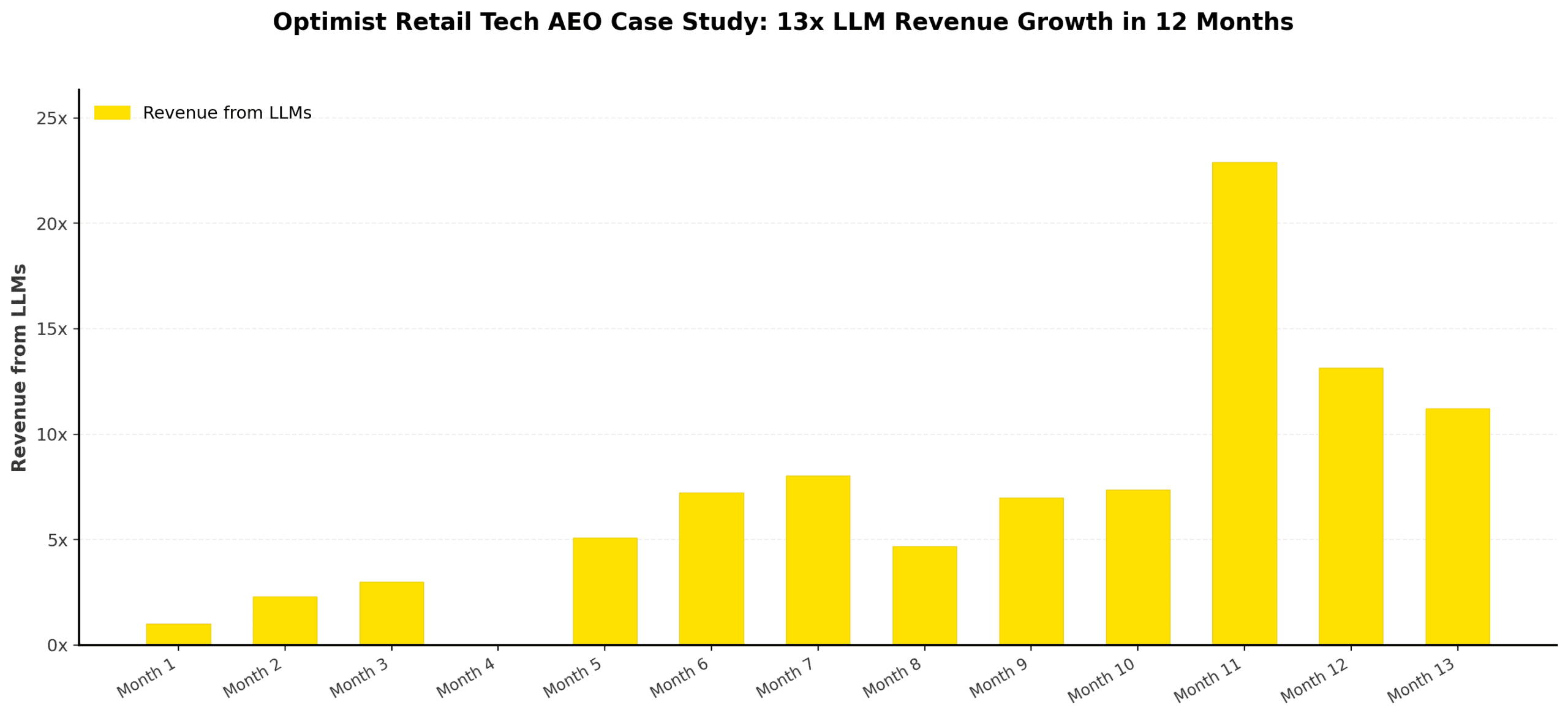
- 13x increase in LLM-sourced revenue, year over year (ChatGPT, Perplexity, Claude)
- Strong visibility gains across category-level and comparison queries in AI answer engines
- Products consistently cited and recommended in relevant category contexts where it previously did not appear
- Structured content gave AI models the detail and confidence to recommend the product for specific buyer needs
- Built a durable category presence that compounds as AI models continue to favor well-structured, category-authoritative sources
The strategy succeeded because it was built on an integrated strategy for both SEO and AEO: Being present in the right conversations and being structured enough for AI models to recommend with confidence.
By owning category-level visibility and backing it with structured product detail, the brand moved from missing in AI responses to being the recommended solution within its core categories.
