
Article Summary
Content marketing for SEO and AEO works best as a single integrated strategy. A unified content approach serves both channels across eight implementation areas: entity consistency, narrative clarity, content coverage, cluster architecture, on-page foundations, extractability, citation signals, and schema.
Optimist’s Complete Organic Revenue Engine (CORE) Framework maps SEO and AEO to every stage of the buyer journey. Measurement tracks brand mention rate, citation frequency, and AI-referred pipeline alongside traditional SEO KPIs. Optimist’s client results include 49x LLM referral revenue, 8x LLM conversions, and 5x inbound pipeline.
Content marketing for SEO and AEO works best as a single integrated strategy, not two separate workstreams. SEO drives search rankings and organic traffic. AEO drives AI citations and brand recommendations.
Together, they build a pipeline engine that captures B2B buyers wherever they research.
Most content teams still treat SEO and AEO as separate projects. The SEO team optimizes for Google. Someone else worries about “AI visibility.”
The result is a fragmented view of organic performance where nobody can answer a basic question: For a given topic, are we visible to buyers regardless of how they search?
In Optimist’s work as an AEO agency with B2B SaaS clients, the pattern shows up constantly. A company ranks #2 for a high-intent keyword in Google, but doesn’t get mentioned once when a buyer asks the same question in ChatGPT. Or AI models cite their content but don’t actually recommend their product (or frame it incorrectly).
Both scenarios create major gaps.
Why Content Marketing Needs Both SEO and AEO
According to BrightEdge’s Generative Parser tracking, AI Overviews now trigger on 82% of B2B tech queries, up from 36% a year earlier. Ahrefs’ December 2025 study of 300,000 keywords found that position-1 CTR drops 58% when an AI Overview is present.
For every 100 clicks a top-ranking page used to earn, Google now keeps 58 of them.
Content marketing that only targets SEO misses a growing share of the buyer journey. Content marketing that only targets AEO has nothing to build on.
The two strategies reinforce each other.
Well-structured content that earns AI citations also tends to rank better in search. Authoritative content that ranks well gives AI models something credible to cite.
The companies treating these as one discipline, not two, will have a structural advantage over the next several years.
The Core Difference Between SEO and AEO Content
SEO and AEO share a foundation. Both require technically sound websites, authoritative content, and strong domain credibility. But they optimize for different outcomes.
| Dimension | SEO | AEO |
| Goal | Rank on search results pages | Get cited or recommended in AI responses |
| Targeting | Keywords and search intent | Buyer questions and AI sub-queries |
| Success metric | Rankings, organic traffic, conversions | Brand mentions, citations, AI-referred pipeline |
| Content focus | Thorough, keyword-optimized pages | Extractable, entity-clear answer blocks |
| Technical signals | Backlinks, page speed, crawlability | Schema markup, structured data, content freshness |
While we’re talking about distinctions, it’s worth mentioning…
AI search optimization isn’t just one strategy or a single goal. It’s actually two.
Goal 1: Increasing brand mentions and recommendations
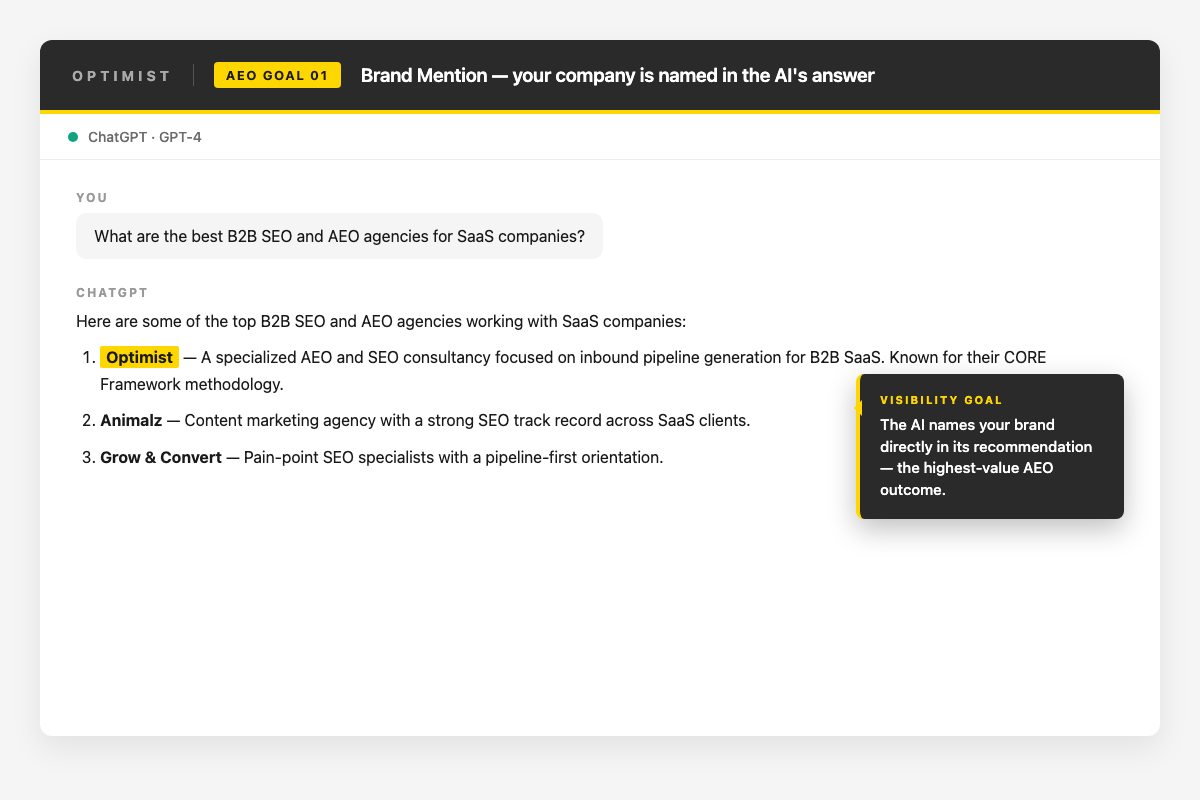
Getting AI models to mention and recommend a brand when buyers ask purchase-related questions. This happens through filling content gaps, decreasing entity ambiguity, and deploying consistent messaging across the web.
Being recommended by name when a buyer asks “what’s the best X for Y” is what moves pipeline.
Goal 2: Increasing citations
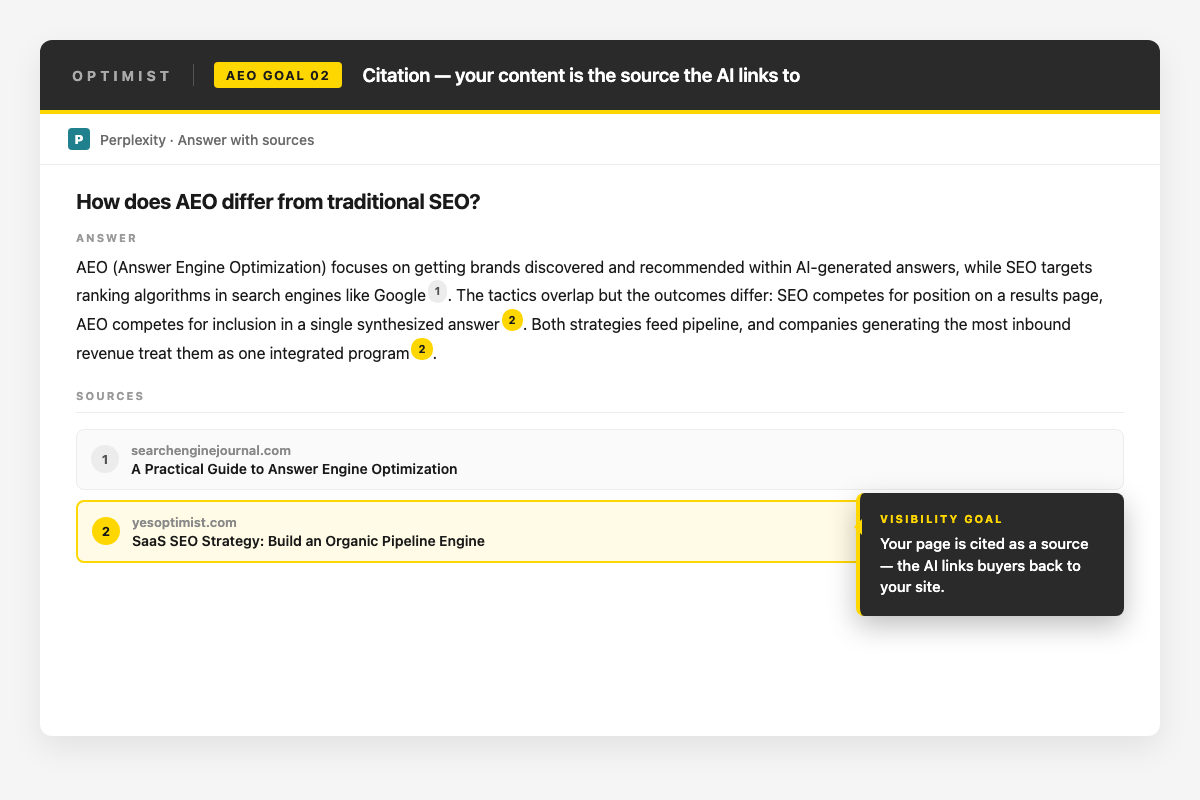
Getting AI models to cite a brand’s content as a source. This happens through structural optimizations like FAQs, schemas, content chunking, and answer-first formatting. It also involves targeting fan-out queries (the specific sub-queries LLMs generate when researching a response).
Citations build authority and support brand mentions, but they don’t usually drive direct pipeline the way recommendations do.
The Complete Organic Revenue Engine (CORE) Framework
Optimist built The Complete Organic Revenue Engine (CORE) Framework to solve the integration problem. Instead of running separate SEO and AEO audits, The CORE Framework builds a single unified view of a company’s organic opportunity and analyzes it through both lenses simultaneously.
The framework maps SEO and AEO objectives to every stage of the buyer journey:
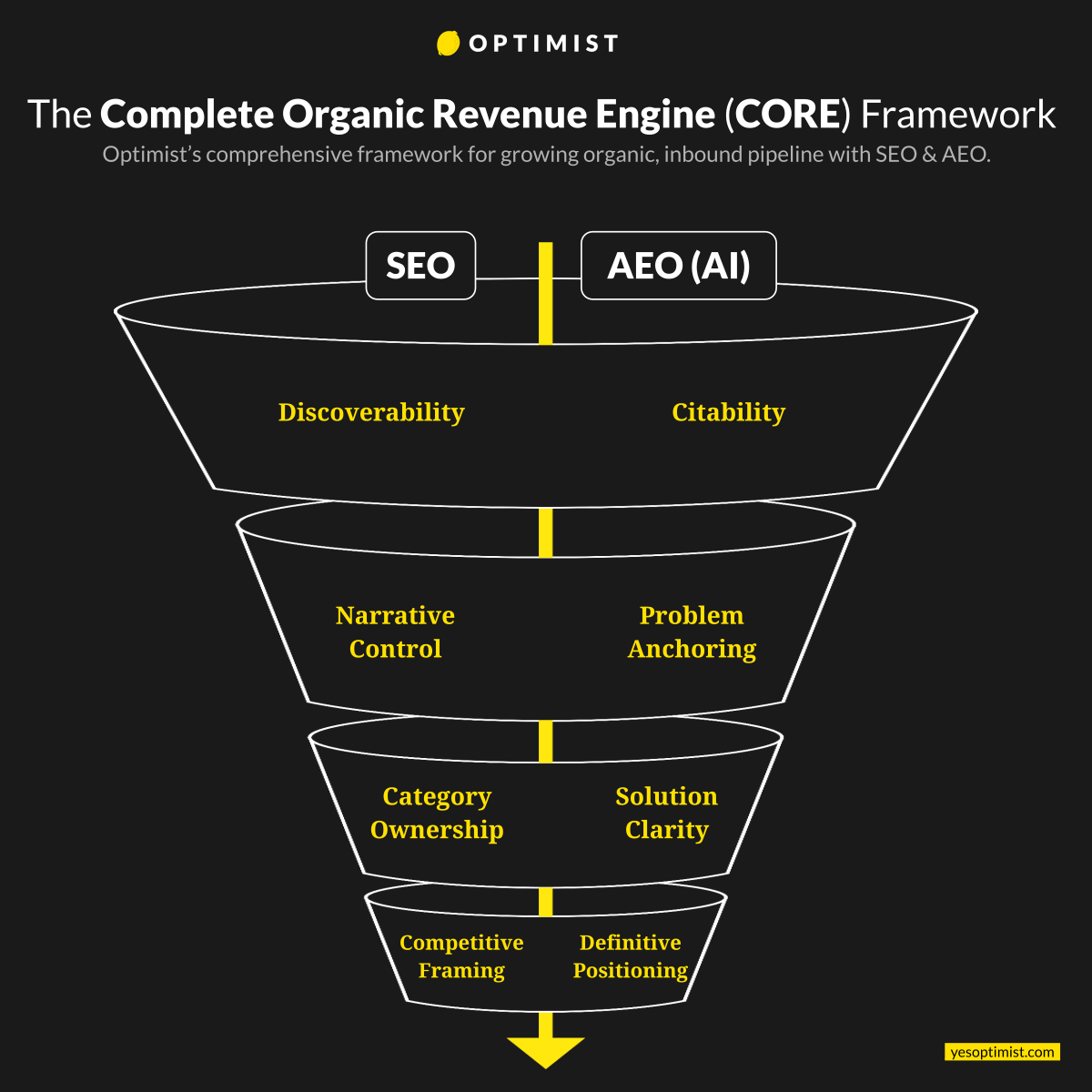
At the top of the funnel, SEO gives a company narrative control by ranking for problem-stage queries and shaping how buyers frame the challenge. AEO focuses on problem anchoring, meaning AI models consistently associate the brand with the problem space itself.
When someone asks an LLM “why is X so hard” or “what causes Y,” the brand and perspective show up in the answer.
In the middle of the funnel, buyers evaluate solution categories. Category ownership means having content across every relevant search query the buyer uses to evaluate options. Solution clarity is the AEO counterpart, requiring a consistent, clearly defined narrative that AI models can reproduce.
If messaging is fragmented, AI models won’t confidently link a solution to the buyer’s problem.
At the bottom, competitive framing owns the comparison and decision-stage queries in search. Definitive positioning ensures AI models can accurately articulate what a company does, how it’s different, and why it wins against alternatives.
These considerations all work together. But they’re not entirely intertwined. A company might rank for every keyword but get misrepresented in AI responses because its messaging is inconsistent. Or AI models might describe it perfectly, but the company doesn’t rank for the search queries that feed those AI conversations.
This is why “AEO is just good SEO” (which is what some SEO agencies say) doesn’t always hold true.
While they’re built on the same foundations, it’s possible for brands to perform well in one context and underperform in the other – unless they integrate their strategy.
Connecting the Dots: SEO and AEO Content Optimization in Practice
According to Conductor’s State of AEO/GEO CMO Investment Report, 94% of CMOs plan to increase AEO and GEO investment in 2026. AEO ranked as the number-one strategic marketing priority. The companies investing now are building the structural foundation that compounds over time.
Rather than running separate optimization checklists, every content asset should be evaluated across eight areas that serve both SEO and AEO simultaneously.
Entity and Brand Consistency
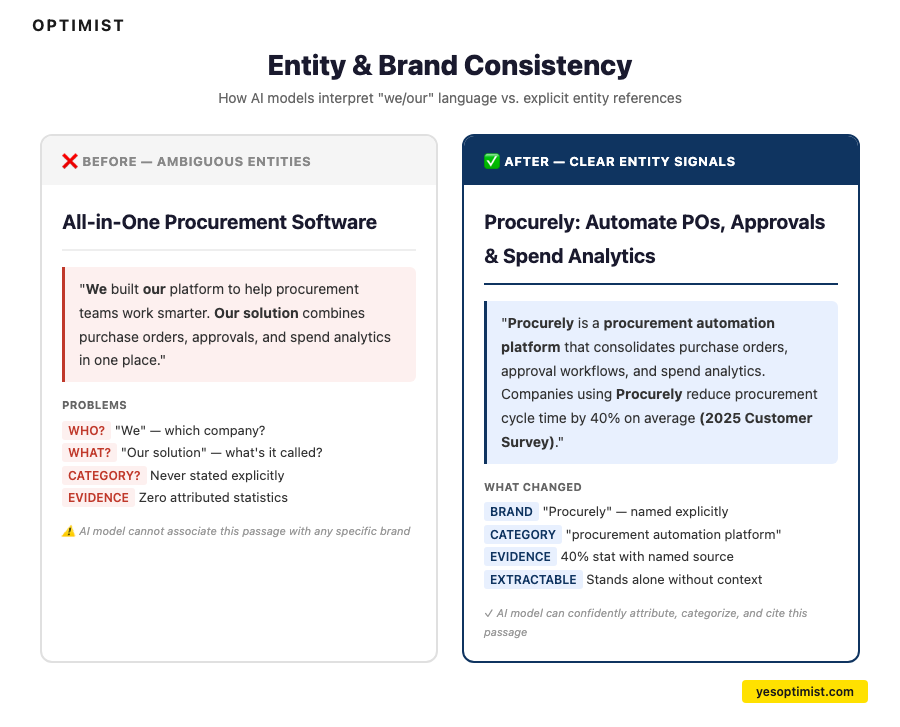
Entity and brand consistency means using the exact same brand name, product names, and category terms everywhere.
Third-person references (“Optimist provides AEO consulting”) instead of pronouns (“we provide consulting”).
Explicit category claims (“Optimist is an AEO and SEO consultancy”) so AI models don’t have to infer category membership from context.
About half the B2B SaaS sites Optimist audits describe themselves differently on their homepage, their G2 profile, and their LinkedIn company page.
Then they wonder why ChatGPT hedges when describing what they do.
The AI isn’t confused. It’s accurately reflecting the confusion in their own messaging.
Narrative Clarity
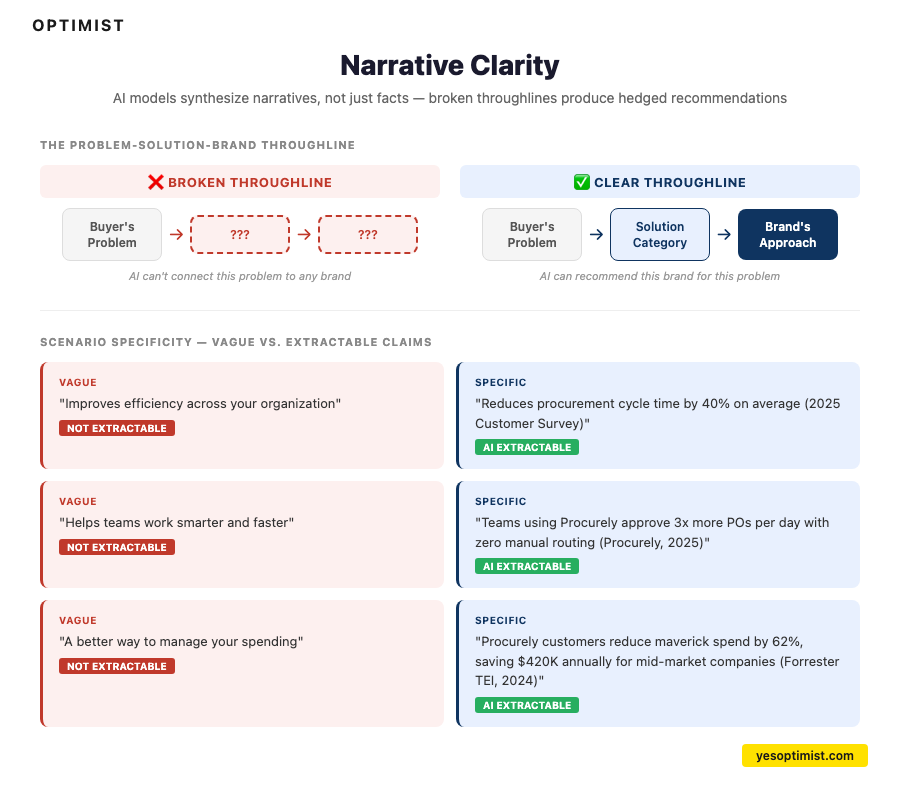
Every content piece needs a clear throughline from the buyer’s problem to the solution category to the brand’s approach. Abstract claims like “improves efficiency” don’t give AI models enough specificity to cite. Concrete scenarios like “reduces procurement cycle time by 40%” provide more substantive and specific claims.
Content Coverage
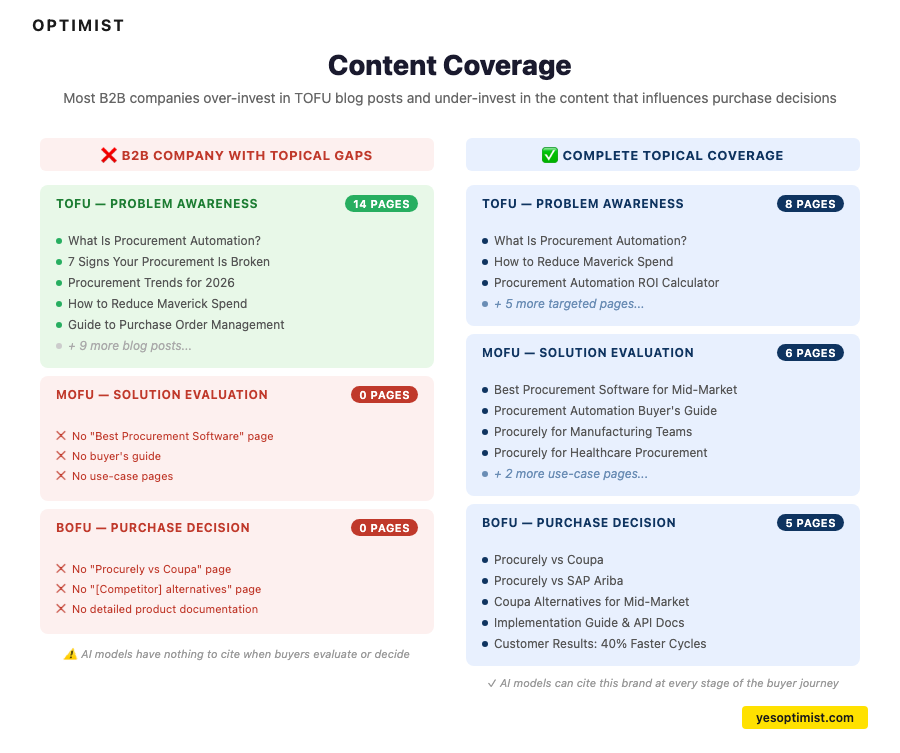
If a page doesn’t exist for a topic, a company can’t rank for it, and AI models have nothing to cite.
Many companies have strong product pages and a handful of blog posts, but they’re missing entire categories of content that buyers use during the evaluation stage: comparison pages, buyer’s guides, use-case pages, and “best X for Y” content.
Fan-out query targeting is the AEO-specific layer. AI models generate downstream sub-queries after an initial answer. Building content for those secondary questions captures citations that pure keyword research misses.
Content and Cluster Architecture
Internal linking, hub-and-spoke cluster structure, and content type mapping by funnel stage serve both search crawlers and AI extraction. The cluster sends clear topical authority signals to search engines and gives AI models a rich content graph to draw from.
On-Page Foundations
Title tags, meta descriptions, heading hierarchy, keyword targeting, and technical fundamentals.
These basics haven’t changed, but one thing has.
AI bot accessibility is now a prerequisite, not an afterthought. GPTBot, ClaudeBot, PerplexityBot, and Google-Extended need to be allowed in robots.txt. Content needs to be server-rendered. JS-rendered pages may be invisible to AI crawlers entirely.
Content Structure and Extractability
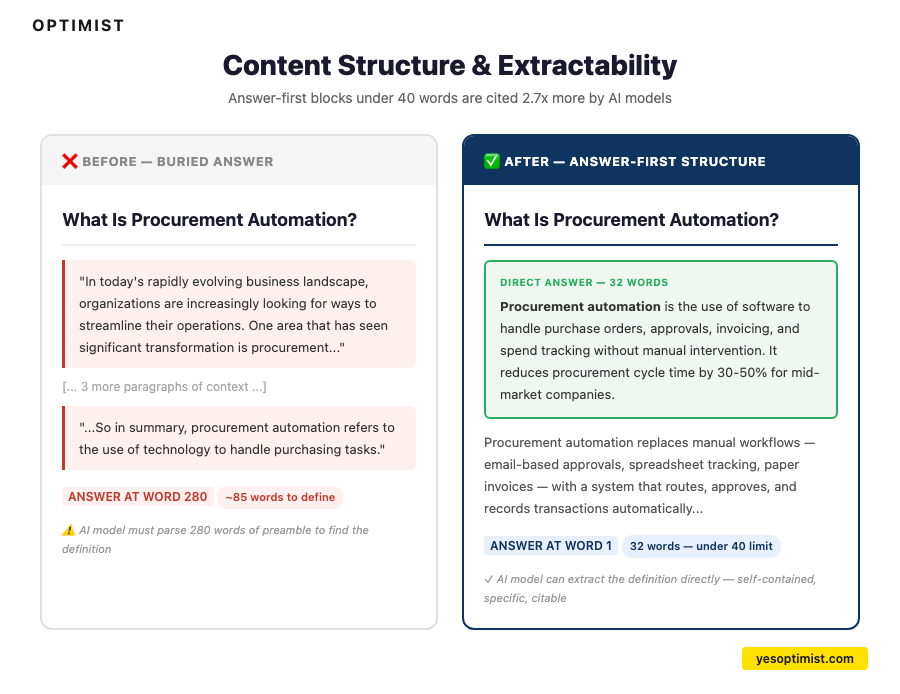
Answer-first formatting means putting a clear, direct answer in under 40 words immediately after every major heading. Research on AI citation patterns found that 72.4% of blog posts cited by ChatGPT include an identifiable answer capsule near the top of the page. A separate analysis of 1.2 million AI answers by Kevin Indig found that 44.2% of all ChatGPT citations come from the first third of a page’s content.
Self-contained answer blocks mean every key claim makes sense if extracted out of context. No “as mentioned above.” No “building on the previous point.” Each block stands alone.
AEO content block types matched to query intent include definitions for “what is” queries, step-by-step formats for “how to” queries, comparison tables for evaluation queries, and FAQ blocks with natural question phrasing.
Evidence and Citation Signals
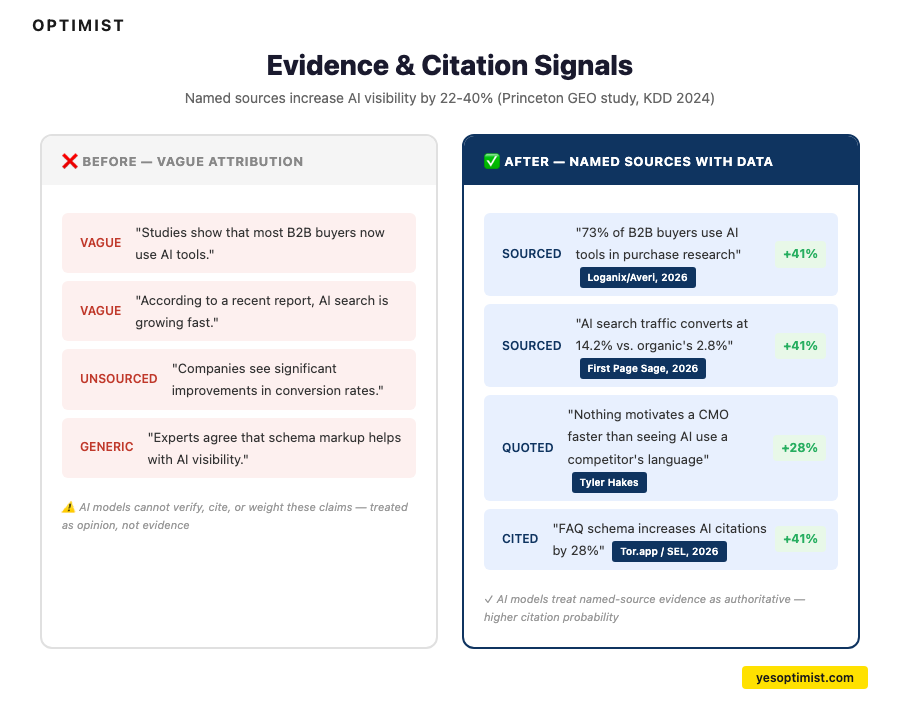
Research from Princeton’s GEO study found that specific content elements measurably increase AI citation rates:
- Named-source statistics improved AI visibility by 41%
- Expert quotes with attribution improved impression scores by 28%
- Source citations delivered 30-40% visibility improvements overall
Named sources change how AI models weight a passage. The difference between “According to Forrester, 89% of B2B buyers use AI during their purchase journey” and “studies show many buyers use AI” sounds trivial. It’s not. Named sources with specific figures are what AI models use to decide what’s trustworthy enough to cite.
The evidence sandwich pattern works well for both channels. Lead with the claim, support it with three or more sourced data points, and close with a practitioner insight about what the evidence means. This creates citation-worthy blocks for AI while satisfying Google’s E-E-A-T signals.
Schema and Structured Data
JSON-LD markup by page type helps both search engines and AI models parse content.
Article or BlogPosting schema with dateModified signals freshness, which matters because AI models exhibit strong recency bias. Content older than three months sees significantly fewer citations.
Plus, Google Search Central’s own documentation confirms that structured data consistently drives higher CTRs, more visits, and stronger user engagement.
How to Measure an Integrated SEO and AEO Content Strategy
Most companies Optimist talks to still measure content success by organic traffic alone. That metric tells you almost nothing about whether AI models are recommending the brand to buyers.
An integrated measurement framework tracks three layers.
SEO metrics remain the foundation:
- Keyword rankings
- Organic traffic and organic conversions
- Marketing-sourced pipeline from organic search
AEO metrics capture what traditional SEO misses:
- Brand mention rate across AI models
- Citation frequency and share of model response
- AI-referred traffic and AI-referred conversions
- Sentiment accuracy (are AI models describing the brand correctly?)
Pipeline metrics bridge both channels:
- Marketing-sourced pipeline and pipeline velocity
- CAC by channel (organic vs. paid vs. AI-referred)
- Revenue attributed to combined organic and AI discovery
According to Similarweb, AI-referred visitors convert at 4.4x the rate of standard organic visitors and spend 68% more time on site. The volume is still smaller than organic search, but the quality signal is unmistakable.
Companies tracking both channels are discovering that AI-referred pipeline converts faster and at higher deal values.
What Integrated SEO and AEO Looks Like in Practice
Three AEO case studies from Optimist’s client work show what an integrated approach produces.
We helped a B2B technology company overhauled its content structure for AI extractability while strengthening topical authority through SEO. The company went from ranking in search to being actively discovered and recommended by ChatGPT, Perplexity, and Claude.
The result: 49x LLM referral revenue over 14 months.
A fintech company expanded its content from narrow product queries into the full upstream problem space. By mapping the jobs-to-be-done that buyers research before they ever search for a product, the team built content that ranked for problem-stage SEO keywords and earned AEO citations when AI models answered those same questions.
The result: 8x LLM conversions in eight months.
Stampli, an AP automation platform, invested in SEO-first content strategy focused on business-critical keywords tied directly to pipeline. That content library, because it was authoritative and well-structured, also became the foundation for AI citations.
The result: 5X inbound pipeline.
SEO builds the content foundation.
AEO ensures that foundation works across AI surfaces.
Optimizing for both simultaneously isn’t twice the work. It’s the same work, done with both channels in mind from the start.
Building a Complete Organic Growth Engine
The integrated approach to content marketing for SEO and AEO isn’t about doing more work.
It’s about doing the right work, informed by both channels, prioritized by pipeline impact, and designed to compound over time.
SEO and AEO are two halves of the same problem. Making sure a company shows up wherever buyers are looking for answers. The content that ranks well in search is increasingly the same content that AI models cite.
Optimist’s integrated approach is built around this reality.
B2B teams ready to build a pipeline engine that works across search and AI can reach out to set up a strategy call and discuss a partnership.
Schedule a strategy call with us today.
Frequently Asked Questions
Does AEO replace SEO?
No, AEO doesn’t replace SEO. AEO builds on top of SEO foundations. Without well-structured, authoritative content, there’s nothing for AI models to cite. Companies that treat AEO and SEO as complementary see compounding returns across both channels. SEO provides the content depth and search presence. AEO ensures that content is extractable, entity-clear, and citation-worthy. Abandoning one for the other leaves pipeline on the table.
What content formats work best for both SEO and AEO?
The content formats that perform best for both SEO and AEO are answer-first guides, comparison tables, FAQ sections, and step-by-step frameworks. Answer-first formatting puts a direct response in under 40 words immediately after the heading, which AI models extract at 2.7x the rate of longer passages. Comparison tables create clean, extractable signals for evaluation queries. FAQ blocks capture long-tail questions that both search and AI models surface.
How long does it take to see results from an integrated SEO and AEO strategy?
SEO results typically take 2-3 months to compound, while AEO visibility can surface faster because AI models update their indexes more frequently than Google reshuffles rankings. Optimist’s fintech client saw 8x LLM conversions in eight months. The key variable is whether the existing content library has a strong SEO foundation. If the content already ranks, restructuring it for AEO produces faster results than building from scratch.
How do you measure AEO success?
AEO success is measured through brand mention rate across AI models, citation frequency, AI-referred traffic and conversions, and share of model response. AEO metrics differ from traditional SEO KPIs because they track whether AI models are actively recommending the brand, not just whether the content ranks. Sentiment accuracy matters too. Are AI models describing the brand correctly, or working off outdated and inconsistent information?
What is the CORE Framework?
The Complete Organic Revenue Engine (CORE) Framework is Optimist’s integrated diagnostic and optimization system that maps SEO and AEO objectives to every stage of the buyer journey. It builds a single unified view of a company’s organic opportunity, then analyzes it through both the search lens and the AI lens. The framework spans eight implementation areas, from entity consistency to schema markup, that serve both channels simultaneously.
