
Article Summary
The SEO monthly retainer model still works because compounding organic work needs recurring capacity. Retainers commonly include technical SEO, content production, on-page optimization, link building and off-site work, and reporting.
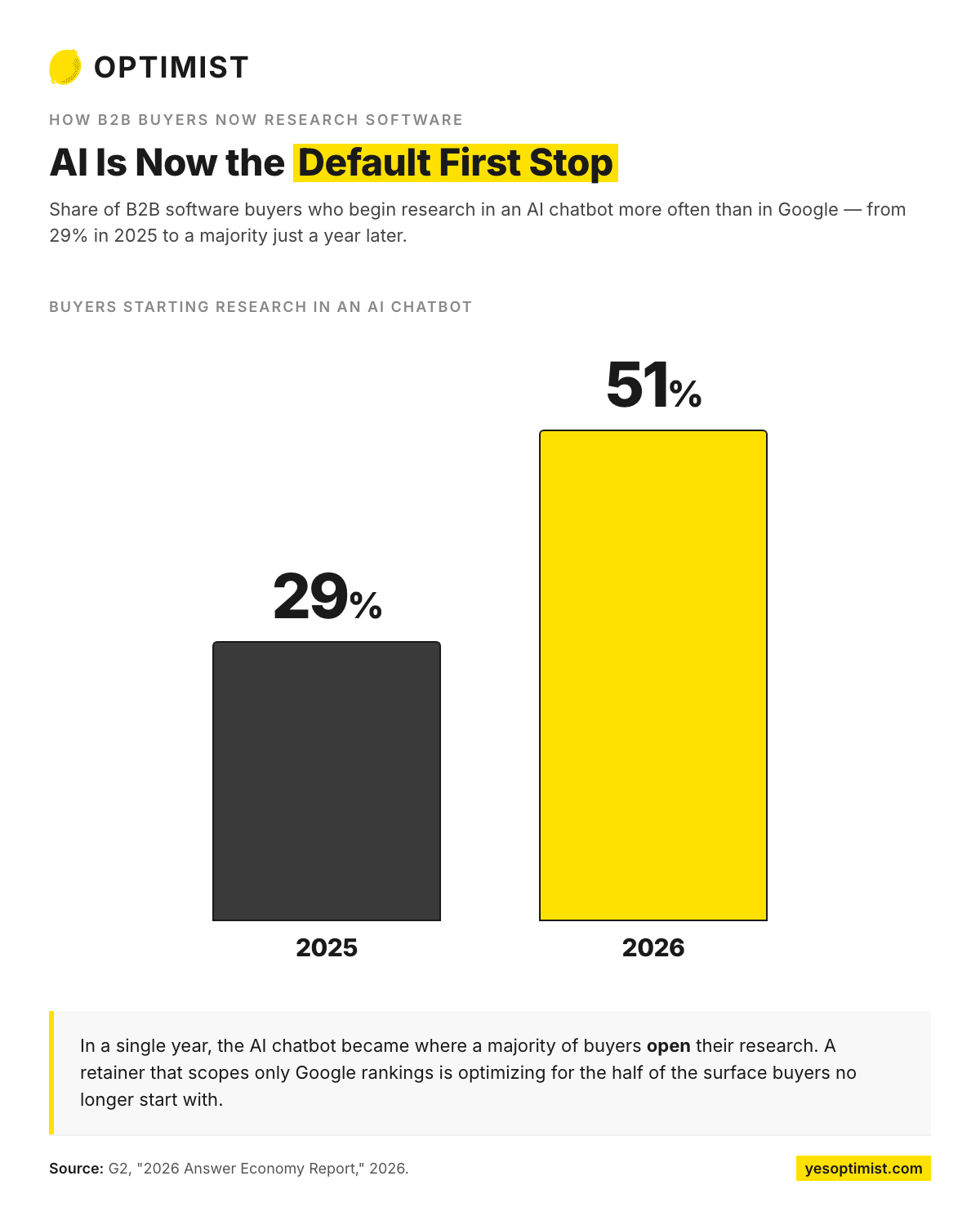
But with 51% of B2B software buyers now beginning research in AI chatbots more often than Google, a retainer that scopes only Google rankings is buying half the surface. The right 2026 monthly SEO retainer is one organic engine spanning Google and AI answer engines.
A monthly SEO retainer is a recurring engagement, billed at a fixed monthly fee, that buys ongoing search engine optimization work from an agency, consultant, or freelancer.
Many contracts (but not all) run 6 to 12 months minimum because SEO compounds over time.
The work in month one may not show up in rankings until month 2, and may not show up in the pipeline until month 3.
The standard SEO retainer scope usually covers five main service categories:
- Technical SEO (site speed, crawl, indexation)
- Content production (blog articles, pillar pages, landing pages)
- On-page optimization (title tags, internal linking, schema)
- Link building, brand mentions, or off-site work
- Performance reporting
Most providers organize the work around those categories.
Then they price the bundle by their own size (freelancer, small agency, mid-market agency, enterprise).
Generally, the larger the agency, the more the engagement will cost for ostensibly the same scope of work (because overhead, offices, etc.)
Truth is, the SEO retainer is evolving in big ways and you should know how to assess these shifts before committing to a deal.
The New SEO Retainer: SEO and AEO As One System
SEO is no longer “just SEO”.
In most cases, SEO now includes AEO (answer engine optimization; sometimes also called GEO or AI SEO).
That’s because the way buyers discover, evaluate, and compare purchases has shifted from predominantly driven by traditional search to now driven by LLMs and AI surfaces like ChatGPT, Claude, and Gemini.
G2’s 2026 Answer Economy report found 51% now begin software research in an AI chatbot more often than in Google, up from 29% just 11 months earlier.
Seventy-one percent rely on AI chatbots for software research and 69% chose a different vendor than initially planned based on AI guidance.
Forrester’s 2025 Buyers’ Journey Survey of roughly 18,000 global business buyers found twice as many B2B buyers now name generative AI or conversational search as their most meaningful research source compared to a year earlier, outranking vendor websites, product experts, and sales reps.
A retainer that scopes only Google rankings is optimizing for half the surface buyers actually use.
The right retainer in 2026 is one organic engine spanning Google and AI answer engines.
AI search visibility is fundamentally linked to SEO performance.
But traditional SEO tactics alone don’t guarantee AEO results.
You need both — as part of a single, integrated strategy.
Not two separate retainers run by two different vendors or an SEO retainer with “AEO” stapled on as a separate-but-undefined line item.
One engagement, one scope, and one scorecard.
When SEO and AEO live in two separate contracts, the connective tissue falls apart. Topic universes drift, funnel-stage mapping diverges, pipeline-value scoring lives in one head and content production lives in another. Plus every optimization you make is half-optimized.
Worse yet, separate SEO and AEO strategies may actively conflict and hurt your results.
In economic terms, you’re paying twice for work that should, instead, be working twice as hard.
A unified retainer shares one topic universe, one funnel-stage mapping, one pipeline-value scoring system. Every piece of work is designed to improve visibility across both search and AI.
The two systems work together:
- SEO topical coverage helps you earn citations and brand mentions from LLMs
- Entity clarity helps Google rank you and helps AI engines disambiguate you
- Structured content helps you win featured snippets and helps you get cited in AI Overviews
Here’s a clean example of why you need both:
When I audit B2B SaaS sites, the most common gap is entity ambiguity.
The brand describes itself three different ways across its homepage, G2 listing, and LinkedIn page, so AI hedges on all three and recommends a competitor that reads as one clear entity instead.
This is the kind of issue a standard SEO retainer wouldn’t consider.
It goes beyond the basic technical SEO factors and rankings and if you’re working with an SEO-only vendor, they’ll probably ignore this issue entirely.
Then you’re revving up search rankings only to capture a declining number of clicks and completely ignoring the larger prize — AI visibility.
At risk of belaboring the point, I’ll just say this.
Hire a partner who handles both as part of one, integrated strategy.
The North Star is Revenue
Show me a case study where you increased revenue or pipeline, not just traffic.
That’s the single question that separates a real SEO retainer from a vanity-metric one, and most providers can’t answer it cleanly. The standard scorecard runs on what’s easy to count: keyword rankings, organic sessions, pages produced, links acquired, traffic curves. None of that is pipeline. Some of it correlates with pipeline; most of it doesn’t.
I’ve seen agency pitches that showed an impressive-looking 400% traffic increase that generated zero pipeline because the entire strategy targeted informational keywords with no buying intent.
The retainer worked beautifully on the dashboard.
It made no money.
A retainer scoped against pipeline, it turns out… does produce pipeline.
We’ve seen it for over 10 years in our work with clients across focused on SEO:
- Stampli saw a 5x increase in organic-search inbound pipeline and a 400% lift in MQLs
- Glide hit 14x product signups in 12 months
- Kubera reached 43x signups in 15 months
- Plytix moved content into the #1 lead driver in its mix
- HelloSign’s inbound engine fueled the growth that led to a $230M Dropbox acquisition
On the AEO side, the same one-engine scope produced:
- 49x growth in LLM referral revenue for a B2B technology client over 14 months
- 13x LLM-sourced revenue year over year for a B2C/D2C retail program
Different categories, different ARR bands, same scorecard.
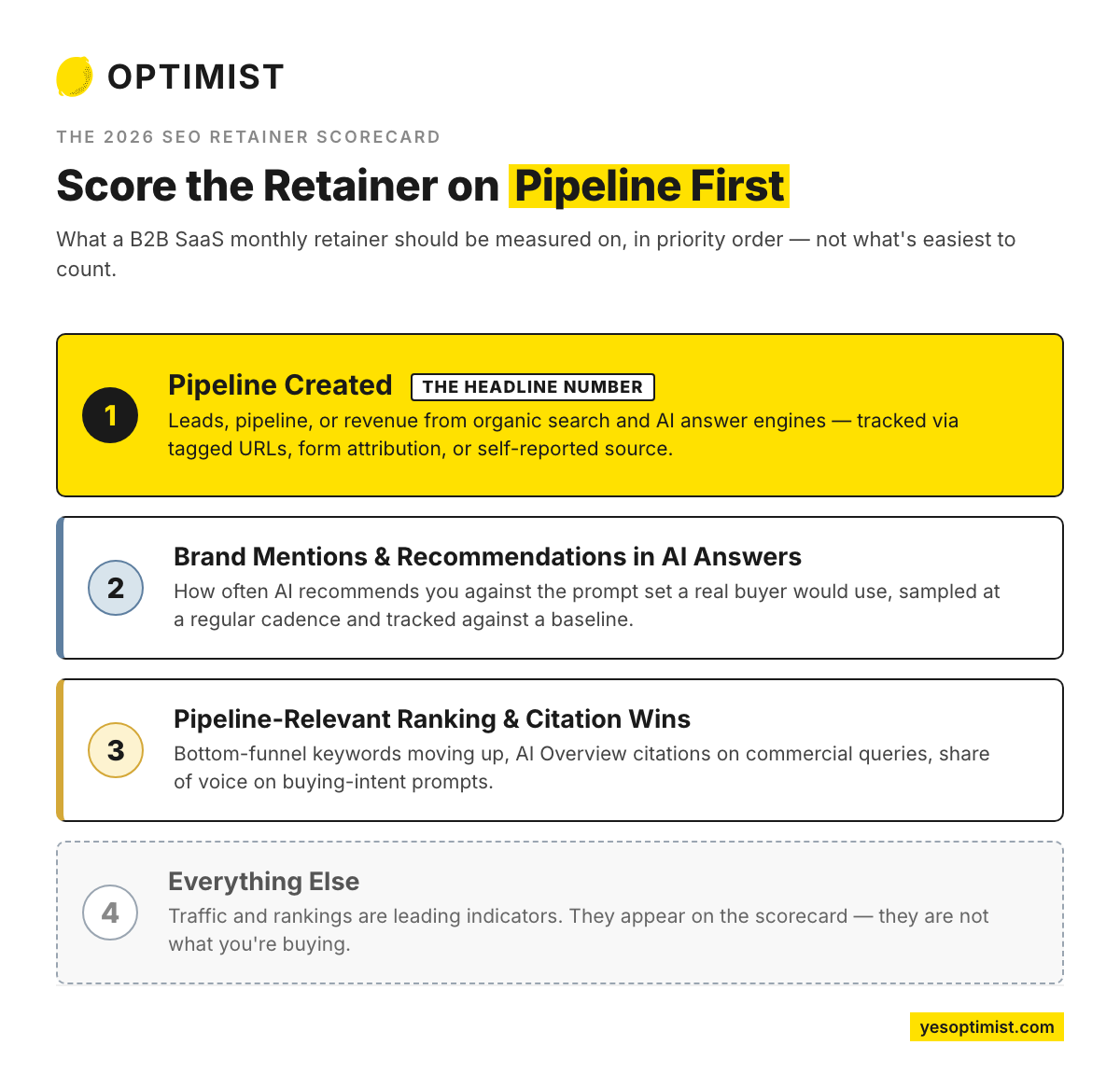
Here is what the scorecard should look like for a B2B SaaS monthly retainer in 2026:
- Pipeline (or leads, or revenue) created from organic search and AI answer engines. The headline number. Tracked via tagged URLs, form attribution, or self-reported pipeline source.
- Brand mentions and recommendations in AI answers. Measured against the prompt set a real buyer would use, sampled at a regular cadence, tracked against a baseline.
- Pipeline-relevant ranking and citation wins. Bottom-funnel keywords moving up, AI Overview citations on commercial queries, share of voice on buying-intent prompts.
- Everything else.
Traffic and rankings are leading indicators.
They appear on the scorecard but they’re not really what you’re buying.
You’re paying your agency to drive meaningful conversions and revenue from organic channels. So that’s what they should be measuring.
A retainer that puts rankings at the top of the scorecard has already lost the plot, because the retainer’s reason to exist is the pipeline it produces, not just raw visibility.
SEO Retainer Costs in 2026
Ahrefs polled 439 SEO providers and found 78.2% charge a monthly retainer, making it the dominant pricing model in the industry.
Average monthly retainer comes in at $3,209 for agencies, $1,348.63 for freelancers, and $3,250 for consultancies.
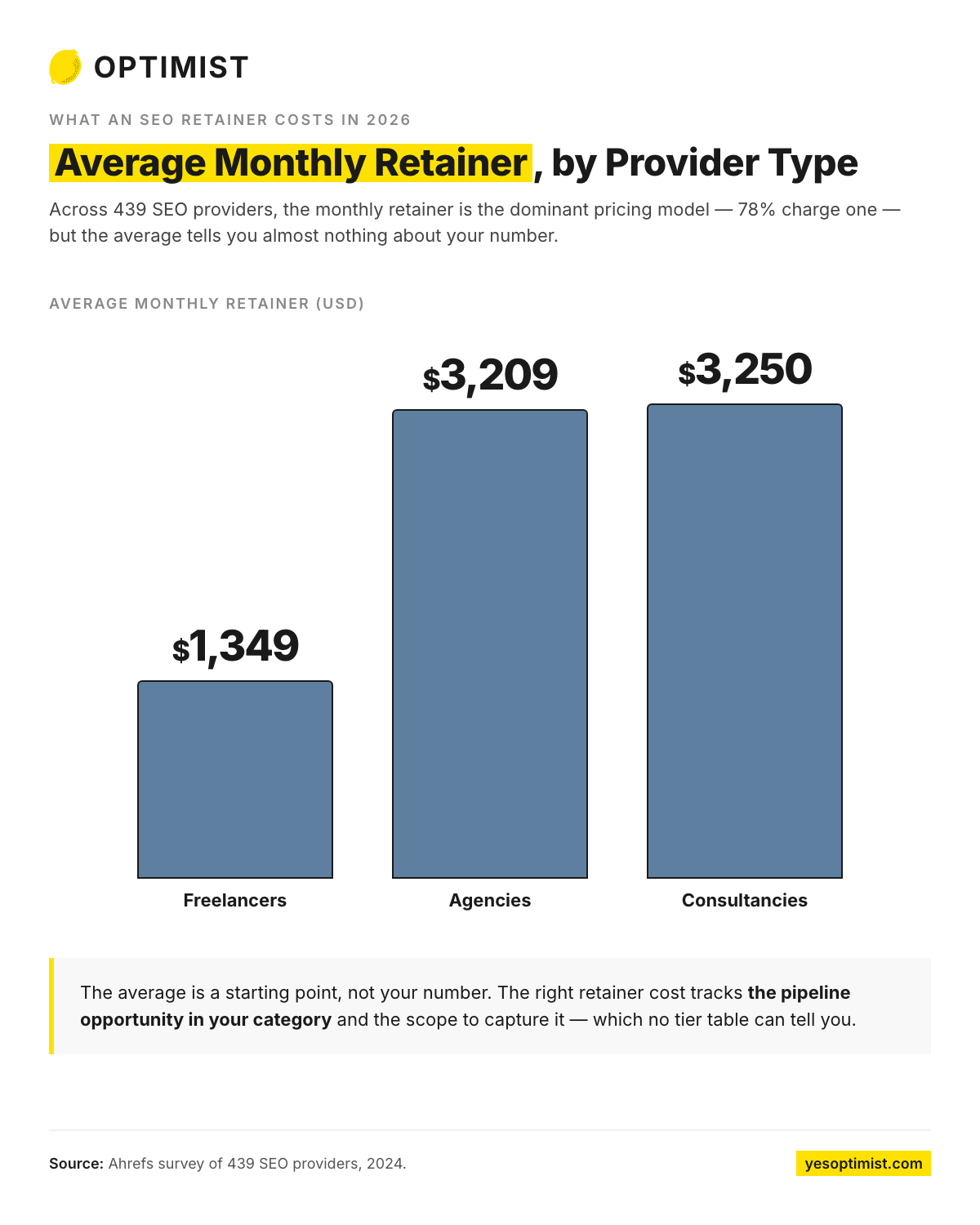
The most common read on the data says an SEO retainer will cost about:
- $1,500/mo for small agencies
- $5,000 for mid-size
- $10,000+ for enterprise
But it’s important to keep in mind that these prices are totally arbitrary and may be wildly disconnected from the needs of your business.
The cost of your SEO retainer should be based on two key factors:
- The organic demand and revenue opportunity in your space
- The specific scope of work it will take to execute
Let’s look at each piece.
Sizing Up the Opportunity
The SEO retainer’s job is to move the organic pipeline number for your business.
That number is different for seed-stage HR tech startup operating in a crowded, billion-dollar industry with hulking incumbents than it is for someone selling a $29/mo PIM and competing against a longtail of mid-pack SaaS competitors.
The value of that SEO retainer is also wildly different.
It might not make sense for a company to invest $1 million in SEO services to capture 50% of an estimated $300k/year in organic demand within their category.
But if it’s a $10 million/year opportunity, you can bet that competitors are probably spending that much – and you may need to as well.
The contestable organic and AI-answer pipeline in different categories isn’t the same.
The work to unlock it isn’t the same
The price shouldn’t be the same either.
Internally, the pricing math should connect to the pipeline contribution your business could plausibly capture, and what’s a fair share of that to invest in the retainer that captures it.
The price shouldn’t feel reasonable but totally arbitrary or, worse, expensive with no reasonable explanation.
Plus, without this context, the SEO work is at the mercy of an understanding CFO who sees the inherent value in SEO.
The Gartner 2025 CMO Spend Survey found 39% of CMOs plan to cut labor costs and the same 39% plan to cut agency allocations. Third-party partners are the first lever CMOs pull when budgets tighten, with overall marketing budgets flat at 7.7% of company revenue.
A monthly SEO retainer competes for that shrinking dollar against AI tooling, paid media, and in-house headcount. The second the CFO takes a hard look, they’ll probably want to see some underlying math that connects this spend to outcomes – whether it’s $1k/mo or $100k/mo. A retainer that can’t articulate the pipeline it produces is exactly the spend that gets cut.
Optimist publishes flat pricing: advisory retainers from $3,000/mo for teams that execute in-house, and full-service engagements from $4,000/mo covering strategy through execution and publishing — all month-to-month. But, the reality is, we have some flexibility. Because we know that our “standard” SEO pricing isn’t going to make sense for every business. And if we can flex the work to fit their need, that also gives us room to flex the price as well.
SEO Retainer Scope: Fixed vs Flexible
Here’s something that really grinds my gears.
Many SEO agencies sell SEO retainers as pre-packaged widgets.
You get: 5 articles, 3 links, and 2 Reddit posts.
That’ll be $3,999.99, please.
Of course, this is all decided before you’ve had a conversation. The package gets scoped, priced, and assigned to you before you’ve even gotten on the phone. And, of course, it’s the exact same package they’re going to pitch to the HR SaaS platform and the diary farm down the road.
They don’t even know anything about your business.
How could they possibly know what scope of work you actually need to drive results?!
While almost every SEO retainer contains some combination of the same work and deliverables, the specific deliverables you get from your partner shouldn’t be packaged up and sold like a microwavable dinner. (Or, if they are, you should expect a microwavable-dinner-quality outcome.)
SEO retainer scope should be prescribed.
Based on strategy.
Sure, maybe you actually need those 5 articles, 3 links, and 2 Reddit posts. But if you’re buying a pre-packaged “SEO plan” then it’s not really a plan at all.
Second thing to note here: The SEO retainer scope should flex.
This month, you might need an all-out sprint of new content.
Next month, you might need more links built to support those new pages.
We shouldn’t have to pause work and renegotiate the scope of the retainer every single time we need to update the scope. Because the needs of every SEO program change and evolve frequently – constantly – based on real-time data and results.
Trust me, you want a flexible scope – not a fixed scope.
How Optimist Structures Retainers
Everything above is the spec I hold our own retainers to.
The whole model runs on one organic engine, not an SEO retainer with AEO stapled on.
We call it The Complete Organic Revenue Engine (CORE) Framework, and it’s the connective tissue that keeps a retainer from drifting toward whatever the dashboard happens to reward.
Diagnosis First, Plan, then Retainer
There’s no point in hiring us if there’s no addressable organic demand in your space.
We start every conversation by running a free Organic Revenue Opportunity Report.
This gives us a snapshot of your brand, your market, and your competitors. We can estimate the total size of the contestable pipeline in your category and how much of it you’re capturing across search and AI today.
That baseline is what every later decision anchors to
Once we begin work with a new client, we start with a deep dive into the data, strategy development, and roadmapping.
We call this the CORE Analysis and CORE Roadmap.
This includes development of the entire topic universe that’s relevant to your business, prompt space creation, SEO benchmarking, AI visibility benchmarking, and pipeline-based prioritization and sequencing.
We build the entire roadmap you’ll need to execute to go from your current visibility to compete with the leaders in your category – or beat them.
Then, and only then, the retainer.
What the Retainer Actually Buys
Retainers are month-to-month: advisory from $3,000/mo, full-service from $4,000/mo.
Optimist offers two core services.
Advisory is just what it sounds like. We help guide your implementation of the strategy we built.
Our team runs the reporting, sets the direction, answers questions, and guides execution.
Full-service is where we run the program. Strategy, ongoing roadmap management, reporting, execution, content deliverables are all included.
But it’s not a pre-packaged plan. The scope shifts and evolves (a fixed number of deliverables; flexible deliverable types).
The retainer gets scoped after we have a plan in place and we know what the roadmap looks like. That way we can see, together, what will be executed.
Our retainers include a mix of deliverables (flexible, again, by design) that include:
- Technical and on-page SEO/AEO projects
- Content creation or content briefs
- Refreshing and optimizing existing content and pages
- Link building and off-site work
That’s the whole model.
SEO Retainers Are Still Worth It (Sometimes)
The SEO monthly retainer still earns its keep.
Compounding organic work needs recurring capacity, and there’s no sprinting your way to it.
But you have to know what you’re buying before you buy it – and don’t buy anything that’s being pre-sold with no context or strategy behind it.
So before you scope or re-scope anything:
- Get an honest baseline of your current organic and AI-answer-engine pipeline
- Get an honest read on what’s contestable over 24 months in your category
- Then, and only then, decide whether a retainer is the right next step, and at what scope and price
The retainer model isn’t broken.
It’s just a bit beaten up after years of agencies jumping on the bandwagon and selling services companies don’t actually need.
Stick with us and you’ll be alright.
Start with an Organic Revenue Opportunity Report to see the capturable pipeline in your space.
Frequently Asked Questions About SEO Monthly Retainers
What is an SEO Monthly Retainer?
An SEO monthly retainer is a recurring engagement, paid at a fixed monthly fee, that buys ongoing search engine optimization work from an agency, consultant, or freelancer. Most retainers cover technical SEO, content, on-page optimization, link building, and reporting.
How Much Does an SEO Monthly Retainer Cost?
Ahrefs’ pricing study put the average monthly retainer at $3,209 for agencies, $3,250 for consultancies, and $1,348.63 for freelancers, with the most common band being $501–$1,000/month (20.4% of respondents). Most published guides quote bands of $1,500–$5,000/mo for small and mid-market agencies and $5,000–$10,000+ for enterprise. The number that actually matters is what the retainer should cost given the pipeline opportunity it’s meant to unlock, which is a per-business answer, not a tier-table answer.
What Does an SEO Monthly Retainer Typically Include?
The standard scope covers six categories: technical SEO (crawl, indexation, site speed), content production, on-page optimization (titles, internal links, schema), link building, local SEO where relevant, and reporting. In 2026, a B2B SaaS-fit monthly SEO retainer should also include AEO work, getting the brand mentioned and recommended in AI answers from ChatGPT, Perplexity, Gemini, and Google’s AI Overviews, as part of one organic engine, not as a separate add-on.
How Long Does a Monthly SEO Retainer Last?
Not all SEO retainers have a fixed duration or minimum commitment. Optimist offers month-to-month retainers with a 30-day notice to terminate. Some retainers run 6 to 12 months at minimum, with many engagements continuing well beyond that as the work compounds. That said, an agency demanding a 12-month minimum without a diagnostic first is a flag worth investigating. The contract is locking in scope before the evidence exists to support it.
Is a Monthly SEO Retainer Worth It in 2026?
Yes, a monthly SEO retainer is worth it, with two conditions. The retainer should be scoped against pipeline across both Google and AI answer engines, not against rankings and traffic alone. And it should be evaluated on pipeline created and brand mentions in AI answers, not on content volume or session counts. In the audits I run, the retainers that are working in 2026 share both conditions; the ones that aren’t share neither.
How Is an SEO Retainer Different From a Project-Based Engagement?
A retainer is recurring monthly work, usually open-scope inside a defined service set, while a project engagement has a fixed scope, deliverable, and timeline (a site audit, a content migration, a one-time keyword research project). Retainers are right for compounding work where ongoing capacity matters; projects are right for one-time diagnostic or implementation work. The cleanest sequence for most B2B SaaS companies is to start with a project (a diagnostic and a plan) and then decide whether a monthly retainer is the right way to execute against that plan.
What’s the Difference Between SEO and AEO in a Monthly Retainer?
SEO optimizes for visibility in Google’s traditional search results. AEO, Answer Engine Optimization, optimizes for visibility in AI answer engines like ChatGPT, Perplexity, Gemini, and Google’s AI Overviews, with brand mentions and recommendations as the primary outcome and citations as the secondary one. The strongest 2026 retainers run AEO and SEO as one organic engine, not two disconnected programs. The two share entity clarity, structured content, third-party brand signals, and topic strategy; splitting them across separate retainers leaves the overlap unowned and weakens both.
What Questions Should I Ask Before Signing an SEO Retainer?
Four questions to ask your SEO agency or consultant that surface what most buyers wish they’d asked before month three: (1) Show me a case study where you increased pipeline, not traffic. (2) Do you run AEO and SEO on one engine or two separate streams? (3) What’s the measurement baseline you’ll set in the first 30 days, and how is pipeline contribution being tracked? (4) What does the first 90 days look like, and what does success at day 90 look like specifically? An agency that can answer all four concretely is a different conversation than one that pivots to a deliverables-and-tenure pitch.
