
Article Summary
Answer engine optimization (AEO) is the practice of optimizing content, brand signals, and technical infrastructure so AI platforms like ChatGPT, Perplexity, Gemini, and Google AI Overviews accurately cite and recommend a brand. AEO is not a replacement for SEO — the two disciplines are complementary. Optimist’s Complete Organic Revenue Engine (CORE) Framework integrates SEO and AEO objectives across four buyer journey stages to drive complete organic pipeline and revenue growth: Pre-Funnel (Discoverability + Citability), TOFU (Narrative Control + Problem Anchoring), MOFU (Category Ownership + Solution Clarity), and BOFU (Competitive Framing + Definitive Positioning).
Answer Engine Optimization (AEO) is a mandatory B2B marketing discipline to ensure AI platforms (ChatGPT, Gemini, AI Overviews) accurately cite and recommend your brand. With AI-sourced traffic surging 527% YoY and buyers making vendor decisions inside AI conversations, brand absence means lost pipeline. Optimist’s CORE Framework helps brands generate measurable revenue from AI search.
AEO has gone from a niche concept to a discipline every B2B marketing leader needs to understand.
AI-sourced traffic surged 527% year-over-year between January and May 2025, according to the Previsible AI Traffic Report.
Buyers are making vendor decisions inside AI conversations, and if your brand is absent from those conversations, you are losing pipeline to companies that show up.
This guide covers what answer engine optimization is, how it works, why it matters for B2B pipeline, how it relates to SEO, and the exact framework Optimist uses to help B2B technology companies generate measurable revenue from AI search.
What Is Answer Engine Optimization?
Answer engine optimization (AEO) is the discipline of optimizing content, brand signals, and technical infrastructure so AI-powered platforms can accurately discover, interpret, and cite a brand as a trusted source in their responses.
Unlike traditional SEO, which targets ranked positions on a search results page, AEO targets inclusion and accurate representation in the direct answers AI systems generate.
Traditional search asks “which pages are most relevant?”
Answer engines ask “what is the best answer, and which sources support it?”
This changes everything about how content needs to be structured, what signals matter, and how brands earn visibility.
When a B2B buyer types “what’s the best AP automation software for mid-market companies” into ChatGPT, the AI does not return ten blue links. It synthesizes an answer, names specific products, and cites the sources it drew from.
The companies that get named in that answer earn a warm introduction before the buyer ever visits a website.
The companies that don’t get named never enter the consideration set.
What Counts as an “Answer Engine”
An answer engine is any AI system that synthesizes information and delivers a direct answer rather than a list of links. The major answer engines in 2026 include:
- ChatGPT (OpenAI), with 800 million weekly active users as of October 2025 according to OpenAI CEO Sam Altman, up from 300 million in December 2024
- Perplexity, an AI-native search engine with real-time web retrieval
- Google AI Overviews, appearing in up to 65% of personalized US search results as of early 2026, up from single digits in early 2025
- Google Gemini, Google’s standalone conversational AI
- Claude (Anthropic), with a growing presence in enterprise research workflows
- Microsoft Copilot, integrated across Microsoft’s productivity suite
AEO vs. GEO: A Quick Note on Terminology
AEO (Answer Engine Optimization) and GEO (Generative Engine Optimization) refer to the same discipline. AEO is the more widely adopted term. Both describe optimizing content for AI-generated answers. This guide uses AEO throughout.
Why AEO Matters for B2B Marketing
AEO is critical for B2B marketers in 2026 because buyers and decision makers are increasingly using AI to understand their problems and needs, evaluate potential solutions, compare vendors and software, and ultimately make informed buying decisions.
According to Forrester’s B2B buyer research, 89% of B2B buyers have adopted generative AI, naming it one of the top sources of self-guided information across every phase of their buying process.
And it’s chipping away at the influence of other channels like traditional SEO.
According to Gartner, traditional search engine volume will drop 25% by 2026 as AI chatbots and virtual agents absorb queries that used to go to Google. ChatGPT alone scaled from 300 million to 800 million weekly active users between December 2024 and October 2025.
For those of us who have been in marketing for a while, this is akin to the rise of the Internet and the original search engine.
The buying journey is fundamentally shifting and buyers now maintain more control over their exploration and decision making. They’re more likely than ever to only approach a vendor after they’ve already completed their own journey and made a final buying decision.
This shift also appears in the rise of zero-click search.
According to Semrush’s 2025 study, 58.5% of US searches end without a click to any website. When AI Overviews appear, that number climbs to 83%. For every 100 clicks that historically went to the first-ranking page, AI Overviews now absorb 58 of them, per Ahrefs’ December 2025 analysis.
Buyers are still researching. They are just doing it inside AI conversations instead of across ten browser tabs.
This means it’s more important than ever for B2B companies to maximize their influence by focusing on increasing their visibility, positioning, and messaging across AI surfaces.
AEO Drives Pipeline, Not Just Visibility
Here is where the AEO conversation usually stalls.
Most content about answer engine optimization talks about “visibility” and “citations” without connecting those signals to the metrics B2B marketing leaders actually care about:
So let’s talk about how AEO drives pipeline and revenue.
Optimist has run AEO programs for B2B technology companies since before the discipline had a name. And we’ve seen the results AEO produces when it is treated as a pipeline channel, not a brand awareness exercise:
- B2B technology company: 49x growth in LLM referral revenue (4,900% increase) over 14 months, with 26x growth in LLM referral traffic
- Fintech company: 8x growth in LLM conversions in 8 months, with 25x growth in LLM referral traffic
- B2B retail company: 13x increase in LLM-sourced revenue year over year
AI search traffic also converts differently than traditional organic.
According to the Previsible AI Traffic Report, LLM visitors convert at 4.4x the rate of organic search visitors. The AI has already pre-vetted the brand before the user clicks through, so the traffic arrives warmer and further down the funnel.
We need to stop treating AEO as a brand awareness play. It is a pipeline channel.
A Note on the AEO Hype Cycle
Let’s be honest: there is a lot of noise about AEO right now. Half the content out there is recycled SEO advice with “AI” slapped on it.
“Add schema markup” and “write FAQ sections” are not AEO strategy.
They are table stakes that should have been in place years ago.
The companies selling AEO as a quick-fix checklist are doing the discipline a disservice. In our work with B2B SaaS clients, the ones who come to us after trying the checklist approach always have the same story.
They added FAQ schema, rewrote a few blog posts, and nothing changed.
That’s because real AI search optimization is a strategic discipline that requires content depth, brand consistency, and entity authority, not a find-and-replace on existing pages.
The data in this guide is real. The results are real. But getting there requires the kind of sustained, strategic work that “10 AEO Tips” listicles conveniently leave out.
How AEO Works: Brand Mentions, Recommendations, and Citations
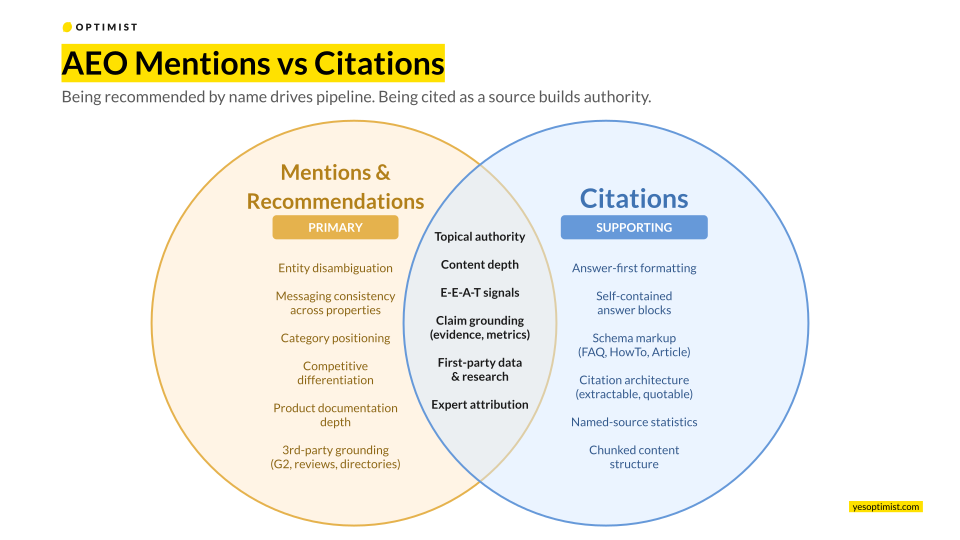
One big difference between SEO and AEO is that AEO is really two different strategies with two different goals.
Strategy 1: Brand mentions and recommendations. The goal is to increase the frequency and accuracy of your brand appearing in AI-generated answers. When a prospective customer asks Claude, “who’s the best AEO agency for B2B SaaS companies?” we want Optimist brand on the list.
And we want those recommendations to include our preferred messaging and positioning.
Strategy 2: Citations. The goal is to increase the frequency of actual links to your content as sources within AI responses. Citations don’t necessarily have a high click-through rate, but they increase visibility and can drive referral traffic directly from LLMs.
But here’s where it gets tricky.
AEO strategies for increasing brand mentions do not necessarily increase citations – and vice versa.
A complete AEO strategy accounts for both.
How LLMs Decide Which Brands to Recommend
Brand recommendations are the highest-value outcome of AEO.
When a buyer asks “what’s the best X for Y,” the brands that appear in the response get considered before the buyer ever opens Google or visits a competitor.
LLMs don’t have a ranking algorithm. They have a confidence model. The question the model is effectively answering isn’t “which page ranks highest?” It’s “based on everything I know about this category, which brands can I confidently recommend for this specific use case?”
That confidence comes from a few inputs:
How clearly the brand is defined in the model’s training data. Every piece of content on the web that mentions the brand contributes to the model’s entity graph. If the brand is described consistently across its own site, review platforms, press coverage, and community discussions, the model builds a strong, clear picture.
If the brand describes itself differently everywhere, the model hedges or gets it wrong.
Whether trusted third-party sources validate the brand. LLMs weigh independent sources to validate self-reported claims. A G2 review that says “Optimist helped us build an AEO strategy that increased AI visibility by 3x” carries more weight than Optimist’s homepage saying the same thing.
Clutch profiles, Reddit threads, editorial coverage, case study mentions on client sites — these are the signals that give the model confidence to recommend.
How strongly the brand is associated with the right category. Models organize brands into categories. If you’re an AEO agency but your website mostly talks about “content marketing” and “brand storytelling,” the model files you in the wrong category. When someone asks for AEO agency recommendations, you don’t surface.
Category association is built through explicit, repeated claims across multiple sources: Site copy, directory listings, social profiles, guest posts, podcast descriptions.
Whether the brand has content that directly answers the question being asked. If a buyer asks “who’s the best AEO agency for B2B SaaS” and your site has a page that explicitly addresses AEO for B2B SaaS companies — with named clients, specific results, and clear methodology — the model has material to draw from.
If your site talks about AEO in general terms without connecting it to B2B SaaS specifically, you lose to a competitor who made that connection explicit.
The volume and recency of brand signals. Models notice when a brand is actively discussed.
Recent blog posts, fresh reviews, current case studies, and recent mentions in industry conversations all signal that a brand is active and relevant. A brand that was prominent two years ago but has gone quiet will fade from recommendations over time.
The practical implication: Brand recommendations are influenceable.
Most companies treat AI recommendations as a total black box. They’re not. Every piece of content, every directory listing, every review, and every consistent brand reference is a signal that either builds or erodes the model’s confidence in recommending you.
It’s not possible to say, “do X and your recommendation rate will increase Y%.” But we can target the factors that we know tend to correlate with higher frequency of brand mentions.
We’ve seen clients go from zero AI mentions to consistent recommendations across three or more models within 8-12 weeks. Not by gaming the system. By closing the gaps between what they actually do and what the AI models could confidently say about them.
How LLMs Select Sources to Cite
The qualities that make content rank well in Google are not the same qualities that make content citable by AI.
AI models don’t rank pages.
They synthesize answers from content they trust, then cite the sources that most clearly supported their response. That is a different selection mechanism than Google’s ranking algorithm, and it catches a lot of teams off guard.
What makes content “citable” to an AI model:
- Clarity of claims: Specific, verifiable statements rather than vague assertions
- Specificity of evidence: Named companies, dollar amounts, percentages, timeframes
- Structural extractability: Content organized so a passage can be pulled out and still make sense on its own
- Authority signals: Expert credentials, institutional backing, first-party data
- Recency: Content with visible, recent update dates gets cited more frequently than older content
There is also an important distinction between being in an LLM’s training data and being cited through real-time retrieval (RAG).
Training data shapes the model’s general knowledge (it’s why ChatGPT “knows” about established brands even without browsing).
RAG is how models like Perplexity and ChatGPT with browsing pull current information from the web to answer specific questions.
And each model does this differently.
Perplexity’s real-time web retrieval is aggressive and source-heavy, ChatGPT’s browsing mode is more selective, and Google AI Overviews pull from their own search index.
AEO is about optimizing for visibility across all AI surfaces, which also means it’s built on foundational SEO that can improve visibility and citation likelihood.
The first time we audited a client’s AI visibility across all five major models, the results were jarring. They ranked on page one for 40+ keywords in Google and were completely invisible in ChatGPT and Perplexity.
Their content was thorough but written in long narrative blocks with no extractable claims, no named statistics, and brand references buried in first-person language.
The information was there. The AI just couldn’t use it.
The GEO Citation Signals (Princeton Research)
Research from Princeton’s Department of Computer Science provides the most rigorous data on what makes content more visible in AI-generated responses. The GEO study by Aggarwal et al., published at KDD 2024, tested specific content optimization strategies and measured their impact on generative engine visibility:
- Statistics with named sources increased AI visibility by up to 22%
- Expert quotes with attribution increased AI visibility by up to 37%
- Citations and source references increased AI visibility by up to 40%
In practice, this means a paragraph that states “According to Gartner, traditional search volume will drop 25% by 2026” is far more likely to be cited by an AI model than one that says “search volume is expected to decline.”
The specificity and source attribution give the model confidence to reference the claim.
Entity Disambiguation
AI models build entity graphs from content.
Entity graphs are an internal map of what a brand is, what it does, what category it belongs to, and how it relates to competitors and customers.
If a brand’s information is inconsistent, fragmented, or ambiguous across the web, models cannot confidently associate that brand with the right categories, claims, and recommendations.
The most common version of this we see in audits: A company calls itself three different things across its homepage, G2 profile, and LinkedIn page.
The AI model has no idea which one is right, so it either picks the wrong one or hedges with something vague. This is fixable, but most companies don’t realize it’s happening.
Entity disambiguation in AEO means:
- Third-person brand references: “Optimist provides AEO and SEO consulting” rather than “We provide AEO and SEO consulting.” Every page should be extractable by an AI model without ambiguity about who is being described.
- Consistent entity naming: Use the exact same brand name, product names, and category terms every time. Alternating between “the platform,” “the tool,” “our solution,” and the actual product name creates noise in the entity graph.
- Explicit category claims: State what the entity IS directly. “Optimist is an AEO and SEO consultancy for B2B technology companies” is extractable. Implying category membership through context is not.
- Parallel construction for differentiation: “Optimist focuses on pipeline generation. Traditional content agencies focus on traffic volume.” Clean, extractable comparison signals.
Content Structure for AI Extraction
AI models extract and cite content at the passage level, not the page level. This means content structure determines whether a page gets cited, regardless of how good the underlying information is.
Answer-first formatting places a direct answer in 40 words or fewer near the top of each section. Based on Optimist’s analysis of client content performance, short, self-contained answer blocks consistently outperform longer passages for AI citation on direct questions, often by a wide margin.
Self-contained answer blocks are passages that make complete sense if extracted out of context. No “as mentioned above,” no pronoun references to other sections, no meaning that depends on surrounding paragraphs.
Content chunking means each section functions as a standalone piece. Clear topic sentences, no cross-section dependencies, and headers that describe the content rather than tease it. “How AEO Changes Content Strategy for B2B Brands” works. “The Next Frontier” does not.
SEO vs AEO: Complementary, Not Competing
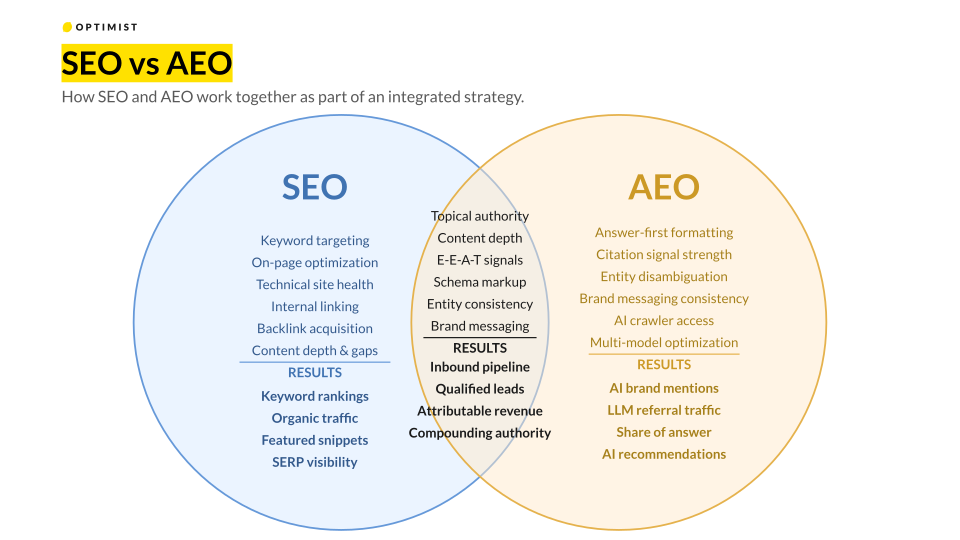
AEO does not replace SEO.
But the relationship between the two is more specific than “they work together.”
Strong SEO does not automatically translate to AI visibility.
According to Ahrefs’ 2025 AI search overlap study, only 12% of URLs cited by ChatGPT, Perplexity, and Copilot rank in Google’s top 10 search results for the same query.
AEO requires additional, specific optimization on top of that SEO foundation.
But AEO without SEO is incomplete.
Without the content foundation that SEO builds (topical coverage, authority, depth), there is nothing for AI models to cite. SEO ensures that content exists and has authority in the first place. AEO makes existing content extractable and citable.
This is why Optimist built the Complete Organic Revenue Engine (CORE) Framework.
CORE is a single methodology that optimizes for both AEO and SEO. Well-structured content that earns AI citations also tends to rank better in search. Grounded claims that AI models trust enough to recommend also build the authority signals that search algorithms reward.
Optimist’s CORE Framework: AEO + SEO at Every Funnel Stage
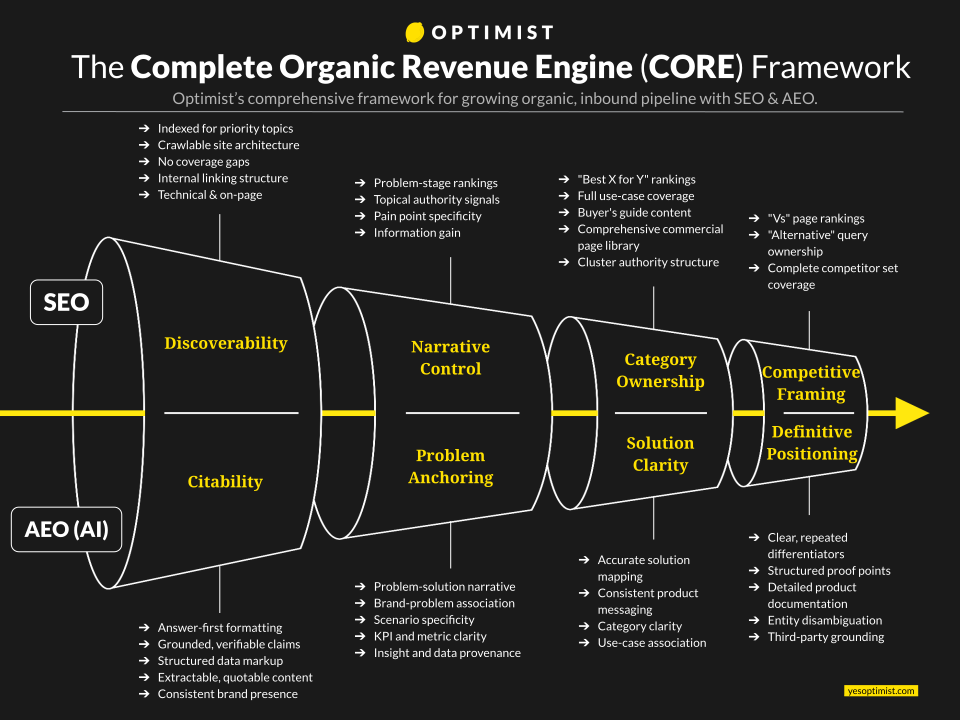
Most AEO content presents the discipline as a flat set of tactics.
Structure your content.
Add schema.
Include statistics.
But AEO is not a checklist. It is a strategic discipline that maps to the buyer journey, with distinct objectives at every stage.
Optimist’s CORE Framework maps SEO and AEO objectives to each funnel stage. Gaps on either side mean lost pipeline. Opportunities where you’re either missing entirely from the conversions or you’re misrepresented.
| Funnel Stage | SEO Objective | AEO Objective | What Happens If You Miss It |
| Pre-Funnel | Discoverability | Citability | You do not exist in either channel |
| TOFU | Narrative Control | Problem Anchoring | Competitors define the problem and the solution criteria |
| MOFU | Category Ownership | Solution Clarity | AI models cannot confidently link your solution to the buyer’s problem |
| BOFU | Competitive Framing | Definitive Positioning | AI recommends competitors in head-to-head evaluations |
Pre-Funnel: Discoverability + Citability. Content must be indexable and ranking (SEO) and structured for extraction (AEO). Without discoverability, you do not exist in search. Without citability, you do not exist in AI-generated answers. These are the baseline conditions, and the number of companies that fail at this stage is higher than you’d expect.
TOFU: Narrative Control + Problem Anchoring. This is where the compounding effect starts. Ranking for problem-stage queries (SEO) shapes how buyers frame the challenge — that’s narrative control. AEO takes it further: It ensures AI models anchor your brand to the problem space itself. When someone asks an LLM “why is content marketing not generating pipeline,” your brand and perspective should be part of the answer. If they’re not, a competitor is framing both the problem and the solution criteria.
MOFU: Category Ownership + Solution Clarity. This is where most B2B companies lose pipeline without realizing it. The SEO side is straightforward., Build category-level content coverage so your brand owns the conversation across relevant keyword clusters. The AEO side is trickier. If your messaging is fragmented across your site, AI models cannot confidently link your solution to the buyer’s problem. They hedge, they equivocate, or they just recommend someone with clearer positioning.
BOFU: Competitive Framing + Definitive Positioning. The bottom of the funnel is where AEO gets ruthless. SEO owns comparison and decision-stage content in search (reviews, “vs” pages, case studies). AEO ensures AI models can accurately articulate what makes your product different when buyers ask for direct recommendations. If those details do not exist or are not consistent across the web, someone else’s positioning fills the gap. By this stage, the buyer is making a decision, not exploring options.
There is no AEO shortcut.
The companies winning are the ones that already did the hard SEO work (content depth, topical authority, real expertise) and then made that content extractable.
Measuring AEO: Metrics That Matter
AEO-Specific Metrics
Share of Model Response measures how often a brand appears when AI models answer relevant buyer queries. This is the AEO equivalent of share of voice in traditional search. Track it by running a library of buyer-relevant prompts through AI models and measuring the percentage that mention the brand. In practice, this is the number that makes marketing leaders uncomfortable. Most B2B brands show up in fewer than 20% of relevant AI responses, even when they rank well in Google.
Brand mention rate by model tracks how often a brand is named across ChatGPT, Claude, Perplexity, Gemini, and Google AI Overviews independently. Performance varies widely across models, and diagnosing which models underrepresent a brand reveals where the optimization gaps are. We have seen brands that are well-represented in Perplexity but completely absent from ChatGPT, or vice versa. Each model has different retrieval patterns, and treating them as a monolith leads to blind spots.
Brand accuracy measures whether AI models describe the brand correctly when they do mention it. Right category, right features, right positioning, right competitive context. A brand that gets mentioned but misrepresented can do more damage than one that is not mentioned at all. This is the metric that usually generates the most urgent action. Nothing motivates a CMO faster than seeing an AI model describe their company using a competitor’s positioning language.
AI-referred traffic and conversions are trackable in GA4 using referral source identification for chatgpt.com, perplexity.ai, and other AI platform domains. Most companies are surprised to find they already have AI referral traffic; they just never segmented it out of “direct” or “other” in GA4.
LLM-sourced pipeline and revenue connects AI-referred conversions to CRM pipeline data. This is the metric that turns AEO from a visibility exercise into a revenue channel. It’s also the one that gets budget approved for year two.
How to Benchmark AEO Performance
Effective AEO measurement starts with an AEO prompt library: A set of synthetic buyer prompts mapped to topic clusters and weighted toward the middle and bottom of the funnel, where AI recommendations have the most impact on purchase decisions.
Each prompt gets tested across AI models (ChatGPT, Claude, Perplexity, Gemini, Google AI Overviews).
For every response, capture whether the brand is mentioned, how it is described, whether specific content is cited, and what competitors appear.
AEO has a faster feedback loop than SEO. Structural content changes typically show up in AI within a matter of hours. Many teams choose to benchmark their AEO performance daily, although weekly reports are probably a cleaner signal.
Optimist’s CORE Analysis benchmarks brand visibility, accuracy, and citation patterns across all five models, then maps findings to the CORE Framework by funnel stage to identify exactly where missing pipeline is occurring.
AEO in Action: Real Results from B2B Companies
Here is what happens when B2B companies implement AEO as a pipeline discipline with a structured methodology.
49x Growth in LLM Referral Revenue (B2B Technology)
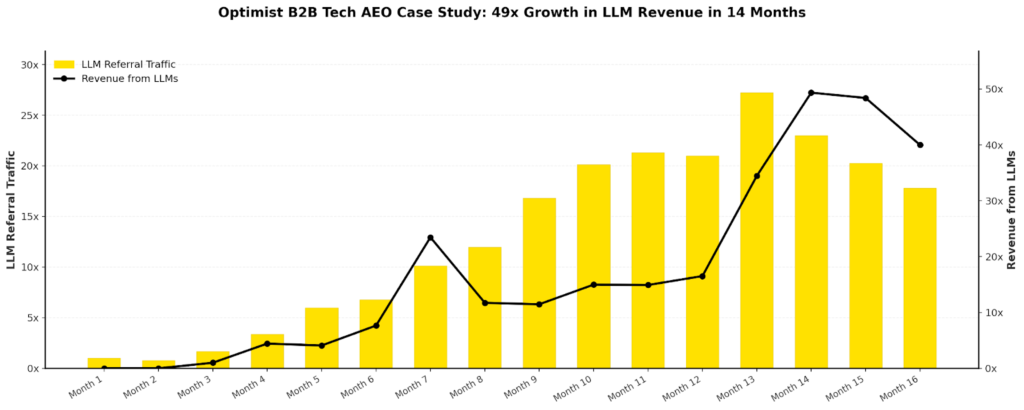
A large B2B technology company engaged Optimist for a 14-month AEO program. The strategy focused on a content structure and citability overhaul across their entire content catalog, SME authority signaling to strengthen entity credibility, and a first-party data program built on proprietary research.
Result: 49x growth in LLM referral revenue (a 4,900% increase) and 26x growth in LLM referral traffic. The brand shifted from ranking in search to being actively discovered and recommended by ChatGPT, Perplexity, and Claude.
8x LLM Conversions in 8 Months (Fintech)
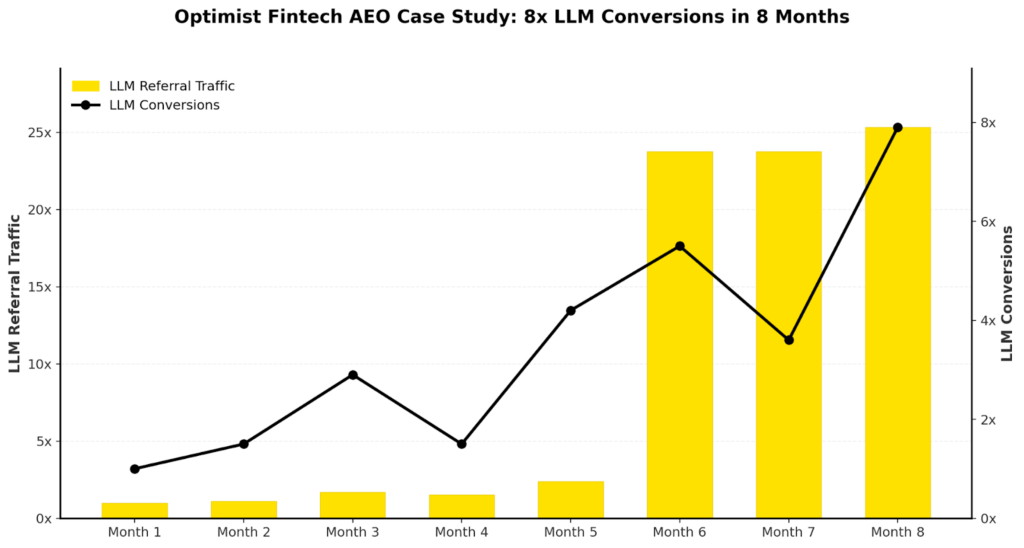
A fintech company used a problem-space expansion AEO strategy. Instead of optimizing for narrow product queries, Optimist mapped the full set of jobs to be done in the buyer’s workflow and built problem-to-solution-to-product throughlines.
Technical on-page AEO was applied to every piece of content.
Result: 8x growth in LLM conversions and 25x growth in LLM referral traffic within 8 months. The company expanded AI visibility from narrow product queries to the full upstream problem space that converted into actual product sign ups and demo requests.
13x LLM-Sourced Revenue Year Over Year (Retail)
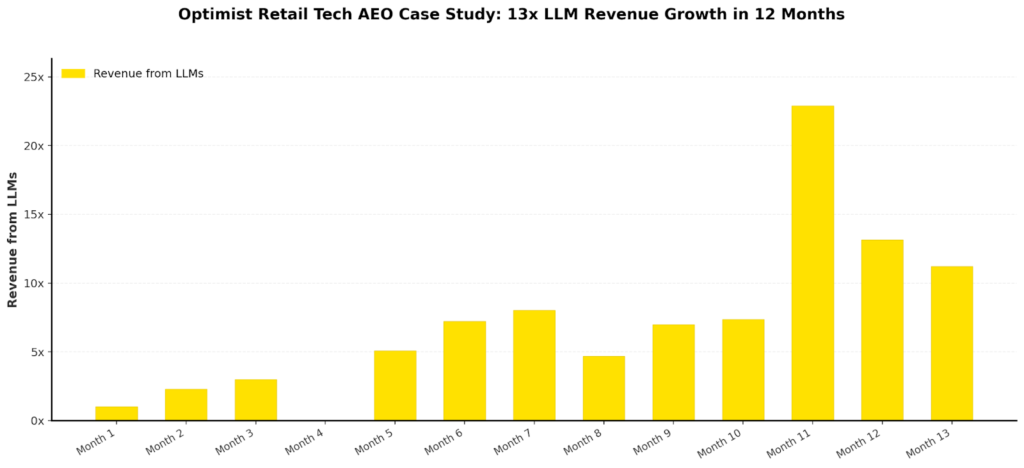
A retail company pursued a category-capture AEO strategy, owning category-level queries with structured Q&A content and schema markup.
Result: 13x increase in LLM-sourced revenue year over year. The product went from invisible in AI responses to consistently recommended in relevant category contexts across ChatGPT, Perplexity, and Claude.
These AEO case studies did not come from isolated AEO tactics. Each engagement applied a 4-layer optimization model across the full content catalog, integrated AEO with existing SEO programs, and measured outcomes at the pipeline level.
The integrated approach also produces proof on the SEO side.
Optimist’s CORE Framework is built on the same foundation used to drive 5x inbound pipeline growth for Stampli and 14x product signups for Glide.
Getting Started with AEO
AEO Readiness Checklist
A quick self-assessment for B2B marketing leaders evaluating where to start:
- Do you know how AI models currently describe your brand? If not, run an AEO benchmark. Ask ChatGPT, Perplexity, and Gemini about your product category and see whether your brand appears, and whether the description is accurate.
- Is your content structured for AI extraction? Answer-first formatting, self-contained sections, entity-clear language. Most content written for SEO alone is not structured for AI citation.
- Do you have schema markup on your key pages? Article, FAQ, and Organization schema at minimum.
- Is your brand positioning consistent across your site and third-party mentions? Check your homepage, service pages, G2 profile, and LinkedIn company page. If the category language differs across those properties, AI models are averaging conflicting signals.
- Are you measuring AI-referred traffic and conversions? Set up referral source tracking in GA4 for chatgpt.com, perplexity.ai, and other AI domains.
AEO for Companies Already Doing SEO
If a B2B company already has a strong SEO program, it is already partway to AEO readiness. The content foundation exists. The topical coverage is there. The authority signals are in place.
The gap is typically in three areas:
- Content structure: Pages rank well but are not structured for AI extraction. The information is buried in long paragraphs rather than formatted as self-contained, extractable answer blocks.
- Brand consistency: Positioning language varies across pages, third-party profiles, and external mentions. The entity graph is fragmented.
- Measurement: AI-referred traffic and conversions are not being tracked, which means pipeline from AI search is invisible in reporting.
Start with an AEO benchmark to see where the brand stands across AI models, then layer AEO optimization onto existing content using the 4-layer model.
The highest-impact starting point is typically restructuring the 10-20 pages that already have the most authority and topical relevance. For B2B SaaS companies, integrating AEO into an existing SaaS SEO strategy is the fastest path to compounding returns.
The Path to Measurable AI Revenue
You’ve seen the data: 49x growth in LLM referral revenue, 8x LLM conversions, and 13x LLM-sourced revenue are the real outcomes of a strategic AEO program.
The CORE Framework is the single methodology that produced these results by unifying SEO authority and AI citability. If you are still only tracking rankings, you are completely missing visibility into the pipeline you’re losing in critical AI conversations.
Stop guessing whether your brand is being cited correctly or misrepresented by ChatGPT, Gemini, and AI Overviews.
Our CORE Analysis is a unified AEO + SEO diagnostic for B2B technology companies — and the first step in Optimist’s answer engine optimization services. It’s a comprehensive assessment of search opportunity and AI visibility, prioritized by pipeline impact.
It is time to turn AEO from a concept into your most powerful revenue channel.
Schedule your strategy call with Optimist today to learn more about how we can help you take control of your AI visibility and map your path to measurable LLM-referred revenue.
Frequently Asked Questions About AEO
What is answer engine optimization (AEO)?
Answer engine optimization (AEO) is the practice of structuring content so AI platforms like ChatGPT, Perplexity, Gemini, and Google AI Overviews can discover, understand, cite, and recommend a brand when users ask questions. Think of it this way: SEO gets you ranked in a list of links. AEO gets you named or cited in the answer itself. The discipline covers content structure, entity clarity, citation-worthiness, and schema markup.
What is the difference between AEO and SEO?
SEO gets you ranked in Google. AEO gets you cited and recommended by AI answer engines.
They’re not the same thing, and strong SEO doesn’t automatically translate to AI visibility.
According to Ahrefs, only 12% of URLs cited by AI models rank in Google’s top 10 for the same query. The most effective approach integrates both: rank in search AND get cited by AI. That is what Optimist’s CORE Framework does.
Does AEO replace SEO?
No, AEO does not replace SEO. And be skeptical of anyone who says it does. AEO builds on top of SEO foundations. Without well-structured, authoritative content (SEO), there’s nothing for AI models to cite (AEO). Companies that treat them as complementary see compounding returns across both channels. SEO provides the content depth and authority. AEO makes that content extractable and citable.
How do you measure AEO success?
The metrics that matter: Share of Model Response (how often your brand shows up in AI answers), brand mention rate by model, brand accuracy (is the AI describing you correctly?), AI-referred traffic and conversions, and LLM-sourced pipeline and revenue. The last one is what separates AEO-as-visibility-exercise from AEO-as-pipeline-channel. Benchmark across five models (ChatGPT, Claude, Perplexity, Gemini, AI Overviews) and connect mentions to downstream pipeline.
Is AEO the same as GEO?
AEO (Answer Engine Optimization) and GEO (Generative Engine Optimization) refer to the same discipline. Both describe the practice of optimizing content for AI-powered search and answer platforms so that a brand is accurately cited and recommended in AI-generated responses.
How long does AEO take to show results?
Faster than SEO. Structural content changes typically show up in AI citation patterns within days or even hours. The caveat: building a full AEO program that drives meaningful pipeline takes 3-6 months of sustained effort across content, structured data, and brand consistency. Optimist’s case studies show significant revenue impact within 8-14 months. Anyone promising overnight AEO results is selling something that doesn’t exist or measuring only microscopic effects versus systemic increases in AI visibility.
Is AEO necessary for B2B companies right now, or is it too early to invest?
AEO is already delivering measurable results for B2B companies that invest early, and the competitive advantage window is narrowing. With 89% of B2B buyers using AI tools for research, companies without AEO strategies are invisible in a growing share of buyer discovery.
Optimist’s AEO clients have documented 49x LLM referral revenue growth, 8x LLM conversions, and 13x LLM-sourced revenue, all within 8-14 months. Early movers are building citation authority that becomes harder for competitors to displace over time.
How do you optimize content to appear in Google AI Overviews and Perplexity results?
Google AI Overviews favor content with clear, concise answers positioned early in the page, supported by authoritative sourcing and structured data.
Perplexity prioritizes well-cited, recent content from crawlable domains. Both reward content that provides information gain beyond what competitors offer.
Optimist’s AEO methodology (The CORE Framework) addresses both platforms through structured content, schema markup, and citability optimization. This approach drove 13x LLM-sourced revenue for a retail tech client and 8x LLM conversions for a fintech client.
