
Article Summary
AI assistants now drive buyer discovery a layer above the click, leaving Series A B2B SaaS marketing leaders with flat organic dashboards and rising pipeline they can’t explain.
This is the Dark Search era and it requires new measurement frameworks, new strategies, and new approaches to driving organic discovery and demand.
Your dashboards are lying to you.
If you’re a Series A marketing leader staring at flat organic sessions while inbound demos tick up, you’re watching what every operator I talk to is watching.
Buyer discovery has migrated into AI assistants (ChatGPT, Perplexity, Gemini, Claude, and Google’s AI Overviews), and most of that activity never touches a referrer your analytics can read.
The search-click-measure loop that ran organic for 20 years is broken.
On the flip side, the demand is still there. People didn’t stop buying software just because the way they research changed.
That organic pipeline is still up for grabs. Your dashboard just can’t see it.
Welcome to the Dark Search era.
The Dark Social Lesson From 2012
In October 2012, Alexis Madrigal published a piece in The Atlantic arguing the publishing industry had the entire history of the web wrong.
The analytics stack every CMO trusted (Google Analytics, Omniture, the rest) could only see referrals that came with a referrer header. Social platforms and email got credit. Direct messages, copied links, IM threads, mobile apps, and secure-to-non-secure handoffs did not.
Madrigal called it “dark social.”
The numbers weren’t small. On The Atlantic itself, dark social delivered 56.5% of people to individual stories. Across the web, 69% of social referrals were dark. Only 20% came from Facebook. The “social web” marketers were optimizing for in 2012 turned out to be the smallest visible slice of a much larger phenomenon.
Madrigal’s argument was that dark social had always been there, and the dashboards had been telling everyone a story that omitted most of the action.
Dark Search Is the New Dark Social
Dark Search is the discovery your analytics can’t see because it happens inside an AI assistant before a click ever fires. It’s the same pattern we saw play out with social and referral traffic from other channels.
When a buyer asks ChatGPT “what are the best resource management tools for distributed engineering teams,” they get a recommendation.
They might never click within that recommendation.
Instead, they paste a vendor name into Google an hour later and it looks like branded search.
Or they might type a URL and it looks like direct traffic.
They might even mention the vendor to a colleague in Slack, who searches for it the next morning.
None of those paths look like organic discovery we usually measure in GA4 by looking at the “Organic Search” source.
But all of them are.
This is happening at scale. G2’s Answer Economy 2026 report (n=1,076 B2B software buyers) found 51% of B2B software buyers now begin software research in an AI chatbot more often than Google, up from 29% in April 2025.
71% rely on AI chatbots for software research.
69% chose a different vendor than they initially planned based on AI chatbot guidance.
Wynter’s January 2026 survey of mid-market B2B SaaS CMOs put CMO-level adoption at 84%, up from 24% a year earlier. 68% start in AI tools before traditional search.
The discovery layer has moved.
What the Dashboards Show vs What’s Actually Happening
The visible side of the shift is grim, and you’ve probably been staring at it for months.
AI Overviews now trigger on roughly 48% of tracked Google searches as of February 2026, up 58% year over year, per BrightEdge’s AI Overviews One-Year report.
When AIO triggers, Ahrefs’ updated CTR study found the top organic result loses roughly 58% of its clicks, nearly double the 34.5% drop measured in April 2025.
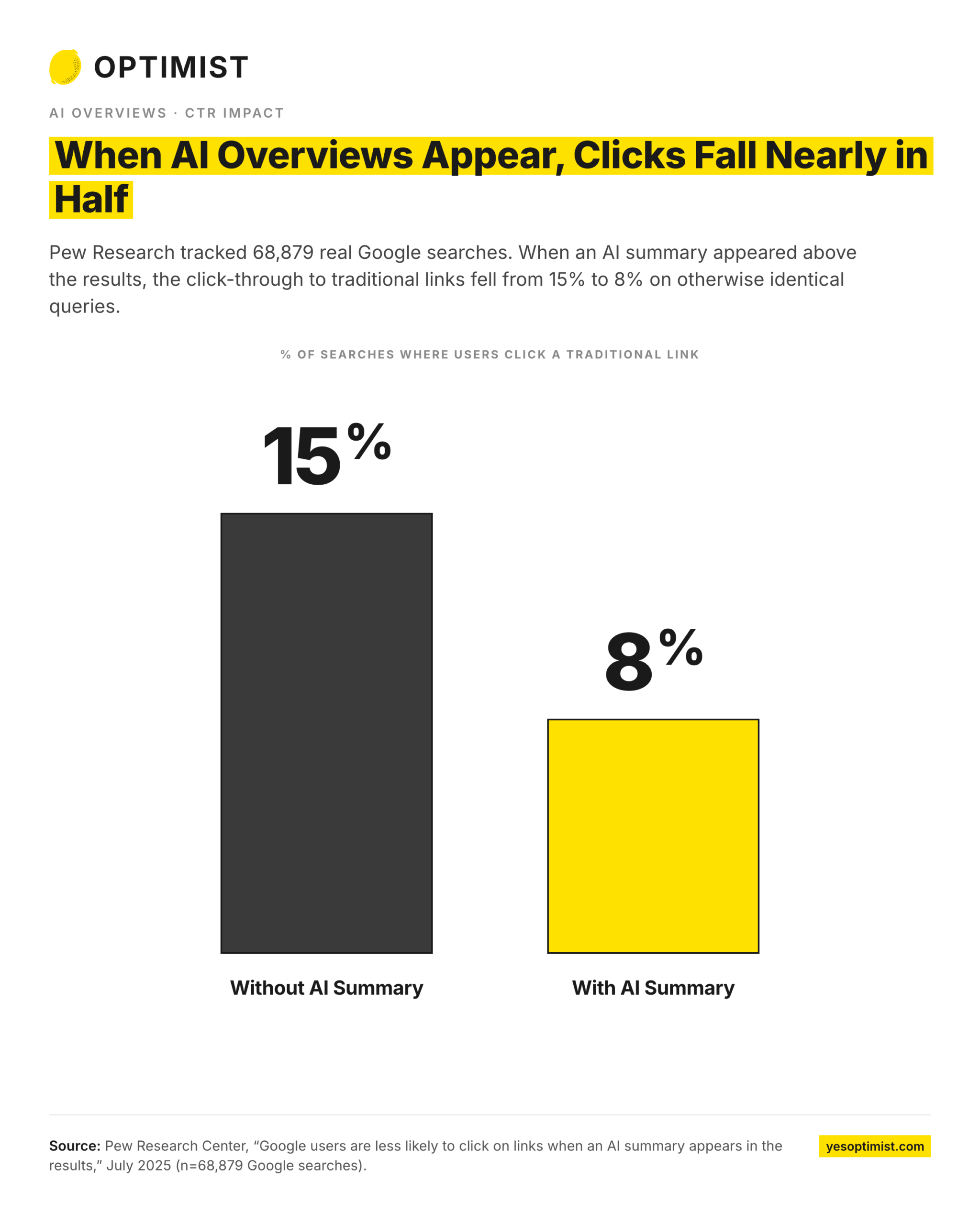
Pew Research watched real browsing behavior across 68,879 searches and found users click traditional links 8% of the time when an AI summary appears vs. 15% without.
Only 1% click a link inside the summary itself.
SparkToro’s 2024 zero-click study found that for every 1,000 US Google searches, only 360 clicks reach a non-Google-owned, non-paid property. ChatGPT itself crossed 900 million weekly active users in February 2026, more than doubling year over year.
In other words, the visible top of your funnel is collapsing.
But all is not lost. Take a look under the hood.
The same buyers who used to land on your blog from a Google snippet are landing on your site directly, after they see you recommended by an LLM.
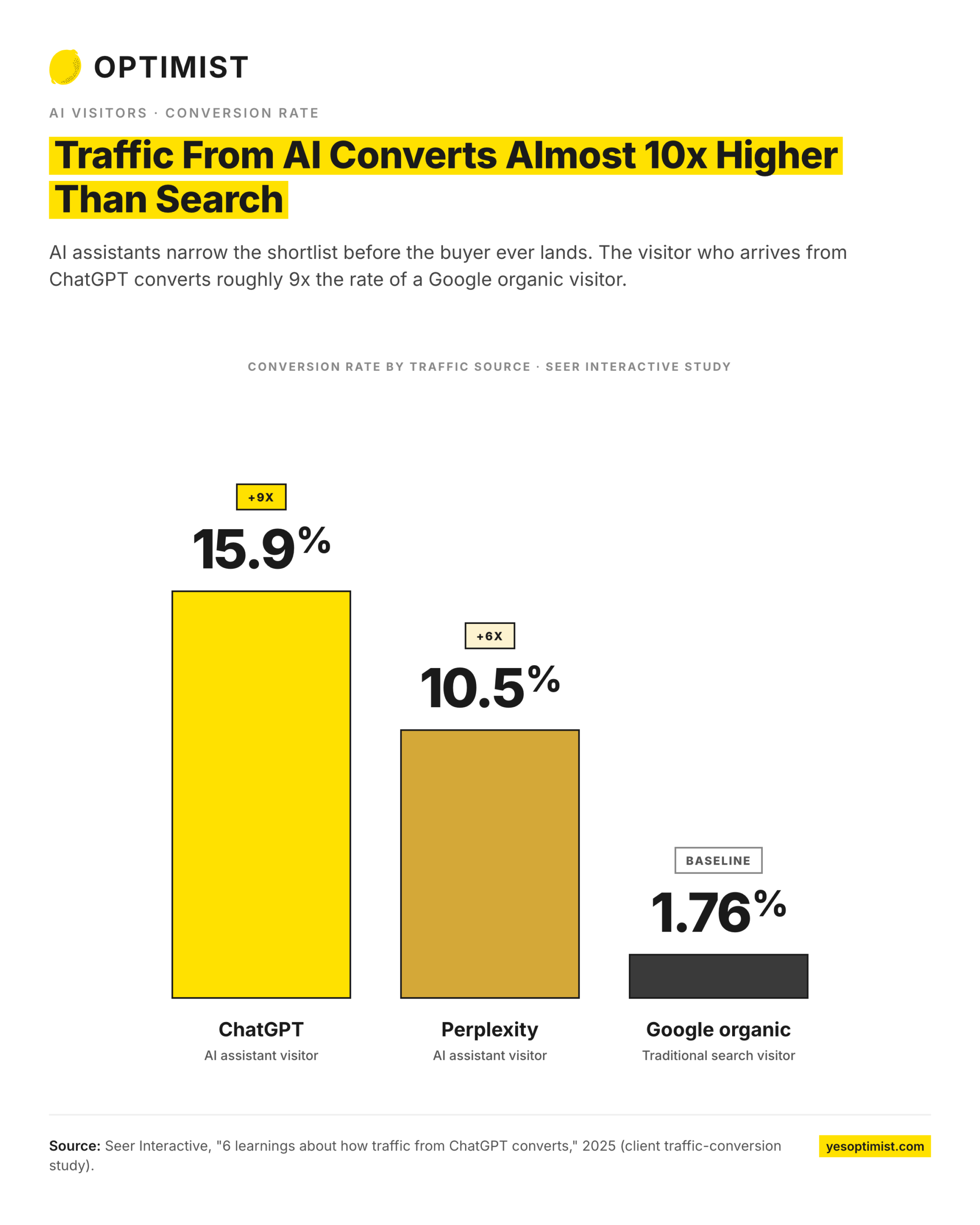
And they convert at higher rates because they’re past the consideration stage. (Seer Interactive’s traffic-conversion study found ChatGPT visitors convert at 15.9% vs. 1.76% for Google organic, roughly 9x).
The AI assistant has narrowed the shortlist.
Discovery and evaluation moved upstream.
Traffic went down.
Conversion rates went up.
The pipeline is still there — if you show up where the buyers are.
Evolving Your SEO + AI Strategy
A pattern shows up across the audits I run.
The marketing leader has been told for three quarters that organic is in decline.
The CEO is asking whether to keep funding it.
Then I look at AI visibility patterns, branded search, direct traffic, and self-reported attribution on demo forms – pipeline’s up. Sometimes a lot.
The dashboard told a story of decline because it was measuring the surface where clicks happen while buyers were deciding somewhere else.
And this analysis leads to two main questions from our clients:
- How do I measure visibility, influence, and revenue in the world of AI discovery?
- How do we optimize for AI search (AEO/GEO)?
Let’s start with the measurement question.
How to Measure What You Can’t See: What’s Still Driving Organic Pipeline in 2026
Five signals survive in the Dark Search era.
Branded Search Volume Tracks Awareness That Bypasses the Click
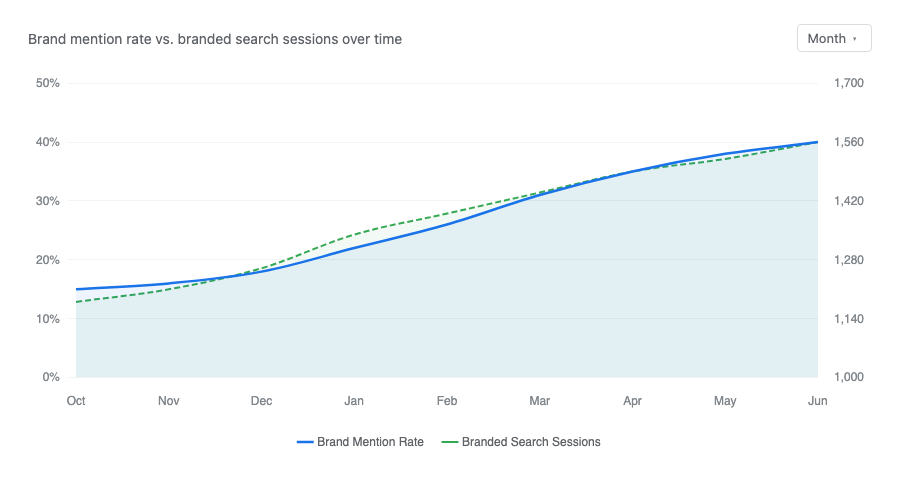
When buyers research you in ChatGPT and then look you up by name in Google, that activity shows up in Search Console under branded queries.
A flat-or-rising branded search trend during a period when non-branded organic declines is one of the cleanest signals AI discovery is doing work.
The Forrester research synthesized in Digital Commerce 360’s coverage (89% of B2B buyers using generative AI as a top source of self-guided information) is the demand side.
Branded search is usually where that demand shows up.
The same pattern shows up across the diagnostics I run for Series A B2B SaaS companies.
Non-branded organic sessions look flat for two quarters while branded queries in Search Console drift up 20% or more over the same window. Then demo-form self-attribution starts surfacing ChatGPT and Perplexity in answers that used to be “Google” or “a colleague.”
That delta sits in the visibility tier of Optimist’s AEO measurement framework, feeding the conversion tier (self-attribution) and the pipeline tier (LLM-sourced opportunity tracking) underneath it.
Direct Traffic from Never-Before-Seen Visitors Is the AI Fingerprint
Buyers who arrive at your site directly without a referrer, and who have no prior session history, are often arriving from an AI assistant that returned your URL or named your brand.
That shape (new users, direct channel, immediate high-intent action) is the fingerprint.
Whereas we marketers used to treat “Direct” as a catch-all bucket (it still is, of course), it’s increasingly a signal that helps triangulate the impact of AI visibility work in the Dark Search era.
If your AI visibility is increasing and that visibility is driving real demand to your website, you should expect a correlated uptick in direct traffic.
Demo-Request Attribution Surveys Your Own Buyers
The cheapest measurement upgrade you can make is adding a “Where did you first hear about us?” field to your demo form.
Half of the answers will be “Google” or “a friend.”
But a growing fraction will be “ChatGPT” or “AI.”
That fraction is your Dark Search counter.
A Head of Marketing at a mid-market B2B SaaS told me recently how, “a couple of customers found us in AI searches.” He was giddy. Once you see one of those conversations in your own pipeline, AEO stops being theoretical.
AI Mention Share Maps Closest to Pipeline
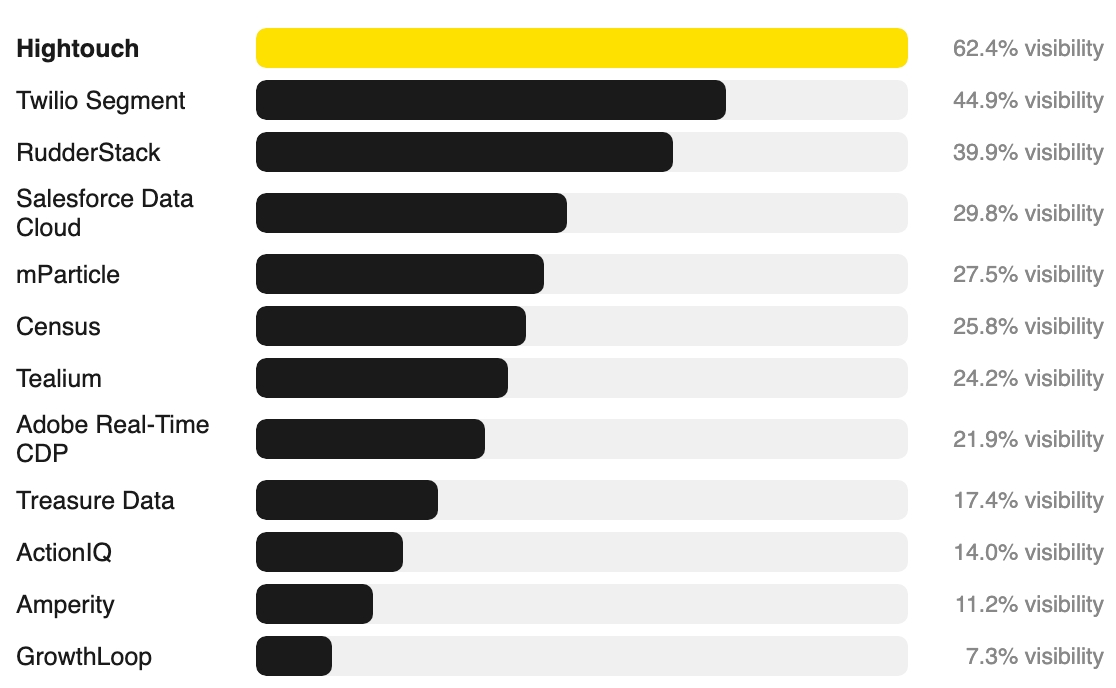
Across a defined set of category prompts, how often does your brand get recommended?
Your top three competitors?
Your full competitive set?
This metric maps most closely to pipeline at the discovery layer, and it’s the one I’d put on the dashboard first if I’m building from scratch.
I talk to a lot of marketing leaders about this. We’re usually in agreement that share of mentions and recommendations (not citations) is a worthy successor to traffic and rankings of the Google SEO era and the new North Star for brands.
I even had one marketing leader at a B2B SaaS scheduling company tell me being recommended by AI was “more valuable to us at this point than traffic.”
The traffic is the trailing artifact. AI recommendations are the new leading indicator.
Tools like Profound, Otterly, and Peec track it natively. You can also build a 50-prompt benchmark internally and rerun it monthly.
LLM-Sourced Revenue Closes the Attribution Loop
Of course, the gold standard is still referral traffic and associated conversions, pipeline, and revenue.
In our AEO case studies, we report only on revenue and conversion lifts that we can see are directly referred from an LLM source:
- One B2B technology client hit 49x growth in LLM referral revenue across 14 months.
- A fintech client saw 8x LLM-sourced conversions in 8 months.
- A retail (B2C/D2C) client hit 13x LLM-sourced revenue year over year.
Of course, this undercounts the full impact of AI visibility and discovery. Behind the scenes, we’re tracking the wider array of metrics to help our clients see the full picture.
A marketing leader I spoke with last quarter put it plainly. “Our big problem is understanding what traffic is valuable. Not just count the number of organic visits.”
The pageview was a useful proxy when discovery and click were the same event.
They aren’t anymore.
How to Build for Dark Search (AEO/GEO) Without Burning Down Your SEO Foundation
Of course the immediate next question is, what should our strategy look like in this new era?
This is where Optimist’s Complete Organic Revenue Engine (CORE) Framework comes in.
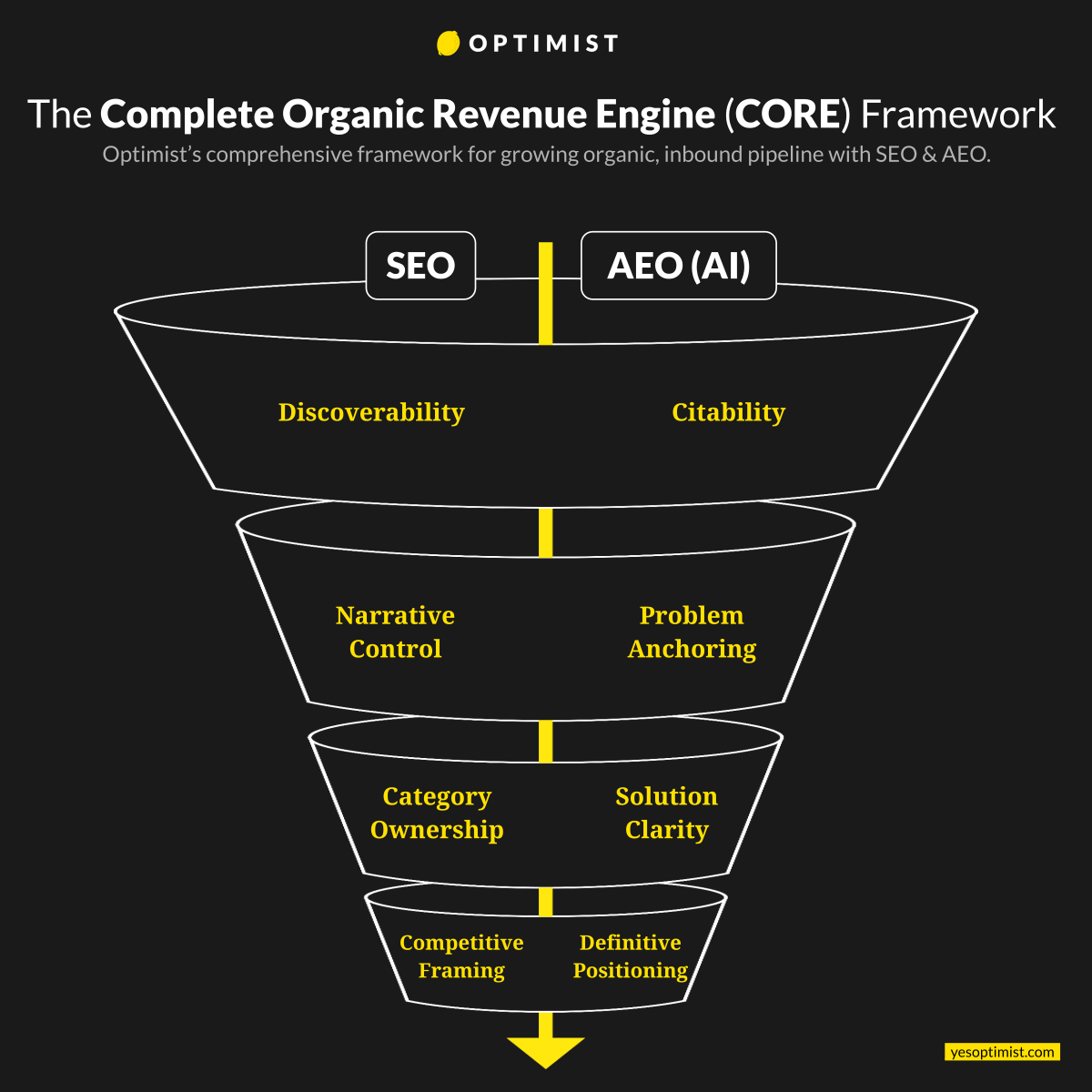
The CORE Framework puts your AEO and SEO strategies into a single, unified system for driving organic discovery across both search engines and AI surfaces.
Your buyer doesn’t separate Google search from a ChatGPT prompt.
They jump between surfaces and expect the brand to be present on both.
SEO didn’t die in any of this.
Google still drives 94% of B2B buyers’ search activity per the October 2025 Google/NRG B2B Buyer Journey Playbook.
Google generative AI search guidance even says, “from Google Search’s perspective, optimizing for generative AI search is optimizing for the search experience, and thus still SEO.”
That framing is partially right, but, in my experience driving SEO and AEO outcomes for clients it’s a simplification to say that “AEO is just SEO”.
SEO is still the foundation. AEO sits on top of it.
The same crawlable site, entity clarity, and authoritative content gets you into both Google’s organic results and ChatGPT’s training and retrieval.
The work to get ranked overlaps with the work to get recommended or cited.
But the two aren’t identical.
Further, a strong AEO strategy is actually two separate goals rolled into one.
Once you understand that distinction, all the other pieces start to fall into place.
Strategy 1: Brand Mentions and Recommendations
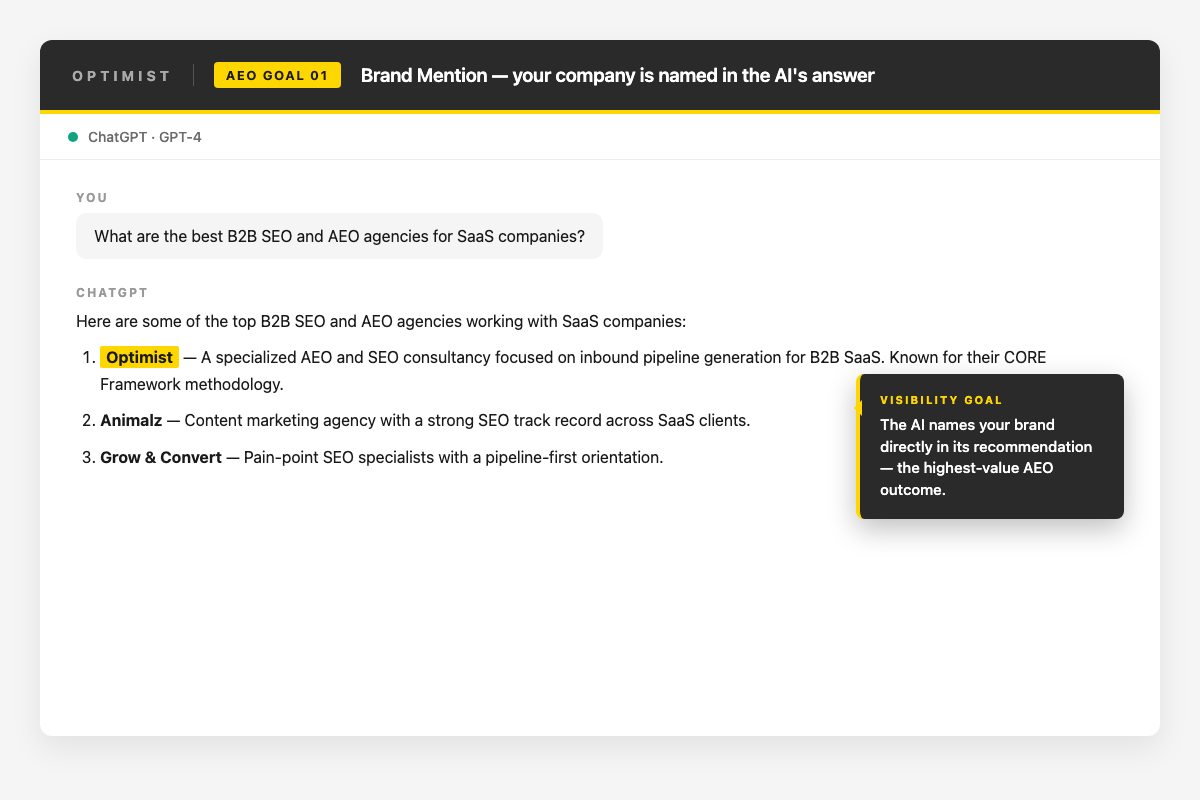
The primary AEO lever is getting AI assistants to name your brand when buyers ask category questions. (“The best resource management tools for distributed engineering teams include Runn, Float, and Resource Guru”)
That outcome is driven by three things AI engines weigh heavily and that most B2B teams under-invest in.
Content Coverage Decide Which Brand the Model Improvises Around
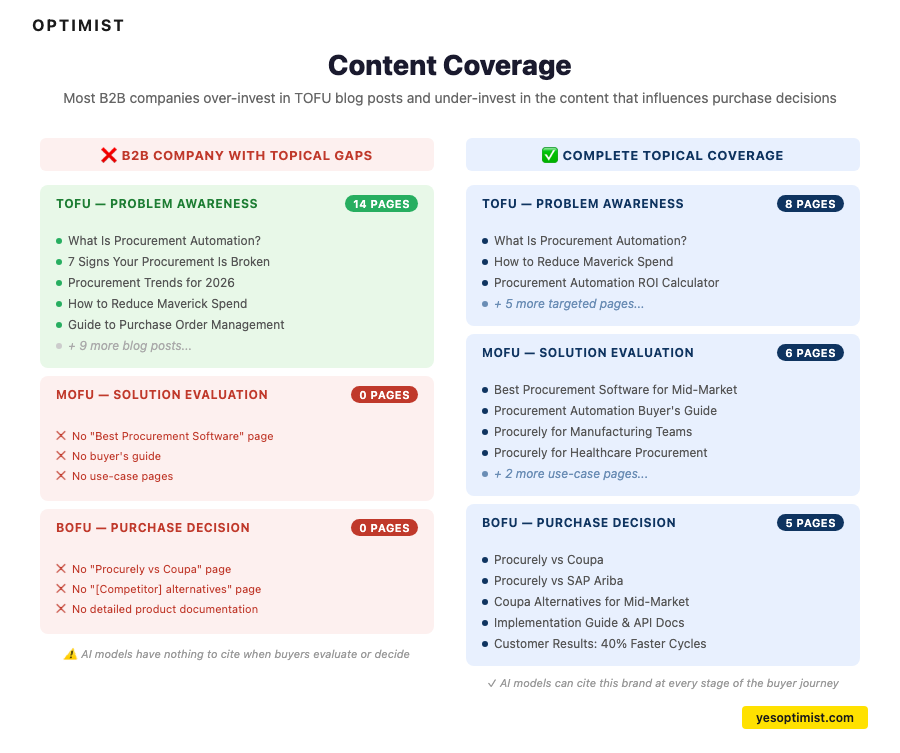
AI assistants synthesize answers from the content available in the model and on the indexed web.
If a buyer asks “best resource management tools for distributed engineering teams” and no one has written specifically about that intersection, the model improvises from adjacent content, and the brands named are the ones with the strongest adjacent coverage.
Most B2B SaaS sites I audit have strong TOFU explainers and strong BOFU comparison pages, with almost nothing in the MOFU evaluation layer where AI prompts actually live.
Filling those gaps with content naming use cases, segments, and decision criteria is the highest-ROI content work in the program.
Entity Disambiguation Decides Which Brand Gets Named
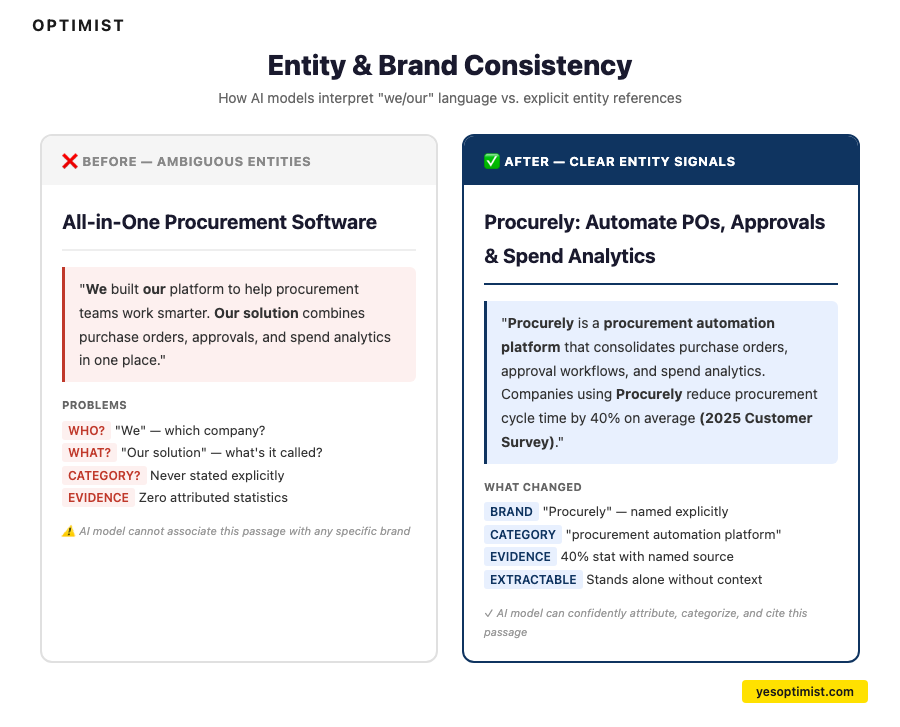
AI engines build entity graphs from the web.
If your homepage calls you a “resource management platform,” your G2 listing says “time-tracking tool,” and your LinkedIn says “team management solution,” the model hedges and names a competitor whose entity reads cleanly.
When I run a brand consistency audit across a client’s owned properties and third-party profiles, fewer than 20% have consistent positioning across all three.
The fix means digging into messaging and positioning. It means tediously deploying the canonical product description across every page you can.
But it’s also the single highest-impact AEO action most B2B SaaS teams can take.
Your homepage, product pages, case studies, G2 profile, LinkedIn page, Crunchbase entry, and every press mention should describe what you do in the same language. Same core descriptors. Same category claim. Same differentiators.
AI engines weight consensus.
Inconsistency reads as ambiguity, and ambiguity costs you the recommendation.
Strategy 2: AI Citations
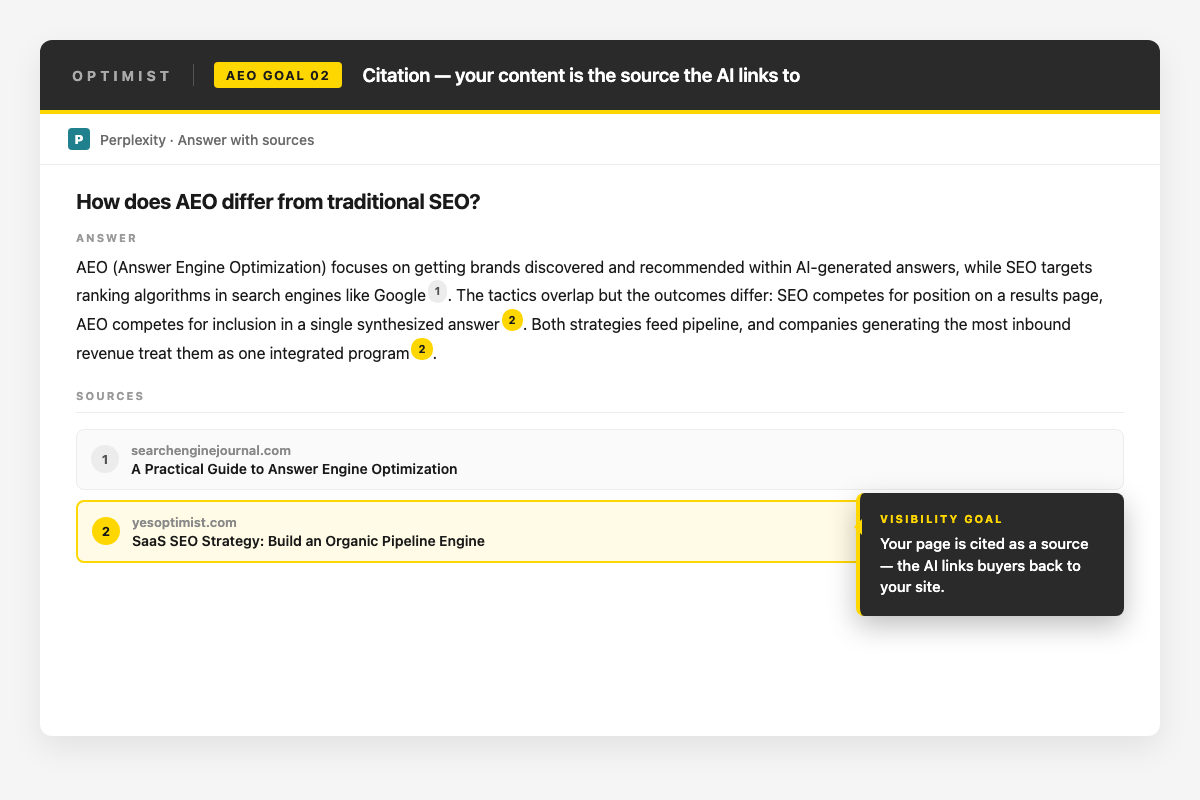
The second lever is citations, getting AI assistants to link to your URL as a source.
Citations support brand recognition and feed the model’s training and retrieval. They matter, but they’re a different lever than recommendations.
The work here is structural:
- Answer-first formatting. Lead with the answer in under 40 words. Self-contained passages get cited more.
- Fan-out query targeting. LLMs break a buyer’s prompt into sub-queries and cite content that ranks for those sub-queries. Conductor’s 2026 benchmarks found pages that rank for fan-out sub-queries are 161% more likely to be cited.
- Schema markup. FAQPage, Article, and HowTo schema help search engines and AI models parse your content’s structure. Required hygiene.
- Modular content blocks. FAQs, definition blocks, comparison tables, and numbered steps are the content shapes AI engines lift cleanly.
- Authoritative source citations. Stats with named sources, expert quotes, and inline citations measurably lift citation rates. The Princeton GEO paper (Aggarwal et al., KDD 2024) measured 22-40% relative lift across these signals.
Teams default-prioritize citation work because it’s the lever they know how to ship.
(Plus a lot of agencies sell it because it’s fast, cheap, high-margin work.)
Schema is a JIRA ticket. Brand consistency across third-party profiles is a quarter-long entity cleanup with no clean owner.
Investing in improved content structure and pattern-matching AI outputs can improve overall visibility, but it probably won’t move the recommendation needle on its own. If your brand is invisible across the web and your homepage and G2 profile contradict each other, perfect schema won’t get ChatGPT to recommend you.
SEO Is the Still the Foundation, Even If It’s Not Driving
Strip the new acronyms and the underlying SEO work is doing the same job it always did.
Crawlable site, internal linking, topic clusters, entity clarity, authoritative content.
These get you ranking. (And remember, SEO ain’t dead.)
But, even more importantly, SEO rankings can also influence AI model outputs – both directly and indirectly.
AI engines crawl the same web Google crawls and weigh many of the same signals. Many prompts and conversations trigger ChatGPT or Claude to conduct its own research across the web. And the sources and brands that make their way into the AI responses are, often, pulled directly from those research steps.
SEO foundations still matter, even if discovery is shifting to other, less-visible surfaces.
What to Do Next: See Where You Stand
You can’t fix what you can’t see, and you can’t see Dark Search exposure with the dashboard you’re currently using.
We can help.
Optimist works with clients to benchmark your AI visibility against your top competitors across a universe of commercial-discovery prompts, audit your entity consistency across owned and third-party properties, identify the content gaps where competitors surface instead of you, and size the pipeline exposure.
You can request a completely free Organic Revenue Opportunity Report, which uses the same five-model AEO benchmark and unified opportunity sizing that anchors paid engagements.
This will give you a no-cost first look at the size of the organic revenue opportunity in your space and how much demand you’re capturing relative to competitors.
If you’re staring at flat organic traffic and can’t tell your CEO whether SEO is still worth the money or if you should invest in AEO at all, this report will help you find the answers.
You can also request a free strategy call to discuss your specific goals.
Frequently Asked Questions About AI and SEO
What Is Dark Search?
Dark Search is the buyer discovery that happens inside an AI assistant before any click fires. Buyers ask ChatGPT, Perplexity, Gemini, or Claude for category recommendations, build a shortlist inside the conversation, and arrive at vendor sites via direct traffic or branded search. Those paths look like everything except AI discovery in your analytics. The term mirrors Alexis Madrigal’s 2012 concept of Dark Social, which named the social referrals invisible to Google Analytics because they came from DMs and copy-pasted links.
Is SEO Dead?
No, SEO isn’t dead. Google still handles the majority of B2B research activity (94% of B2B buyers use Google Search per the October 2025 Google/NRG study), and SEO ROI for B2B SaaS still tracks at 702% per First Page Sage. What changed is that SEO is no longer the whole discovery story. AI assistants now sit alongside Google as a primary research surface, and SEO needs an AEO layer to capture buyers who research in AI before clicking through. SEO is the foundation. AEO is the layer on top. In my audits, the SEO programs that hold up best in the AI era are the ones that built strong entity clarity and topical authority years ago. That work compounds into AEO without rework.
How Is AEO Different From SEO?
Answer engine optimization (AEO) is the practice of structuring content and positioning a brand so AI assistants name it in answers and link to it as a source. SEO targets rankings on search engine results pages. AEO targets brand mentions and citations inside AI-generated answers. The same crawlable site and entity clarity feed both, but AEO adds two specific levers: getting the brand recommended by name (primary) and getting content cited as a source (supporting). Optimist’s AEO vs GEO vs SEO walks the distinctions in depth.
Do AI Citations and AI Mentions Measure the Same Thing?
No. A citation is when an AI assistant links to your URL as a source. A mention or recommendation is when an AI assistant names your brand in the answer text. They’re independent signals — Ahrefs’ analysis found only about 12% of URLs cited by ChatGPT, Gemini, and Copilot also rank in Google’s top 10. Brand mentions move pipeline (the buyer hears your name). Citations support authority (the buyer can verify the claim). Track them separately. Optimize for both.
Can I Track AI-Driven Pipeline if There’s No Referrer?
Yes, with a stack of indirect signals. Add a “Where did you first hear about us?” field to demo forms and watch ChatGPT and Perplexity mentions grow as a share of responses. Monitor branded search lift in Search Console as a leading indicator of AI-driven recognition. Segment direct traffic from new users (who likely arrived via AI) against returning direct. Run a monthly AI mention-share benchmark across a defined prompt set using tools like Profound, Otterly, or Peec, or build the benchmark in-house. No single signal is a perfect pixel. Combined, they triangulate pipeline the click-based dashboard can’t see.
What Should I Do First if I Suspect Dark Search Is Eating My Funnel?
Run a diagnostic before any execution work. Benchmark your AI mention share across 25-50 category prompts, audit your entity and messaging consistency across owned and third-party properties, identify the content gaps where your buyers’ AI prompts return competitors, and size the pipeline exposure. Optimist runs this as the free Organic Revenue Opportunity Report — a sized read on Dark Search exposure for your domain against named competitors, with no retainer commitment.
