
Article Summary
Answer engine optimization (AEO) structures your content, technical setup, and brand presence so platforms like ChatGPT, Google AI Overviews, Perplexity, Gemini, and Copilot mention and cite your brand.
- Why it matters: Over half of B2B buyers now start research in AI chatbots rather than traditional search, and AI referral traffic converts at over 4x the rate of organic search.
- How AI search works: Models use “query fan-out” to run multiple sub-queries. Over 80% of AI citations don’t rank in Google’s top 10 for the user’s initial prompt, but heavily overlap with these sub-query results.
- Key strategy: Combine on-page structure and coverage (The Short Arc) with off-page brand presence and third-party citations (The Long Arc) to build end-to-end visibility.
- Measurement: Track both brand mentions and direct citations over time, tying visibility gains directly to revenue and pipeline outcomes.
Answer engine optimization (AEO) is the practice of structuring content, brand signals, and technical setup so AI platforms can easily discover, digest, and cite your brand.
AEO is focused on improving brand visibility, share of voice, and recommendation rates across AI surfaces like ChatGPT, Google AI Overviews, Perplexity, Gemini, and Microsoft Copilot.
Even if your brand ranks first in Google for a key term, an AI answer might still omit you. AI models run their own web searches before they respond. A model breaks the question into more specific underlying questions and cites the pages that answer those.
Key Answer Engines for B2B AEO
Five AI platforms are generally considered most important for reaching B2B buyers:
- ChatGPT
- Google AI Overviews
- Claude
- Gemini
- Microsoft Copilot
Instead of presenting a page of blue links, each platform generates written responses with a small set of source citations. Google AI Overviews integrates directly into standard search results, so a single query influences both the AI summary and organic links.
Market share in this space shifts quickly. According to Similarweb’s AI search data, ChatGPT’s share of generative AI site visits dropped from 76% in June 2025 to about 53% by May 2026, while Gemini grew to 27%.
Tracking one platform is helpful, but brands really need a full picture to truly understand their AI search visibility.
Why Answer Engine Optimization Matters for B2B Buyer Research
AI chatbots are increasingly replacing traditional search for early-stage B2B research.
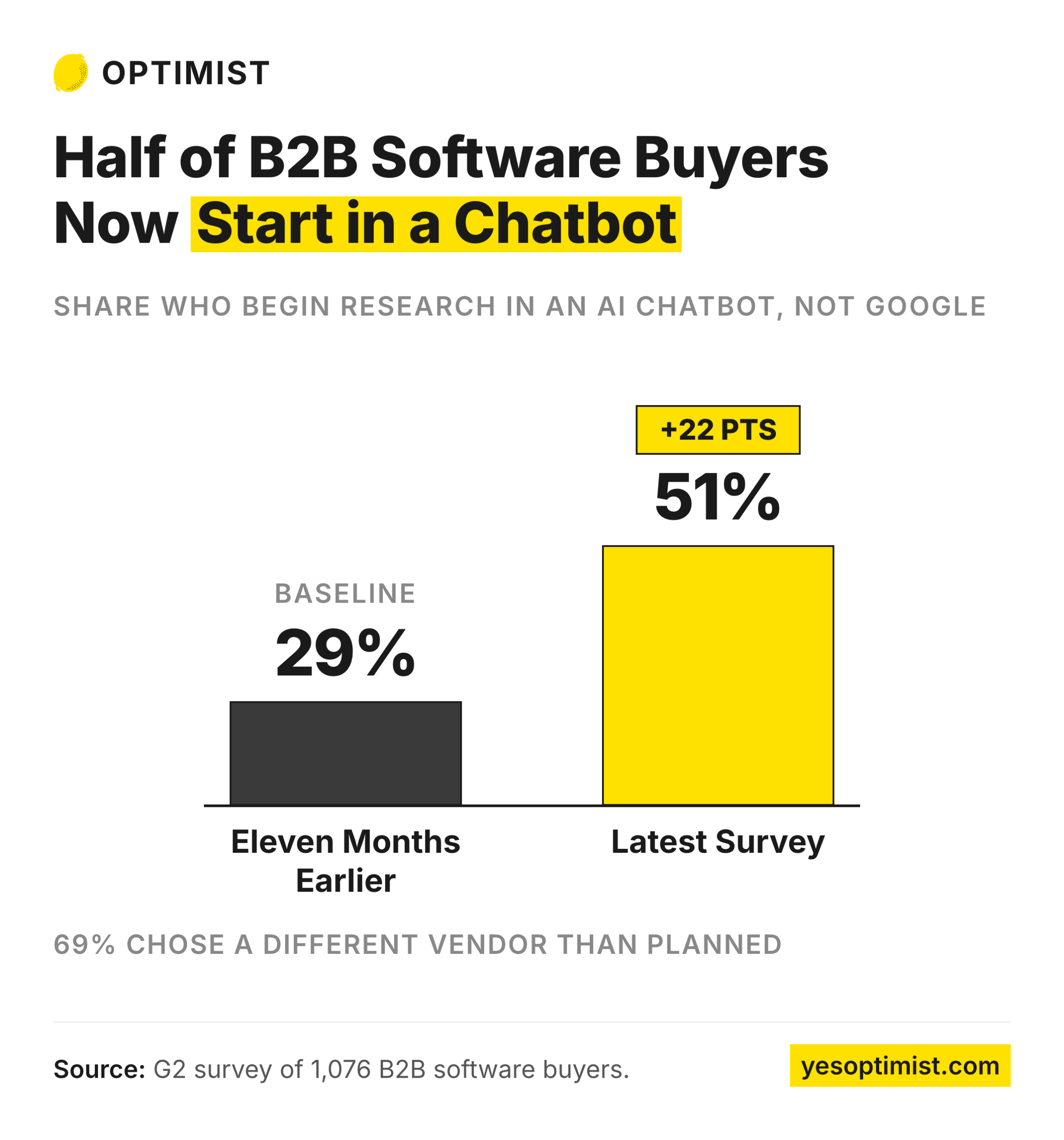
A G2 survey of 1,076 buyers revealed that 51% of B2B software buyers now begin research in an AI chatbot rather than Google—up from 29% eleven months prior. Even more impactful for revenue teams, 69% of buyers chose a different vendor than originally planned based on chatbot recommendations.
While AI referral traffic remains small, it carries high intent.
Conductor benchmarks show AI referral traffic accounts for 2.80% of total website traffic in IT and 3.37% in software and services. Meanwhile, a Semrush AI search study found that AI search visitors convert at 4.4 times the rate of traditional organic visitors.
We’ve seen this shift in real time with our clients.
Many companies have started investing specifically in optimizing for visibility across AI chatbots and other surfaces primarily because the traffic they receive from these sources tends to convert better than other channels.
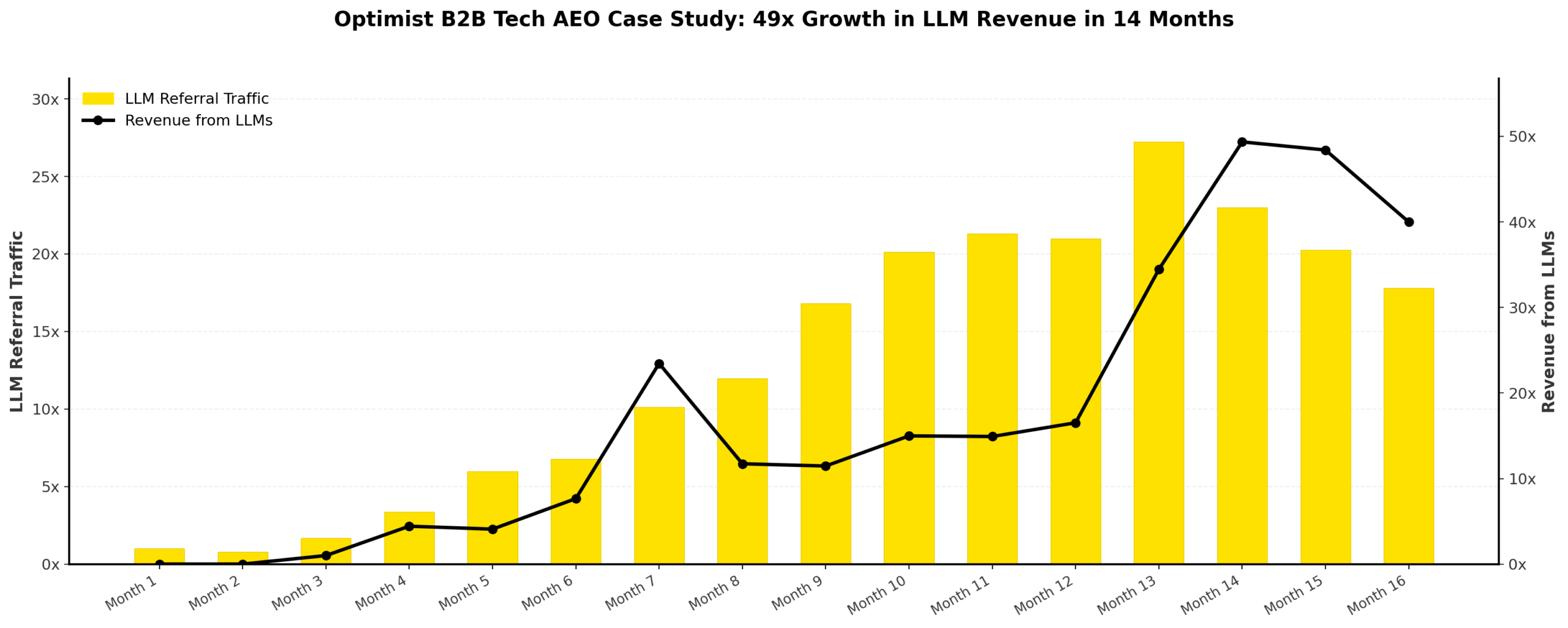
For example, we helped one client achieve 49x growth in LLM referral revenue over 14 months for a B2B tech client by optimizing their content and website for LLM visibility and helping them capture more in-market visitors from AI surfaces.
AEO vs. GEO vs. AI Search Optimization: Terminology Explained
Quick answer: They’re the same thing.
Wikipedia’s generative engine optimization entry lists answer engine optimization and large language model optimization among names used interchangeably, and notes that “no consensus definition distinguishing these terms had been established in the academic literature as of early 2026.”
The terms sometimes carry different habits of use.
AEO is usually the oldest term, originating from discussions of optimizing for voice assistants and voice search.
Generative engine optimization shows up most in research and vendor writing about generative models.
AI search optimization is the widest of the three, covering the whole AI-assisted research path plus sometimes referring to AI-powered SEO services and products.
Optimist (usually) uses AEO as the umbrella term.
Pick whichever one your team and your buyers already say, then spend the saved energy on the work underneath.
AEO vs. SEO: Key Differences and Search Overlap
Both AEO and SEO depend on search indexability, but they differ across four key areas: goals, output format, competitive landscape, and measurement metrics.
| SEO | AEO | |
| Goal | Rank a page in the top 10 | Get the brand named and the page cited in the answer |
| Mechanism | A list of links to choose from | Written response with a few sources attached |
| Surface area | 10 organic slots on one query | A few citation slots across the queries a model runs and a named recommendation in commercial discovery context |
| Measurement and KPIs | Rankings, clicks, and conversions | Brand mentions, AI citations, and the revenue that follows |
The scope of competition is often the biggest surprise. An Ahrefs study of 15,000 prompts cross-referenced AI citations with Google’s top 10 results. Citations overlapped only 28.6% of the time for Perplexity and 8.0% for ChatGPT, meaning nearly 80% of AI citations do not rank in Google’s top 10 for the initial user query.
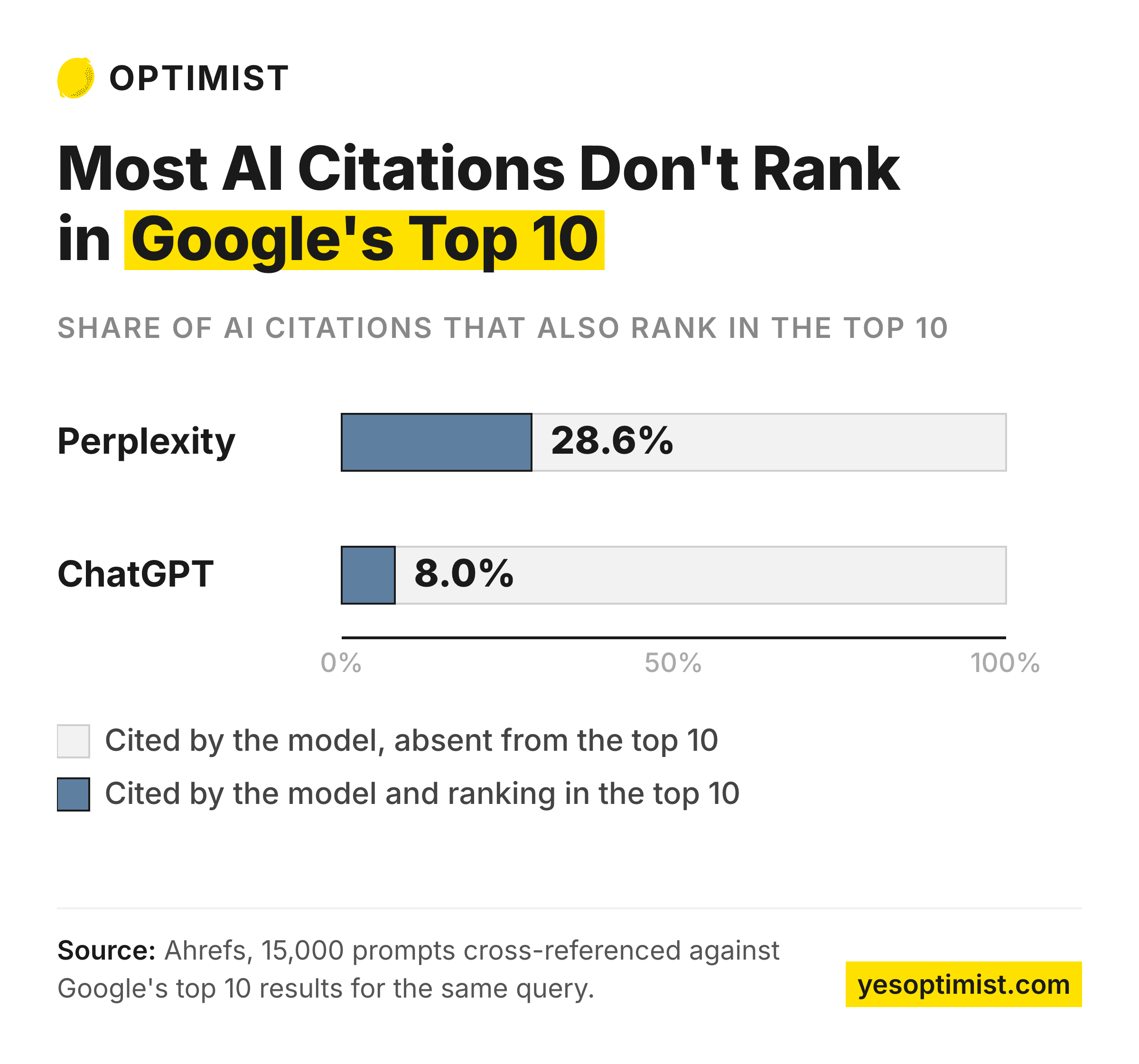
In other words, SEO alone doesn’t drive AI visibility.
Despite these differences, existing SEO investments can power AI answers. Because AI engines resolve queries by running web searches, pages that rank for underlying sub-questions get retrieved. As Google Search Central notes, optimizing for generative AI search means optimizing overall search experience, making it an evolution of SEO.
However, SEO alone is not always enough. Traditional SEO creates the foundation for retrieval, but earning citations and recommendations after retrieval requires additional optimization.
How AI Answer Engines Find, Select, and Cite Sources (Understanding Query Fan-Out)
When prompted to recommend B2B vendors, ChatGPT and other LLMs often execute multiple sub-searches before generating a response.
In other words, they break down your prompt into smaller questions.
Then they search the web for answers or sources to ground their existing logic.
Google documentation calls this “query fan-out”—a sequence of concurrent, related searches run by the model to retrieve comprehensive background context.
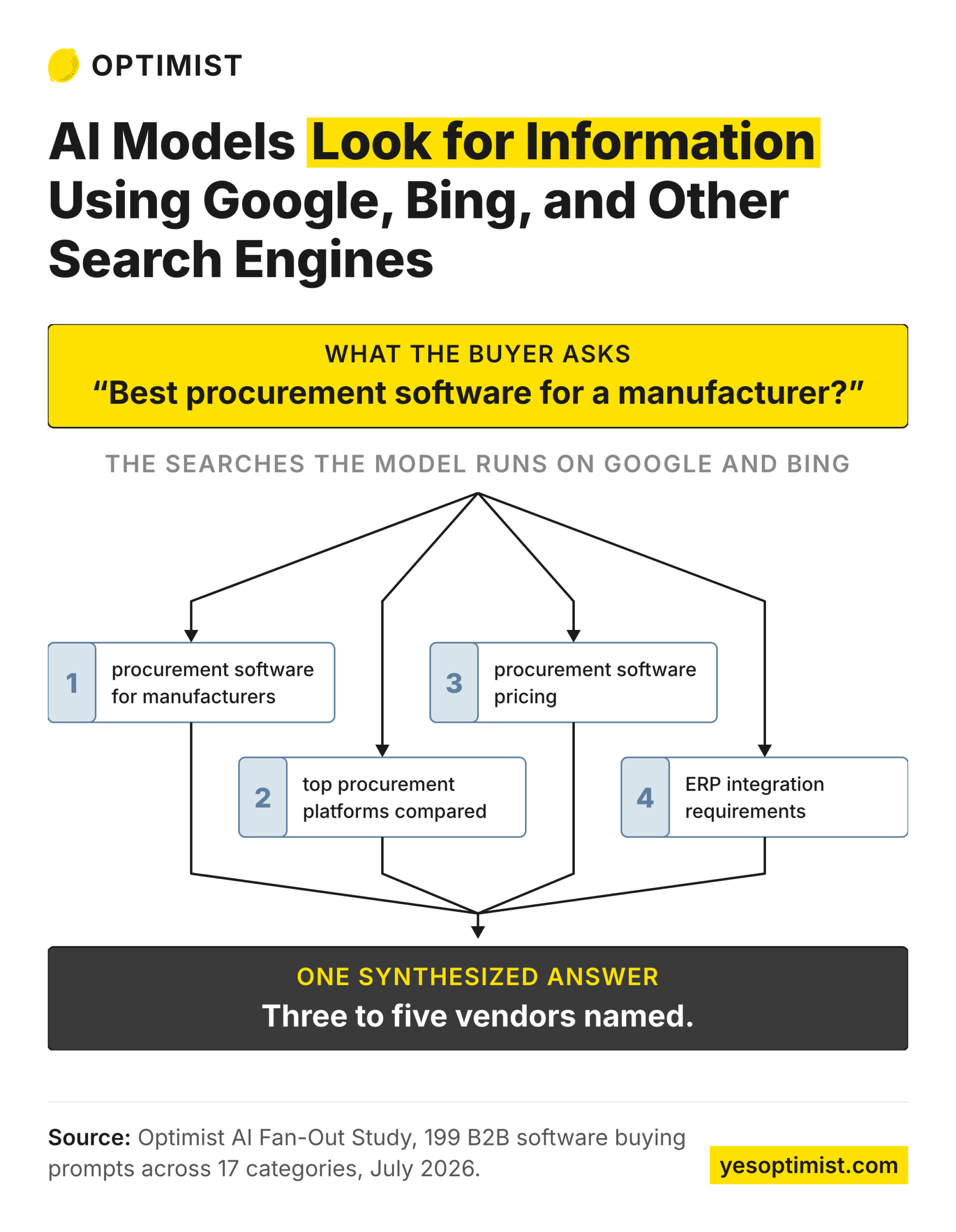
An iPullRank fan-out analysis identified 8 distinct query variant types, with AI systems executing up to 20 search iterations per prompt.
Based on the SERP for these fan-out queries, models often find specific sources and information that they latter cite in their final response. This retrieval happens at a passage level rather than document level, aligned with foundational retrieval research from Lewis et al. (NeurIPS 2020).
Optimist’s research looked into this effect across 199 B2B SaaS prompts and 1,708 Google SERPs.
Pages cited by Gemini appeared in Google’s top 20 for the model’s fan-out queries about 66% of the time.
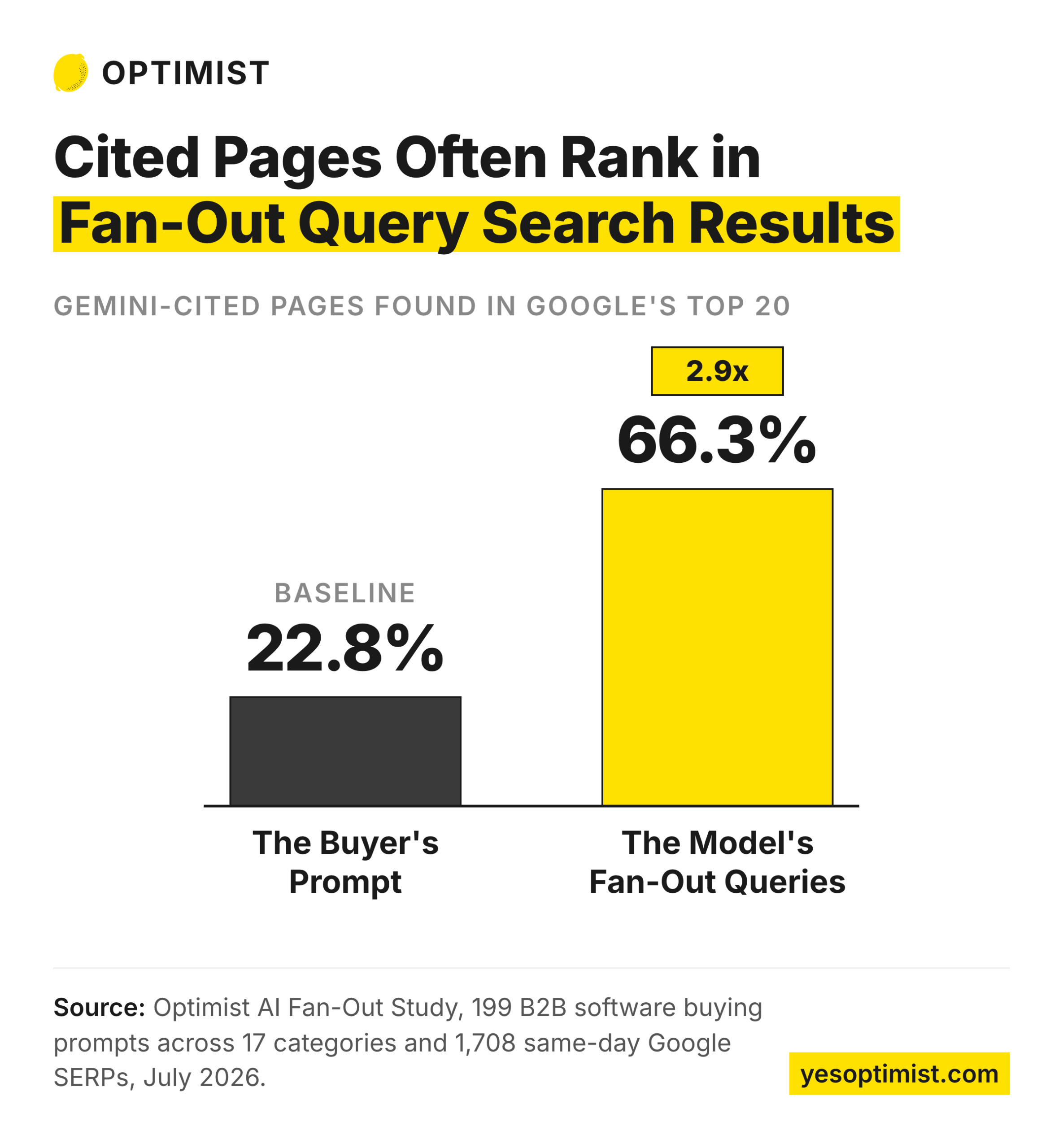
Other AI models like ChatGPT, Claude, and Perplexity perform a similar process and we found similar trends connecting search visibility for the model’s fan-out queries with the citations that show up in their final response.
In other words, search often drives citations.
And citations often drive brand mentions and recommendations.
Google AI Overviews follow a similar pattern: even when prompts were entered directly as Google searches, about 38.3% of cited pages were present in the organic top 20 for that prompt, indicating that many of the cited pages likely came from additional searches the AI model uses to surface sources and information.
Fan-out queries tend to read like real buyer questions, focusing on pricing, feature comparisons, limitations, integrations, and implementation details.
Best Practices to Improve Your Visibility in AI Answers
In practice, the work of AEO – actually optimizing your brand’s visibility – can be broken down into two key areas of focus, each one covering multiple strategic and tactical areas.
The Short Arc: On-Page Content Structure and Direct Sourcing Strategy
When we describe AEO to clients, we talk about The Short Arc as the factors that you control completely. They’re things you can literally optimize today on your website or across your web presence to try to improve AI visibility.
Content Coverage
Chief among them is your existing content footprint or what we call Content Coverage.
In a word: Do you have pages that cover all of the topics and information that matter to your business and your buyers?
Without the right content strategy, your ability to directly influence AI responses is limited. In this way, content is still the fuel for most organic engines – it’s just now running through an AI model rather than a search engine.
Content Structure
From there, the structure of the content plays a role in how easily and frequently your page content is lifted and/or cited. Each section should answer one question completely and survive being lifted out of the page around it. Short, self-contained answers near the top give a model something clean to take.
Credibility Factors
The substance of the content matters, too. Princeton’s GEO study from Aggarwal and colleagues reports that factors like citing sources, adding direct quotes, and including statistics all correlated with a 30-40% improvement in AI model citations and visibility.
Structured Data and Schema
Schema can also play a role, although it’s not a cure-all that some agencies make it out to be.
Google’s AI-search guidance says “structured data isn’t required for generative AI search, and there’s no special schema.org markup you need to add.” Schema helps a machine parse a page that already deserves parsing.
The Long Arc: Off-Page Presence and Third-Party Media Coverage
Mathematically, most AI citations come from somewhere other than the brand’s own domain.
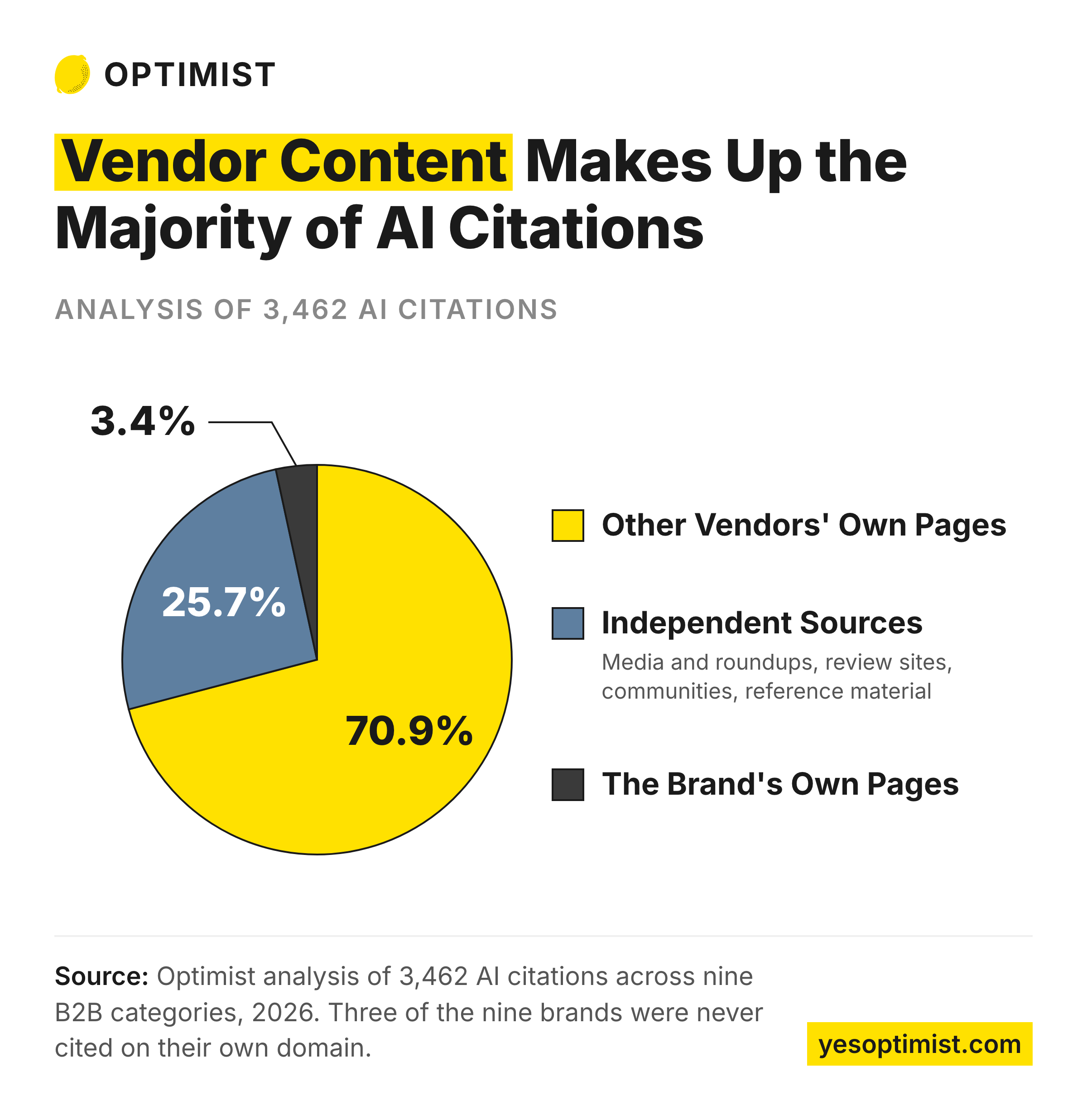
We classified 3,462 citations from AI answers across nine B2B categories. About three in four went to a page published by some vendor in the category, but a single vendor’s pages only accounted for about 3% of citations on average.
This means that, while you have some influence over AI models, the majority of the response is shaped by a combination of the model’s underlying training data (what it already knows about the world) and information coming from other sources like competitors and third-party sources such as media and roundups, review sites and directories, communities and video, and reference material.
These patterns will shift depending on the industry and the type of prompts you’re testing.
Magna tested 5,127 prompts across three models and measured Wikipedia influencing 58% of definitional queries but only 8% of “best” recommendation queries. This makes sense, too, because Wikipedia is an objective (and generally reliable…although imperfect) source for a specific type of information – definitional content. It’s not a source of rankings or recommendations.
All that to say this: The Long Arc is about your overall brand presence across the web.
Are you visibility across all of the other surfaces – beyond your own website – that AI models can see and cite? If your footprint is small, chances are AI will see you, statistically, as a small player rather than an industry leader.
To drive AI visibility through The Long Arc, we need to think about broader strategic investments in brand building, PR, and overall visibility.
But it shouldn’t be just scattershot “brand building”.
Based on the underlying citation and search patterns we can extract from the AI model responses, we can understand the types of content, websites, and even specific pages that are most closely linked to AI visibility within the space and then target our efforts there.
How to Measure AEO Performance: Mentions vs. Citations
Two goals are the focus for an AEO program:
- Brand mentions are AI answers naming or recommending your company.
- AI citations are AI answers linking your pages as a source.
They share most of their levers, but they’re ultimately different outcomes that require separate measurement.
In some cases, they can even move in opposite directions.
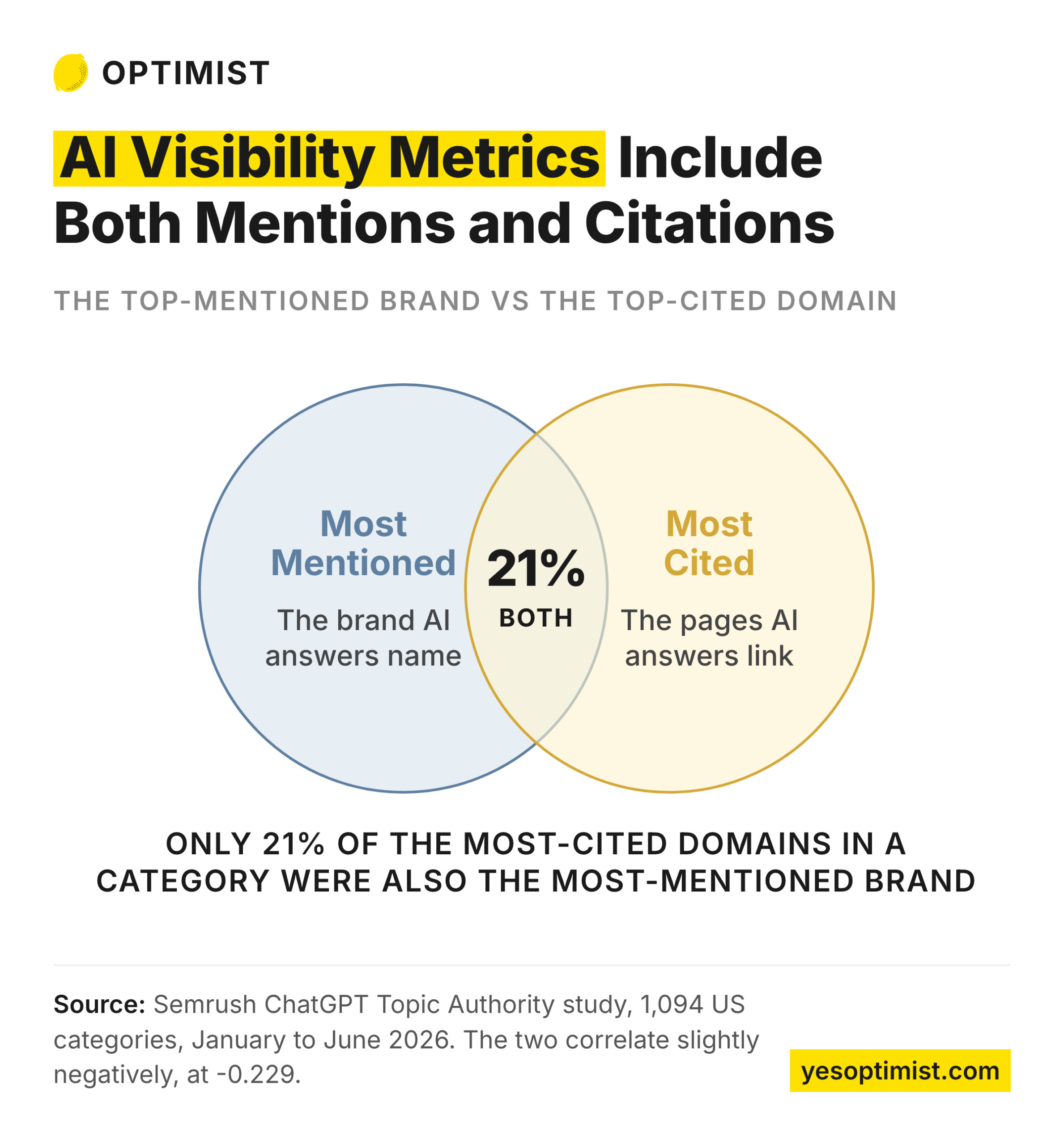
Semrush’s ChatGPT Topic Authority study tracked 1,094 US categories from January to June 2026 and found that “only 21% of the most-cited domains in a category were also the most-mentioned brand, and the two correlate slightly negatively (-0.229).” Semrush quotes Kevin Indig on the same page, telling readers to treat the correlation as a hypothesis rather than a finding.
I recently talked to a Director of Content at a B2B SaaS company who described the split from the inside. “We have the top share of voice on our competitors as well as the visibility score,” she told me. “But when it comes to citations, we don’t do as well.”
Our fan-out study found a matching gap from the other side, where Gemini skipped 8.8% of vendors whose sites were visible in their category’s fan-out SERPs.
One key thing to know about measuring any AI visibility metric: They’re probabilistic – directional.
Measuring them once isn’t necessarily the objective truth. You have to measure and track them over time.
Schulte, Bleeker, and Kaufmann ran 32 prompts across four engines for 45 days and found source sets overlapping by only 34% to 42% between consecutive days. If you want the actual, statistically valid number at any moment in time, you’d have to run the same set of prompts 7 times in the same day.
In the end, AI mentions and citations are leading indicators.
Measuring them is a directional pattern that only tells you, in general terms, whether your visibility is increasing or decreasing over time. Capturing your “true” visibility number is less important than knowing whether visibility is up over the last 90 days.
The numbers that actually decide whether the work continues is revenue, pipeline, leads, or conversions. They’re concrete and less ephemeral than visibility scores, too.
So dig into attribution and how you’ll measure AEO performance before you kick off work to make sure you aren’t just chasing a moving target.
How to Start Optimizing for Answer Engines: Actionable Checklist
“Whenever I write content, I don’t know how to write … content geared toward AI.”
I heard that from a marketing director at a B2B analytics company, who writes all of the company’s content herself. She’s definitely not alone. Most people aren’t sure how to create pages or content that are optimized for the new world of AI visibility and LLM extraction.
When I run an AEO analysis for a company that already does SEO well, there are usually three main gaps:
- Content structure
- Brand consistency
- Measurement
Based on these gaps, I generally start with a few key action items that are almost universal opportunities for AI visibility improvement:
- Check that AI crawlers can reach the site: Vercel and MERJ’s crawler analysis found that no major AI crawler renders JavaScript, including OpenAI’s, Anthropic’s, and Perplexity’s, so client-side-rendered content is invisible to them. Gemini is the exception, since it runs on Googlebot’s infrastructure.
- Fix content structure: build the coverage list from the category’s comparison, pricing, integration, and implementation questions rather than from the head term, then answer each one in a section that stands on its own.
- Fix brand consistency everywhere a model reads it: the homepage, the product pages, the review profiles, and the roundups already rankin should all have a clear and consistent message about what your brand is, what you do or sell, and who it’s for.
- Set up measurement before changing anything: get a baseline of your AI visibility (most teams have no objective measure of their current visibility) by using a tool or a partner who can set up basic tracking for you.
Skip llms.txt for now. There’s no conclusive proof this helps with AI visibility, even though it’s often pitched as a quick fix. Ahrefs checked 137,210 domains and found 28% publishing one. Of the roughly 38,000 valid files, 97% got zero requests in May 2026.
“Before I [publish a new article], it would be nice to know if this is actually going to move the needle,” a founder at a vertical accounting software company told me on a call.
I had to pause.
I wish I could say, “if you just publish this specific thing in this specific way, you’ll see more AI visibility.” But, I can’t. No one can.
AEO is a whole new world and the systems themselves are built on logic and connections that even the engineers themselves don’t fully understand.
Publish the draft
Then measure it.
The best form of certainty in AEO is following a proven framework – and experimenting.
The 7 Layers of the CORE Framework for AEO
Having worked with over 50 clients on AI visibility in the last year, we’ve developed a system and framework we use to identify opportunities, prioritize work, and drive more AI visibility for our clients.
We call it The Complete Organic Revenue Engine (CORE) Framework.
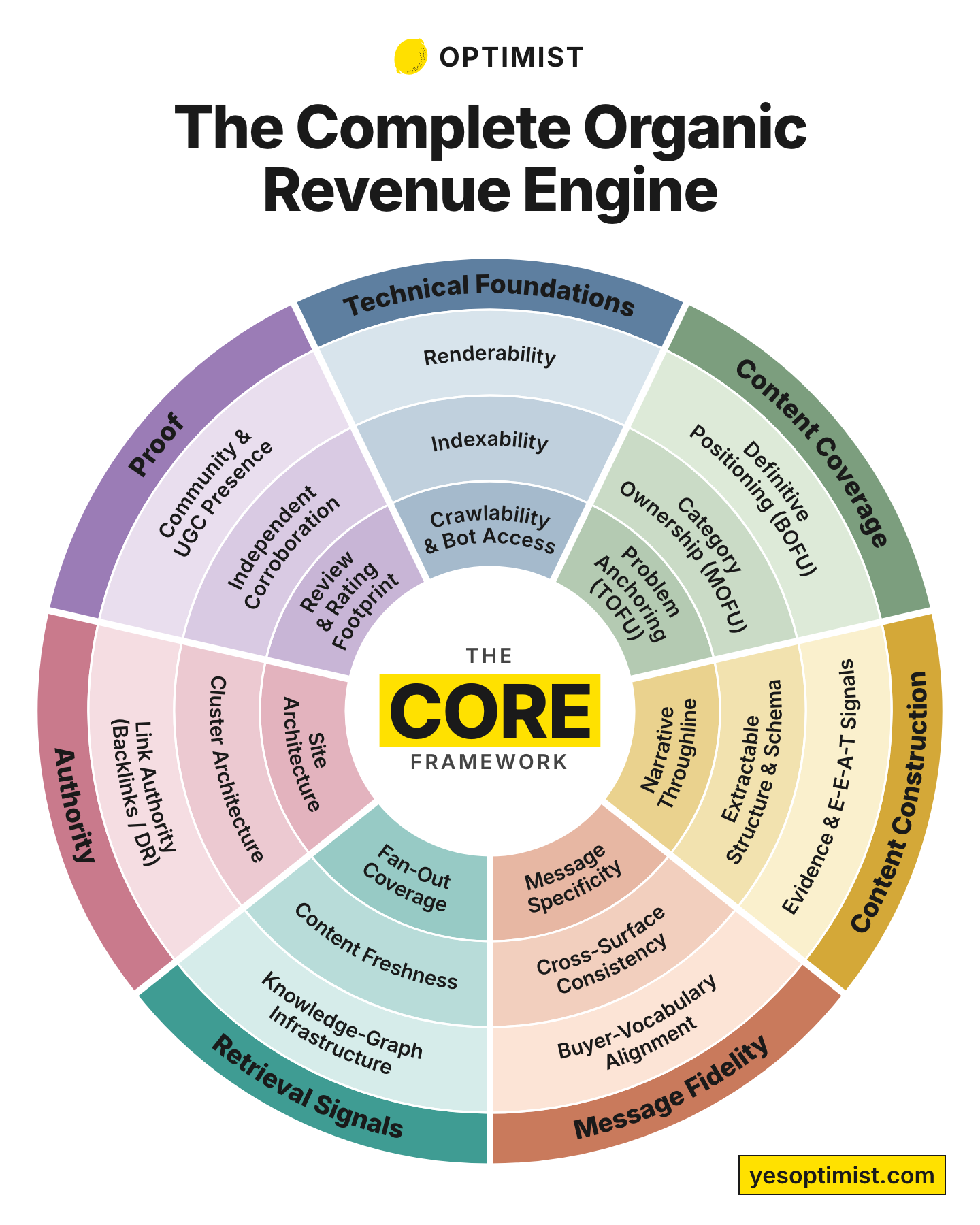
Optimist’s CORE Framework analyzes your brand’s AI visibility and performance across 21 key factors sorted into 7 dimensions:
- Technical Foundations: whether search engines and AI crawlers can reach, read, and index the site.
- Content Coverage: whether a page exists for each stage of the buyer’s search, from problem to decision.
- Content Construction: whether pages are built so a buyer can follow them and a model can quote them.
- Message Fidelity: whether machines meet the same brand story everywhere they look.
- Retrieval Signals: whether models find, date, and recognize the brand as they assemble an answer, which is where fan-out coverage lives.
- Authority: whether the site’s structure and reputation carry its individual pages.
- Proof: whether the brand shows up on the outside sources AI models trust.
Based on these dimensions, analysis of your brand’s AI visibility, and the underlying fan-out and citation patterns driving AI visibility within your space, we can identify the specific, high-impact work that’s most likely to help you improve performance.
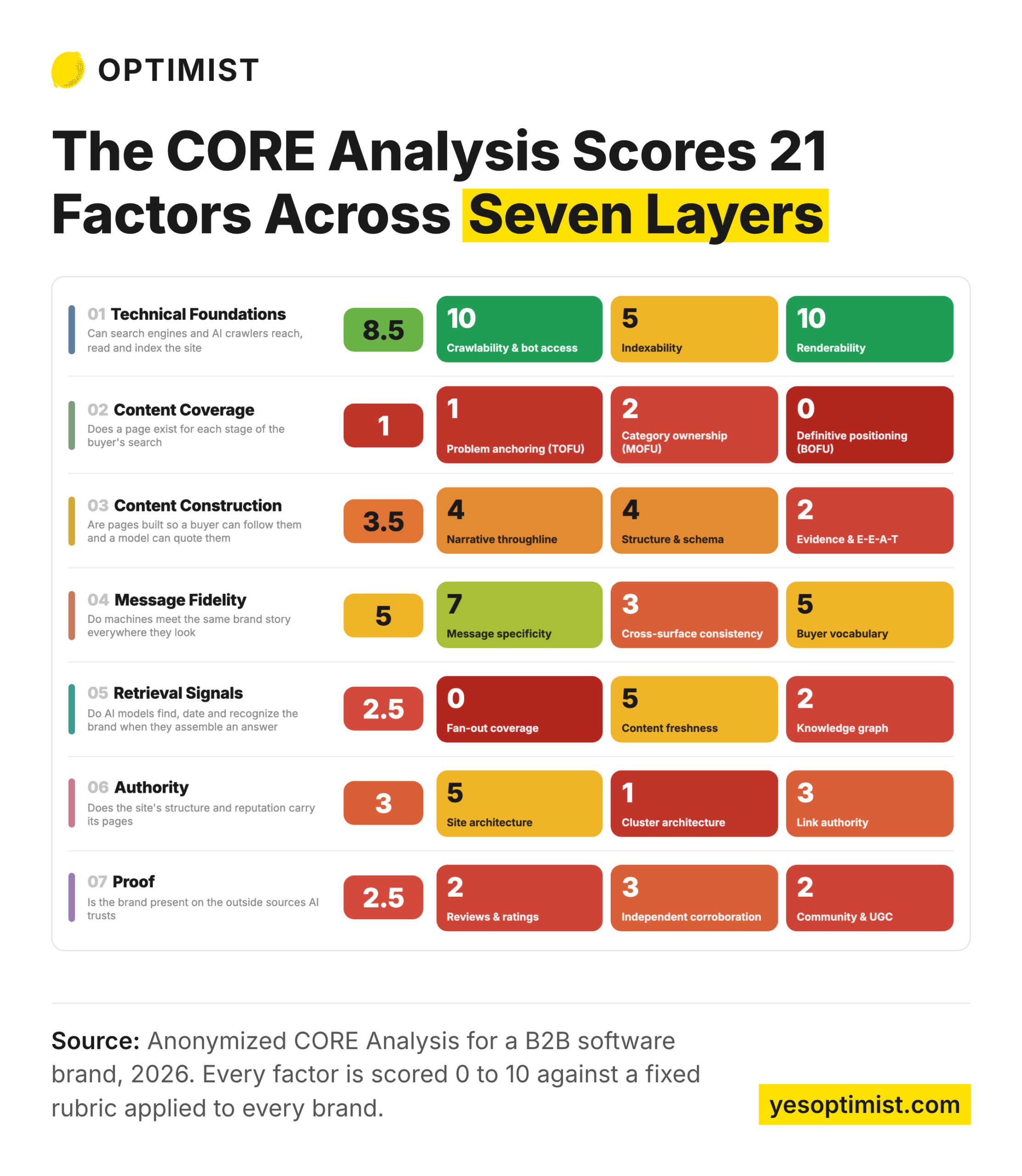
Take the example of the B2B SaaS brand that tops its category at 61% of tracked prompts and still lags on citations. Message Fidelity and Authority show up strongly, indicating they aren’t likely to be factors limiting visibility. Content Construction and Retrieval Signals, on the other hand, score poorly and indicate these factors are where we should prioritize investment.
See Where You Stand and Build a Data-Driven AEO Strategy
AEO strategy is all about prioritization and focus.
While there are a million things that could influence your brand’s visibility across ChatGPT and AI Overviews, the real question is… which specific factors should you focus on?
Optimist is an SEO and AI search consulting firm that helps marketing teams answer that question.
We offer free consultations, strategy help, audits, and ongoing consulting that helps you increase AI visibility, capture more inbound demand, and drive more pipeline and revenue.
If AEO still feels like a bit of a mystery and you’re looking for an expert to help you, drop us a note and see if we’re a fit.
Book a free AEO strategy call.
Frequently Asked Questions (FAQ) About AEO
What Is Answer Engine Optimization (AEO)?
Answer engine optimization (AEO) is the practice of structuring content, brand signals, and technical infrastructure so AI platforms name a brand and cite its pages in their answers. Those platforms are ChatGPT, Google AI Overviews, Perplexity, Gemini, and Microsoft Copilot. The work covers the questions buyers ask, page structure a model can quote, a consistent brand description across the web, and presence on third-party pages.
What Is the Difference Between AEO and SEO?
The difference between AEO and SEO is the goal, the result shape, what a brand competes for, and how it’s measured. SEO works to rank a page in the top 10 so a buyer clicks it. AEO works to get the brand named and the page cited inside the answer. The two compete for different things, 10 organic slots on one query against a few citation slots across the queries a model runs. Both end at revenue, pipeline, leads, or conversions.
Does AEO Replace SEO?
No, AEO doesn’t replace SEO. Answer engines resolve most queries by searching, so a page that ranks for nothing a model asks about rarely gets retrieved. What changes is the work after retrieval. A page can rank and still get passed over because its claims carry no sources or the brand describes itself three different ways across the web.
How Do You Learn Answer Engine Optimization?
You learn answer engine optimization by running it on a site you can measure, and structured courses exist if you want the vocabulary first. Coursera hosts a four-hour course from SkillUp, AI SEO: Mastering Generative Engine Optimization (GEO), free to enroll with a paid certificate. Almost everything I know about which pages get pulled came from running prompt sets against client sites and watching what moved after publishing.
How Do You Measure AEO Success?
You measure AEO success with two tracked outcomes and one business number. Track brand mentions, meaning how often AI answers name the company, and AI citations, meaning how often those answers link its pages. Then tie both to revenue, pipeline, leads, or conversions, because a rising score beside a flat pipeline is a reading and not a result. Run the prompt set repeatedly, since a single day’s sample moves enough to point the wrong way.
