The 10X AI SEO Agency
AI Search Optimization Services for B2B Companies
That Want to Win The New World of Buyer Discovery
Your customers getting recommendations from ChatGPT, Claude, and Gemini — right now.
And if you’re not showing up in AI answers, your competitors are.
Optimist is an AI search optimization agency that helps B2B technology companies get found, cited, and recommended across AI answer engines, building on SEO foundations to maximize inbound pipeline.
The Complete Organic Revenue Engine (CORE) Framework
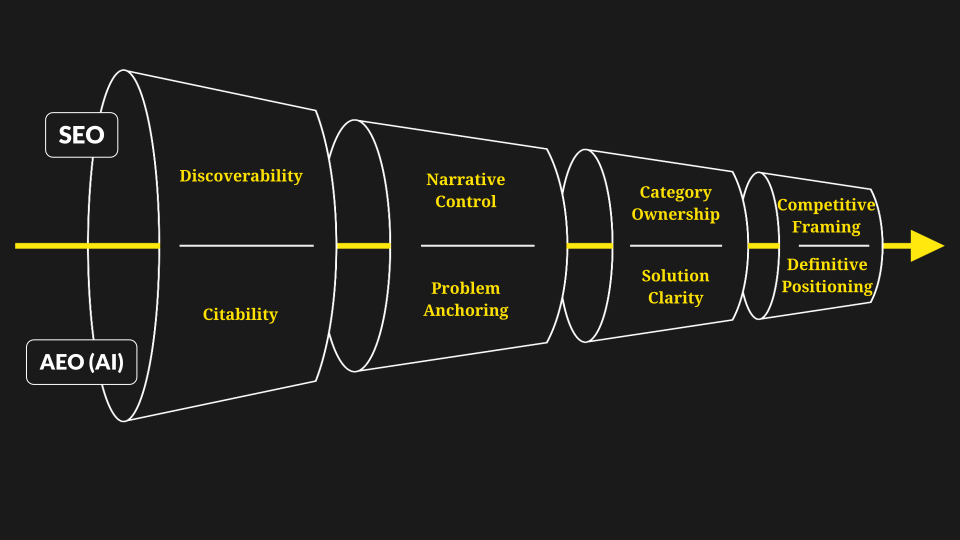
AI Search Case Studies on Driving Real Revenue
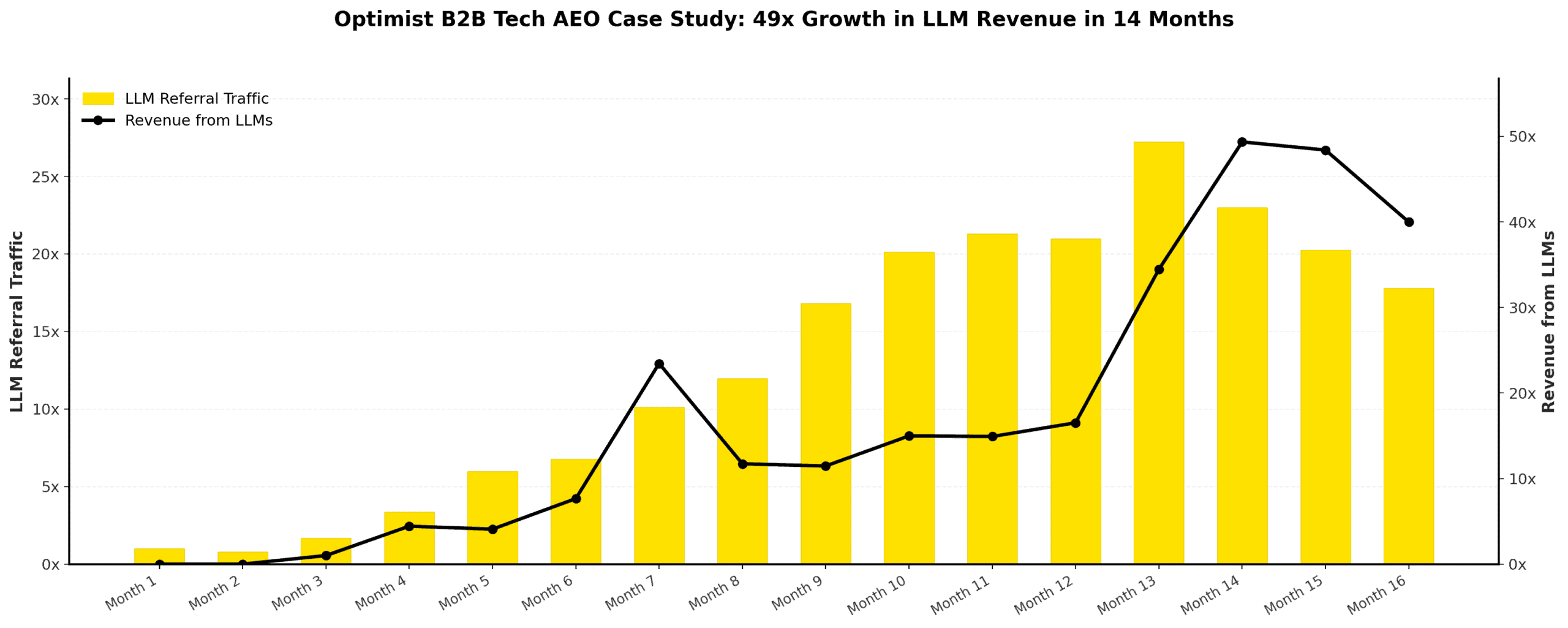
B2B Tech AEO
49x LLM Revenue
26x LLM Referral Traffic
We helped this large B2B tech client reset their content strategy to drive major growth in AI visibility and referral revenue & traffic from LLMs
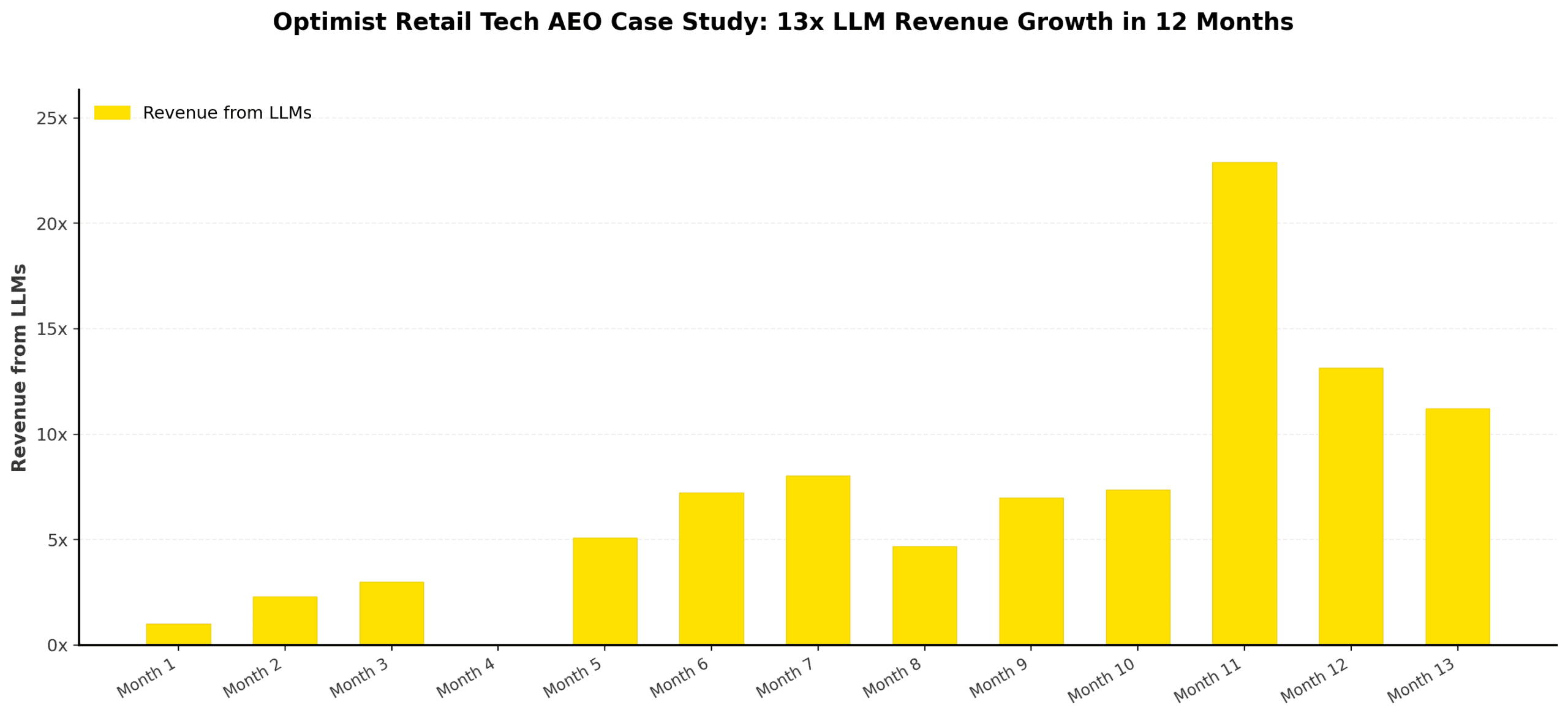
Retail AEO
13x LLM Revenue
Our team helped a retail client dominate ChatGPT, Perplexity, and Claude by creating targeted, strategic, and structured category content that led to product recommendations & revenue.
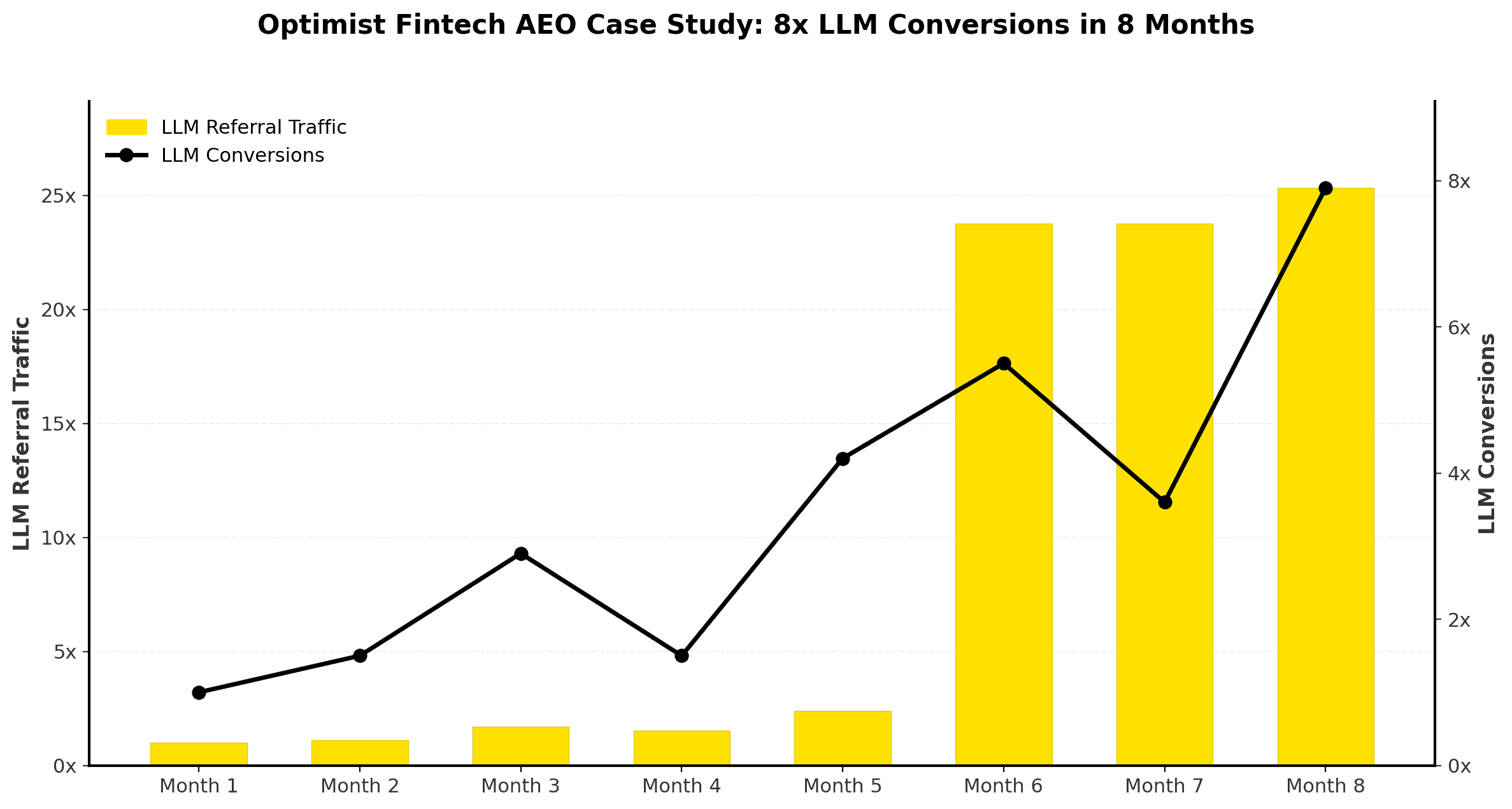
Fintech AEO
8x Conversions from LLMs
25x LLM Referral Traffic
This fintech client achieved massive growth in LLM referral traffic and conversions in just 6 months.
We Help Your Brand Get Recommended by ChatGPT, Claude, AI Overviews, and More
AI search optimization is how your brand gets recommended and cited inside generative engines, LLMs, and AI Overviews.

AI Search Optimization is Built on SEO Foundations
AI Search Optimization Services That Drive Measurable Growth
Most B2B companies are completely invisible in AI. Optimist helps you get mentioned, recommended, and cited to win the shortlist before prospects even visit your website.
Integrated AI Search & SEO Strategies
- Unified organic discovery strategies spanning search and AI surfaces like AI Overviews, ChatGPT, Claude, Perplexity, and more
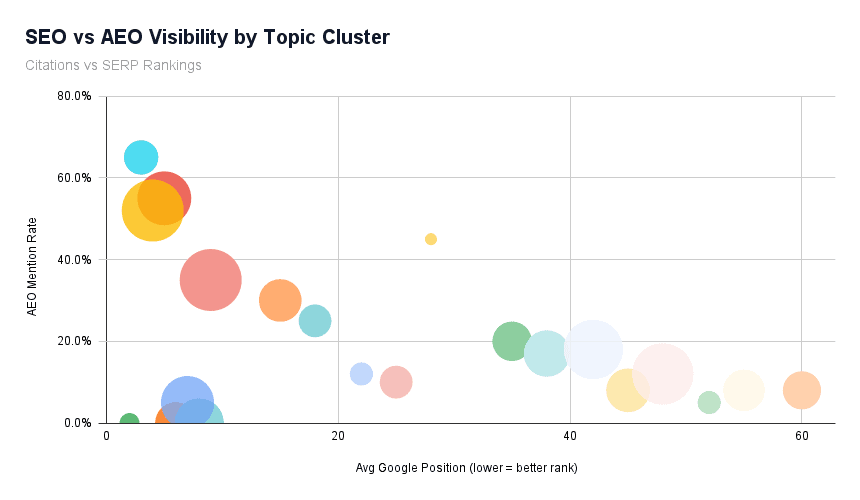
- Content that ranks in Google AND gets cited in AI answers
AI Search Visibility Strategy
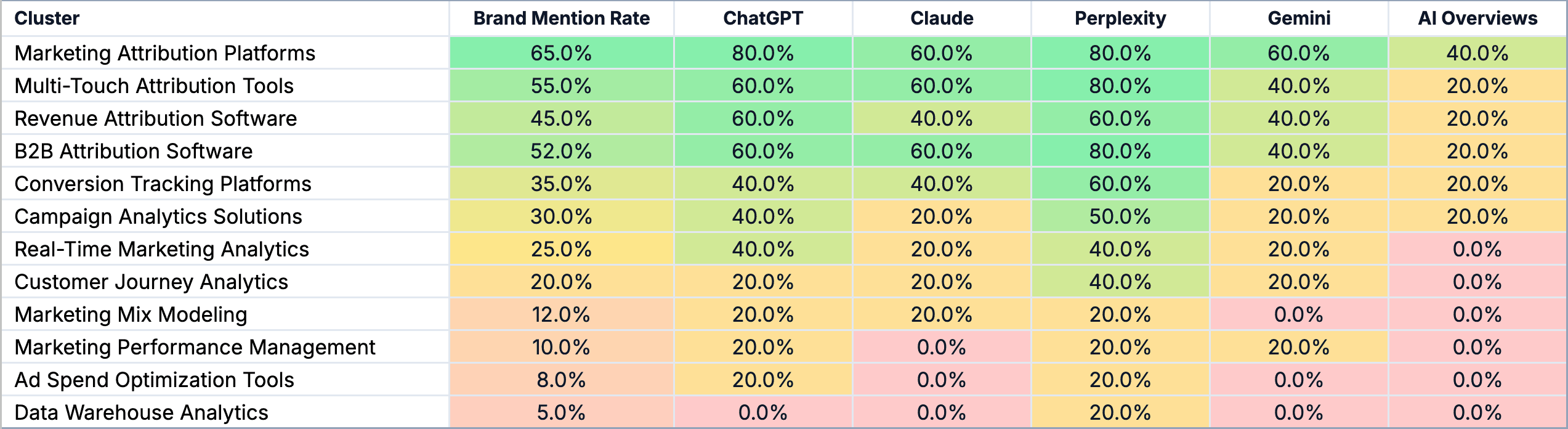
- Comprehensive audit of your brand’s current visibility across ChatGPT, Perplexity, Gemini, Claude, and Google AI Overviews
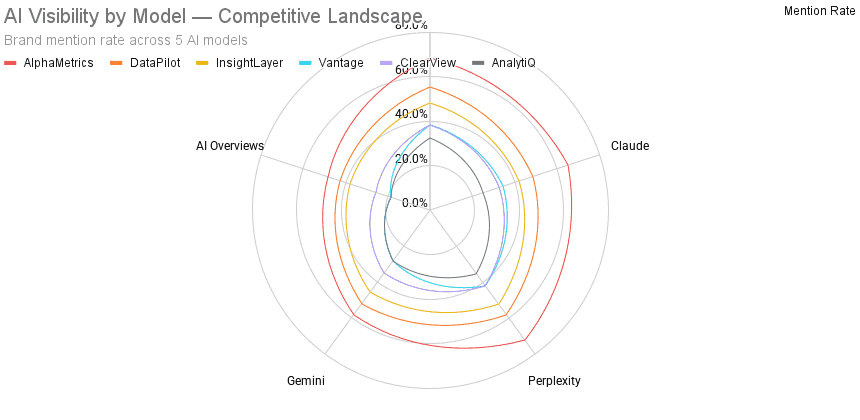
- Competitive AI visibility analysis — who’s getting cited in your category and why
- Strategic roadmap for increasing AI citation rate and share of answer
Content Optimization for AI Recommendations
- Answer-first content structuring
- Entity optimization to ensure your brand, products, and category associations are clear and consistent
- Content reformatting and creation for maximum AI comprehensibility
- Multi-format optimization across text, video, and audio surfaces
Technical Optimization
- Schema markup and structured data implementation for AI comprehension
- Entity graph optimization and brand signal consistency
- Site architecture designed for AI crawlability and citation
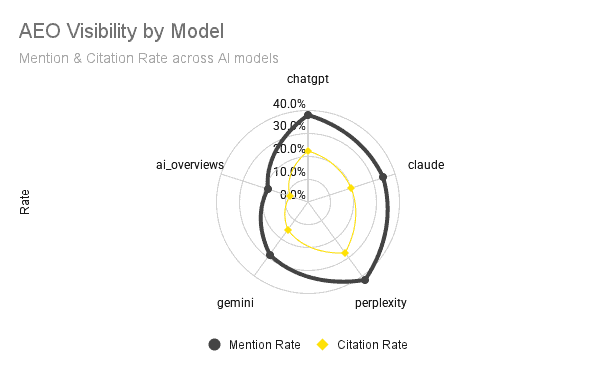
AI Visibility Reporting & Pipeline Attribution
- AI-referred lead and revenue tracking across all major answer engines
- Share-of-voice and recommendation rate measurement against competitors
- AI-driven pipeline attribution connecting discovery to inbound leads and revenue
- Ongoing optimization based on performance data
Trusted by the World’s Best B2B Brands
The Optimist team has worked with nearly 200 B2B tech & SaaS clients over 10 years.
We work alongside in-house teams at companies like Semrush, ZoomInfo, DreamHost, and HelloSign to define and execute marketing strategies designed to scale.














“From keyword research to cranking out content and even tackling technical SEO audits, I didn’t have to hover or micromanage a thing.
Having experts like you handling the nitty-gritty made me way more effective, and honestly, it was a lifesaver.”

Hussam AlMukhtar
Head of Demand Generation, ScreenMeet
Why Optimist Is the AI Search Optimization Agency B2B Companies Trust
AI search optimization and SEO run as one system, not one instead of the other.
Some agencies now sell AI search optimization as the thing that replaces SEO. Google still drives the majority of organic pipeline for most B2B companies, and AI assistants build their answers by searching, so the two feed each other. We run them as one organic engine — one strategy, one content plan, one set of numbers.
We were early to AI search optimization for B2B.
Optimist was among the first agencies to build dedicated AI search optimization services for B2B companies, and the results are on the board. One B2B technology client grew LLM referral revenue 49x over 14 months. A fintech client grew LLM conversions 8x in eight months.
The reporting ends at pipeline.
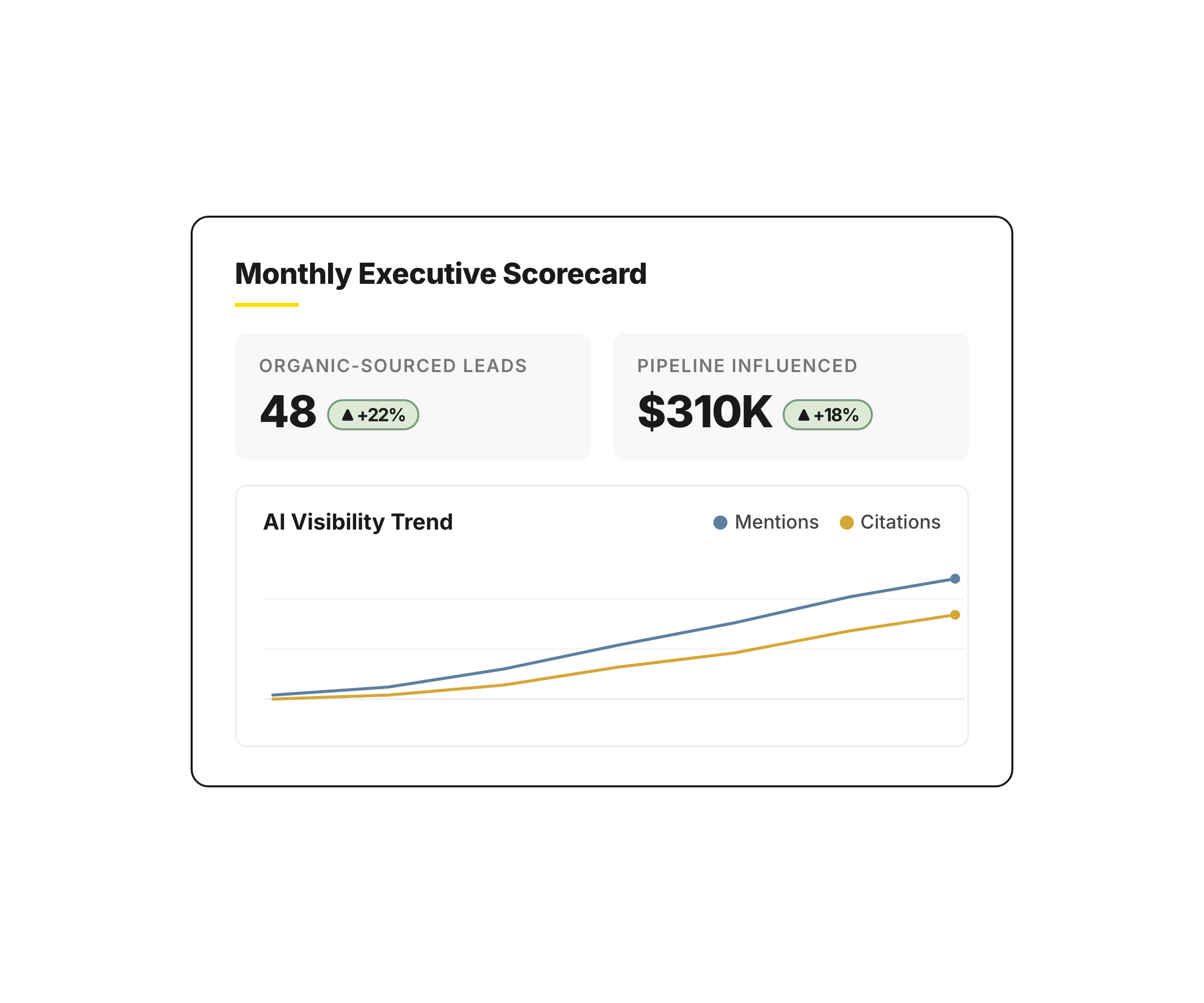
We benchmark your brand every month across ChatGPT, Claude, Perplexity, Gemini, and Google AI Overviews, then connect what moves to AI-referred leads and revenue. You get a monthly executive scorecard your CFO can read without a translator. Visibility is the input we manage, but revenue and conversions are what matter.
We work inside your team, not around it.
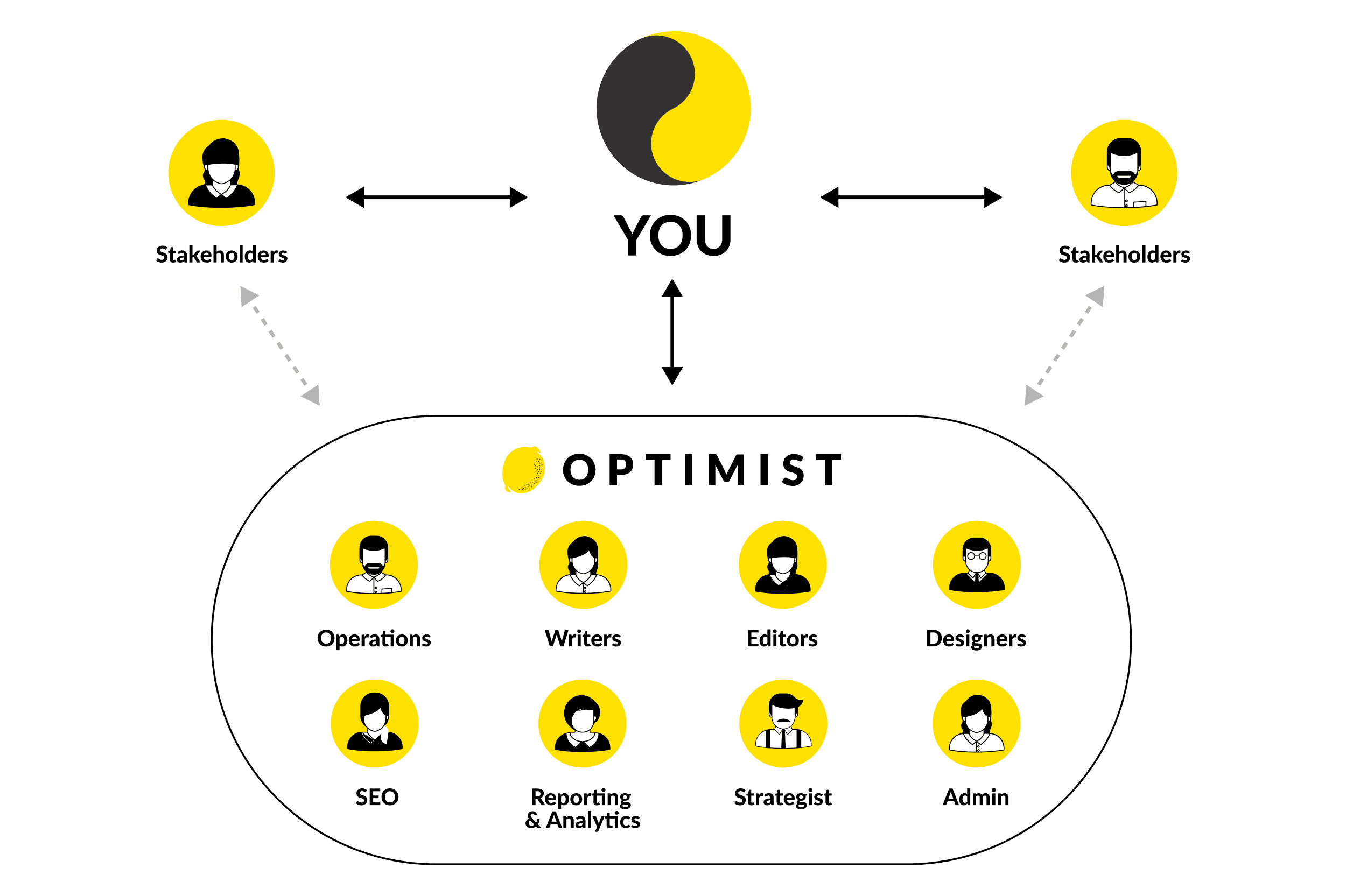
Optimist plugs into your Slack, your Asana or Notion, and the content workflow you already run.
We Help B2B Companies Show Up, Stand Out, and Drive Real Revenue

Increased SEO & AI Visibility

More Inbound Traffic

Scalable Inbound Lead Generation

Lower CAC & CPL

Predictable MRR Growth
“Optimist is a kick-ass partner. They’re a critical part of the Plytix team. They’ve helped us build a predictable growth strategy and turned organic into our #1 channel for traffic and leads.”

Morten Poulsen
CEO, Plytix
FAQs About Choosing & Hiring an AI Search Optimization Partner
Let’s dive into the details and answer key questions you should consider when choosing an AI search partner.

How much do AI search optimization services cost, and what does Optimist charge?
Optimist publishes flat prices.
One-time strategy and roadmap engagements start at $7,500. Ongoing AI search optimization and SEO advisory retainers start at $3,000 a month for teams that execute in-house.
Full-service engagements covering strategy through execution and publishing start at $4,000 a month.
Every retainer is month-to-month.
Across the market, B2B AI search optimization retainers run from roughly $1,500 to $25,000 a month.
Does AI search actually drive B2B pipeline, or is it hype?
It drives revenue, and it shows up in the same reports your board already reads.
One Optimist client, a B2B technology company, grew LLM referral revenue 49x over 14 months, alongside 26x growth in LLM referral traffic.
We helped a fintech client grow LLM conversions 8x in eight months. Those are revenue and conversion numbers, not just visibility scores.
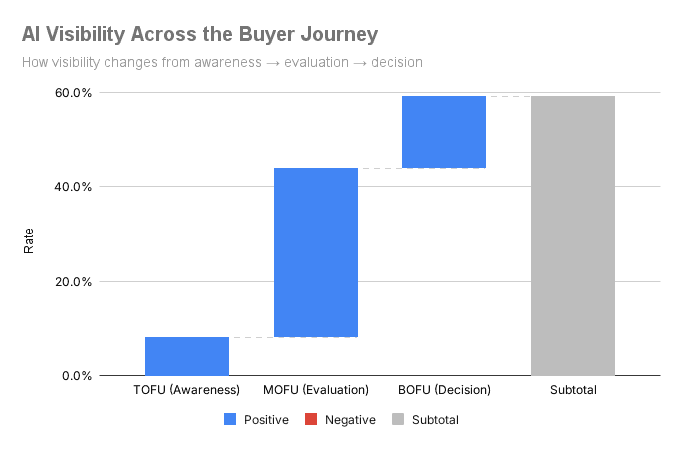
AI search sends fewer clicks than Google does, and it will for a while. What it sends is different. A buyer arrives after a model has already framed the category, compared the options, and named you as one of them, so they land further along than a cold organic visitor and they convert accordingly.
Track AI-referred leads and revenue from the first month and the hype question answers itself in a quarter.
Which AI platforms should we prioritize — ChatGPT, Perplexity, Gemini, Claude, or Google AI Overviews?
Prioritize where your buyers already are, which for most B2B companies means ChatGPT first and Google AI Overviews second.
This matters less than it sounds, though.
Many of the levers that earn a brand mention or a citation are the same everywhere. Clear entity signals, coverage of the questions your buyers actually ask, answer-first structure, and credible third-party coverage all play a role in nearly every model’s reasoning.
Work done for ChatGPT shows up in Perplexity and Gemini too. What differs between engines is retrieval behavior and which sources each one leans on, and that changes sequencing rather than strategy.
We benchmark all five so the priority comes from your data instead of a guess. Some categories are Perplexity-heavy. Some are almost entirely AI Overviews. You’ll know which one you are inside the first month.
Should we shift budget from SEO to AI search optimization? Is AI search going to replace Google?
Don’t move budget out of SEO. Add AI search optimization on top of it.
Google still drives the majority of organic pipeline for most B2B companies. More to the point, these aren’t two budgets doing two jobs.
AI assistants build answers by searching, and what they retrieve is largely what ranks. Optimist’s AI Fan-Out Study tested 199 buyer-style prompts across five AI surfaces against 1,708 Google SERPs and found that pages ranking for a model’s own follow-up queries explain its citations at roughly five times the rate of a randomized control.
Rankings and AI citations ride the same rails.
Cutting SEO to fund AI search optimization removes the foundation it runs on. The reallocation that does make sense happens inside the organic budget. It’s less volume for volume’s sake, more coverage of the questions buyers ask, better structure on pages you already have, and cleaner brand and entity signals everywhere models read about you.
As for replacement, Google is running AI Overviews on top of its own index. The likelier outcome is that the interface changes while the retrieval layer stays recognizable. Plan for a shift in how buyers read answers, not for the disappearance of search.
Do we need to publish more content to win in AI search?
Usually less than you’d expect, and almost never more articles on topics you already cover.
AI models synthesize the median answer in a category. Another competent post about a topic that already has twenty competent posts gives a model nothing it needs, and volume for its own sake is the pattern search engines built their scaled-content policies to catch.
Three things move AI visibility more than volume.
- Coverage of the questions your buyers ask that nobody in your category has answered well.
- Structure that lets a model lift a clean answer off the page — direct answers near the top, real headings, schema.
- Consistent entity signals, so every place a model reads about you describes you the same way.
Most of the AI search optimization work we do in the first quarter happens on pages that already exist.
Can we do AI search optimization in-house instead of hiring an agency?
Yes. If you have a strong content operator and someone who owns measurement, you should probably run most of it yourself.
The hygiene layer is largely public knowledge now (although there’s still much debate on specifics).
Schema, entity cleanup, FAQ and answer-first structure, a visibility tracker for a few hundred dollars a month. A capable in-house team can stand all of that up without help.
Most teams look for outside help to provide guidance and expertise rather than pure execution capacity. The dashboard reports your score, not which gaps are worth money or what to fix first.
Teams end up tracking prompts nobody buys from. There’s no line from a brand mention to a closed deal, so the program dies at the first budget review. And most self-serve tools still don’t cover every engine, so the picture you’re steering by is partial.
The judgment layer is critical. If you want the plan without the delivery, Optimist offers a one-time strategy and roadmap engagement that gets you the sequenced action and your team executes it. If you want ongoing strategy, briefs, and specs while your team ships, Optimist offers an advisory retainer.
What does getting started with Optimist look like, and what happens in the first month?
Working with Optimist starts with a call, then an analysis of where you stand, then a roadmap. Retainer work runs from there, month-to-month.
The analysis benchmarks your brand across ChatGPT, Claude, Perplexity, Gemini, and Google AI Overviews, maps the topics and questions your buyers are actually asking, and compares your visibility against the competitors showing up in your place.
It covers the SEO foundation underneath as well, since that’s where most AI citations get retrieved from.
That becomes your roadmap, built on Optimist’s Complete Organic Revenue Engine (CORE) Framework. The CORE Roadmap is sequenced by impact with a measurement baseline. It covers the real horizon of the work rather than a fixed number of weeks, and it gets re-sequenced as results come in.
Then you pick a lane. On the advisory track we supply the strategy, briefs, and specs, and your team ships. On the full-service track we build and run the program end to end, with the roadmap produced inside month one as part of the retainer and nothing publishing without your approval.
Let's Build an Organic Growth Engine Together
Schedule a free strategy session with Tyler to discuss your organic growth targets.