
Article Summary
Generative engine optimization (GEO) is the additive layer on top of SEO that gets a brand named, recommended, and cited in ChatGPT, Perplexity, Gemini, Claude, and Google AI Overviews when buyers ask category questions.
Most of GEO is good SEO, but =entity disambiguation, cross-property messaging consistency, content gap closure against the AI prompt space, citation-friendly structure, and third-party grounding drive measurable pipeline lift that standard SEO playbooks miss.
Three published Optimist case studies anchor what the additive work produces on top of an existing SEO program.
Generative engine optimization (GEO) structures a brand’s content and online presence so AI answer engines like ChatGPT, Perplexity, Gemini, Claude, and Google AI Overviews recommend, cite, and accurately describe that brand when buyers ask category questions.
GEO shares most of its foundations with SEO.
It adds specific levers SEO doesn’t cover, and those levers are where measurable revenue lift shows up. Google’s official position is that GEO is “still SEO.”
That position is partially correct, but… not the full picture, based on my experience working with clients to drive increased AI visibility over the last 2+ years.
The work that separates strong Google rankings from strong AI visibility is real, measurable, and underway at every B2B company already pulling pipeline from ChatGPT and Perplexity.
What GEO Means in Practice
GEO, answer engine optimization (AEO), AI search optimization, and AI SEO refer to the same operational discipline. Wikipedia lists them as interchangeable.
I use AEO across my own work because it’s more specific and doesn’t collide with geography in search results, but the work is the same.
GEO (or AEO) focused on two outcomes on the same surface.
- AI Recommendations: AI models name the brand when a buyer asks a category question.
- AI Citations: AI models cite the brand’s content as a source for the answer they generate.
Related but distinct optimization work sits behind each.
The real argument is whether GEO is a distinct category of optimization or a relabeling of competent SEO.
The Google Position on GEO and Why It’s Half Right
Google’s Search Central team published official guidance on optimizing for generative AI features in May 2026, and the position is direct.
“From Google Search’s perspective, optimizing for generative AI search is optimizing for the search experience, and thus still SEO.”
Google tells creators to ignore AEO-specific hacks like llms.txt files or content chunking purely for AI, “because our generative AI features on Google Search are rooted in our core Search ranking and quality systems.”
Danny Sullivan, Google’s Search Liaison, said the same thing more colorfully at WordCamp US in August 2025. “Good SEO is good GEO, or AEO, AIO, LLM SEO, or LMNOPO.”
John Mueller has echoed it on Reddit and Bluesky, warning that “the higher the urgency, and the stronger the push of new acronyms, the more likely they’re just making spam and scamming.”
Sooo…case closed.
End of article.
Right?
Heh.
So, let’s just ignore for a moment how the trustworthiness of Google-issued guidance on optimizing for systems which, by nature of the enormous conflict of interest, they generally do not want you to understand how to influence.
Should you listen to them in this case?
Look, I think Google is right about most of it.
Most of GEO is SEO done well: Technically sound pages, genuine depth and authority, clear writing, structured data. Anyone running a serious SEO program already has the foundation AI engines reward.
The disagreement is on the residual.
Standard SEO playbooks don’t address a slice of AI search optimizationwork that drives measurable revenue from LLM referrals.
Plus, Google is describing its own AI features, where core ranking systems do most of the retrieval. The rest of the AI search surface, including ChatGPT, Perplexity, Claude, and Gemini outside Google AI Mode, pulls from different inputs.
The data on the gap is consistent.
Ahrefs analyzed 15,000 queries across ChatGPT, Gemini, and Copilot and found that only about 12% overlap exists between URLs cited by AI models and URLs ranking in Google’s top 10 for the original query. Conductor’s 2026 AEO/GEO benchmark of 13,770 enterprise domains and 100 million citations puts the number at 25% to 39%.
That gap is the operational proof that something specific is happening in AI retrieval that good SEO alone doesn’t address.
And we’ve seen the same thing in our work with clients.
One B2B technology client of Optimist’s hit 49x LLM referral revenue growth in 14 months after months of flat or declining AI visibility. The SEO foundation was there — but the added levers translated the surface area for AI discovery.
Why Strong Google Rankings Don’t Translate to AI Visibility
Ranking a web page is fundamentally different from recommending a specific solution.
So it’s not so much that SEO doesn’t factor into GEO. (It does.)
It’s that GEO adds an entirely new layer of considerations that go into the most critical optimization work your brand can do. These considerations drive whether AI models directly recommend your brand in commercial-investigation contexts, how your brand is described, which categories it fits into, and how it compares vs competitors.
This is not standard SEO work.
Because search engines never had to synthesize information with this level of precision and sophistication. They just had to blend together the formulas and ranking factors and then sort the list. (And sometimes steal a snippet or text from one of the articles.)
Then there’s the actual retrieval mechanism itself.
Google ranks pages against a query string.
One search = one set of results.
AI engines decompose a buyer question into sub-queries (“fan-out queries”) and assemble an answer from content that wins those sub-queries. The buyer’s original question gets answered by content the buyer never searched for directly.
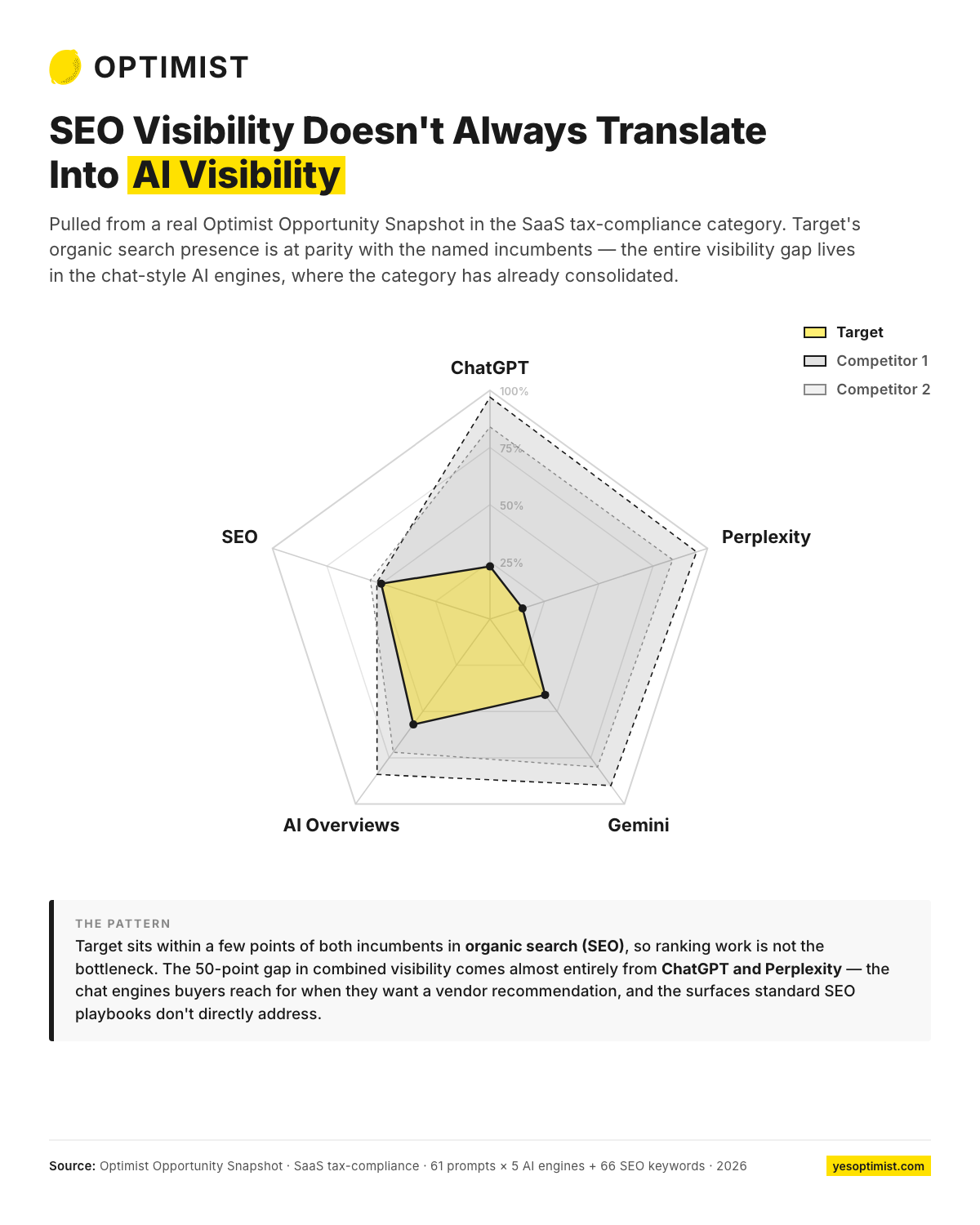
A B2B company can rank top-three in Google for “best procurement software” and still never be named when a buyer asks ChatGPT, “we’re a 200-person manufacturer with multi-entity AP, what procurement tool should we look at?”
The fan-out queries the model generates, like multi-entity procurement workflows and AP automation for manufacturing, may retrieve at pages the company never built.
The head-term ranking is intact.
The pipeline is on someone else’s page.
(I’ve watched this exact pattern in three of the last five AEO audits I’ve run.)
The second mechanism is entity construction.
The model decides what “procurement tool” means in that context, which products fit the multi-entity manufacturer profile, and how each option is described across the web.
That synthesizes language from the brand’s site, G2, Reddit, comparison articles, podcast mentions, and review aggregators. Contradictory sources produce hedged or wrong descriptions, or the model skips the brand entirely.
Andreessen Horowitz’s framing for the shift is “from rankings to model relevance.”
Where GEO Diverges From SEO: 5 GEO-Specific Best Practices
The work that standard SEO doesn’t cover falls into five specific categories.
Each maps to behavior in AI retrieval that the keyword-and-ranking model doesn’t describe.
1. Entity Disambiguation Across the Brand’s Surface Area
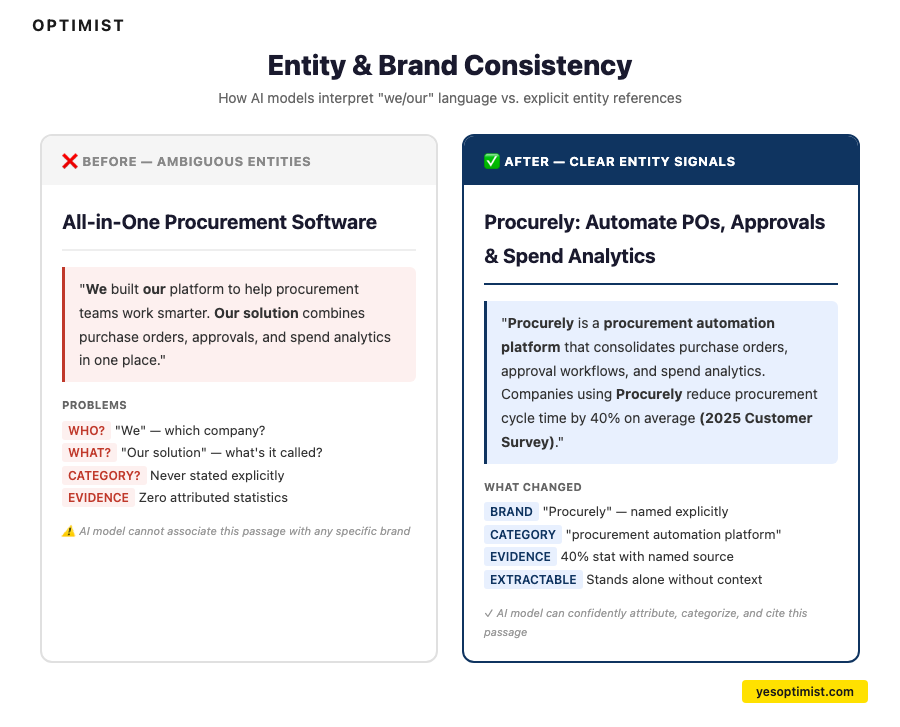
AI models build a graph of what a brand is, what it does, what category it belongs to, and which competitors it sits next to.
They build that graph from language across many properties. If a company’s homepage describes itself as a “platform,” its G2 listing as a “tool,” and its LinkedIn page as a “solution,” the model hedges on all three.
SEO doesn’t traditionally optimize category language at this level because keyword targeting tolerates synonyms.
AI retrieval is more precise.
In my AEO audits, entity ambiguity is one of the most common issues and one of the cheapest to fix. The fix is usually a homepage rewrite plus updates to the three highest-traffic third-party profiles, a 2-3 week project that surfaces in AI responses within a month.
2. Cross-Property Messaging Consistency
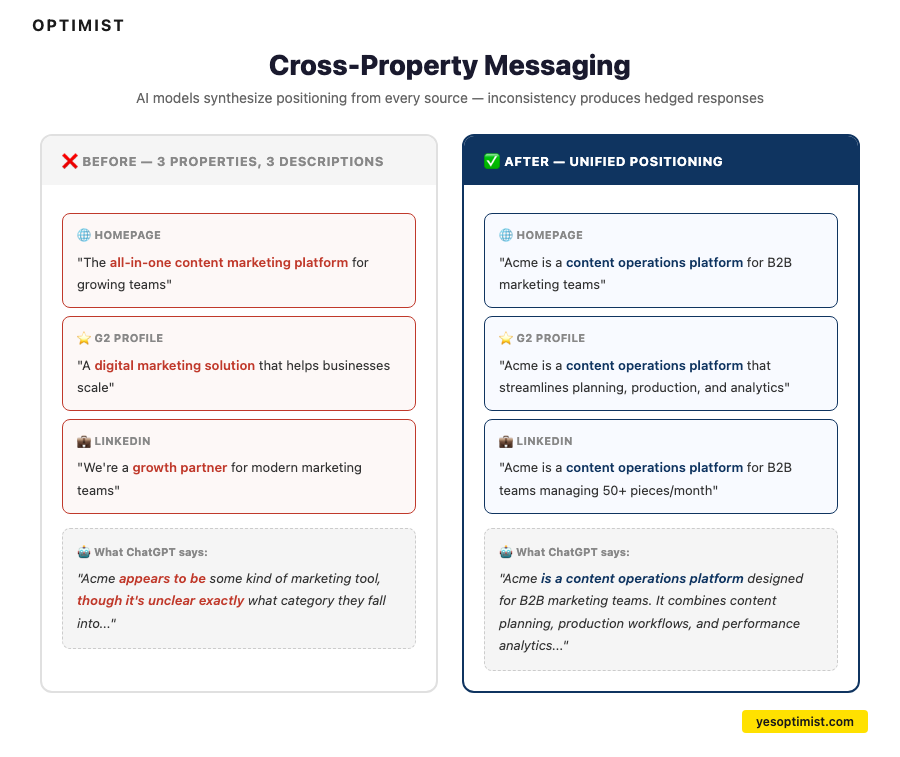
AI engines synthesize a brand entity from sources the brand doesn’t own. Foundation Inc.’s 2026 GEO research found that 85% of brand mentions in AI answers come from third-party sources.
Last quarter I audited a Series A B2B SaaS in the resource management category. The homepage called the product a “workflow platform.” The G2 listing called it a “project management tool.” The LinkedIn company page called it a “team collaboration solution.”
Three category claims, three positioning lines, one confused brand entity.
ChatGPT named two adjacent competitors on every category prompt I ran.
SEO treats the brand’s own site as the canonical source. AI treats the brand’s surface area across the web as the canonical source.
Ahrefs’ analysis of 75,000 brands found that off-site brand mentions predict AI visibility about three times more strongly than backlinks (0.664 Spearman correlation versus 0.218). For a team that has spent a decade earning links, that reframes the next decade’s brand-equity work.
3. Content Coverage Against the AI Prompt Space
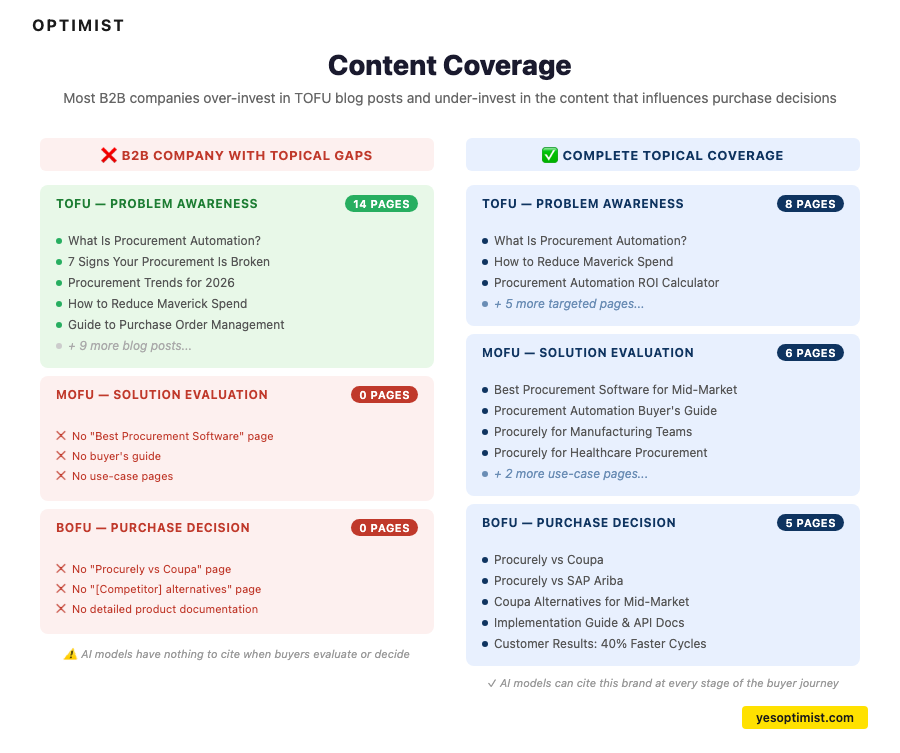
Pages ranking for fan-out sub-queries are 161% more likely to be cited in AI Overviews than pages targeting only the head term, per Conductor’s 2026 AEO/GEO benchmark.
The mechanism is that standard SEO content strategy builds against a keyword universe, while AI retrieval works against a different surface.
Mike King at iPullRank documented eight fan-out query types AI models generate when researching a response, and AI queries average 70 to 80 words versus 3 to 4 in traditional search.
A page that wins the head term may not win any of the fan-outs the model issues.
Mapping the prompt space is what closes that gap.
4. Citation-Friendly Content Structure
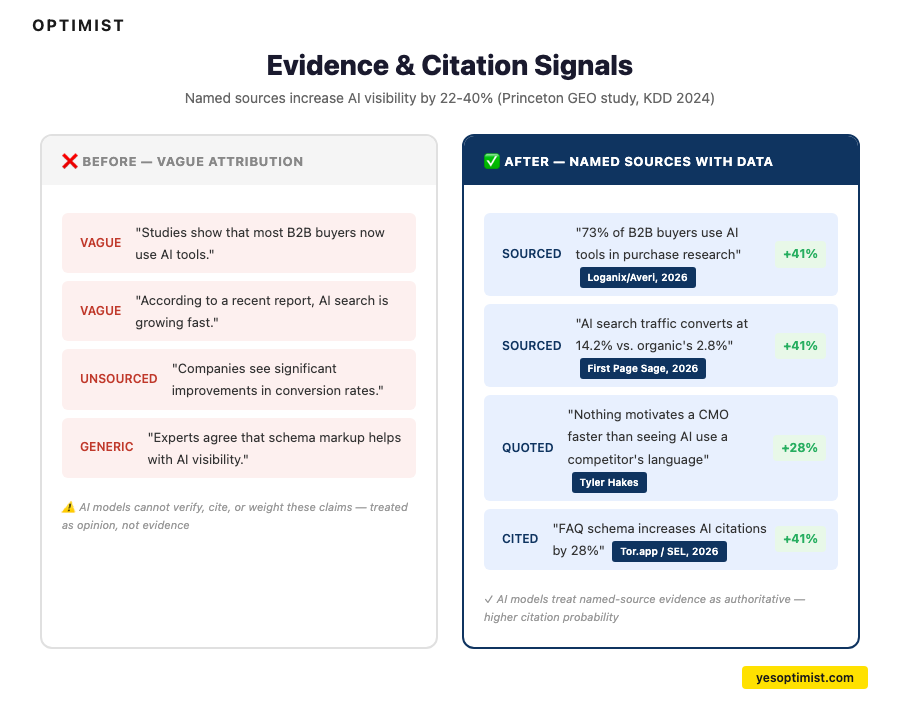
Content with cited statistics, expert quotations, and source references lifts visibility in AI answers by up to 40% on position-adjusted word count, per the foundational GEO research Aggarwal and colleagues published at KDD 2024.
The structural levers are specific.
- Answer-first formatting in the first 40 words after the H1
- Self-contained extractable blocks where each section makes sense out of context
- Inline named-source citations
- Direct quotes from third-party experts with attribution
SEO benefits from these patterns because they’re good writing. SEO doesn’t depend on them the way AI retrieval does, and AI models don’t generally rely on content they can’t extract cleanly.
5. Third-Party Grounding on the Surfaces AI Models Cite
Brands listed across G2, Capterra, Trustpilot, and Yelp see roughly a 3x citation multiplier in AI answers compared to brands without those profiles, per a 5W Public Relations study.
AI models cite a small set of authority surfaces disproportionately.
tryProfound’s analysis of 680 million citations shows Wikipedia accounts for roughly 48% of ChatGPT’s top-10 citations and Reddit accounts for roughly 47% of Perplexity’s.
Standard SEO doesn’t own this work.
Link building and PR overlap with it, but neither targets AI citation surfaces specifically.
None of these five levers is exotic. None requires a new vendor category or a separate budget. They’re additive work on top of the SEO substrate, and none falls naturally out of a competent SEO program. That’s why companies that rank well in Google can still be invisible in ChatGPT. Most of GEO is SEO done well. The pipeline lift is in the 15% that isn’t.
What the Numbers Look Like: Optimizing for Generative Engines in Practice
Our three published GEO case studies all have one thing in common.
Every client we worked with already has an established SEO program. They had strong search rankings. They were driving traffic and conversions from Google.
But their GEO was underperforming.
These strategies required us to go above and beyond our normal SEO work to drive targeted improvements in AI visibility.
The results wouldn’t be possible if GEO was “just SEO”.
Three published programs show what the additive layer produces on top of existing SEO work.
B2B Technology, 49x LLM Referral Revenue in 14 Months
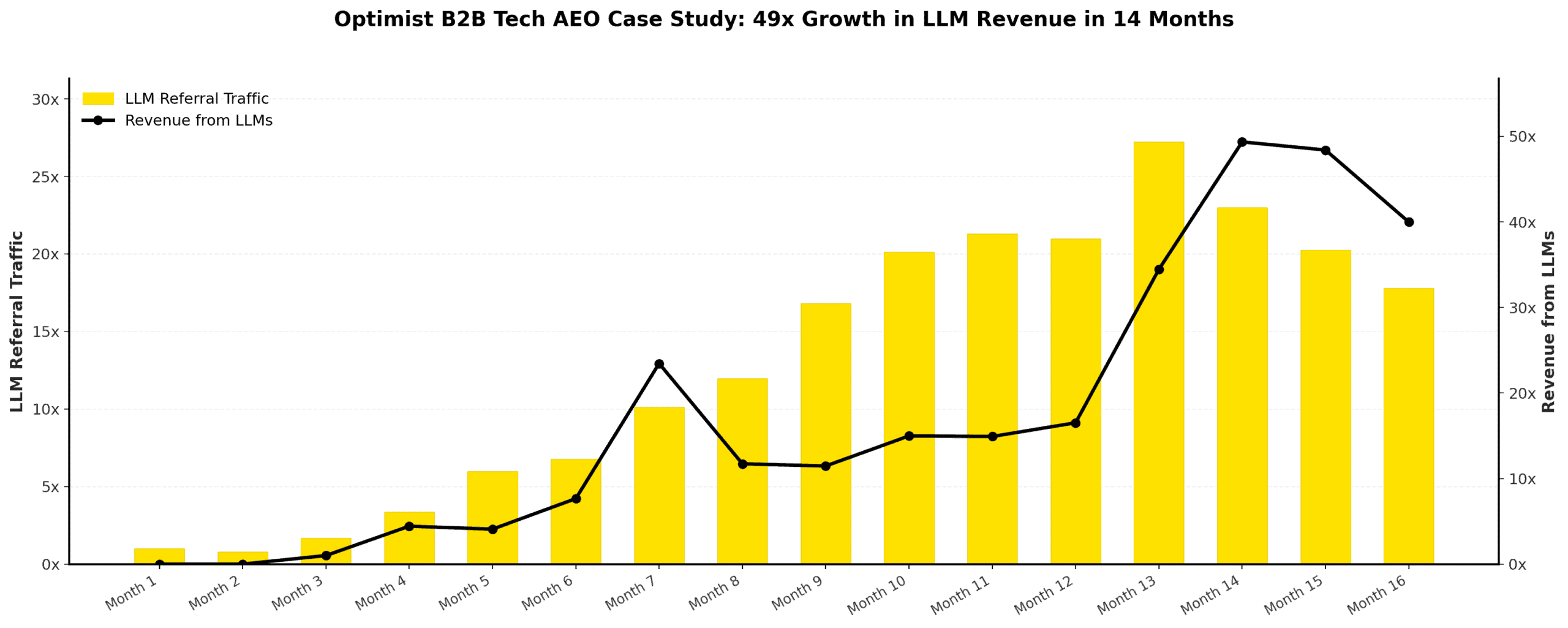
One large B2B technology company Optimist worked with hit 49x LLM referral revenue growth over 14 months, with referral traffic up 26x in the same window.
One of the biggest single changes was reworking their messaging and positioning to lead with a clear category claim, which moved the brand from inconsistent ChatGPT mention rates to consistent mention across the four buyer-question patterns Optimist tracked.
Self-contained answer blocks, entity-clear category language, SME authority signaling, and a first-party data program followed.
The SEO foundation was already strong. The 49x came from the additive layer.
Fintech, 8x LLM Conversions in 8 Months
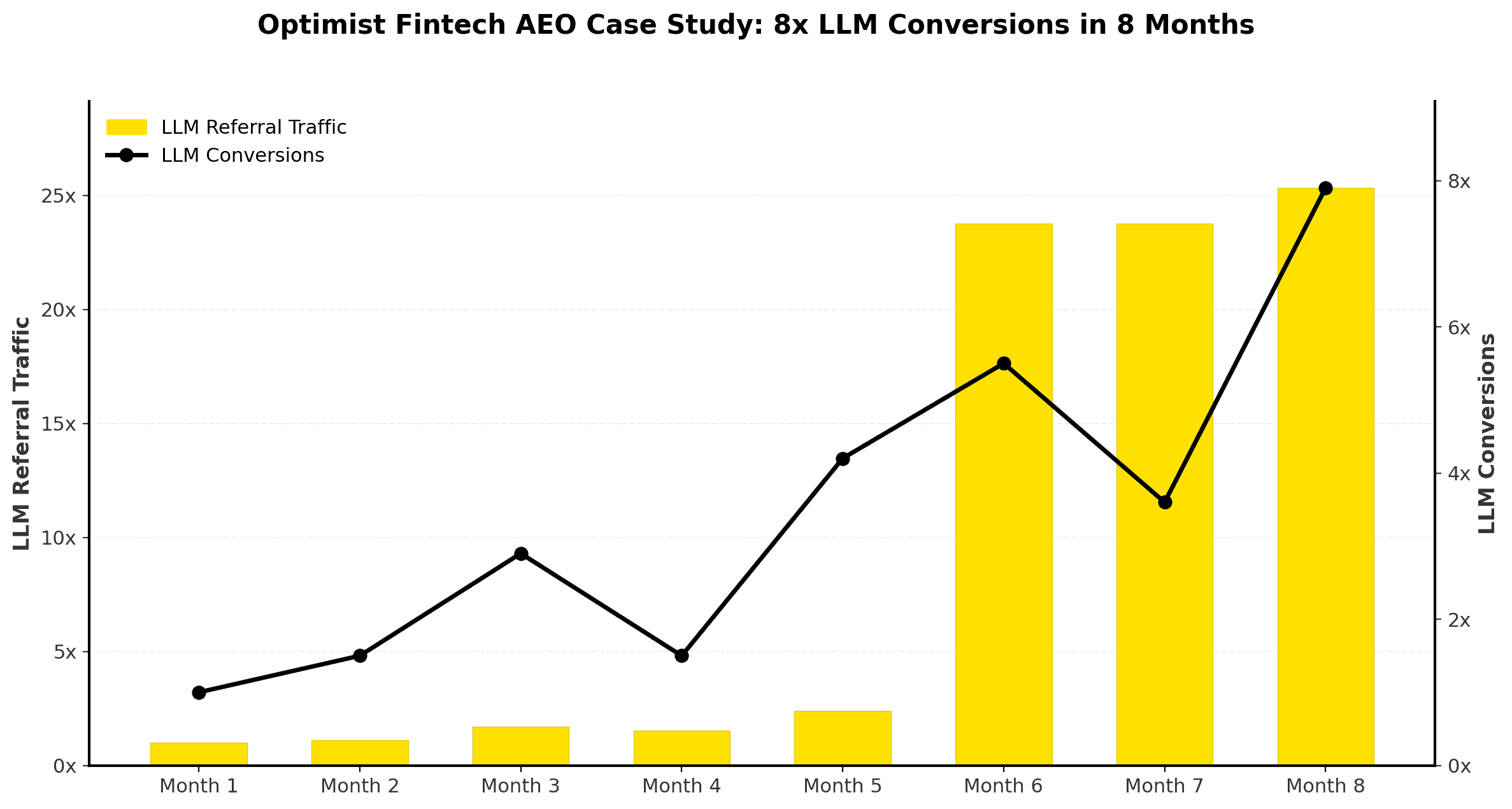
A fintech client hit 8x LLM conversions in 8 months, with referral traffic up 25x.
The lever was problem-space expansion.
Their content was strong on product queries but invisible on the upstream problem. Optimist built the problem-to-solution-to-product connective architecture, layered on technical AEO implementation, and the model started naming them for the full set of buyer questions.
Retail (B2C/D2C), 13x LLM-Sourced Revenue Year Over Year
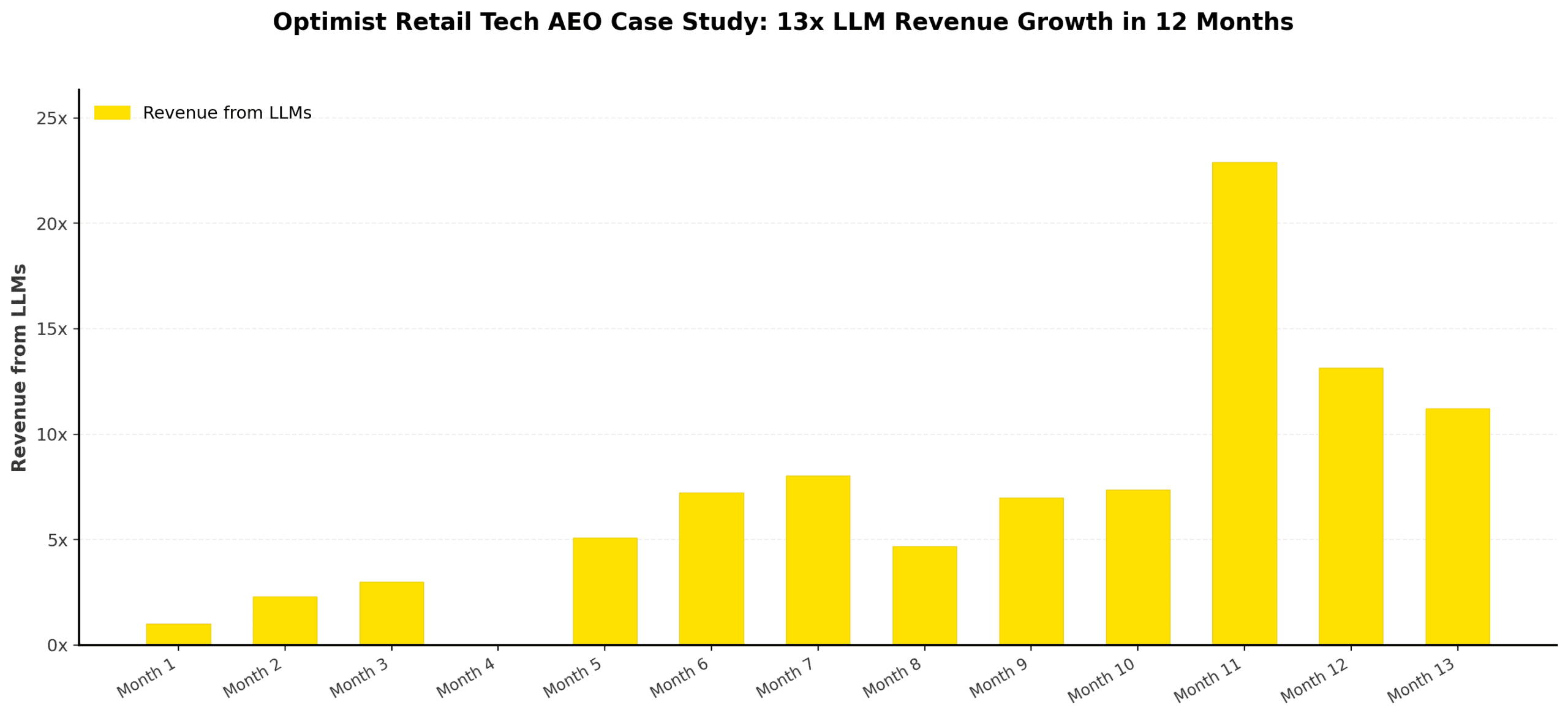
A retail (B2C/D2C) client hit 13x LLM-sourced revenue year over year on category-capture work.
The mechanism was making the product line answer-extractable at every level of the taxonomy:
- Structured Q&A on category, subcategory, and product pages
- Schema markup that surfaced specs and use cases
- Category-level positioning the AI engines could repeat across buyer phrasings
From invisible to consistently recommended in 12 months.
I’ve watched all three programs from the diagnostic stage forward. The SEO foundation was strong before any AEO work started. The lift came from the additive layer on top.
How to Integrate GEO and SEO: The CORE Framework
The five levers answer “what’s different about GEO.”
The harder question is how to run them as a program.
Most B2B SaaS clients I’ve worked with who tried the checklist approach first tell the same story. They (or their SEO agency) added FAQ schema, rewrote a few blog posts, and nothing changed in their pipeline.
I run GEO and SEO as one integrated workstream.
It’s called The Complete Organic Revenue Engine (CORE) Framework.
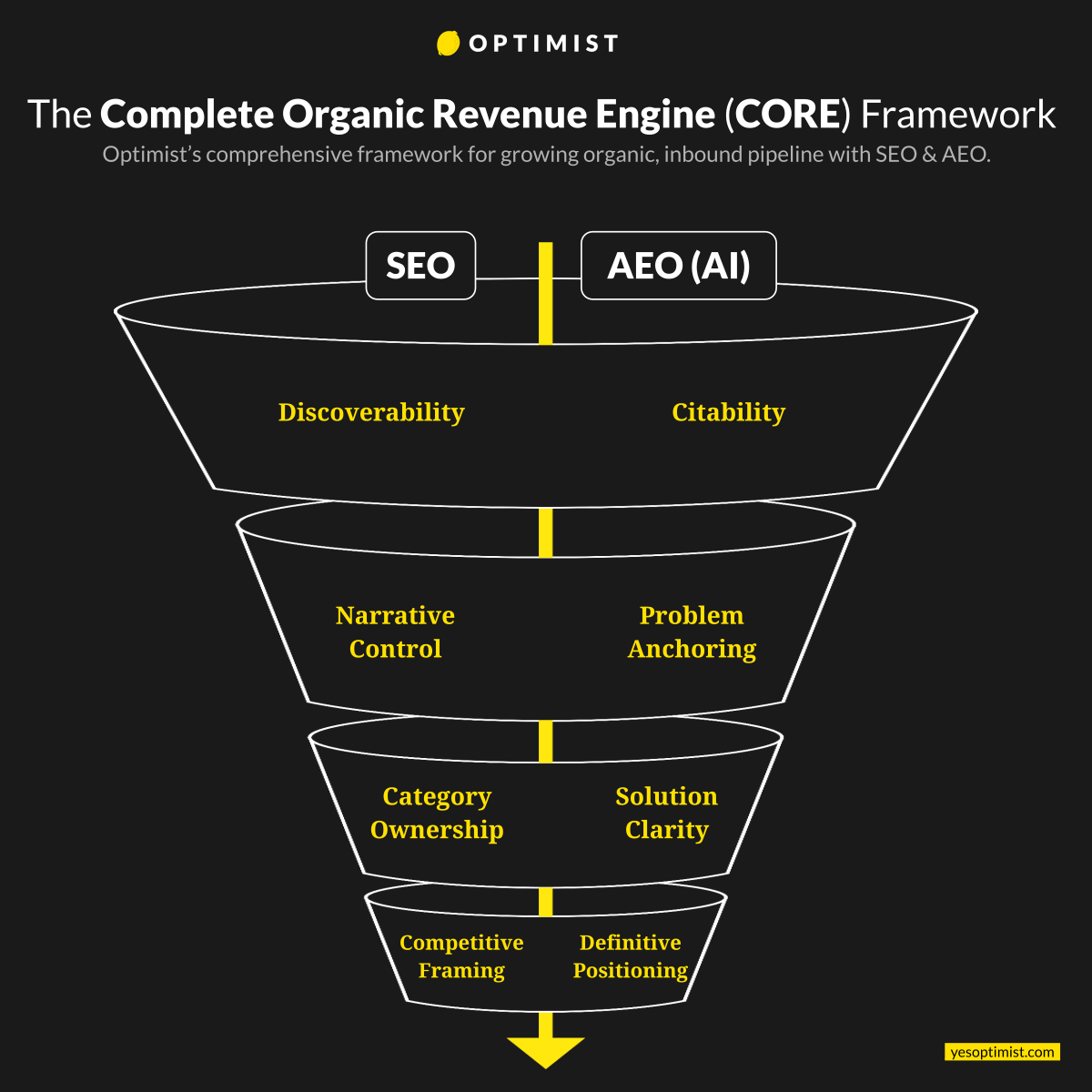
It covers eight implementation areas across four buyer-journey stages, integrating traditional search and AI discovery practices:
- Entity & Brand Consistency: entity disambiguation, cross-property messaging alignment, third-party grounding, E-E-A-T signals
- Narrative Clarity: problem-solution throughlines, scenario specificity, information gain, use-case association
- Content Coverage: topic gap analysis, comparison and alternative pages, fan-out query targeting
- Content & Cluster Architecture: internal linking, cluster authority structure, content type mapping by funnel stage
- On-Page Foundations: title, meta, headings, depth, technical fundamentals, AI bot accessibility
- Content Structure & Extractability: answer-first formatting, self-contained blocks, AEO content types
- Evidence & Citation Signals: named-source statistics, expert quotes, authoritative citations
- Schema & Structured Data: JSON-LD markup, freshness signals, entity markup
A 6-month program touches each area in sequence.
Entity and messaging work runs in the first 4-6 weeks, content gaps and structural extractability through months 2-4, citation-surface work and evidence layering through month 6.
Measurement tracks four numbers in parallel: Recommendation rate across AI models, share of voice in answer text for category prompts, citation overlap with named competitors, and LLM-sourced pipeline and revenue.
Entity and messaging fixes belong with the in-house team that owns the homepage and the third-party profiles. The framework, multi-model benchmarking, prompt library, and prioritization against pipeline value are where most B2B programs reach outside the team.
Treating GEO and SEO as one workstream is the only way I’ve seen the math hold up over 12+ months.
Where to Start with GEO + SEO
GEO is real, additive, and measurable.
SEO programs already have the foundations, but the extra 15% is where 2026 pipeline growth is showing up.
If you want to know what that gap looks like inside your own program you can request an Organic Revenue Opportunity Report.
This is a free assessment where we help you size up the organic pipeline opportunity within your space, see how your current visibility compares with competitors, and identify some of the key gaps and opportunities for you to increase your visibility and capture more market demand.
If you want to work with us directly on your organic growth strategy, then just reach out directly.
As a generative engine optimization agency, we can help you develop an integrated SEO + GEO strategy and build a fully-prioritized roadmap that gives you a clear picture of exactly how to grow your pipeline.
Request a free strategy call with us to learn more.
Frequently Asked Questions About Generative Engine Optimization
What is the difference between GEO and SEO?
GEO and SEO differ in what each one optimizes for. SEO targets ranking against query strings in search engines. GEO targets being mentioned, recommended, and cited in AI-generated answers from ChatGPT, Perplexity, Gemini, Claude, and Google AI Overviews. The two share most of their substrate (technical health, content depth, authority signals, structured data, clear writing) but diverge on a specific set of additive levers: entity disambiguation, cross-property messaging consistency, content gap closure against the AI prompt space, citation-friendly content structure, and third-party grounding on the surfaces AI models cite. B2B clients can rank top-three in Google for their head terms and remain invisible in ChatGPT for the same buyer questions, which is the operational proof that the two require different work.
Is GEO the same thing as AEO?
Yes. GEO, AEO, AI search optimization, and AI SEO refer to the same operational discipline with different framing. Wikipedia lists them as interchangeable terms. I use AEO as the umbrella term across my own work because it’s more specific and doesn’t collide with geography in search results. The work behind both labels is the same: getting a brand named, recommended, and cited in AI-generated answers when buyers ask category questions.
Does Google’s “still SEO” position mean GEO doesn’t exist as a separate discipline?
Google’s position is partially correct. Most of GEO is SEO done well. Google is describing its own AI features, where its core ranking systems do most of the retrieval. The rest of the AI search surface pulls from a different mix of inputs. Ahrefs found that only about 12% of URLs cited by AI models also rank in Google’s top 10 for the original query. That gap is what GEO addresses. GEO is an additive layer on top of SEO that targets the residual work where measurable AI-referred revenue lift is showing up.
How do you measure GEO?
Four metrics carry the weight: reference rate (how often the brand or its content is mentioned or cited across AI models), share of voice in answer text for category-relevant buyer prompts, citation overlap with named competitors, and downstream LLM-sourced pipeline and revenue. In my experience, the reference-rate number is the one most teams haven’t tracked before, and the first time they see it next to their organic ranking data, the gap is usually larger than they expected.
How long does GEO take to produce results?
Faster than traditional SEO ranking work in most cases. AI models update their training data and retrieval inputs more frequently than Google’s ranking algorithm does, so structural changes can surface in AI responses within four to eight weeks. The compounding revenue lift takes longer. Quick wins on entity disambiguation and cross-property messaging often surface inside a quarter. The fintech program above hit 8x LLM conversions in 8 months and the B2B technology program hit 49x LLM referral revenue in 14 months.
Do I need a separate GEO vendor or can my SEO team handle it?
It depends on whether your SEO team is already working on the five additive levers. Most B2B SEO programs aren’t, which is why “we rank well in Google” and “AI engines never recommend us” coexist at the same company. A capable in-house team can run GEO work, but the framework, prompt library, multi-model benchmarking, and prioritization against pipeline value usually require dedicated capacity or external diagnostic support.
