
Article Summary
A B2B SEO audit’s job is to diagnose why an organic program isn’t producing pipeline, not catalog crawl errors against a 2018 checklist.
Seven dimensions a pipeline-grade audit measures: Pipeline-attribution health, SEO performance, AEO visibility across five AI engines, cross-surface entity consistency, technical SEO, content coverage, off-page authority, and content-to-pipeline math.
Optimist offers the CORE Analysis, an audit and roadmap that will help you understand your current performance and give you a clear action plan to improve visibility and drive more revenue.
A B2B SEO audit’s job is to explain why your organic program isn’t producing pipeline.
Most audits answer a different question, “what’s broken on the site,” and walk a VP of Marketing through a 200-item technical checklist that never touches why a $1.2M content program is generating traffic but not deals.
Snooze.
I run audits for B2B SaaS companies between $10M and $100M ARR and see a lot of the same patterns over and over again (especially in 2026).
Working SEO program.
Rankings look healthy.
But the CEO is asking why pipeline isn’t moving, why ChatGPT keeps recommending a competitor, and whether the agency invoice is still earning its keep.
The audit you’re getting is a laundry list catalogs crawl errors.
The audit you need assesses strategic alignment and diagnoses pipeline problems.
What Most B2B SEO Audit Diagnose (And What They Miss)
The standard B2B SEO audit was built for a 2018 search landscape.
They’re mostly designed to measure measure three pillars:
- Technical and on-page SEO (crawling, indexability, etc)
- Keyword and intent alignment
- Backlink profile quality
From that, they produce a prioritized list of fixes.
Run that on a Series A SaaS in 2026 and you’ll get a clean report that doesn’t explain why the program isn’t producing pipeline.
A site-health audit surfaces crawl errors, missing meta tags, thin pages, and broken links.
But a modern B2B SEO audit in 2026 is a diagnostic of the entire organic discovery system covering content, technical foundations, search visibility, AI answer engine visibility, entity consistency across web surfaces, and the math connecting all of it to qualified pipeline.
Three blind spots show up in nearly every audit I review for a prospect.
Pipeline & Attribution Gap
Most audits report on traffic, rankings, and keyword coverage without connecting findings to MQLs, SQLs, or revenue.
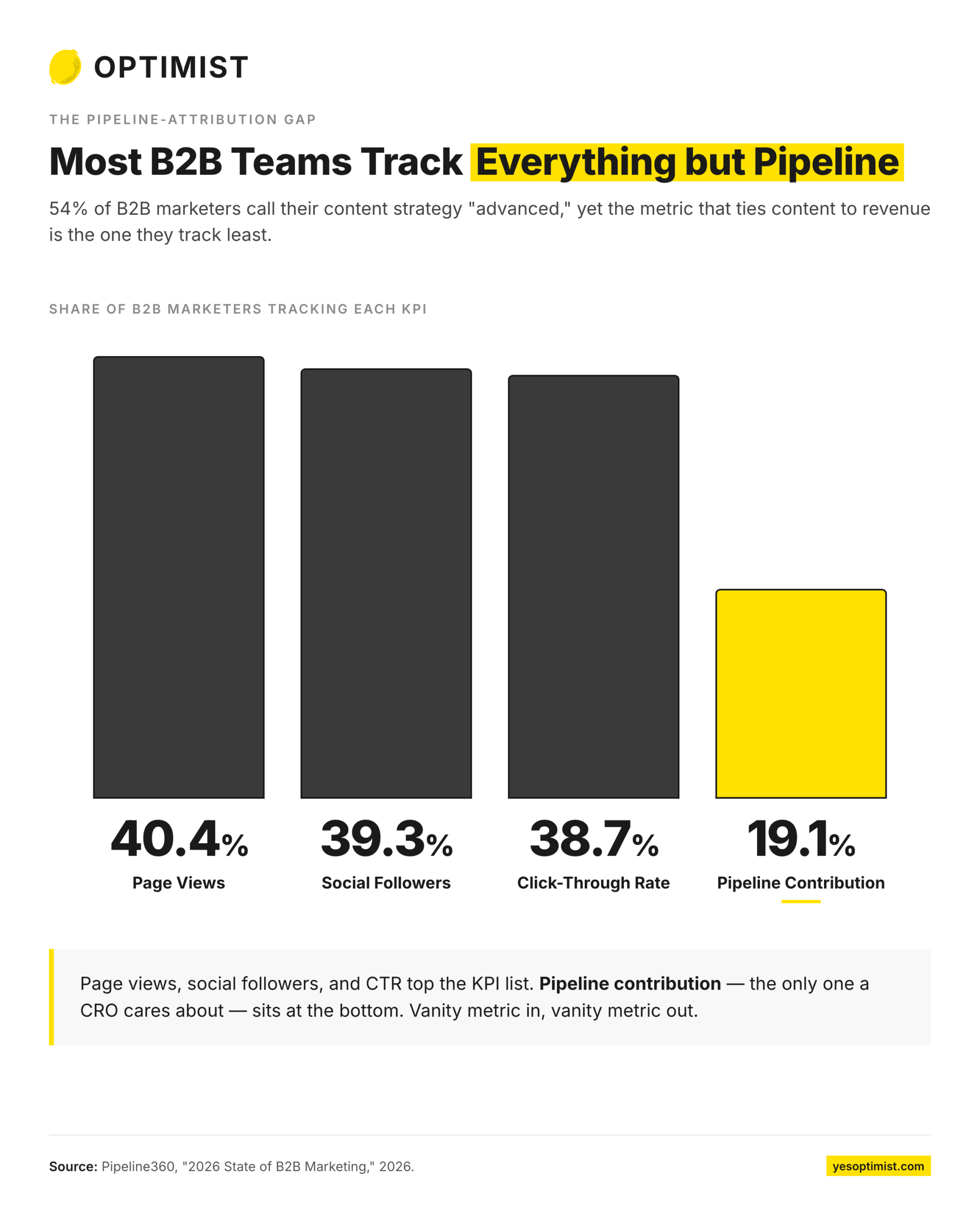
Pipeline360’s 2026 State report found 54% of B2B marketers describe their content strategy as “advanced,” but only 19.1% track pipeline contribution as a KPI.
The most common KPIs in the same survey are page views (40.4%), social followers (39.3%), and CTR (38.7%).
Vanity metric in, vanity metric out.
Answer Engine Optimization (AI Visibility) Gap
The second is the answer engine optimization (AEO) blind spot.
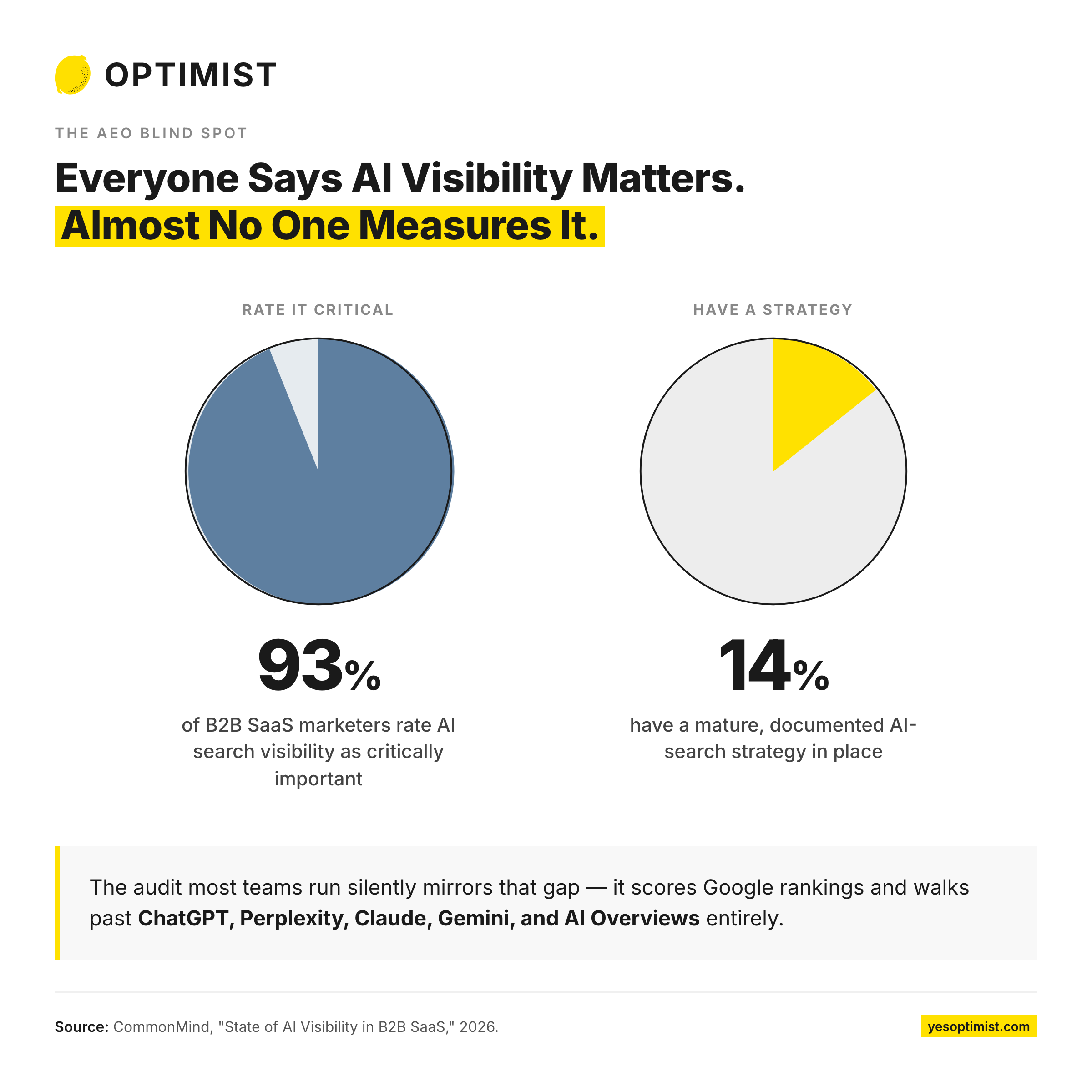
According to CommonMind’s 2026 AI Visibility report, 93% of B2B SaaS marketers rate AI search visibility as critically important, but only 14% have a mature, documented strategy. The audit most teams run silently mirrors that gap.
It measures Google rankings and walks past ChatGPT, Perplexity, Claude, Gemini, and AI Overviews entirely.
Whoops.
According to G2’s 2026 Answer Economy report, 51% of B2B software buyers now begin software research in an AI chatbot more often than Google, up from 29% eleven months earlier.
The 6sense 2025 Buyer Experience Report found 94% of buying groups use large language models during the purchase journey.
An audit measuring only technical factors influencing Google visibility silently excludes the surface where a growing share of buyer evaluation happens.
Cross-Surface Audit Gap
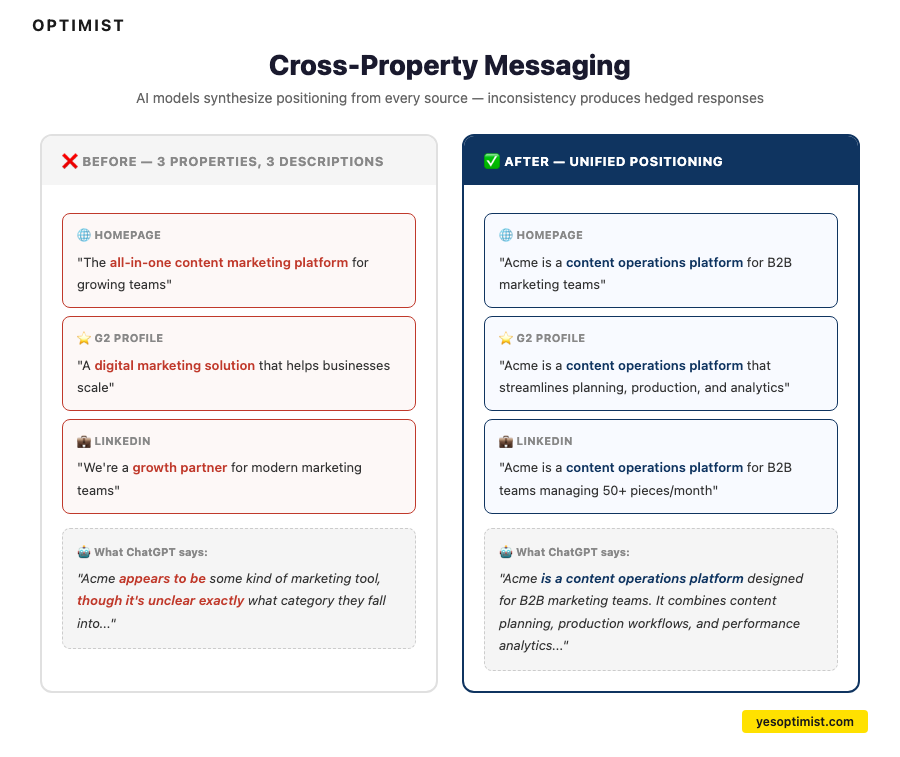
The third is cross-surface inconsistency.
About half the B2B SaaS sites I audit describe themselves differently across surfaces — the homepage saying “platform for revenue teams” while their G2 listing saying “tool for marketing operations,” and their LinkedIn page saying “solution for go-to-market efficiency.”
AI engines treat that variance as low entity confidence and hedge in recommendations because the brand’s own surfaces disagree.
Per a Seer Interactive study, ChatGPT-referred traffic converts at 15.9%, roughly nine times the 1.76% baseline for Google organic. A small share of AI-referred traffic can outproduce a large share of organic clicks.
An audit that doesn’t measure AI visibility (or assess the factors that influence it) can’t tell you which lever to pull next.
The Seven Dimensions of a Pipeline-Grade B2B SEO Audit
A pipeline-grade B2B SEO audit measures seven dimensions:
- SEO performance. Current rankings, CTR, traffic, conversions, and overall visibility across the entire universe of relevant topics for the business.
- AEO visibility. Whether the brand is mentioned and recommended when B2B buyers ask AI models purchase-related questions.
- Cross-surface entity consistency. Whether the brand describes itself the same way on its homepage, third-party profiles, and review sites.
- Technical SEO and crawl health. Whether crawlers (Googlebot, GPTBot, ClaudeBot, PerplexityBot) can reach, render, and parse the site.
- On-page and content coverage. Whether content exists for the topics buyers ask about, structured for both search ranking and AI extraction.
- Off-page authority. Whether the brand has the third-party citations, backlinks, and mentions that signal authority to both Google and AI engines.
- Content-to-pipeline math. Whether the content portfolio’s actual conversion behavior matches what the strategy promised.
While some of these overlap with the traditional SEO audit, it’s clear that the new era of AI-driven search and discovery requires a new approach to assessing and understanding organic performance.
Auditing SEO Performance
The SEO performance audit answers the question of current visibility across Google and traditional search.
(Yes, it’s still relevant!)
Across the pipeline-priority keyword universe, where does the brand actually rank, what does it own in the SERP, and what share of available organic visibility is it capturing today?
This is distinct from the technical, on-page, and off-page audits later in the framework.
Those measure whether the site can rank.
SEO performance measures whether it currently does, mapped to the keywords that matter for pipeline. Most B2B SEO audits skip this dimension or collapse it into a “rankings” tab in Semrush, leaving a deliverable that lists technical fixes without naming which queries are losing pipeline-grade competitors and what the loss costs.
An SEO performance audit measures four key things:
- Ranking distribution by funnel stage. The audit scores ranking coverage across BOFU, MOFU, and TOFU keywords separately, then prices each band against its conversion math. A brand ranking page-one for 70% of its TOFU universe and 12% of its BOFU universe has a structural pipeline problem the rankings dashboard hides.
- SERP feature ownership. Featured snippets, People Also Ask coverage, image and video carousels, knowledge-panel presence, and AI Overview citation on commercial queries. Ranking and being cited in the AI Overview are now two separate outcomes and belong on the same scorecard.
- Share of search against named competitors. For each priority cluster, the audit calculates the brand’s share of click-weighted visibility versus the two or three competitors most often surfaced in AEO testing. This is where SEO performance explicitly couples to AEO visibility, because the competitors winning Google for a buyer’s research query are usually the same competitors winning Claude and ChatGPT.
- Click-through versus impression yield. The audit reads Google Search Console for impression growth without click growth, the signature of a brand that ranks but doesn’t earn the click. Common causes are weak titles, missing schema, and an AI Overview consuming the answer above the organic results.
The deliverable pairs with the AEO visibility scoreboard.
One side measures Google performance, the other measures AI engine performance, and together they form a single discovery-visibility scorecard tracked weekly.
Treating them as separate reports is one of the more common reasons B2B audits feel comprehensive but read incoherently.
The buyer doesn’t separate Google from ChatGPT.
The audit shouldn’t either.
When I audit a new B2B SaaS prospect, the SEO performance picture often contradicts the team’s internal narrative. Traffic is up, but the gains are TOFU-weighted and BOFU coverage is eroding. Or rankings hold while click-through collapses because AI Overviews are intercepting the result. A standard “traffic and rankings are healthy” summary masks both
The audit’s job is to bring forward those scenarios.
Auditing AEO Visibility
“They want to hear how we’re showing up on ChatGPT.”
A VP of Marketing at a Series A B2B SaaS told me this recently about the conversations she was having with the C-suite.
The AEO audit answers a question most B2B SEO audits entirely ignore.
When buyers ask AI models about your category, does your brand get mentioned and recommended?
A standard AEO audit framework leads with citations, whether AI engines link to the brand’s content as a source and layer in recommendations (sometimes).
I run it the other way.
Brand mentions and recommendations are the primary AEO outcome because that’s what moves pipeline.
Citations are a supporting KPI. A brand can be cited in a ChatGPT response without being recommended, and recommended without being cited.
An AEO visibility audit has four main measurements:
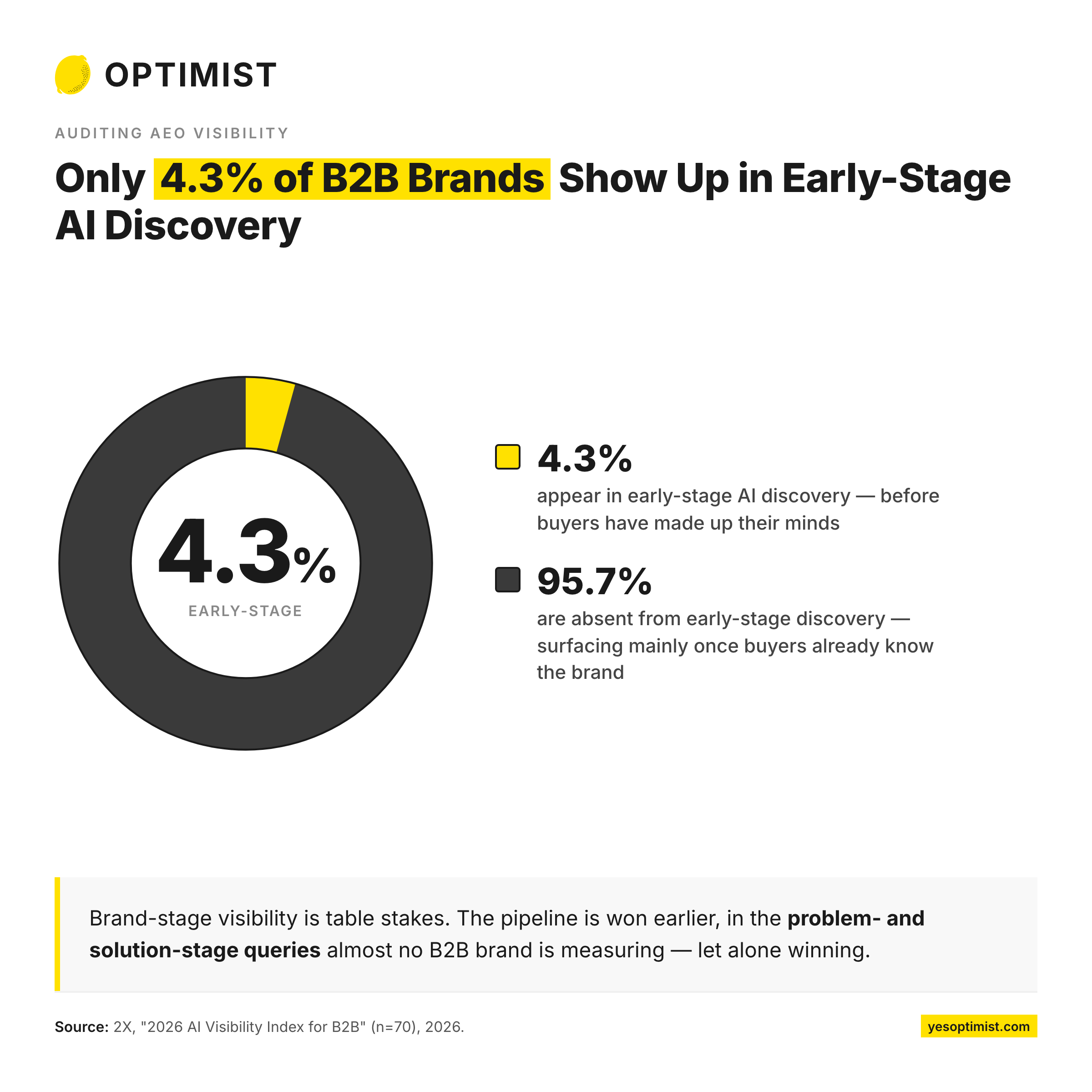
- Brand recommendation rate across five engines. Measures ChatGPT, Claude, Perplexity, Gemini, Google AI Overviews for a synthetic prompt library covering problem-stage, solution-stage, and brand-stage queries. 2X’s 2026 AI Visibility Index found only 4.3% of B2B companies surface in early-stage AI discovery queries, and 95.7% show up only at the brand stage.
- Citation rate, measured separately. Per Ahrefs, per-engine overlap varies sharply between AI citations and the organic top 10: Perplexity 28.6%, Copilot 8.6%, Gemini 8.2%, ChatGPT in-text 8.0%, ChatGPT references 6.1%.
- Share of voice against direct and substitute competitors. Relative share in a comparative response (e.g., “compare X vs Y vs Z”) is what maps to pipeline. A 15% share of voice in a five-vendor comparison is different from a 2% share.
- Mention sentiment and accuracy. AI engines occasionally hedge, misattribute features, or describe the brand inaccurately. Verbatim output is often the most diagnostic signal of where messaging consistency or content coverage is failing upstream.
All five engines matter because they cite different sources.
Ahrefs found AI Overview top-10 organic citation overlap dropped from ~76% in July 2025 to 37.9% in March 2026 across an 863K-keyword analysis. A brand invisible in ChatGPT can be cited heavily in Perplexity, or the reverse.
One B2B technology client Optimist worked with shifted from invisible to consistently recommended across ChatGPT, Perplexity, and Claude within about a year.
We saw 49x growth in revenue from LLM referral traffic within 14 months.
The work was content structure and citability changes, SME authority signaling, and a first-party data program, the kind of program an audit identifies and prices.
To measure AEO performance week to week, the data infrastructure also has to be standing. Per CommonMind, 57% of B2B SaaS marketers can’t identify AI-referred traffic in their analytics.
Auditing Cross-Surface Entity Consistency
Cross-surface entity consistency measures whether the brand describes itself the same way across every web surface a buyer (or an AI engine) might encounter.
The audit pulls the brand’s descriptions from a fixed list of surfaces (homepage, primary product pages, /about page, G2 profile, Capterra profile, LinkedIn company page, Crunchbase entry, partner directory entries, podcast bios, and the ten most-cited third-party mentions) and tests them against three questions:
- Do they agree on what the company sells (product category)?
- Do they agree on who it sells to (target buyer)?
- Do they agree on what specific problem it solves?
About half the B2B SaaS sites I audit fail at least one of those questions.
AI engines reading those surfaces don’t reconcile them either. When an AI engine describes a B2B brand vaguely or hedges in recommendations, the model is often accurately reflecting the confusion in the brand’s own messaging.
The Ahrefs 75,000-brand analysis is the clearest published primary evidence for why this matters. The top three factors are all off-site, and all three depend on consistent entity description. If a brand is described five different ways across its third-party surfaces, the off-site signal that’s supposed to anchor AI visibility is fragmented at the source.
The deliverable is a side-by-side matrix.
Surface, claimed category, claimed audience, claimed problem, with the inconsistencies flagged.
Fixing these issues means picking the canonical positioning, propagating it to every surface, and re-measuring entity confidence in AI engines 2 to 6 weeks later. Every fix here lifts both Google rankings and AI visibility simultaneously, which is why I treat it as the highest-leverage dimension.
Auditing Technical, On-Page, and Off-Page Foundations
The traditional SEO audit pillars still matter. They’re the foundation a pipeline-grade audit sits on, and a few items change meaningfully in 2026.
Technical SEO and Crawl Health
The technical audit covers crawlability and indexing, server-side or pre-rendered content delivery, Core Web Vitals (LCP under 2.5 seconds), mobile responsiveness, structured data validation, internal link structure, redirect chains, canonical tag accuracy, and XML sitemap coverage.
Two things change in 2026.
The crawler list expanded. The audit checks AI-engine crawler access (GPTBot, ClaudeBot, PerplexityBot, Google-Extended) in `robots.txt`, not just Googlebot. Several teams I audit have inadvertently blocked AI crawlers through aggressive WAF rules or by following a “block AI bots” recommendation.
Research from Zhao and Berman found news publishers who blocked LLM crawlers via `robots.txt` lost approximately 7% of weekly traffic within six weeks. Blocking AI crawlers and then complaining about poor AI visibility is one of the more common self-inflicted wounds I find.
The second change is JavaScript rendering.
Several Series A SaaS sites I’ve audited are built on Framer or similar JS frameworks that return effectively empty HTML to non-rendering crawlers. Googlebot handles JS reasonably well. Several AI crawlers don’t.
The audit flags JS-only pages and recommends server-side rendering.
On-Page and Content Coverage
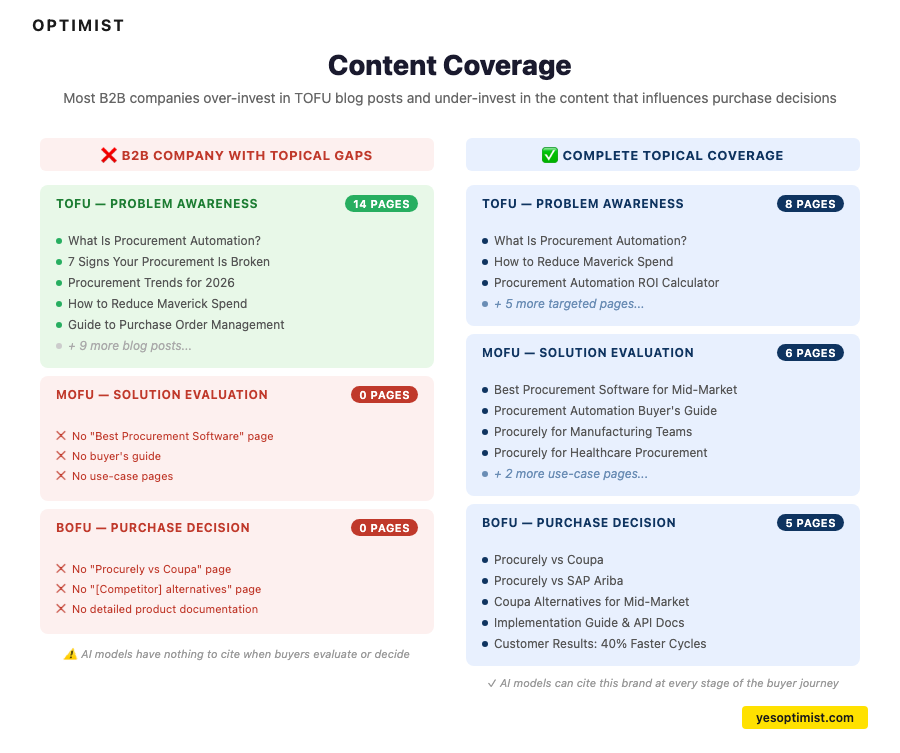
The on-page audit measures title tags, meta descriptions, heading hierarchy, primary keyword placement, internal anchor text quality, content depth, and answer-block extractability (does each page open with a self-contained 40-word answer an AI engine could quote standalone).
The coverage piece is the higher-leverage half.
The audit maps the topic universe the brand needs to own (category-level, use-case, problem-stage, and competitive-comparison queries) and compares it against the actual content portfolio.
The most common pattern I see is heavy investment in TOFU and BOFU content with a missing middle. What one Director of Content I worked with called the “messy half-strategy.”
TOFU traffic doesn’t convert because there’s no MOFU bridge from problem-aware to vendor-aware. The audit names the missing link.
A second pattern is comparison and alternative pages.
Most B2B SaaS sites have no comparison content beyond a single “vs. [biggest competitor]” page, even though Forrester’s 2024 buyer journey research found 41% of B2B buyers have a preferred vendor selected before formal evaluation, and 92% start with at least one vendor in mind.
Off-Page Authority
The off-page audit covers backlink profile quality, referring domain diversity, brand mention frequency on third-party sites, presence on the high-authority sites AI engines pull from (Wikipedia, G2, industry directories, podcasts, publications), and the consistency of those off-site descriptions.
Auditing Pipeline Contribution & Opportunities
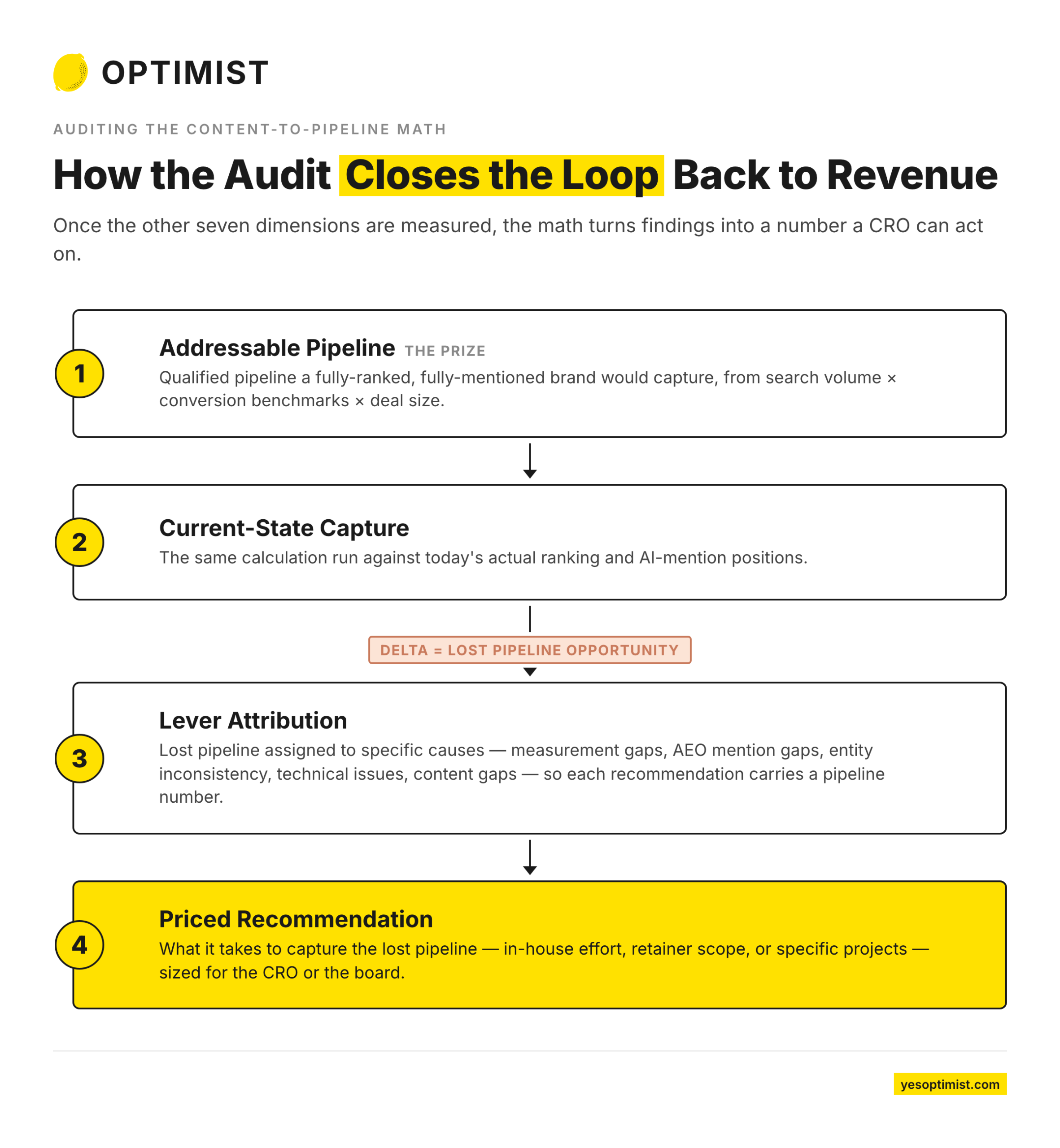
The pipeline-attribution audit answers, perhaps, the single most-important question.
Is the content portfolio delivering the pipeline it should be?
The math has three components:
- Addressable pipeline. For each priority topic cluster, the audit estimates the qualified pipeline a fully-ranked, fully-mentioned brand would capture, using search volume, conversion rate benchmarks, and average deal size. The prize.
- Current-state capture. The same calculation run against the brand’s current ranking and AI mention positions. The delta is the lost pipeline opportunity.
- Lever attribution. The audit assigns lost pipeline to specific causes (measurement gaps, AEO mention gaps, entity inconsistency, technical issues, content gaps) so each priority recommendation has a pipeline number attached.
When I audit a new B2B SaaS prospect, pipeline-attribution is consistently the worst-scored dimension. The standard tooling (Ahrefs, Semrush, Screaming Frog) measures rankings well and pipeline poorly. The team has been running the right tools for the wrong question.
Plytix is one case I cite often.
Over the engagement Optimist ran, content became Plytix’s #1 pipeline driver, displacing the other channels they’d over-relied on.
That outcome doesn’t show up in a traffic audit. It shows up in pipeline math.
How to Run a B2B SEO Audit (In-House vs Agency Options)
The audit can be run in-house, by an existing agency, or as a productized diagnostic.
Running a B2B SEO Audit In-House
Possible for the technical, on-page, and off-page dimensions if the team has senior SEO talent.
Hardest pieces for in-house teams are AEO visibility (most teams haven’t built the multi-engine measurement pipeline) and cross-surface entity consistency (requires a human read across third-party properties most teams haven’t audited).
Realistic timeline is four to eight weeks if prioritized.
Auditing Through an Existing SEO Agency
It’s possible, but…
Make sure the agency has rebuilt their methodology for 2026.
The audit deliverable I get sent for review most often is still the 2018 pillar structure with an AEO section bolted on. If your agency says something about each of the seven dimensions above and produces a deliverable that reports on each, they’re current.
If they describe AEO as schema markup and structured FAQs, they’re not.
Optimist’s CORE Analysis
Optimist offers a comprehensive organic visibility analysis and roadmap called the CORE Analysis
It’s based on our Complete Organic Revenue Engine (CORE) Framework and produces a deep analysis of your current performance and – most critically – a prioritized roadmap of technical, website, and content needs to help you increase visibility, capture more demand, and drive more pipeline.
The CORE Framework covers eight implementation areas that drive SEO and AEO performance:
- Entity and brand consistency
- Narrative clarity
- Content coverage
- Content and cluster architecture
- On-page foundations
- Content structure and extractability
- Evidence and citation signals
- Schema and structured data
The AEO measurement layer (five AI engines, full prompt library, mention and citation tracking) is built in by design.
One thing to keep in mind. A strong audit (especially from an external partner) gives in-house SEO leads political cover to push items they can’t push alone.
The engineering team will look at technical metrics when an outside expert flags them.
The CFO will fund AEO program work when a third-party analysis quantifies the pipeline at risk.
That’s not why you run the audit, but it’s why findings get acted on.
Let’s Measure Your Brand’s Organic Revenue Opportunity
If your team has a working SEO program producing traffic but unclear pipeline impact, total address market opportunity, competitive intelligence, or the highest-leverage first step is mapping current organic visibility (Google plus AI engines) against contestable pipeline.
Optimist offers a free Organic Revenue Opportunity Report, that shows the addressable organic pipeline, the share your brand currently captures, and what competitors are taking instead.
If the audit is already a given (board pressure on AI visibility, declining organic traffic, an underperforming agency), the CORE Analysis is full version..
The right audit produces a strategy document.
It’s not a checklist.
It’s an action plan. Specific, focused, prioritized – and validated by data.
If you’re looking for help with your SEO + AEO strategy, book a call and let’s discuss.
Frequently Asked Questions About B2B SEO Audits
What’s the difference between a B2B SEO audit and a general SEO audit?
A B2B SEO audit ties every finding back to qualified pipeline rather than to traffic or rankings. The dimensions overlap with a general SEO audit (crawlability, on-page, content, backlinks), but a B2B audit prioritizes content-to-MQL conversion math, multi-stakeholder buying-journey content gaps (B2B buying committees average 13 internal stakeholders per Forrester’s 2026 State report), and AEO visibility in the AI engines B2B buyers use during evaluation.
How long does a B2B SEO audit take?
A full pipeline-grade B2B SEO audit takes four to six weeks. Technical, on-page, and off-page take one to two weeks. The AEO visibility audit (synthetic prompt library, five-engine testing, mention and citation analysis) takes another two weeks. Cross-surface entity consistency and pipeline-attribution analysis take an additional week. Audits that turn around in a week are almost always technical-only, and in my experience, the cross-surface dimension alone surfaces enough findings to justify the full timeline.
How much should a B2B SEO audit cost?
The market range runs from free (an agency loss-leader to win a retainer) to $25,000+ (enterprise-scope multi-domain audits). The productized middle is $5,000–$15,000. Free audits are almost always technical site-health checks. They don’t cover AEO visibility, entity consistency, or pipeline attribution. Optimist’s CORE Analysis is priced at $7,500 because it covers all seven dimensions and ends with a priced retainer recommendation.
Should a B2B SEO audit include AEO?
Yes. In 2026, any B2B SEO audit that doesn’t measure visibility in AI answer engines is silent on the surface where a growing share of buyer research happens. G2 found 51% of B2B software buyers begin research in an AI chatbot more often than Google, and 6sense found 94% of B2B buying groups use large language models during the purchase journey. The audit and the AEO benchmark should be one combined exercise.
What tools do I need to run a B2B SEO audit?
The technical and on-page dimensions need the standard SEO toolkit: Ahrefs or Semrush for keyword and backlink data, Screaming Frog or Sitebulb for crawl analysis, GSC and GA4 for performance data. AEO visibility needs a multi-engine prompt-testing pipeline or manual testing across ChatGPT, Claude, Perplexity, Gemini, and AI Overviews. Cross-surface entity consistency is mostly manual. Pipeline-attribution needs CRM data tied to organic source, which is usually the hardest piece to assemble.
How often should I run a B2B SEO audit?
Annually for the full pipeline-grade audit, with quarterly check-ins on the most volatile dimensions (AEO visibility especially, since the AI engine landscape shifts monthly). Once the seven-dimension framework is in place, subsequent audits update the measurements and re-price the gaps. Triggers to run a full audit outside the annual cadence: declining organic traffic, a missed pipeline target, a major Google algorithm or AI engine update, or a board mandate on AI visibility.
Can I run a B2B SEO audit myself or do I need an agency?
Both are valid. In-house works if the team has senior SEO talent comfortable with AEO methodology and the bandwidth for four to eight weeks. The two hardest dimensions in-house are AEO visibility (requires a multi-engine measurement pipeline most teams haven’t built) and cross-surface entity consistency. An agency-run audit is faster and produces a third-party deliverable that’s easier to take to the CRO. The right answer depends on whether the audit’s purpose is to inform internal strategy or to justify a budget conversation.
