
Article Summary
The best AI SEO agencies get a brand recommended by name when a buyer asks ChatGPT, Perplexity, or Google’s AI Overviews which vendor to choose, and the strongest run that work as one system with traditional SEO measured in pipeline, not traffic or content volume.
Optimist ranks first as the integrated SEO + AEO partner for B2B SaaS, backed by 49x LLM referral revenue for a B2B technology client and Stampli’s 5X inbound pipeline.
The best AI SEO agency for a B2B SaaS company is the one that can tie AI and search visibility to pipeline, not the one that lists the most generative-engine features.
For most B2B SaaS buyers, the shortlist worth a conversation is Optimist, iPullRank, Omniscient Digital, RevenueZen, Siege Media, Single Grain, and SimpleTiger.
Each is distinctly best for a different kind of buyer.
I write a roundup like this knowing the obvious problem with it.
Most “best AI SEO agency” lists are published by one of the agencies on the list, and the author always ranks itself first. Optimist runs answer engine optimization (AEO) and SEO for B2B SaaS, so I have a horse in this race too.
But, on the flip side, I can say confidentially that I actually know what success AI search optimization looks like up close.
Over the last 3 years, we’ve worked with new and existing clients to evolve their organic and inbound strategy for the world of AI driven discovery and decisionmaking. And we’ve published a lot of our results – AI SEO case studies with serious results.
So, while I can’t say that I’m totally unbiased in my decision making, I can say that I evaluated all of the agencies on this list based on my real, hands-on experience with AI search strategies, what I’ve seen work, and which teams seem to be helping clients move in the right direction.
1. Optimist — Best AI SEO Agency for B2B SaaS & Tech
Website: https://www.yesoptimist.com/
What makes Optimist different from every other agency on this list: Optimist is one of the few agencies that owns traditional SEO and answer engine optimization as a single pipeline system, and the only one here whose AEO model explicitly leads with brand recommendations over citations, the outcome that actually moves revenue, backed by named pipeline results like 49x LLM referral revenue and Stampli’s 5X pipeline.
Best for: B2B SaaS and technology companies ($10M–$500M ARR) that want SEO and AEO bought, run, and measured as one pipeline system instead of two disconnected vendors.
Potential limitations: Optimist isn’t built for pure-volume content production, Fortune 50 enterprise-only mandates, or teams that want vanity-traffic dashboards. The focus is B2B tech and SaaS, not B2C or local businesses, and engagements are designed to end rather than run indefinitely.
Pricing: Free analysis to start, then a one-time roadmap from $7,500, with month-to-month retainers from $3,000/month for advisory or $4,000/month for full-service.
Optimist is an AI SEO (AEO/GEO) consultancy for B2B technology and SaaS companies
We run answer engine optimization and traditional SEO as a single system built for inbound pipeline. The methodology we use at Optimist is called The Complete Organic Revenue Engine (CORE) Framework.
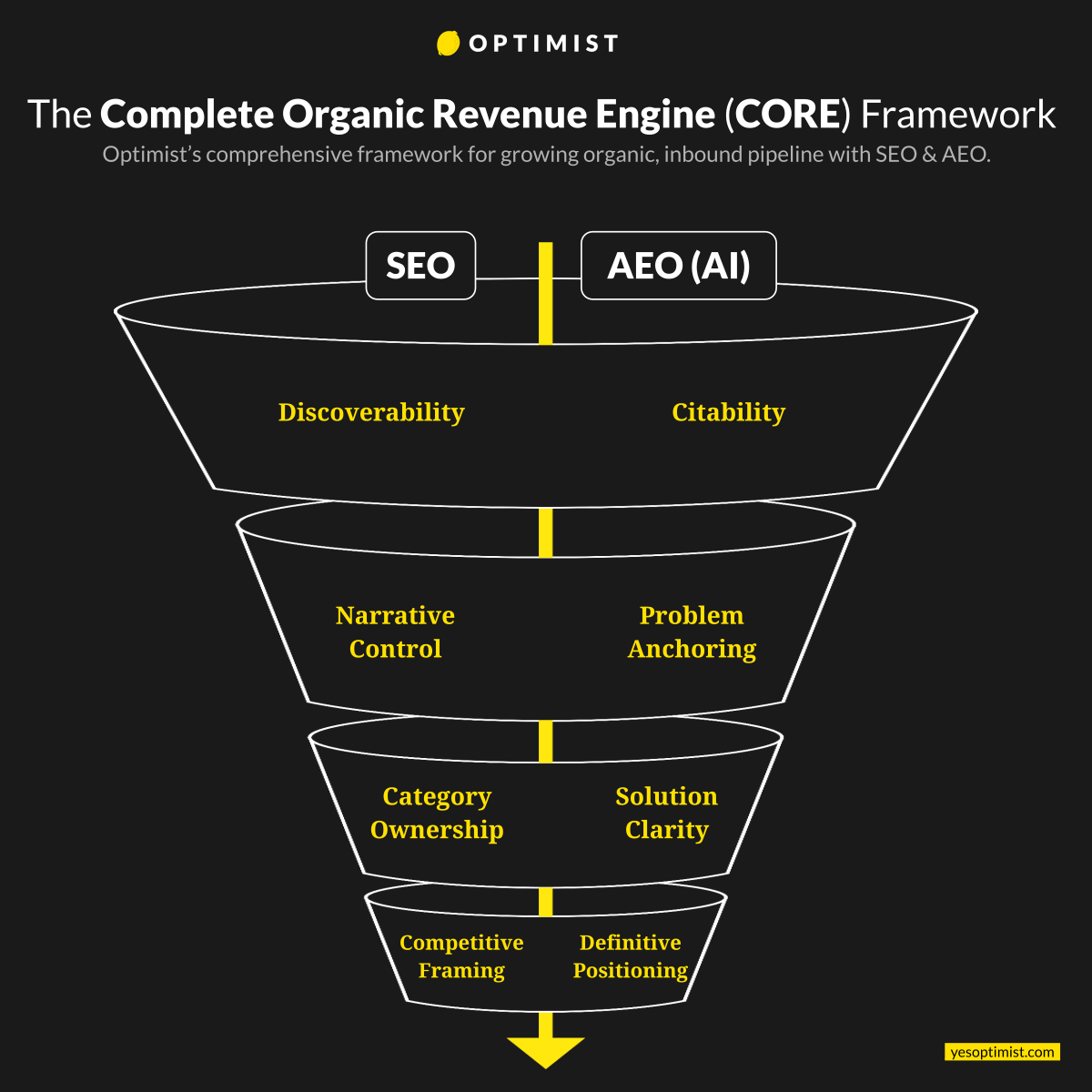
The CORE Framework is an eight-area optimization standard for driving growing across both traditional search (SEO) and AI search (ChatGPT, Gemini, Claude, Perplexity, AI Overviews). It spans a range of factors, including:
- Website crawlability and citability
- Entity consistency
- Narrative clarity
- Content coverage and structure structure
- Problem anchoring and solution clarity
It’s not a bolt-on AI search package. It’s not “just add schema”. And it’s not a framework built on spamming Reddit to try to boost your ChatGPT mentions.
Increasing your brand’s recommendations across LLMs come from more foundational work like closing content gaps, reducing entity ambiguity, and keeping messaging consistent across your site and the wider web
This allows AI models to confidently name you when a buyer asks what to buy.
Citations come from structural optimization like schema, FAQs, content chunking, answer-first formatting, and targeting the fan-out sub-queries LLMs generate when they research a response.
Both belong in a complete program.
When I audit B2B SaaS sites, the most common gap is entity ambiguity: the brand describes itself three different ways across its homepage, G2 profile, and LinkedIn page, so AI hedges on all three and recommends a competitor that reads as one clear entity instead.
Optimist’s proof is in pipeline and revenue, not traffic charts:
- One B2B technology client Optimist worked with grew 49x LLM referral revenue and 26x AI referral traffic over 14 months by rebuilding its content catalog for AI discovery
- A retail (B2C/D2C) client saw a 13x increase in LLM-sourced revenue year over year after capturing category-level queries
- A fintech client grew 8x LLM conversions in eight months
Our AI SEO framework is built on more than a decade of expertise driving organic growth through SEO:
- Stampli grew 5X inbound pipeline
- Kubera hit 43x signups in 15 months
- HelloSign’s inbound engine helped fuel its $230M acquisition by Dropbox
- Optimist has worked with marketing teams at Semrush, ZoomInfo, Superhuman, and DreamHost, and many more.
Evan Vuckovic, Director of Growth Marketing at Stampli, summed up the fit in a Clutch review: “I was impressed by their domain expertise and their outside-the-box thinking around the changing AI-search landscape.”
2. iPullRank
Website: https://ipullrank.com/
What makes iPullRank different from every other agency on this list: iPullRank approaches AI search as information-retrieval engineering, working with embeddings, query fan-out, and passage retrieval rather than content production, an approach its founder formalized as “Relevance Engineering.”
Best for: Complex enterprise and mid-market companies with deep technical SEO needs that want an information-retrieval-grade GEO approach.
Potential limitations: iPullRank leans enterprise and technical rather than B2B-SaaS-native, and emphasizes relevance engineering over pipeline and revenue attribution storytelling.
Pricing: Not publicly listed.
iPullRank is an enterprise technical SEO and generative engine optimization agency led by founder and CEO Mike King, who coined the term “Relevance Engineering” for the discipline.
iPullRank works with embeddings, query fan-out analysis, passage retrieval, and advanced schema to engineer visibility inside ChatGPT, AI Overviews, and Google’s AI Mode.
That technical depth shows up in iPullRank’s roster. iPullRank has delivered organic search work for SAP, American Express, HSBC, Nordstrom, and General Mills. For a buyer who wants the most technically rigorous read on why a brand does or doesn’t surface in AI answers, iPullRank is the reference point.
The tradeoff is focus. iPullRank’s center of gravity is enterprise technical relevance, not B2B SaaS pipeline attribution. If your evaluation hinges on tying AI visibility to MQLs and closed-won revenue in a board deck, that storytelling sits outside iPullRank’s core strength, which is the engineering underneath the visibility.
3. Seer Interactive
Website: https://www.seerinteractive.com/
What makes Seer Interactive different from every other agency on this list: Seer Interactive is one of the few agencies running a productized GEO (generative engine optimization) service and publishing its own AI-search experiments. That willingness to test in public, backed by founder Wil Reynolds’s long record of sharing data and even failures, makes Seer Interactive a credible AI-search partner inside a full-service shop.
Best for: Enterprise companies (B2B and B2C) that want GEO capability embedded in a full-service agency covering SEO, paid media, analytics, creative, and CRO under one roof.
Potential limitations: Seer Interactive is a full-service agency, not a B2B-pipeline specialist. Most of Seer’s case studies report on traffic, visibility, and conversion rather than pipeline and revenue, and the full-service model can carry higher overhead that can mean more junior talent per dollar than a focused consultancy.
Pricing: Not publicly disclosed. Clutch lists $200–$300/hour with a $10,000+ minimum project size.
Seer Interactive is a full-service digital marketing agency founded by Wil Reynolds in 2002, with more than 250 employees across Philadelphia and San Diego. Seer Interactive holds a 3.8 out of 5 rating on Clutch and has worked with enterprise brands including LinkedIn, Intuit, Capital One, Autodesk, and Harvard Business School Online.
For an enterprise team that wants AI-search work handled alongside SEO, paid media, and analytics rather than bought from a separate specialist, Seer Interactive is a strong full-service option.
4. Siege Media
Website: https://www.siegemedia.com/
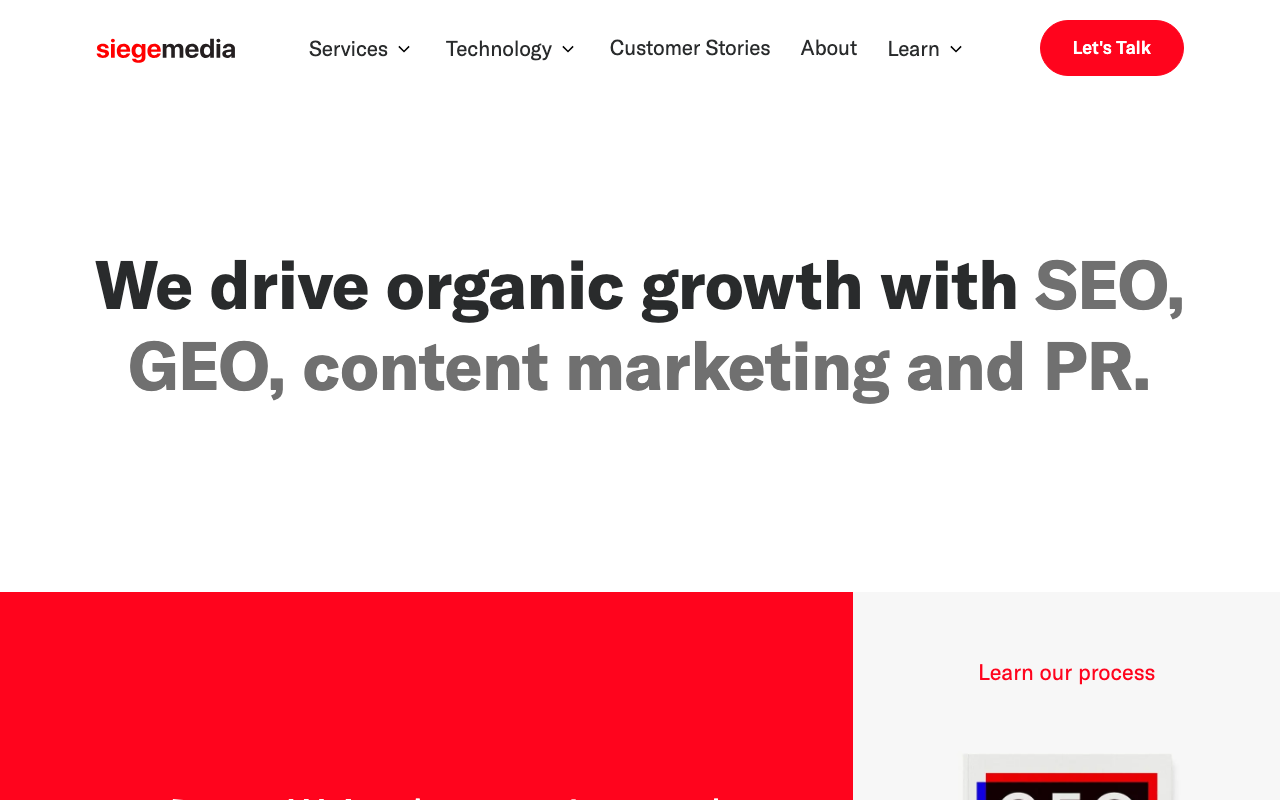
What makes Siege Media different from every other agency on this list: Siege Media operates content and link building at a scale most agencies can’t match, roughly 3,000 links a month and $148M+ in yearly client traffic value, which builds the topical authority AI engines increasingly reward.
Best for: Mid-market and enterprise brands that need high-quality content and links at real scale, with AEO benefit as a byproduct of topical authority.
Potential limitations: Siege Media’s scorecard is traffic value and links rather than pipeline or named AEO recommendation outcomes, and AEO is layered onto a content-SEO core rather than run as a standalone discipline.
Pricing: From around $11,000/month.
Siege Media is a content-first organic growth and link-building agency that produces linkable, authoritative content engineered to earn rankings, links, and increasingly AI citations. Siege Media’s model is built on topical authority at volume. The agency states it generates more than $148M in yearly client traffic value and builds roughly 3,000 links per month. As AI engines reward established authority, the citations follow the same topical strength that already drives Siege Media’s search rankings.
The proof points are substantial. Siege Media drove a 94% traffic increase and more than $730K in traffic value for Zendesk, 1,580-plus organic links and $7.77M in traffic value for The Zebra, and $6.1M in traffic value for Zapier. Siege Media also publishes its own GEO and AEO vertical agency rankings, signaling that the agency tracks the AI-search shift closely. For mid-market and enterprise brands that need high-quality content and links at real scale, Siege Media delivers a level of production volume few boutiques can match.
The scorecard is where buyers should look closely. Siege Media measures success in traffic value and links rather than pipeline, revenue, or named AEO recommendation outcomes. AEO sits as a byproduct of topical authority rather than a standalone discipline with its own attribution model. That’s a fine fit if topical authority is your goal, and a mismatch if you need AI recommendations tied directly to closed revenue.
5. RevenueZen
Website: https://revenuezen.com/
What makes RevenueZen different from every other agency on this list: RevenueZen builds entity and verbal-identity work directly into the program.
Best for: Financial services or professional service companies looking for AI SEO help.
Potential limitations: RevenueZen targets a wide variety of industries (including startups, professional services, renewable energy, and financial services) rather than focusing on one specialization.
Pricing: Commonly reported at $5,000–$9,000/month, with month-to-month engagements available; treat figures as a reported range rather than a published rate.
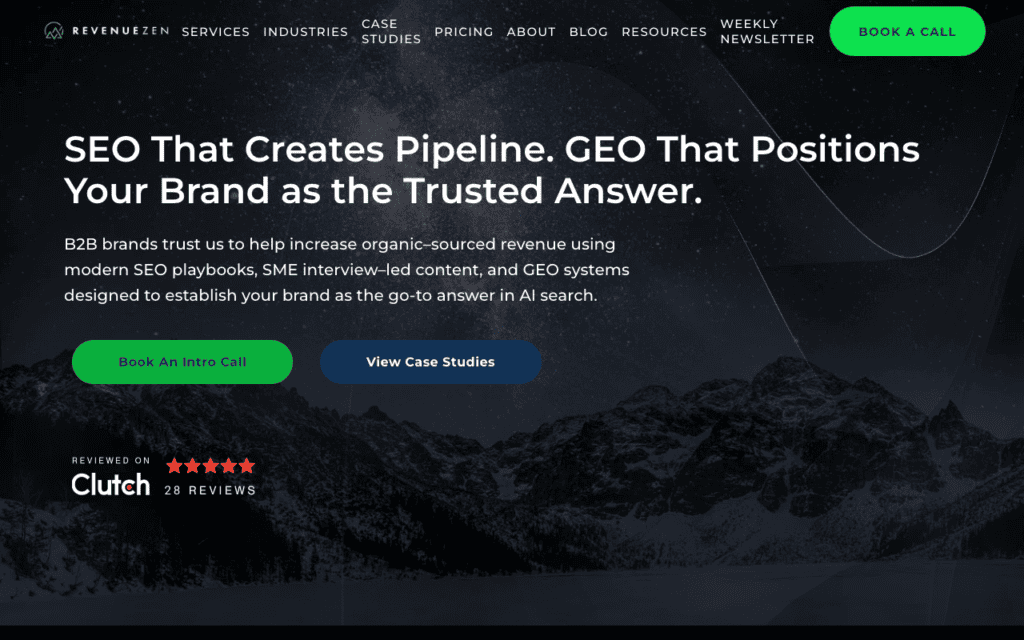
RevenueZen is a B2B organic growth agency, based in Portland, that builds its work around organic-sourced revenue and pipeline rather than traffic. RevenueZen combines modern SEO, subject-matter-expert-interview-led content, entity optimization, and verbal-identity work to “make a brand the go-to answer in AI search.”
RevenueZen doesn’t seem to run content at the volume of Siege Media or other content-focused shops, and GEO is an expanding discipline within the agency rather than its founding specialty.
6. Single Grain
Website: https://www.singlegrain.com/
What makes Single Grain different from every other agency on this list: Single Grain embeds AI SEO and GEO inside a coordinated multi-channel growth program that runs paid, content, and CRO together, rather than selling it as a standalone retainer.
Best for: Growth-stage companies that want AI search embedded inside a broader multi-channel growth program under one partner.
Potential limitations: Single Grain is a multi-channel generalist rather than a B2B-SaaS-native or AEO-pure specialist, and AI SEO is one offering within a broad menu.
Pricing: Startup-tier engagements typically run around $5,000–$8,000/month; enterprise pricing is custom.
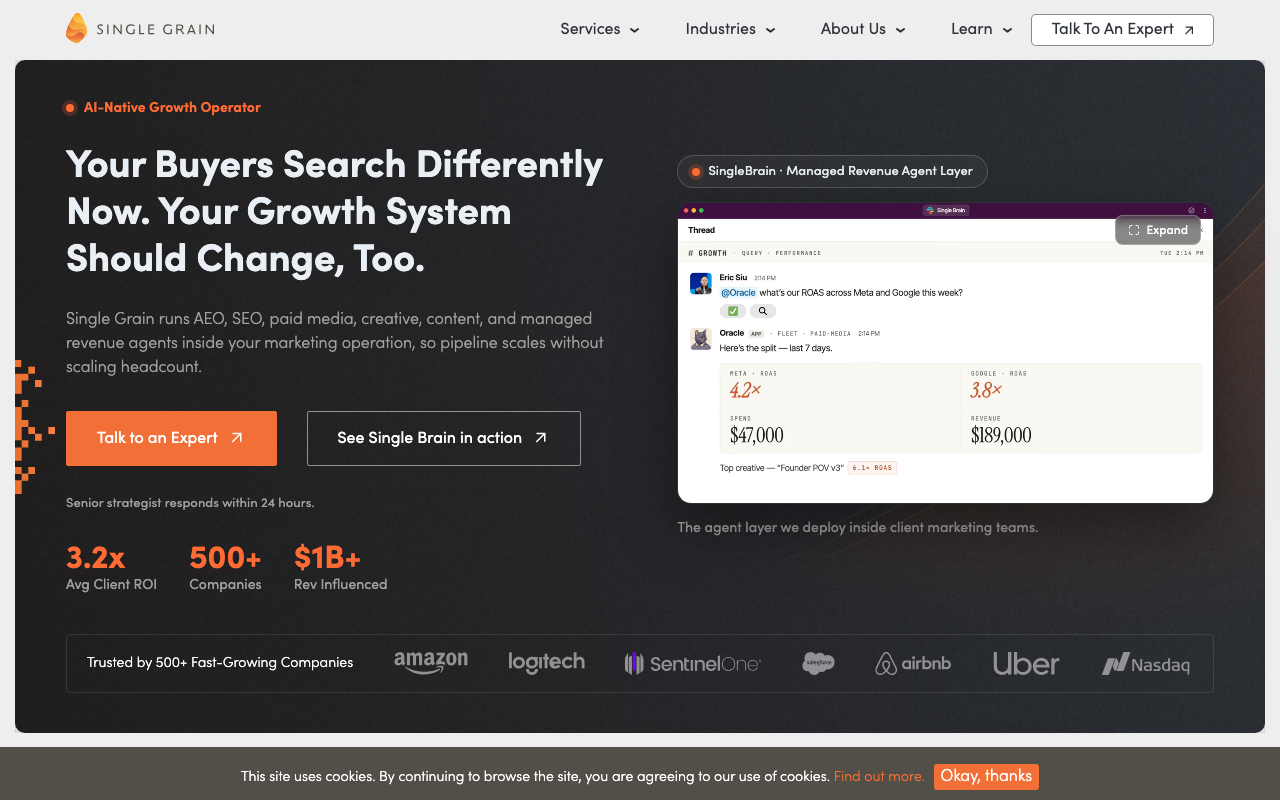
Single Grain is a long-tenured full-service digital growth agency led by Eric Siu that connects AI SEO and GEO to a broader multi-channel growth engine. Rather than selling AI search as a standalone retainer, Single Grain folds generative engine optimization into a program that also spans paid media, content, and conversion rate optimization. The thesis is that AI visibility performs better when it’s coordinated with the other channels driving demand, not run in isolation.
Single Grain offers breadth that the AEO pure-play shops don’t.
Breadth is also the constraint. Single Grain is a generalist multi-channel agency rather than a B2B-SaaS-native or AEO-pure specialist. AI SEO is one line on a broad agency menu, which suits buyers who want coordination over depth but works less well for teams that want a partner whose entire focus is AI search visibility.
7. Intero Digital
Website: https://www.interodigital.com/
What makes Intero Digital different from every other agency on this list: Intero Digital delivers AI SEO work through a proprietary, trademarked framework (GRO) plus its own InteroBOT and GRO Score audit tools, giving clients a measurable, repeatable read on AI-search visibility inside a large full-service shop.
Best for: Mid-market and enterprise brands that want GEO delivered inside a large full-service digital agency with proprietary tooling.
Potential limitations: Intero Digital is a large generalist agency rather than B2B-SaaS-native or pipeline-attribution-led, and GEO is one service among many.
Pricing: Not publicly listed.
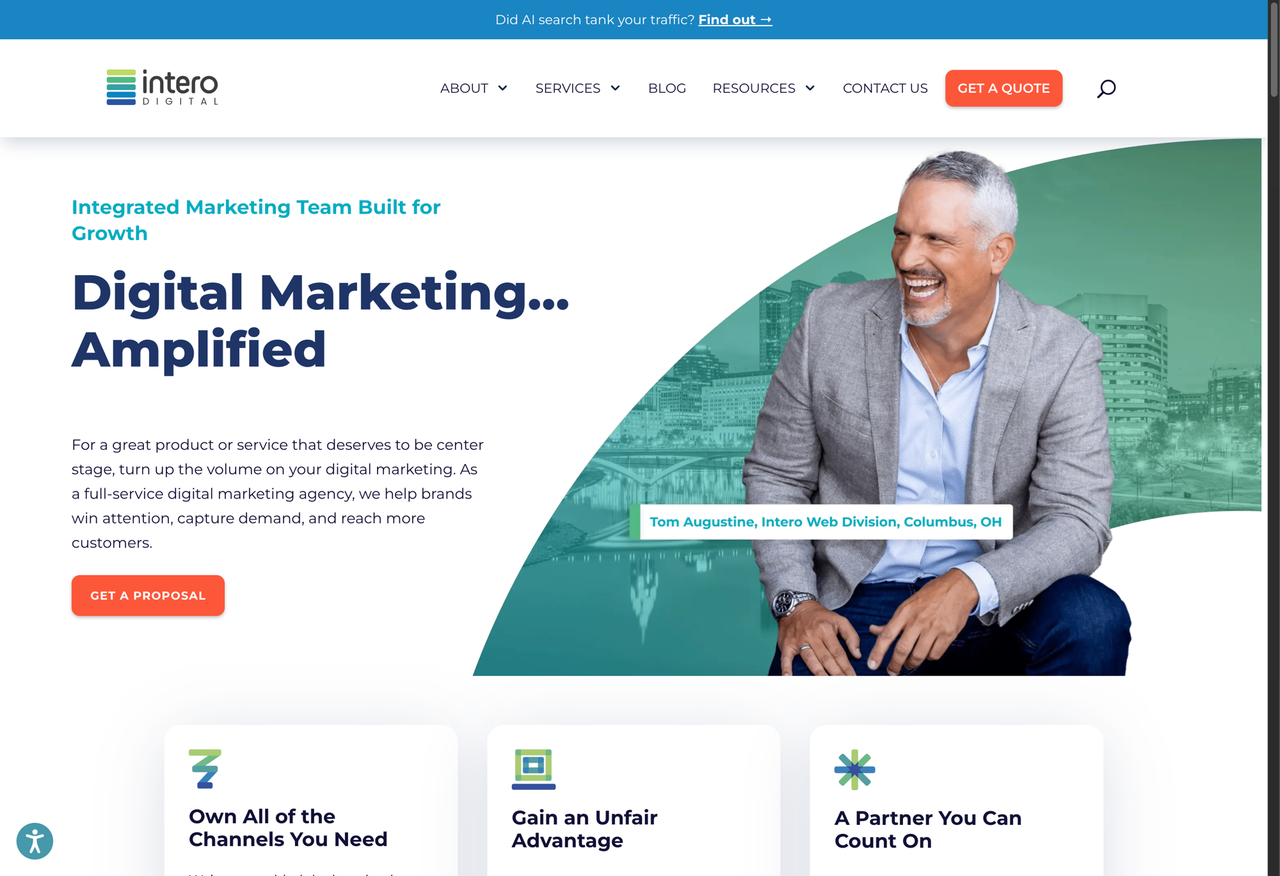
Intero Digital is a full-service digital agency, originally SocialSEO and now several hundred employees serving roughly 1,500 customers from Colorado Springs.
Intero Digital optimizes for ChatGPT, Copilot, Perplexity, and Gemini, and was named in Google’s AI Overview for this category.
The proprietary tooling is Intero Digital’s clearest differentiator. GRO launched in June 2024 as a structured, repeatable approach to AI-search visibility, and the GRO Score and InteroBOT tools give clients a measurable read on where they stand. Intero Digital works with brands including Logitech, Salesforce, Alcoa, Rodan + Fields, Cadence, and Sierra Wireless.
As with most large generalist agencies, the tradeoff is specialization. Intero Digital isn’t B2B-SaaS-native or pipeline-attribution-led, and GEO is one service among many channels the agency runs. A buyer who wants AI search as the entire engagement, tied directly to pipeline, is buying against the grain of a broad full-service model.
How to Choose the Right AI SEO Agency for Your Company
Match the agency to your motion.
The decision comes down to three questions about your own situation:
- What’s your real blocker? A deep technical extractability problem at enterprise scale points to iPullRank. A SaaS-specific, integrated SEO and AI/AEO program? That’s Optimist.
- How does AI visibility need to show up? If it has to appear as attributable pipeline and revenue, prioritize agencies with client outcomes over agencies with citation screenshots. The proof an agency volunteers tells you what it optimizes for.
- Do you want a tactic vendor or a strategic partner? A team that can execute briefs and wants direction is buying strategy. A team that wants every task handled forever is buying execution, and the agencies built for one aren’t built for the other.
Once the shortlist is built, two questions on the first call separate the partners from the vendors.
Ask for a named client where AI visibility produced pipeline, and watch whether the answer is a revenue figure or a citation screenshot.
Then ask whether the agency runs AEO/GEO and SEO on one engine or two invoices.
The answers map straight back to the test above.
AI Search Is Now the Buyer’s First Stop
AI search is now where a majority of B2B software research starts.
G2’s 2026 Answer Economy report found that 51% of B2B software buyers now begin their research in an AI chatbot more often than in Google, up from 29% just 11 months earlier, and 71% rely on AI chatbots for software research.
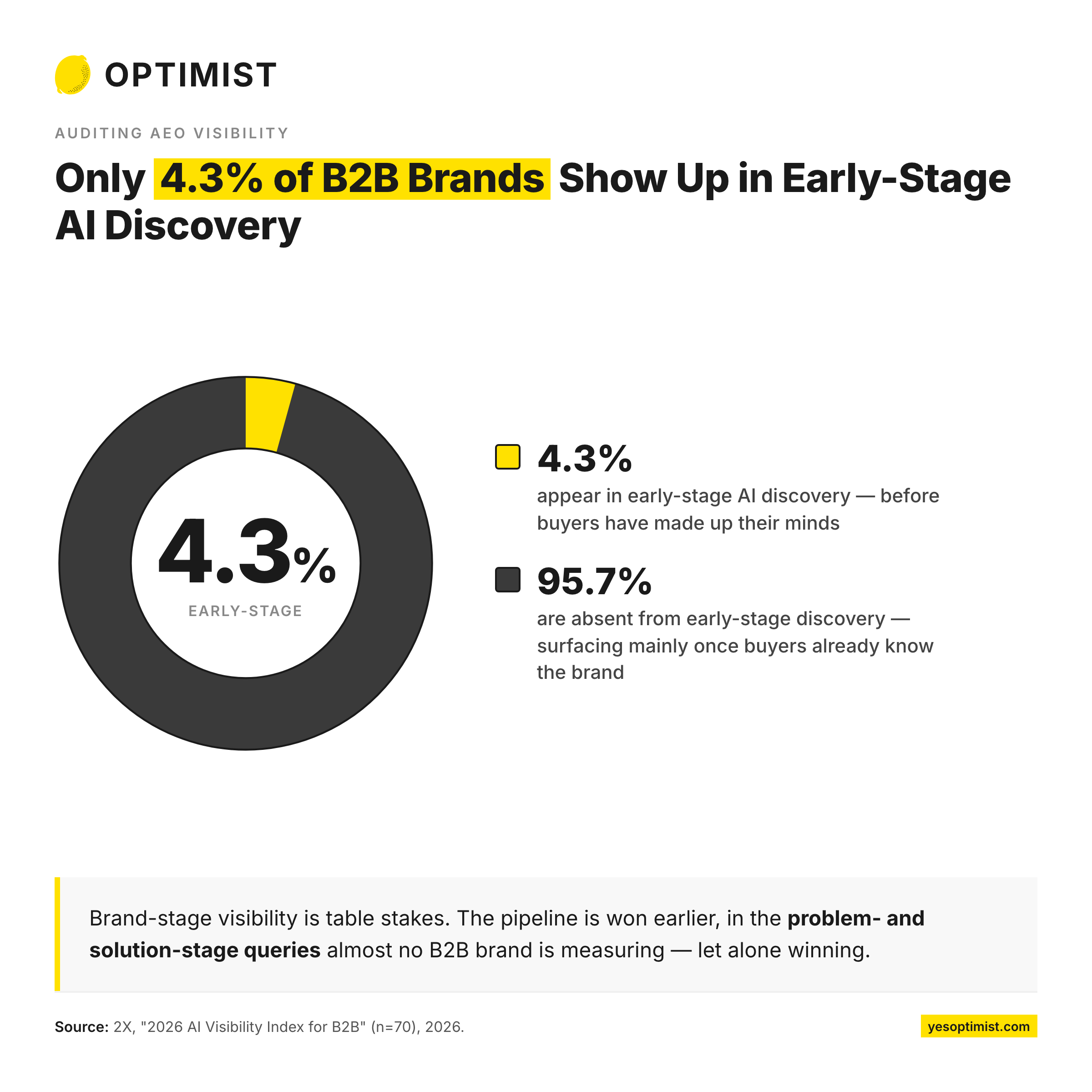
The 6sense 2025 Buyer Experience Report found 94% of B2B buyers use LLMs during the purchase journey.
The buying behavior is the part that should change how you think about an agency.
G2 found that 69% of B2B buyers chose a different vendor than they’d initially planned based on AI chatbot guidance, and one-third bought from a vendor they hadn’t previously heard of. When two-thirds of buyers will switch vendors mid-decision on the AI’s say-so, the recommended name is the one that survives the switch.
Being named in that answer decides whether you make the shortlist or never appear on it.
Yet CommonMind’s 2026 State of AI Visibility report found that while 93% of B2B SaaS marketers rate AI search visibility as critically important, only 14% have a mature documented strategy. The demand is real and the readiness gap is wide, which is most of why this category of agency exists.
Across r/SaaS and r/SEO agency threads, the recurring community warning is that many traditional agencies repackage old SEO tactics with an “AI” label and call it a new service.
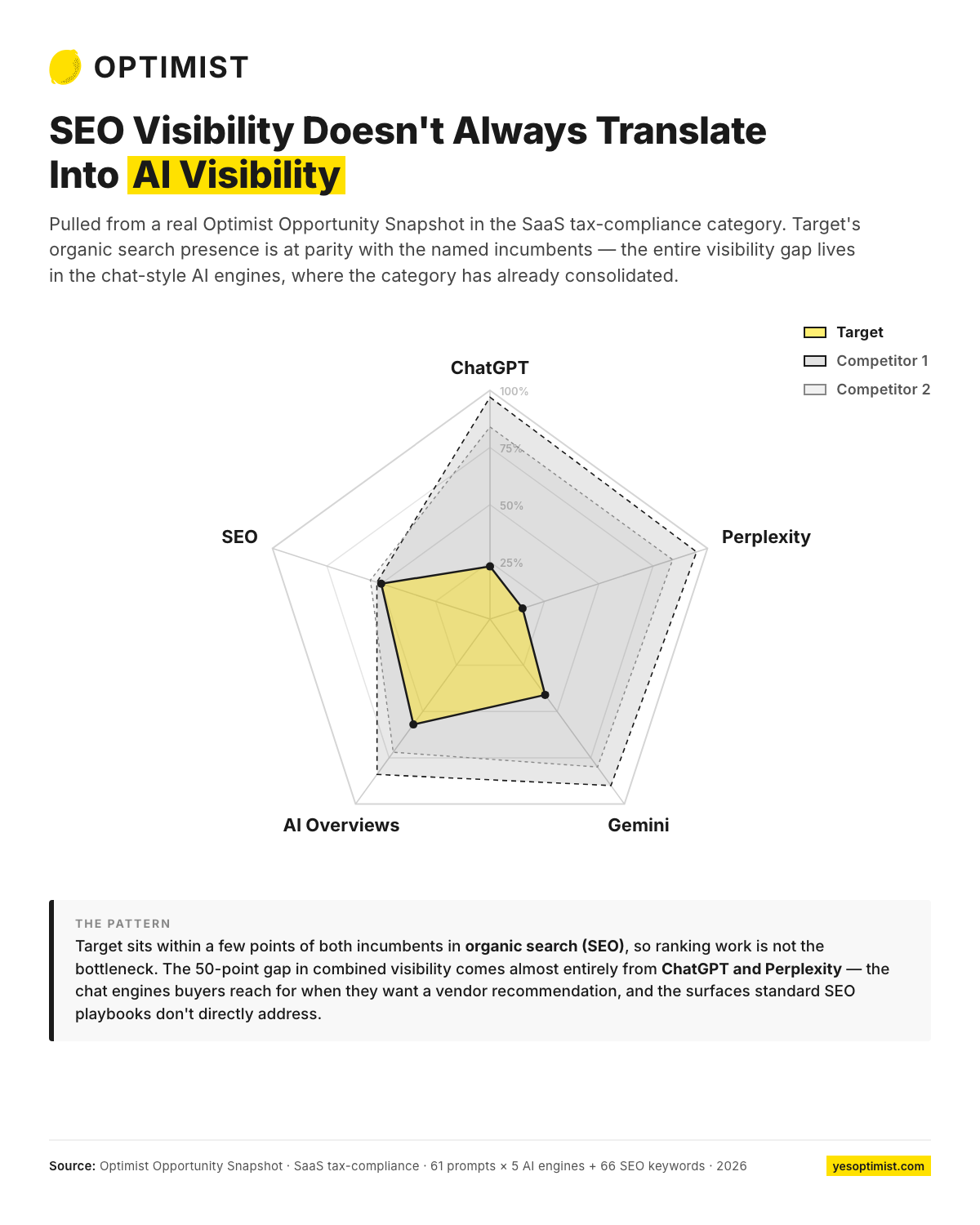
When I screen agencies, the tell is whether the case studies lead with a revenue or pipeline number or with a traffic chart, because the ones reporting traffic almost never have the pipeline figure to fall back on.
The agencies on this list that lead with pipeline are doing different work than the shops that report traffic value and link counts.
Let’s Grow Your AI SEO Visibility
Every agency on this list is genuinely good at something, and the right pick depends on what you’re actually buying.
The thread connecting the best of them is that they optimize for being recommended, run AI search as part of one organic system rather than a bolt-on, and report in pipeline.
An agency that does all three is rare.
Our CORE Framework comes from that decade of experience plus years of testing, learning, and measuring AI search optimization strategies for our clients.
We’ve learned what works and (perhaps more importantly) what’s a waste of time and budget.
Our expertise working with B2B tech startups and SaaS companies has driven millions of dollars in leads, pipeline, and revenue for our clients.
Set up a free call for us to discuss your current AI visibility, understand your goals, and answer questions you have about how AEO and GEO actually work in practice.
If it’s a fit, we’ll explore how we can help.
→ Schedule a free strategy call today.
Frequently Asked Questions About AI SEO Agencies
What is an AI SEO agency?
An AI SEO agency makes your brand visible and recommended across AI search surfaces like ChatGPT, Perplexity, Gemini, and Google’s AI Overviews, alongside traditional Google rankings.
The work goes by several names, including answer engine optimization (AEO), generative engine optimization (GEO), and LLM optimization, but the goal is the same. It gets your company named and cited when a buyer asks an AI which vendor to choose.
The best agencies treat this as an extension of SEO, not a replacement for it.
How is AI SEO different from traditional SEO?
AI SEO targets visibility inside AI-generated answers, while traditional SEO targets rankings on Google’s results page. The two share a foundation but diverge sharply at the surface.
Traditional SEO earns the click while AI SEO earns the recommendation. A complete program runs both as one system because the underlying signals of authority, entity clarity, and useful content overlap even when the rankings don’t.
What’s the difference between being cited and being recommended in AI search?
Being cited means an AI model links to your content as a source.
Being recommended means the model names your brand as an answer when a buyer asks what to buy.
They’re separate (but related) outcomes connected by different work. Citations come from structural optimization like schema, FAQs, and content chunking. Recommendations come from closing content gaps, reducing entity ambiguity, and keeping your positioning consistent across the web so AI confidently names you.
A strong AI SEO agency leads with recommendations and treats citations as the supporting structural play.
How much does an AI SEO agency cost?
AI SEO agency pricing generally runs from around $2,500/month at the entry level to $12,000/month or more for premium enterprise or full-service retainers, depending on scope.
When you compare quotes, anchor on the pipeline outcome the work is meant to produce, not the retainer size alone.
How do I know if an AI SEO agency is just repackaging old content services?
Ask what outcome the agency optimizes for.
If the answer is content volume, production speed, or “AI-powered content at scale,” you’re likely looking at a traditional content service with a new label. A genuine AI SEO agency optimizes for getting your brand recommended and cited in AI answers, and it can point to outcomes tied to pipeline or revenue, not just traffic charts and link counts
The recurring warning across SaaS communities a lot of “AI SEO” is old SEO with an “AI” sticker. The one-question screen filters most of it out.
Should the same agency handle both my SEO and AEO?
Yes, in most cases one agency should run SEO and AEO as a single system.
The two channels share a foundation but only partially overlap, so splitting them across a legacy SEO shop and a GEO pure-play leaves the connective tissue unowned and costs pipeline.
The work that wins AI answers and the work that wins search rankings have to be coordinated by one team to avoid gaps. Google’s own guidance reinforces this: good SEO and good GEO are built on the same foundation, layered for different surfaces.
How long does it take to see results from AI SEO?
Most AI SEO programs show early movement in AI visibility within a few months, with meaningful pipeline impact compounding over 2 to 3 months as content, entity signals, and authority build.
One of Optimist’s B2B technology clients grew 49x LLM referral revenue over 14 months, and a fintech client reached 8x LLM conversions in 8 months
Timelines depend on your starting authority, how clean your entity signals already are, and how competitive your category is in AI answers. AI engines also favor fresh, frequently updated content, so the work is ongoing rather than a one-time fix.
