
Article Summary
A content marketing strategy in 2026 is the decision layer that commits to qualified pipeline, treats Google search and AI answer engines as a unified visibility surface, and designs every page to carry a complete problem-to-solution-to-product narrative.
The process includes identifying the problems content has to solve, defining goals, building strategies, choosing channels, executing tactics, and measuring metrics — with the Content Strategy Canvas as the working artifact.
Content marketing has always been a rollercoaster ride.
New tactics rise and fall, and Google’s endless updates add the twists and turns.
But right now, it feels different. Something fundamental has changed.
Buyers no longer start a research project on Google and end it on a vendor’s site. They start in ChatGPT, finish in a peer Slack, and the brand may never see the journey on its analytics stack. Marketing budgets are under pressure to prove pipeline, not traffic. The tried-and-tested playbooks aren’t working the way they used to.
That’s why rethinking your entire approach is a smart move, not a luxury. This guide is designed to walk you through crafting a content strategy that holds up to internal scrutiny and delivers results that hit wider business goals — across both Google and AI answer engines.
I’ll warn you now:
It’s going to take plenty of work and some deep thinking.
But trust me, it’s worth it.
Before we start, one frame worth setting up front.
A strategy is the decision layer.
A plan is the execution layer.
Most of the “strategies” I review when running a CORE Analysis for B2B clients are editorial calendars with a strategy slide stapled to the front — they tell me what’s getting published, but they can’t tell me what pipeline it’s supposed to generate, where AI answer engines are recommending the brand today, or why a buyer would self-steer to one page over another.
That gap is where the pipeline goes missing, and closing it is what this guide is about.
Why You Need a Formalized Content Strategy
Why are you doing content marketing?
It might seem like a strange question to ask. But many companies skip this critical moment of self-reflection.
They dive into content marketing simply because a competitor is seeing success.
If it’s working for them, we should be doing it too.
This often leads to what I call the “blog and pray” approach: Pump out content and wait for something to happen. Unfortunately, that something rarely comes. The fallout can be ugly. Instead of altering their approach, key stakeholders lose faith in the idea of content marketing altogether. Budget cuts loom.
Marketers often get swept along in the tide.
We accept the initial enthusiasm for content marketing from our superiors without diving deeper into the why. And then we’re left to pick up the debris.
How do you avoid being washed up like this? By having a rock-solid strategy in place.
The Purpose of Your Content Marketing Strategy
As a marketer, your content strategy serves several functions.
First, it’s your mission statement. It declares what you’re trying to achieve and how you plan to do it.
Second, your strategy is your map. It provides clear directions, helping you find your way toward your stated goals. Whenever you need to make a tactical decision, the strategy keeps you properly oriented.
Third, your strategy is your business plan. When you need to bid for funding and navigate internal politics, it’s vital to have documentary evidence to back up your claims. It gives you a seat at the table; you’re no longer the backseat passenger who has no say.
Fourth, in 2026, your strategy is the defense your CFO will sign for. Marketing leaders are getting asked the question “how are we showing up in ChatGPT?” by boards that want a quantifiable answer. A content strategy that anchors itself to qualified pipeline, names the visibility surface it has to win on, and shows the math from keyword to closed-won is the document that survives a budget review. One that talks about traffic and rankings is not.
To cover all these bases in one document, you need to create something that is specific, detailed, and clear.
Strategy vs. Plan
It’s important to note that your content marketing strategy is not the same thing as your content marketing plan.
This might seem pedantic. But it’s not.
Here’s the difference:
- Your strategy is the overarching vision of your content marketing efforts.
- Your plan contains the individual steps you’ll take to build that vision.
Your strategy is what informs your plan. That includes deciding which ideas you’re not going to pursue. Without a strategy, you end up creating a pile of blog posts with no clear direction or purpose.
Another point of difference is complexity. A good content strategy can be summarized with a single sentence. For example:
> “We will grow qualified pipeline by owning the buyer’s category questions on Google search and AI answer engines through a unified, pipeline-mapped content footprint.”
The more you add, the less focused your strategy will be.
In contrast, a plan needs to specify exactly how you will execute your strategy. And that means adding much more detail.
In this guide, we’ll get into planning — how to come up with specific content ideas, how to build the editorial calendar — but only after we’ve gone through all of the underlying steps to define the why, who, and how of our strategy.
The Many Layers of Content Marketing Strategy
Every good content marketing strategy starts with a problem.
I’m not talking about mistakes or design flaws here. I’m referring to a business problem.
Content marketing is a tool for fixing specific marketing challenges that are holding you back. As you build your strategy, it’s important to identify the problems that you want to address. You can then create goals that guide you toward fixing those problems. To hit those goals, you’ll have to develop individual strategies. And to apply those strategies, you need to select appropriate marketing channels for delivering your content. Then, based on the channels you choose, you’ll need to decide your on-the-ground tactics.
Zoomed out, the workflow looks like this:
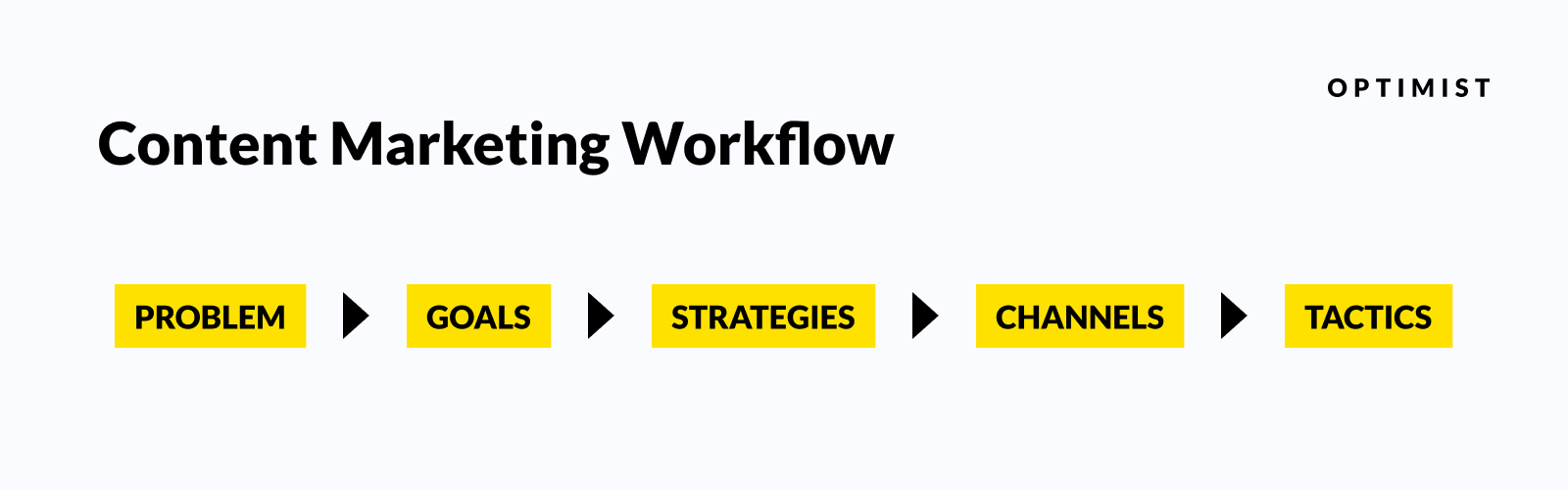
Problem → Goals → Strategies → Channels → Tactics → Metrics
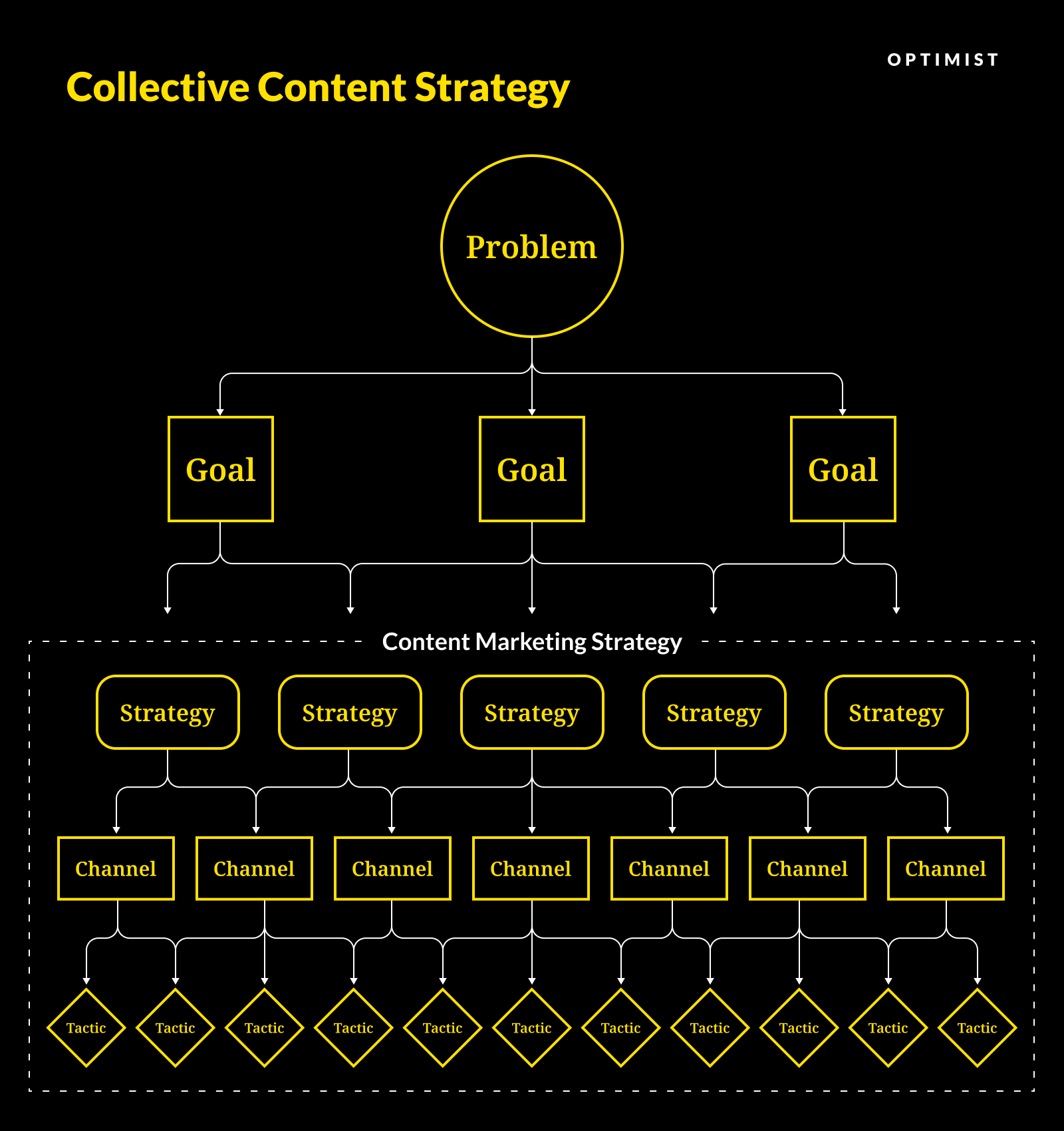
Note that the final framework won’t be so linear. In fact, it will look more like an org chart.
To solve each problem, you’ll need to create one or more goals. To hit these objectives, you may need several strategies, each relying on multiple tactics. In other words, you need to attack each problem at increasing levels of detail.
The end result should be a constellation of finely tuned strategies, channels, and tactics, rather than a catch-all playbook. This reflects the reality of modern content marketing: your “strategy” is actually multiple individual strategies under one roof.
Stages of the Funnel
Looking at the workflow above, we can see where content strategy fits into the family tree of decision-making.
But how do you apply this idea to the funnel?
Ideally, the problems you identify should be specific to the individual stages of the funnel. Perhaps at the top of the funnel (what I call the Exploration stage, also known as TOFU), your main challenge is brand recognition. Here, you might create a goal related to website traffic or AI brand mentions. You would then shape your content strategies and select your tactics with these objectives in mind.
The same principle applies in the middle (Consideration, or MOFU) and bottom (Decision, or BOFU) stages of the funnel. It even applies pre-funnel (Affinity) and post-funnel (Retention).
Each stage will call for different strategies.
Mapping the Visibility Surface for Google and AI Answer Engines
Here’s the part of content strategy that didn’t exist a few years ago and is now central to almost every decision downstream.
In 2026, your organic strategy (SEO + AEO) has to span both Google search and AI answer engines. These are two separate channels that determine your content’s overall visibility, distribution, and reach.
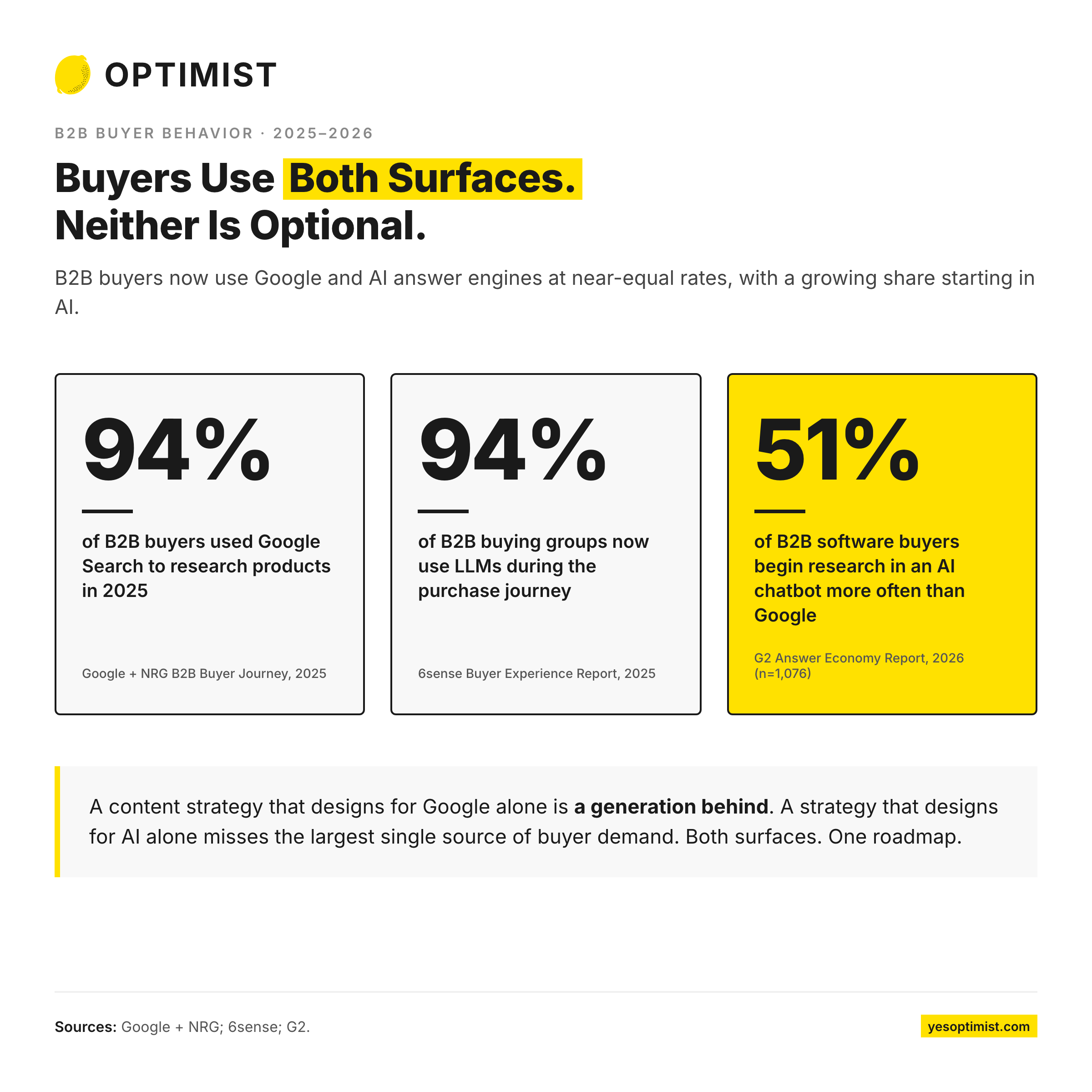
The buyer numbers tell the full story:
- 94% of B2B buyers used Google Search to find products and research purchases in 2025, according to research Google ran with NRG.
- 94% of B2B buying groups now use large language models during the purchase journey, per 6sense’s 2025 Buyer Experience Report.
- 51% of B2B software buyers now begin research in an AI chatbot more often than in Google, with 71% relying on AI chatbots for software research, according to G2’s 2026 Answer Economy report (n=1,076).
And they don’t always drive 1:1 results.
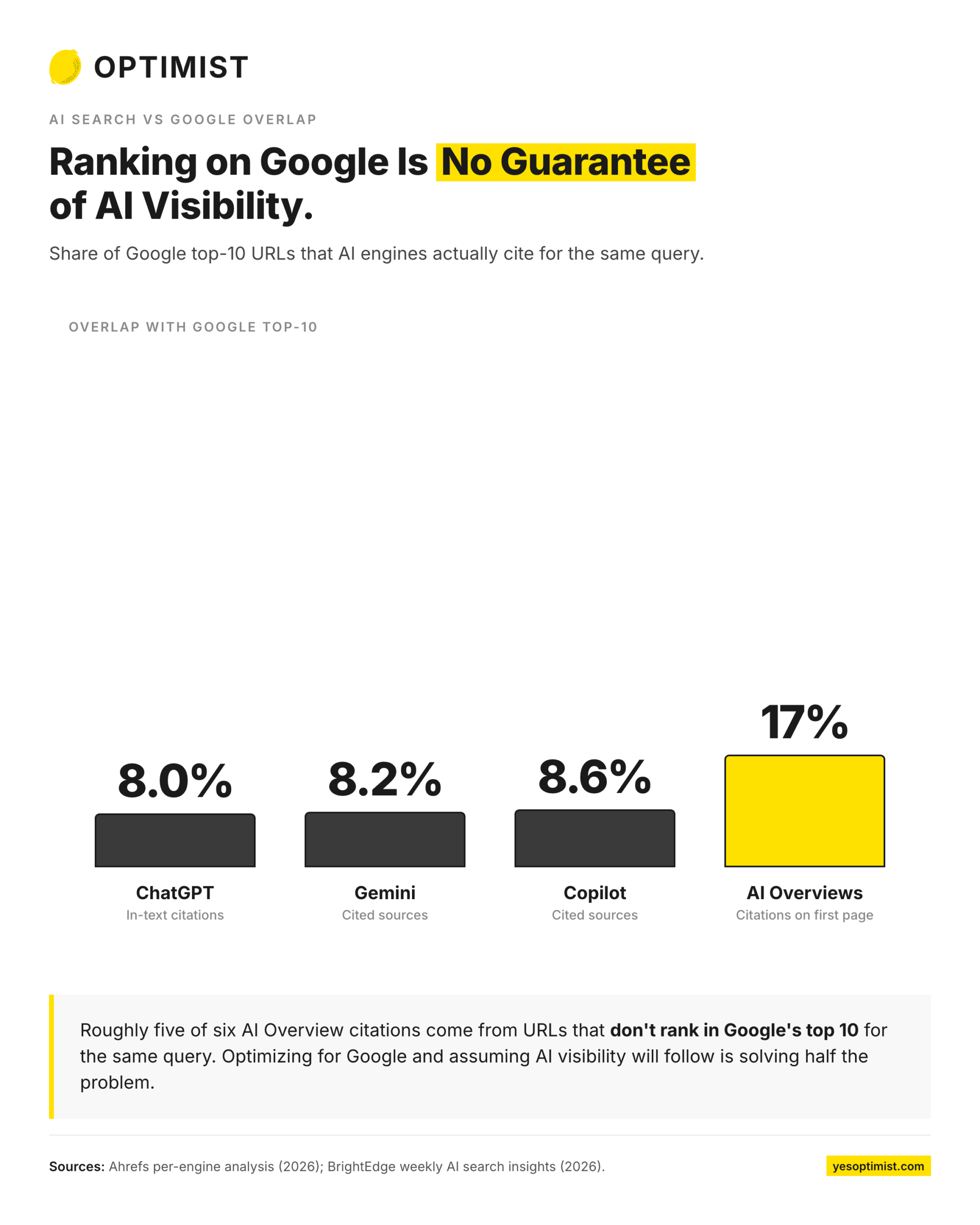
The overlap between Google’s top 10 and the URLs AI engines actually cite is small, and it’s getting smaller. According to Ahrefs’ per-engine analysis, the overlap between Google’s top 10 and the citations the major AI chatbots pull from sits at 8.6% for Copilot, 8.2% for Gemini, and 8.0% for ChatGPT in-text citations.
In other words, page ranking #2 in Google for the buyer’s question can be invisible when the same buyer asks the same question in ChatGPT or Perplexity.
BrightEdge measured AI Overview overlap with Google’s first page at around 17%, meaning roughly five of six AI Overview citations come from URLs that don’t rank in the top 10 for the same query.
A content strategy that optimizes for Google and assumes AI visibilitywill follow is solving half the problem.
We’re beyond asking “do we invest in answer engine optimization (AEO) on top of SEO?”
The question is how you build a strategy that integrates SEO and AEO to drive organic performance for the new buying reality.
Different Content Types
There is one more layer to consider here: content function.
Not all content performs the same function. Branded content is made to raise awareness. Lead gen is designed to drive conversions. SEO helps you reach new customers through Google. AEO earns recommendations and citations in AI answers.
Here are the six main functions that your strategy is likely to support:
- Brand: Builds awareness, shapes perception, and establishes trust and authority around your company and values.
- Demand Gen: Educates and engages potential customers early in their journey, sparking interest and creating a desire for your solutions.
- Lead Gen: Captures contact information from interested prospects in exchange for valuable resources, moving them further down the sales funnel.
- SEO: Optimizes your online presence to rank higher in search engine results, driving organic traffic and increasing discoverability.
- AEO: Earns brand mentions and citations in AI answer engines, where a growing share of buyers now start their research and shortlist their vendors.
- Lifecycle: Nurtures customers throughout their entire relationship with your brand, from initial awareness to post-purchase engagement and advocacy.
As you build strategies for each stage of the funnel, it’s important to consider these varying roles and think about how they can complement one another.
Putting It All Together
As you can see, modern content strategy is a multi-dimensional game.
You’re not constructing one overarching strategy.
You’re really compiling a set of individual strategies to solve various challenges.
To help you fit together the many pieces of this jigsaw puzzle, Optimist devised a little something called the Content Strategy Canvas.
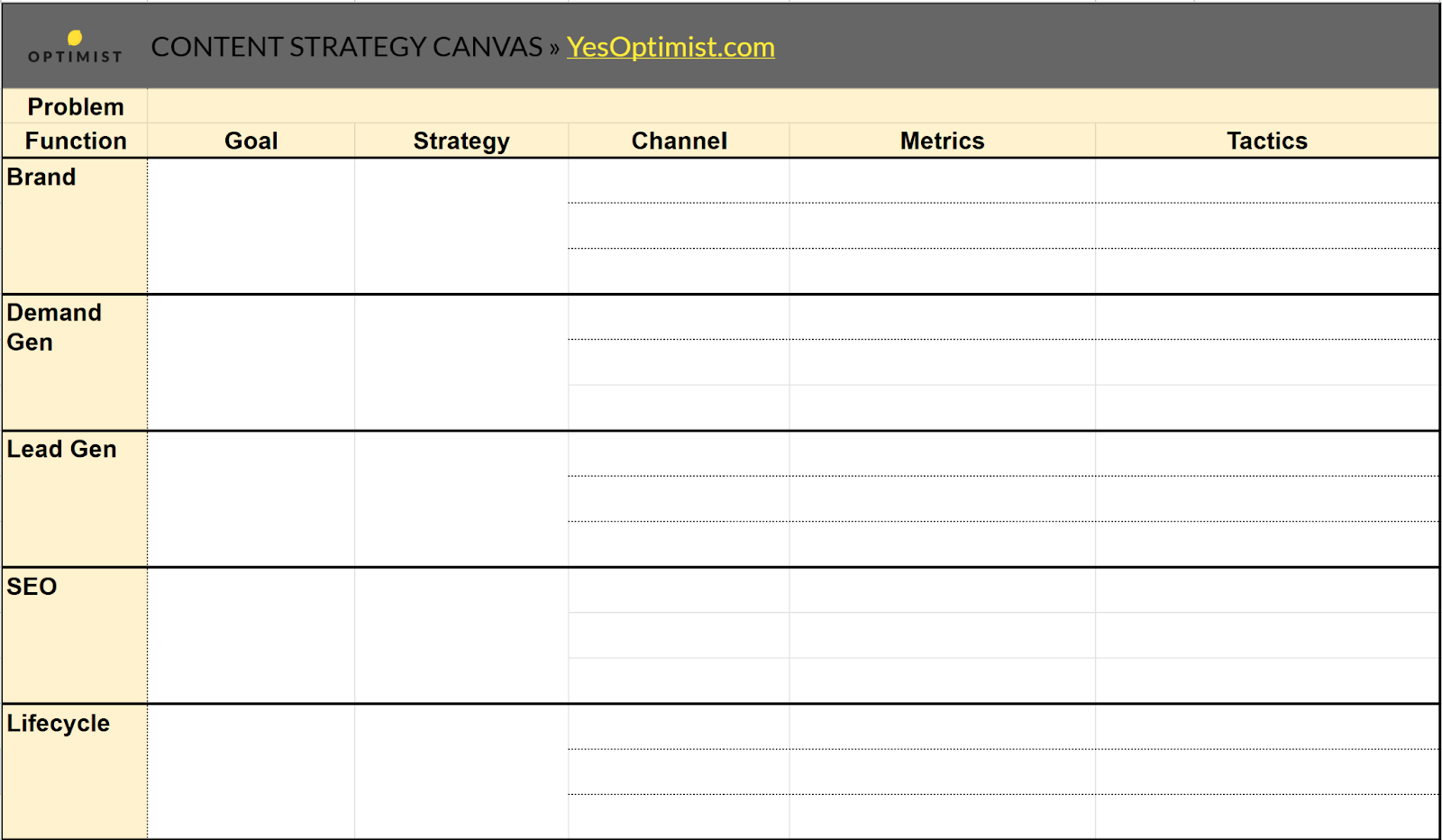
The Canvas is essentially a workbook. It provides a framework for organizing your problems, goals, strategies, and tactics at each stage of the funnel, along with various content types. I’d recommend making a copy of the Canvas and filling it out as we walk through building your strategy. That’s what we do at Optimist for every client.
Once your Canvas is complete, it becomes a reference document. The framework allows you to see all the moving parts while maintaining a high-level overview of your content strategy.
Identifying the Problems You Need to Solve
Enough with the theory. It’s time for action.
The first step in building your content strategy is to identify the problems you want to address. Hopefully, you already have some idea of what you want to fix here. Consider which areas of your marketing funnel are underperforming, and where content could help.
If possible, focus on the problems associated with a specific ICP (ideal customer profile). This will make it easier to identify appropriate solutions as you fill out the Strategy Canvas.
Let’s work through some examples.
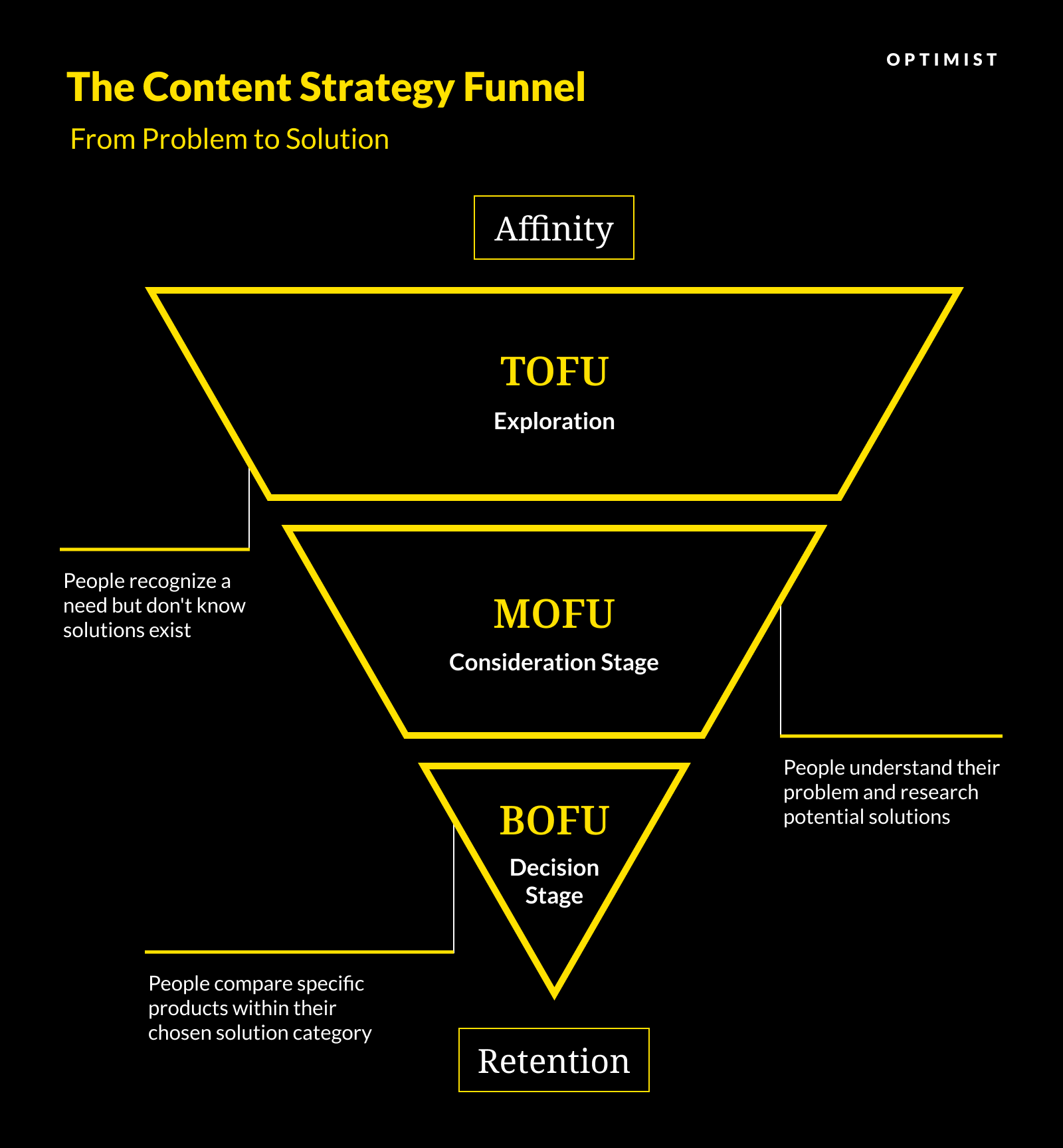
Example: Pre-Funnel Problem (Affinity Stage)
Imagine you’re the Head of Marketing for a software company. Your product is an AI-powered analytics platform for payroll, aimed at organizations with 500 employees or more.
Many larger HR and finance departments are quite resistant to change. Managers are aware of the flaws in everyday processes, but they don’t want to rock the boat. As such, they are not actively looking for new solutions.
Before you can start promoting your product, you need to lay the groundwork.
The pre-funnel problem here is:
> “HR and finance leaders don’t recognize the inefficiencies our product can help address.”
Example: TOFU Problem (Exploration Stage)
Just because your target audience is now aware of payroll analytics doesn’t mean they’re going to land on your solution.
The top of the funnel (the Exploration stage) is a competitive place. To turn curiosity into conversions, you need to be seen early — and in 2026, “being seen early” means being mentioned by name when a buyer asks ChatGPT “what’s the best payroll analytics platform for a 500-person company?”, not just ranking #4 in Google for the same query.
The TOFU problem here is:
> “Decision makers are not aware of our brand or the specific solutions we offer, in Google search or in AI answer engines.”
Notice that this problem hits several key requirements:
- It can be addressed with content.
- It’s specific to one stage of the funnel.
- It provides a clear, quantifiable target to aim for.
- It’s a problem you can tackle from multiple angles, using a mix of content types.
If you study the following examples, you’ll see a similar pattern.
Example: MOFU Problem (Consideration Stage)
In B2B marketing, one of the biggest hurdles in the Consideration stage is internal friction.
Individuals within your target organization might discover your solution and like what they see — but they can’t see how to sell the idea to their superiors and coworkers.
In this case, the problem is:
> “Individuals at target organizations don’t have the resources they need to feel confident selling our solution internally.”
Example: BOFU Problem (Decision Stage)
For the BOFU example, let’s assume everything is going well.
Plenty of enterprise HR and finance leaders now know about your brand and what you offer. They are engaged, have internal buy-in, and are ready to make a purchasing decision.
But implementing a new payroll system is a significant investment and potential risk. These leaders need a little extra reassurance that your platform will integrate seamlessly with their existing systems and deliver the promised efficiency gains.
At this stage of the funnel, your problem might be:
> “Prospects don’t have enough information to decide if our AI payroll solution is the right choice for their enterprise needs.”
Example: Post-Funnel Problem (Retention Stage)
Now that you’ve successfully onboarded customers to your AI-powered payroll analytics platform, a new challenge emerges: ensuring they fully realize the ongoing value, and (ideally) expand their usage.
You notice that some customers only use the basic features of your platform, missing out on advanced capabilities that would deliver even greater ROI. In 2026, some of those customers are also self-serving via AI assistants — asking ChatGPT “how do I do X with [our product]?” — which means your owned support content has to be discoverable on that surface too, or the answer gets generated from somewhere else.
The retention problem here is:
> “Customers don’t fully understand how to get the most value from our product, and they’re increasingly asking AI assistants rather than our docs.”
Defining Your Goals
Being able to name and describe your problems isn’t the same as knowing how to solve them.
That’s why the next step is goal setting.
The purpose of this step is to identify what success would look like. By setting clear objectives, you make it possible to measure your progress toward solving your problem. At the same time, you create a path of stepping stones that leads toward your ideal destination — a useful mental model I like to use when goal setting.
Mapping Goals to Content Functions
Take another look at the Content Strategy Canvas. You’ll notice there’s space for a goal next to every major content function.
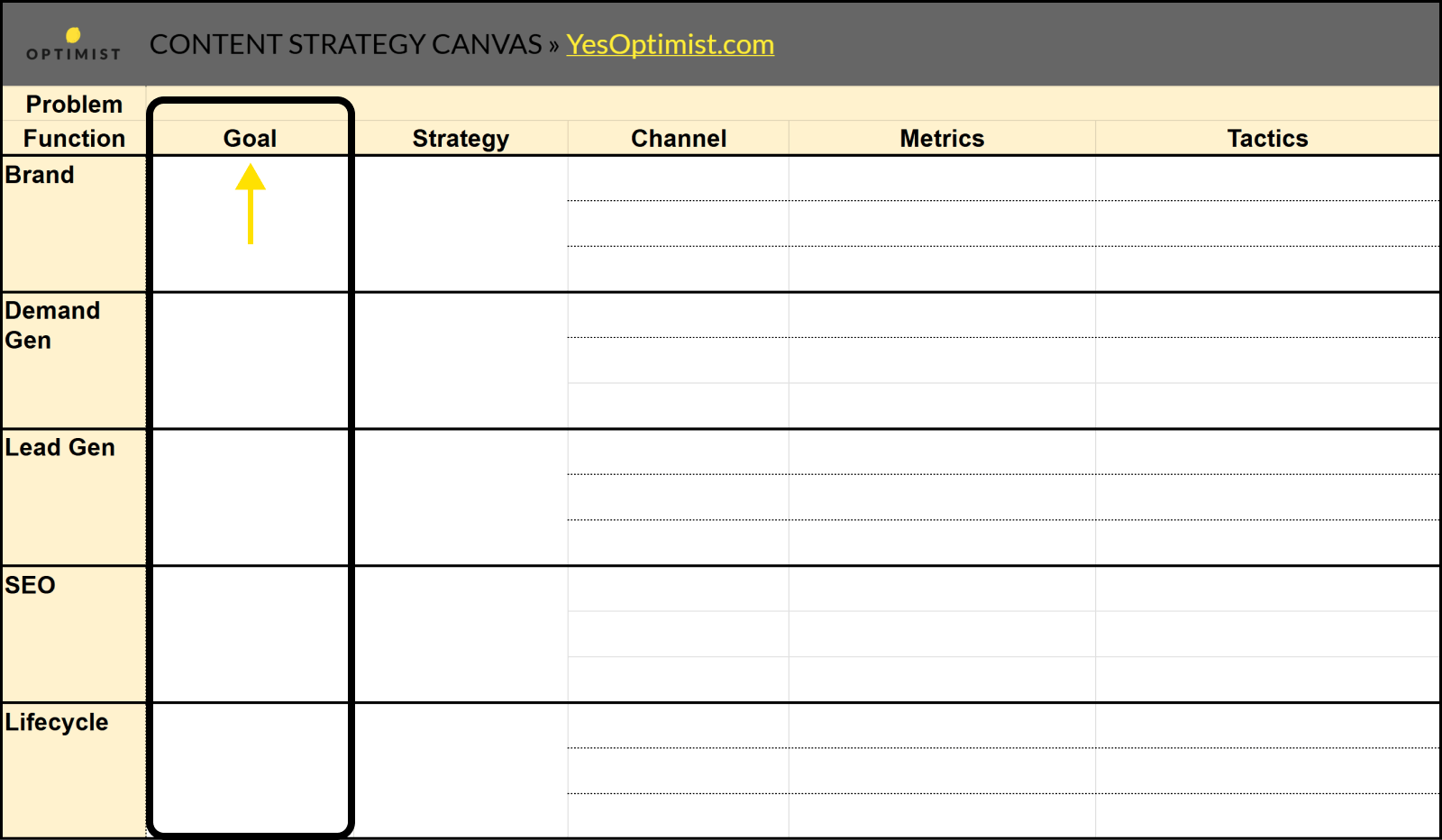
You don’t have to use every box. But it’s worth thinking about how different content categories could contribute toward solving your headline problem.
Say your challenge is that you’re not reaching the full spectrum of your target audience. You could consider the following goals:
- Brand: Increase social following for branded accounts and personal leadership profiles.
- Demand Gen: Increase visits to your homepage.
- AEO: Increase brand mention rate in ChatGPT for 20 priority buyer prompts from 0% to 30% within 90 days.
- Lifecycle: Get existing clients to consume more of your content and voluntarily recommend it to others.
You now have four clear goals across four different functions. They each tackle very different parts of the problem, and individually none would solve the issue. But if you hit all of those objectives, you should be well on the way to better exposure on both Google and AI surfaces.
This is also where you start anchoring the strategy to pipeline-stage goals, not just function goals. The Canvas leaves space for both. The pipeline-stage metrics that work as goals — and not just as KPIs after the fact — are:
- Visitor-to-lead conversion rate at a target percentage by funnel stage.
- MQL-to-SQL conversion rate by topic cluster.
- SQL-to-opportunity and opportunity-to-close by source content cluster.
- Pipeline value per page, calculated from search volume, ranking position or AI mention rate, conversion benchmarks, and ACV.
A 2026 SMART goal that takes both the pipeline frame and the AEO surface seriously looks like:
> “Drive 40 MOFU-stage SQLs from organic content in Q3, up from 18 in Q2, with at least 30% of those sourced from queries where the brand is mentioned by name in at least 3 of 5 tested AI engines.”
That’s a goal you can defend at a board review, and it’s a goal that forces your content team to design for both surfaces from the brief stage.
Setting SMART Goals
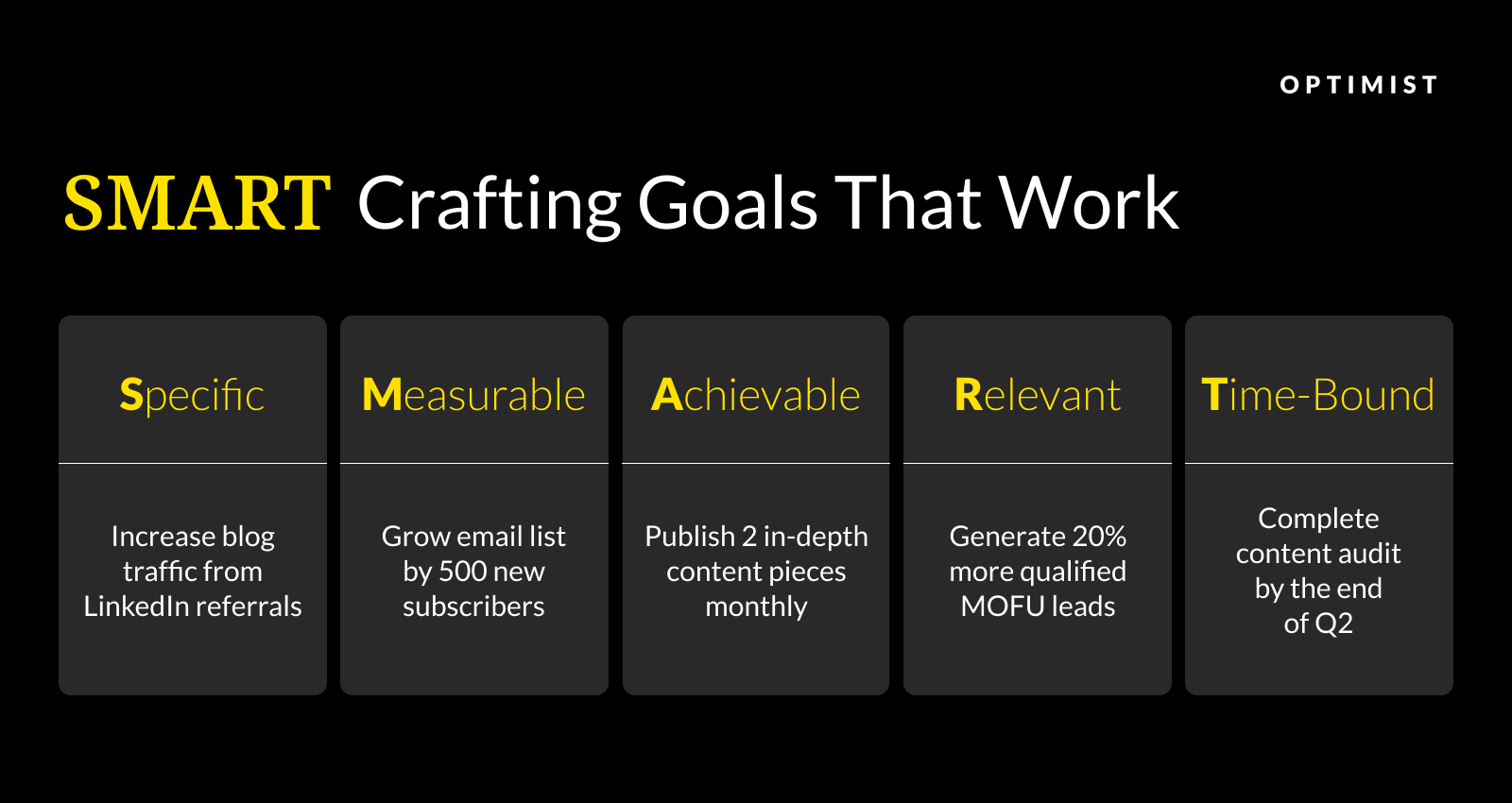
When you’re filling out the goal sections of your worksheet, I’d recommend following the SMART method.
You’ve probably come across this acronym before. As a recap, it stands for:
- Specific
- Measurable
- Achievable
- Relevant
- Time-bound
Let’s take a closer look at each.
Specific. Many marketers fall into the trap of creating vague goals. It’s fine to talk about “boosting engagement” — but what does that really mean in practice? Define what success would actually look like. A more specific goal would be, “Attracting more comments on our LinkedIn posts.” That clearly shows what you’re trying to achieve.
Measurable. The last example is specific but not measurable. Setting goals with a quantifiable target is really important. The only way to know which of your strategies is working is by measuring the results. And that’s also how you prove to your boss that it’s worth continuing with the plan. So a better goal would be, “Attracting 10% more comments on our LinkedIn posts.”
Achievable. Some people say you should aim for the stars and be happy when you land on the moon. That’s a nice fairytale, but we’re in the business of reality. When you set goals for your content strategy, make sure they’re truly gettable. You might be tempted to aim high to impress the higher-ups, but that gamble is likely to deliver a bite later. If you’re starting from a very low base, setting a target of 10% more LinkedIn comments is achievable with the right time budget.
Relevant. Remember the stepping stone analogy. You don’t have to lay out your stones in a perfectly straight line — you can take the scenic route. But ultimately, the path across the river should end at the other bank. In other words, your content goals don’t have to address your marketing problem head-on. Each goal can provide a small contribution that nudges you in the right direction. Just make sure each goal you create is actually relevant to the problem at hand. No side quests.
Time-bound. When are you going to achieve your goals? Setting a clear time limit is a great way to maintain accountability. The time aspect of your goal also affects achievability. Increasing comments on your LinkedIn profile by 10% is achievable within a month, but you might struggle to hit that in 24 hours.
Selecting Your Strategies
You now know what you’re trying to achieve. How are you going to get there?
When you’re devising strategies, it’s helpful to think of yourself as an explorer. Your problem is the starting point. Each goal is a destination.
How are you going to bridge the gap?
The answer will be your strategy.
There’s a good chance you’ll need more than one strategy to solve each problem — not least because you may be aiming for multiple goals. But each goal should be addressed with a single, custom-made strategy.
If you open the Strategy Canvas, you’ll notice there’s space for a strategy next to every goal. Needing multiple strategies is also a consequence of using multiple content functions and channels to address a specific challenge. Each path requires a different approach.
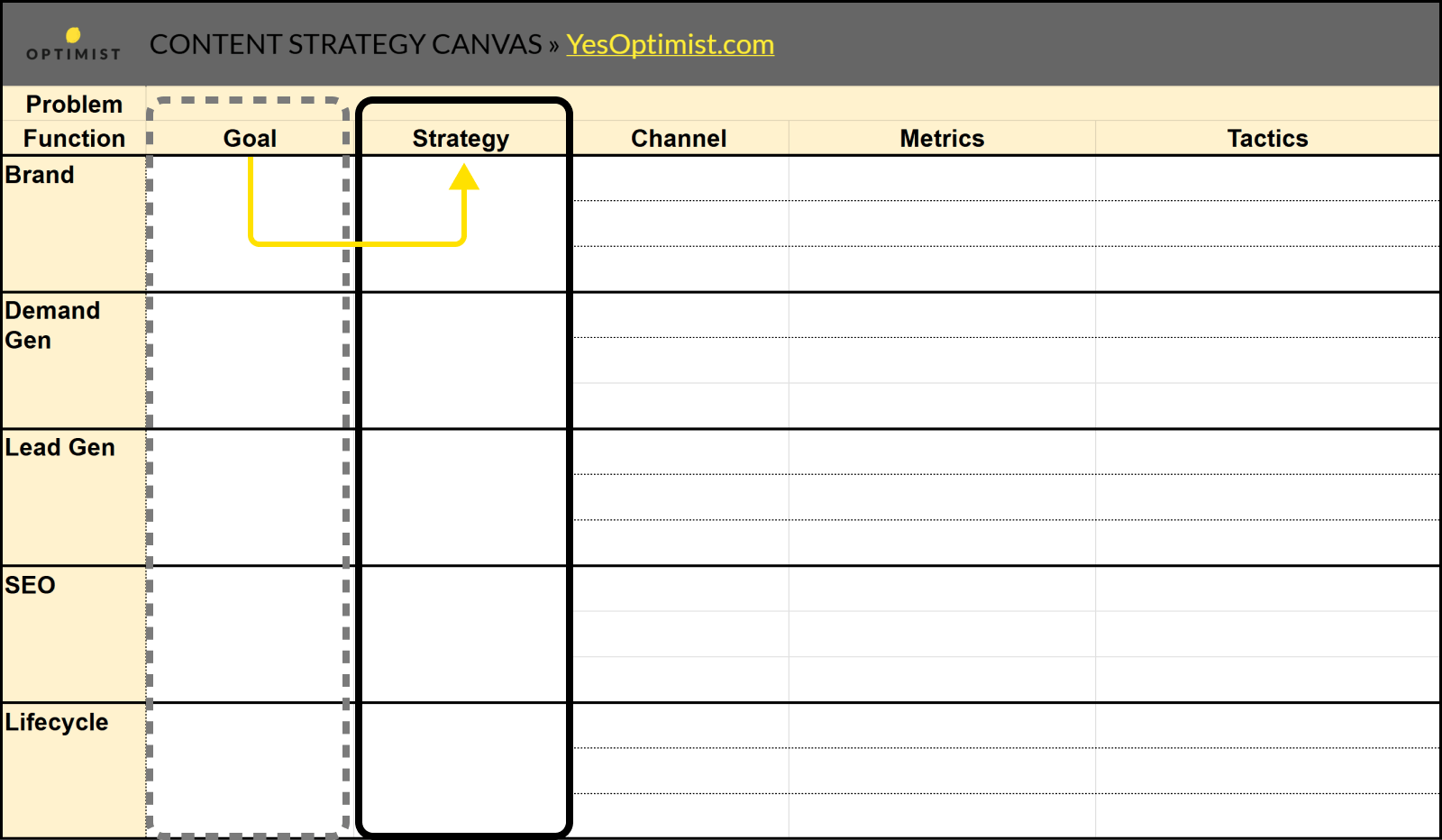
What do those paths look like? Let’s take a wander.
Roles, Goals, and Worries
The best content strategies don’t come from online templates. You won’t find them on X or in your favorite Slack group.
They come from your customers.
To be clear, I’m not expecting your paying clients to be content strategists. I’m talking about the insights you can pick up simply by listening to your customers and leads.
These people make up your target audience. And just like you, they have problems they want to solve. It could be a burning question. Maybe they’re looking for a good source of information. Or they could just be bored.
Whatever the issue might be, you can solve it with content. And that’s what attracts people to your brand.
So your starting point should be to understand the needs of your target readers.
Figuring this out might seem daunting at first, but we can break it down into smaller chunks. Begin by selecting one of your ICPs. Then identify three key attributes:
- Roles: Which hats does this person wear? That could mean different tasks they cover within a business, like the head of hiring and the HR helper. It could also mean the various roles in someone’s personal life — parent, head of DIY, weekend golfer.
- Goals: What does this ICP want to achieve? Maybe they’re trying to make life easier at work, earn more money, or buy a new car.
- Worries: What is standing between this ICP and their goals? Maybe they’re struggling to convince their boss that the department needs an IT upgrade. Perhaps they just don’t know where to start with a new purchase.
Then layer one more thing on top of the Roles/Goals/Worries frame: the jobs the content is hired to do. A piece that does “diagnose whether my current strategy is producing pipeline” has a different shape than one that does “help me defend my AEO investment to my CFO.”
Same buyer, different job.
Map your ICP to the three or four jobs they hire content to do most often, and keep that list visible everywhere the strategy lives.
Not sure what to enter? Get to know your customers a little better. Run some surveys or set up some conversations. You can always offer an incentive, like a gift card, in exchange for their time.
Building Strategies To Deliver Value
Once you have a clearer picture of what makes your customers tick, it becomes much easier to see how you can deliver value through content.
Say your main offer is business consulting for startup founders.
At the top of the funnel, your demand gen goal is to attract more homepage visits. From your research, you know that your clients and leads are hungry for information. They’re desperately looking for real, actionable examples of startup success.
So what’s your strategy going to be?
In this case, I’d recommend a “building in public” content strategy — publishing articles and social posts that peel back the curtain on your own business. It’s guaranteed to engage your target audience, and you can link to your homepage in every post.
There’s your first strategy. Bridge construction complete.
Another Strategy Example
Consider a different ICP.
Perhaps your company has a SaaS product for the financial services industry. You’re reaching prospects with your TOFU content, and your MOFU content is converting them into genuine leads. But you’re struggling to get deals across the line. Your leads are impressed, but they stick with big-brand competitors — even when those products seem like an imperfect fit.
Why? Jumping to a lesser-known solution feels like a risk. And they can’t find enough evidence to prove making the leap is worthwhile.
You may conclude that integrated SEO and AEO can help here. You set a goal of increasing the visibility of your brand for terms related to the decision-making process, both in Google rankings and in AI engine recommendations. If your brand appears more prominently in both surfaces, you might just earn the trust of those risk-averse leads.
How do you make a bigger impression?
In this case, I’d suggest creating search-and-AEO-optimized articles that help readers evaluate and decide between different specific solutions in your niche. The same content that ranks in Google for “best [category] for [vertical]” is the substrate AI engines pull from when answering “what [category] vendors should I consider?” Design both queries into the same brief.
By creating valuable content that directly addresses the needs of search users and gives AI engines the entity clarity they need to recommend you by name, you have an excellent chance of being seen across both surfaces. As a secondary benefit, your new content gives readers the confidence to choose your product.
This is exactly the work Optimist did with Stampli’s 5X inbound pipeline and 400% lift in MQLs — an SEO program scoped against pipeline from day one. The program produced pipeline because pipeline was the success criteria in the original engagement scope, not because traffic happened to convert.
The Importance of Goals
Coming up with content strategies is usually more about filling in the blanks than inventing something new — like a game of connect the dots.
When you put your business goals and the needs of your ICPs on the same piece of paper, it’s easy to see where the connecting line should be. Get it right, and you end up with a neat picture.
This is a good moment to go back to the importance of goal setting.
If your goals don’t actually address the flaws in your marketing work, your strategy picture is going to deteriorate. Misguided goals are like dots in the wrong place. Yes, you’ll still be able to draw lines, but you’ll end up with an abstract mess.
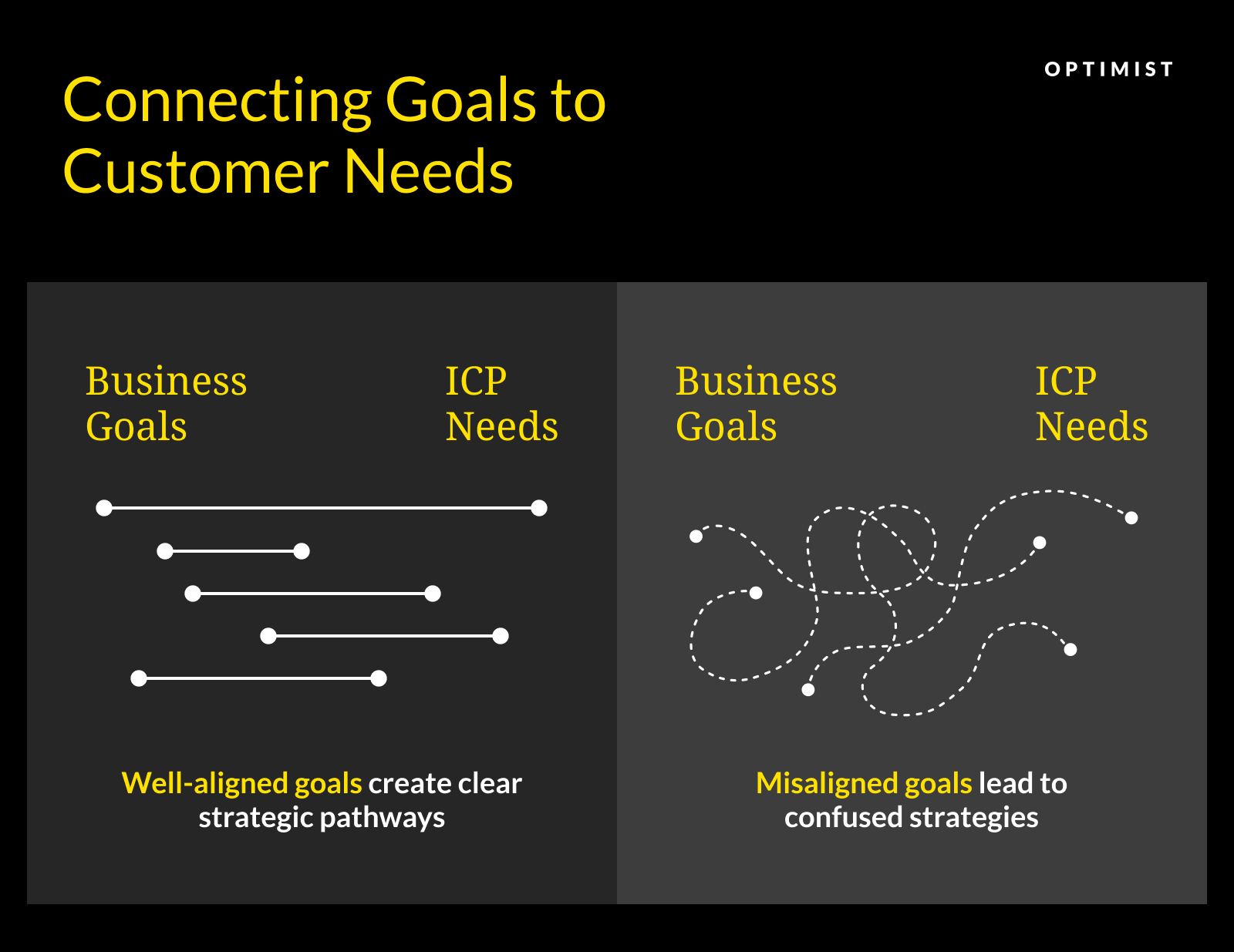
So before you start strategizing, make sure you’re aiming at the right target. If possible, include the insights from your ICPs at the goal-setting stage. It’s much easier to spend a little more time on setting goals than trying to fix your mistakes with creative strategies.
Choosing Your Channels
Good work. You’ve chosen strategies that align with your carefully chosen goals.
Now, you need to figure out how to deliver.
Many marketers make the mistake of jumping straight into tactics at this juncture. The tactics, however, come last in the workflow. The reason is simple: channels dictate tactics.
There’s zero point in researching popular hashtags and fresh video content ideas if you’re going to launch an email marketing campaign. And even a world-class white paper is unlikely to impress anyone on TikTok.
You get the idea.
So how do you choose which channels to target? Once again, your goals and your ICPs hold the answers.
Find Your ICPs, Then Add Your Goals
For any channel to be included in your overall content marketing strategy, it must be somewhere your ICPs spend time.
A quick example to illustrate the point:
- If you’re selling gaming chairs, consider setting up a Reddit profile and creating a community on Discord.
- But creating content for LinkedIn will likely lead you nowhere.
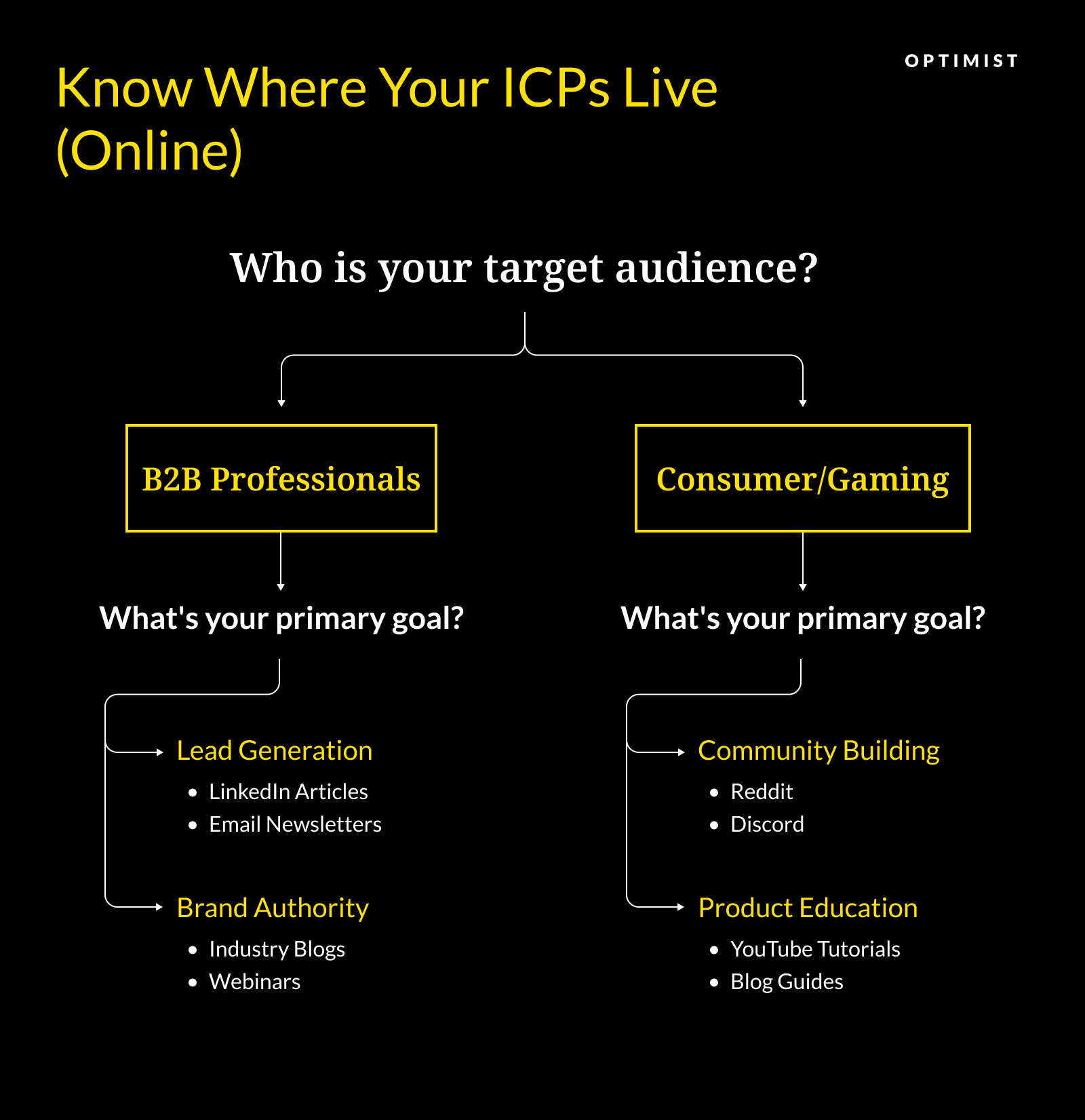
Once you’ve narrowed the field, start picking out the channels that work with your goal and strategy for your chosen type of content.
Returning to the gaming chairs for a minute:
- Posting a long-form buyer’s guide on Reddit or your blog to attract more leads to your website could work well.
- But no one is going to wade through 2,000 words on Discord. And they definitely won’t click your website link at the end of the message.
Effective channel selection is about servicing the needs of your audience in a way that contributes to your business goals.
For most B2B SaaS programs in 2026, channel selection also means reversing the default order of operations. Most strategies commit to a pipeline number, then choose channels by reach. Reverse it. Rank channels by realistic pipeline contribution per dollar invested, then commit to the two or three that pencil.
For most B2B SaaS programs in 2026, the channel set looks like this:
- Owned organic search. Still the largest single source of researched buyer demand. Earns visibility through Google rankings and AI engine citations on the same content. Compounds. Slow to start.
- AI answer engines as a discovery surface. Brand mentions in ChatGPT, Perplexity, Gemini, and AI Overviews. Earned through entity clarity, messaging consistency, and content gaps closed in places the model expects to find answers. Marketing leaders are now grading agencies on AEO point of view first. If AEO isn’t named as a channel, the strategy is already a generation behind.
- LinkedIn (founder and executive-led). High pipeline efficiency for B2B because the buyer’s network is there, and most of the consumption happens off the brand’s analytics stack. A senior content lead at a public marketing-tech company told me she became a champion for a SaaS tool entirely by reading the founder’s LinkedIn posts for weeks before ever visiting the site. Her attribution stack scored that journey as zero, which is why I size LinkedIn contribution off downstream pipeline outcomes, not session counts.
- Peer communities (Slack, Discord, Reddit, Pavilion, RevOps Co-op). Where the buyer validates a shortlist before they trust the brand’s content. Earned through real participation, not link-dropping.
- Owned podcast or video. Optional. Pencils for some categories, not others. Most teams overestimate the pipeline contribution.
- Email and lifecycle. A capture-and-nurture layer that converts demand the other channels generate. Not a top-of-funnel channel for most B2B.
What’s not on this list as a primary channel: paid social as the pipeline engine, gated lead magnets as the primary capture mechanism, and generic “content syndication” deals. Each has a role; none belongs in the top three for a pipeline-led strategy in 2026.
Executing Your Strategy With Tactics and Metrics
At last, we’ve arrived at the execution layer. It’s time to put the theory into practice.
Up until now, the strategy development process has been quite linear. One step informs the next, and so on. But when you get to tactics, things get a little looser. This is your moment to be creative and consider all the possibilities.
Not sure where to start? Here are some proven techniques for establishing your tactical playbook.
Build the Content Footprint by Funnel Stage
Before you write a single brief, sketch the footprint. The funnel stages still matter even if the buyer doesn’t walk through them in order, because they describe the content the buyer needs at each point regardless of whether the brand controls the path between pages.
- Pre-Funnel (Affinity). Industry-trend or category-defining content for buyers who haven’t named the problem yet. The SEO play is discoverability; the AEO play is citability.
- TOFU (Exploration). Names the pain, frames the cost of status quo, introduces the solution category. The SEO play is ranking; the AEO play is problem anchoring — AI engines associate the brand with the problem itself.
- MOFU (Consideration). Compares approaches and maps the brand’s solution to the buyer’s specific job. The SEO play is category ownership; the AEO play is solution clarity AI engines can repeat back.
- BOFU (Decision). Vendor comparisons, alternatives pages, pricing transparency, decision criteria. The SEO play is competitive framing; the AEO play is definitive positioning, with enough detail for AI engines to advocate accurately.
- Post-Funnel (Retention). Customer content that reduces churn, expands accounts, and produces the evidence layer feeding back into BOFU and MOFU.
Every stage carries an SEO play and an AEO play. The strategy commits to both at every stage, not one at the top and the other at the bottom.
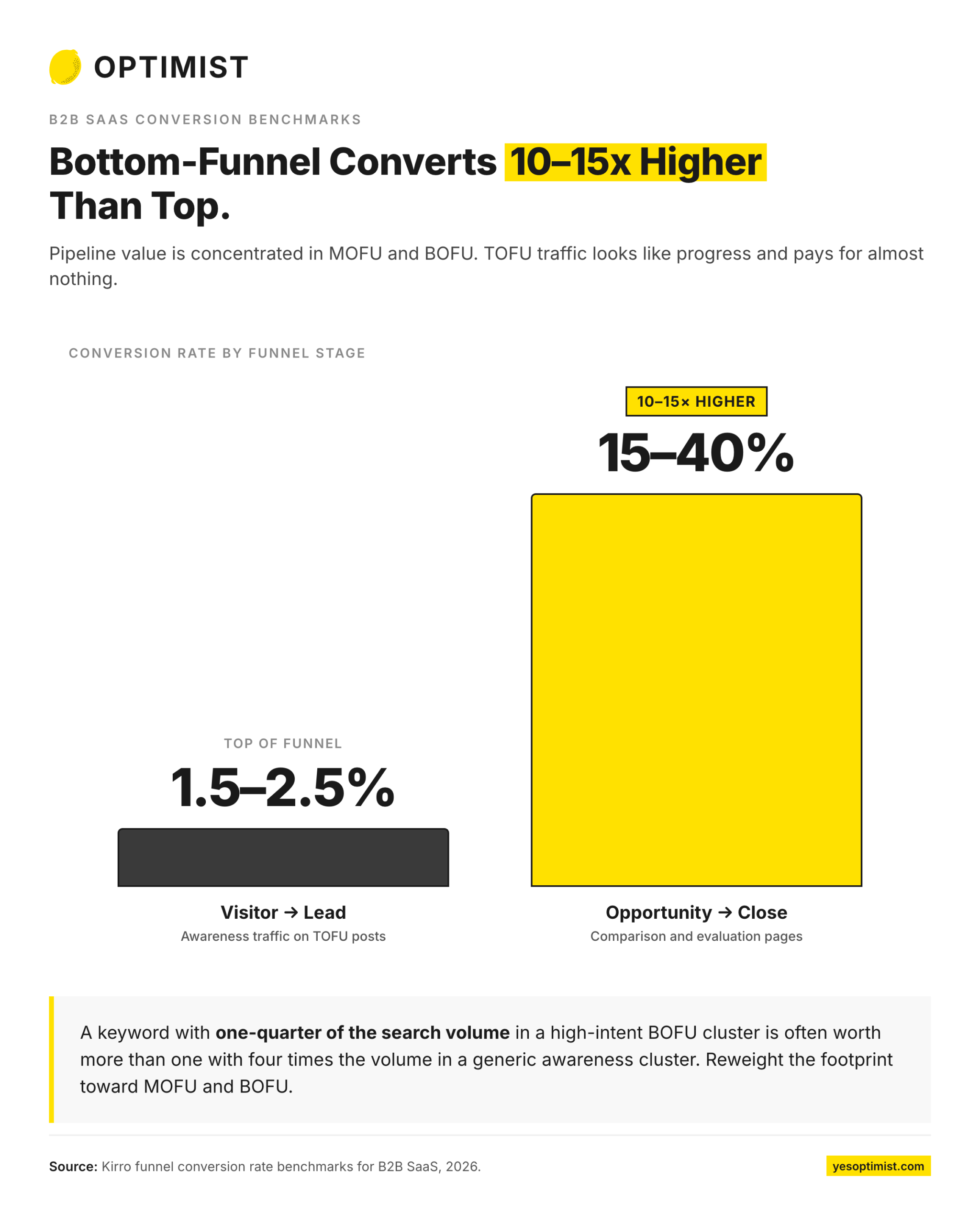
The trap most strategies fall into is over-investing in TOFU because it’s cheap, ranks faster, and produces traffic that looks like progress. The pipeline value is concentrated in MOFU and BOFU. B2B SaaS conversion benchmarks show bottom-of-funnel conversion rates running 10 to 15 times higher than top-of-funnel rates (visitor-to-lead at 1.5–2.5% versus opportunity-to-close at 15–40%). A keyword with a quarter of the search volume in a high-intent BOFU cluster is often worth more than one with four times the volume in a generic awareness cluster.
When I size a content roadmap, I’ll usually find the highest-pipeline-value cluster is one the team has been undershipping because it’s not where the easy traffic is. Reweighting toward MOFU and BOFU comparison and evaluation content is one of the most reliable pipeline lifts available in a refresh.
What’s Already Working for You?
A good place to start the tactical playbook is with your existing content.
Run a content audit to determine what’s working, what you can retire, and what you can repurpose. For written content on your site, review your Analytics and Search Console reports to see what’s drawn clicks over the last 1–2 years. Brainstorm ways to recreate or repurpose those hard-working posts. You can do the same for email newsletters and social content using the built-in analytics tools on your chosen platforms.
In 2026, add an AEO audit alongside the SEO audit. Run a sample of your priority buyer prompts through ChatGPT, Perplexity, Gemini, Claude, and AI Overviews. Note which pages get cited (if any) and which competitors get mentioned by name. The pages that earn AI citations are often the same pages that already rank well in Google, but the gaps are different — and the gaps are where the strategy adds the most value.
As you dissect your existing content, look for areas you can improve. If there’s a blog post that earns loads of backlinks, is there a way to make it even more linkable by building an infographic? Is there content in the post you can repurpose on other platforms? Are you interlinking your most popular posts with new pieces of content?
Updating, recycling, and re-optimizing content your audience already loves is way easier than starting from scratch.
What Is Your Audience Looking For?
As with your strategy, your tactics should be led by the preferences of your ICPs.
Previously, we looked at the big picture — roles, goals, and worries. But to guide your tactical plan, you’ll need a much more detailed understanding of your audience.
That means knowing:
- Which posts they enjoy most.
- What time of day they’re likely to check your chosen channels.
- What kind of search terms they use.
- Which buyer prompts they’re now running in AI chatbots, and which brands those chatbots name in response.
- How they usually consume content.
- What actions they take after consuming a helpful piece of content.
You may be able to establish some facts using analytics, or through some good old-fashioned online sleuthing. Here’s one method I often use:
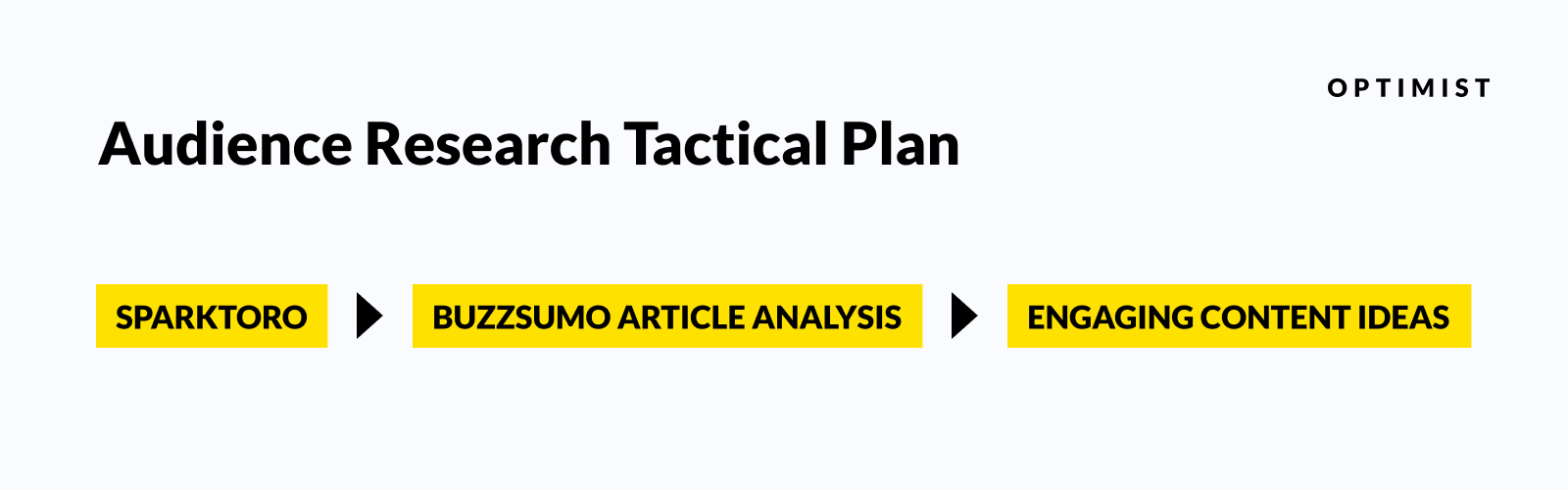
- Fire up SparkToro to learn more about your target audience. Plug in your audience type (e.g., “digital marketing managers”) and get data on whom they follow, the websites they visit and amplify, and which podcasts they listen to.
- Take that information and use a tool like BuzzSumo to get an idea of which topics perform well on the sites they visit, and apply that to your guest posting or blog strategy.
- Then run a sample of buyer prompts — the actual questions a real prospect would ask in ChatGPT or Perplexity — and note the brands the models name. That’s your competitive set in the AI surface, and it’s not always the same competitive set Google shows you.
It’s always worth asking your ICPs directly if you have the chance. A survey that takes just three minutes to complete can reveal a lot about your target audience.
Copy Your Competitors
Content marketing isn’t about reinventing the wheel. And there’s no copyright on strategies and tactics.
It’s totally okay to cherry-pick ideas from your competitors and adjust them to match your goals. Figuring out what your competitors are doing well is surprisingly easy. Look at their content through the lens of search traffic and social traction, and see what they’re promoting.
Then brainstorm topics and content types your competition hasn’t quite nailed.
You can even go head-to-head if you want. But unless you own the bigger brand, this approach usually just makes it harder to stand out, so it’s generally better to take the best ideas and switch them up a little.
Participation as Content
We often think of content marketing in terms of traditional publishing: you share your content, your audience consumes it.
But content isn’t a one-way street anymore. There’s often as much value in conversations as there is in content creation.
As you compile your tactics, include interaction in your content calendar. Comments and messages might seem like a waste of time, but a positive interaction could be as effective at driving interest as a well-made blog post. Participation also feeds the third-party grounding layer that AI engines weight — Reddit discussions, podcast appearances, even even LinkedIn posts are exactly the kind of source material a model trusts more than your homepage.
Measure Your Progress With Metrics
How do you tell whether your strategies and tactics are working? By measuring your progress.
Metrics can reveal whether your content marketing is helping you achieve your business goals.
The link isn’t always direct. For example, you can’t possibly measure what effect content marketing alone is having on total sales. Equally, looking at content metrics (e.g., page views, time on site) alone won’t tell you anything about the business value you generate through content.
You need metrics that tie your tactics to your objectives. They should help you answer questions like, “Is this content actually creating value for our business?”
It’s important to choose your metrics wisely. They are likely to influence your actions as you execute your content marketing strategy.
Imagine you decide to monitor your bounce rate. There’s a good chance you’ll focus on tactics that get people from one page to the second page. This may be valuable, but only if it actually contributes something toward your business goals.
Building Useful Metrics
To test this, you need to go beyond your basic metrics, like page views, and design something more specific.
Pipeline-stage metrics anchor the program against revenue. The AEO metrics prove the program is keeping pace with the visibility shift. Track both. Report both at the same cadence.
Pipeline-stage metrics worth tracking:
- Visitor-to-lead conversion rate, segmented by funnel stage of the entry page. First Page Sage’s SaaS benchmarks put the SEO/organic baseline at 2.1%, with SEO posting the highest MQL-to-SQL rate (51%) of any channel benchmarked.
- MQL-to-SQL conversion rate, by topic cluster. Tells you which topics produce real buyers.
- SQL-to-opportunity and opportunity-to-close, by source content cluster. Long-cycle but the only true revenue signal.
- Pipeline value per page, calculated from search volume, ranking position or AI mention rate, conversion benchmarks, and ACV. This turns the content footprint into a forecast.
AEO-specific metricsworth tracking alongside:
- Brand mention rate across AI engines. How often the brand is named when a representative buyer prompt is run through ChatGPT, Claude, Perplexity, Gemini, and AI Overviews. Optimist benchmarks this across five models per prompt and tracks weekly.
- Citation frequency. How often specific pages are linked as sources in AI answers. Lagging signal but useful for diagnosing which pages earn AI trust.
- Share of voice in AI answers. When the brand and named competitors both appear, what share of the answer text is the brand’s.
- AI-referred sessions and conversions. Sessions and conversions sourced from ChatGPT, Perplexity, and Claude referrers. Seer Interactive’s research found ChatGPT traffic converts at 15.9% versus a 1.76% Google organic baseline, roughly 9x. The volume is still smaller, but the conversion economics are dramatically different.
Notice how we’ve taken the primary goal — qualified pipeline — and broken it down into specific measurements that you can monitor every day, week, or month. This makes it easier to determine if the results match your expectations.
The combined view lets you tell a board, in one slide, what the content strategy is producing. Pipeline contribution by topic cluster. AI visibility by buyer prompt. Conversion economics by entry stage.
One nuance worth flagging on the AI-referred metric. A senior marketer at a global health-tech company explicitly rejected a “drive traffic from chat” goal her team had been pushing, in favor of measuring registration completions instead, because, in her words, people use ChatGPT precisely to avoid clicking through. AI-referred traffic is real, but the bigger story is what AI visibility does to a buyer’s perception of the brand before they ever land on the site. Measure both, and weight the perception story heavier than the click.
Putting the Pieces Together
Remember the difference between a content strategy and a content plan?
Now is the time to build the plan.
Having developed your tactics, you can start working on individual content ideas. Sift, sort, and categorize these ideas into a working calendar, with due dates assigned to each piece.
Your editorial calendar should detail what you’ll be publishing and when. It should also provide an overview, making it easier to plan strategically.
What is the goal for a particular piece? What promotion or outreach tactics will you be doing? Who is the audience? Which buyer prompt is the piece designed to win in AI engines, in addition to its Google target?
Having all of this data in a single calendar view will help you maintain your strategic vision and prioritize work that needs to be done, based on the strategy you’ve defined.
Assuming you have completed the steps above, your Content Strategy Canvas should look something like this:
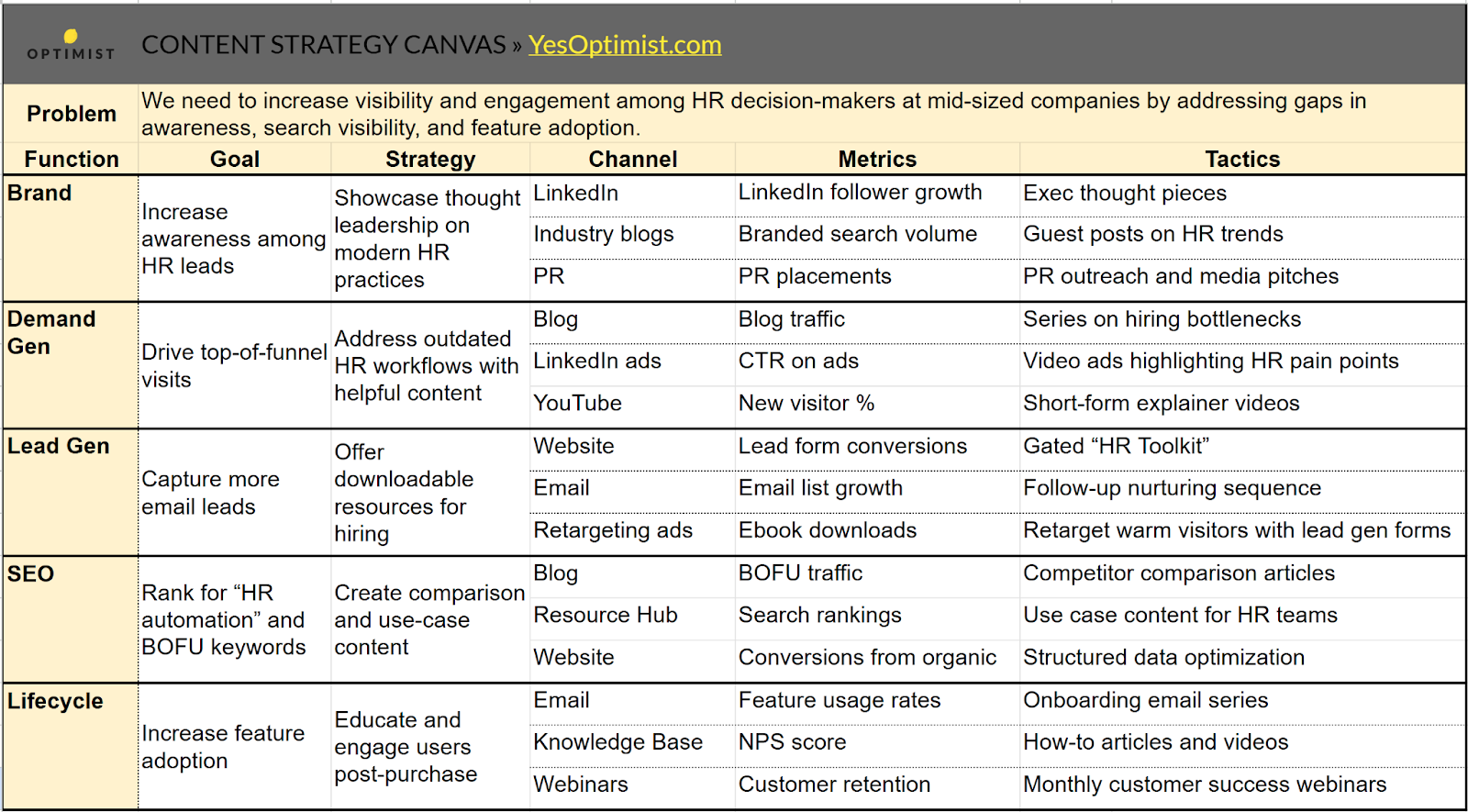
- Problem: Clearly states your task within this stage of the funnel.
- Goals: Aligned and SMART, each working toward solving your problem — including pipeline-stage goals and AEO-visibility goals.
- Strategies: Crafted with your audience’s roles, goals, and worries in mind, with every page running the full problem-to-solution-to-product narrative.
- Channels: Where your ICPs hang out, ranked by pipeline contribution per dollar.
- Tactics and Metrics: The creative execution and the means to monitor success hand-in-hand, across both Google and AI surfaces.
Seeing the Strategy Canvas filled out helps you appreciate how deliberate each step was — nothing left to chance.
When you map the Canvas across both Google and AI surfaces, you’ve built the Complete Organic Revenue Engine (CORE) — the framework that turns a content strategy into a pipeline engine.
This same clarity becomes your greatest asset when communicating your strategy internally or collaborating with your team.
Building A Content Marketing Strategy Focused on Organic Pipeline: The CORE Framework
Once you start designing strategies that span both Google and AI answer engines, you need a system that ties the pieces together to create a unified organic strategy. (Otherwise the work fragments back into “an SEO program” and “an AEO project” that don’t share a roadmap.)
Optimist builds these strategies using our Complete Organic Revenue Engine (CORE) Framework.
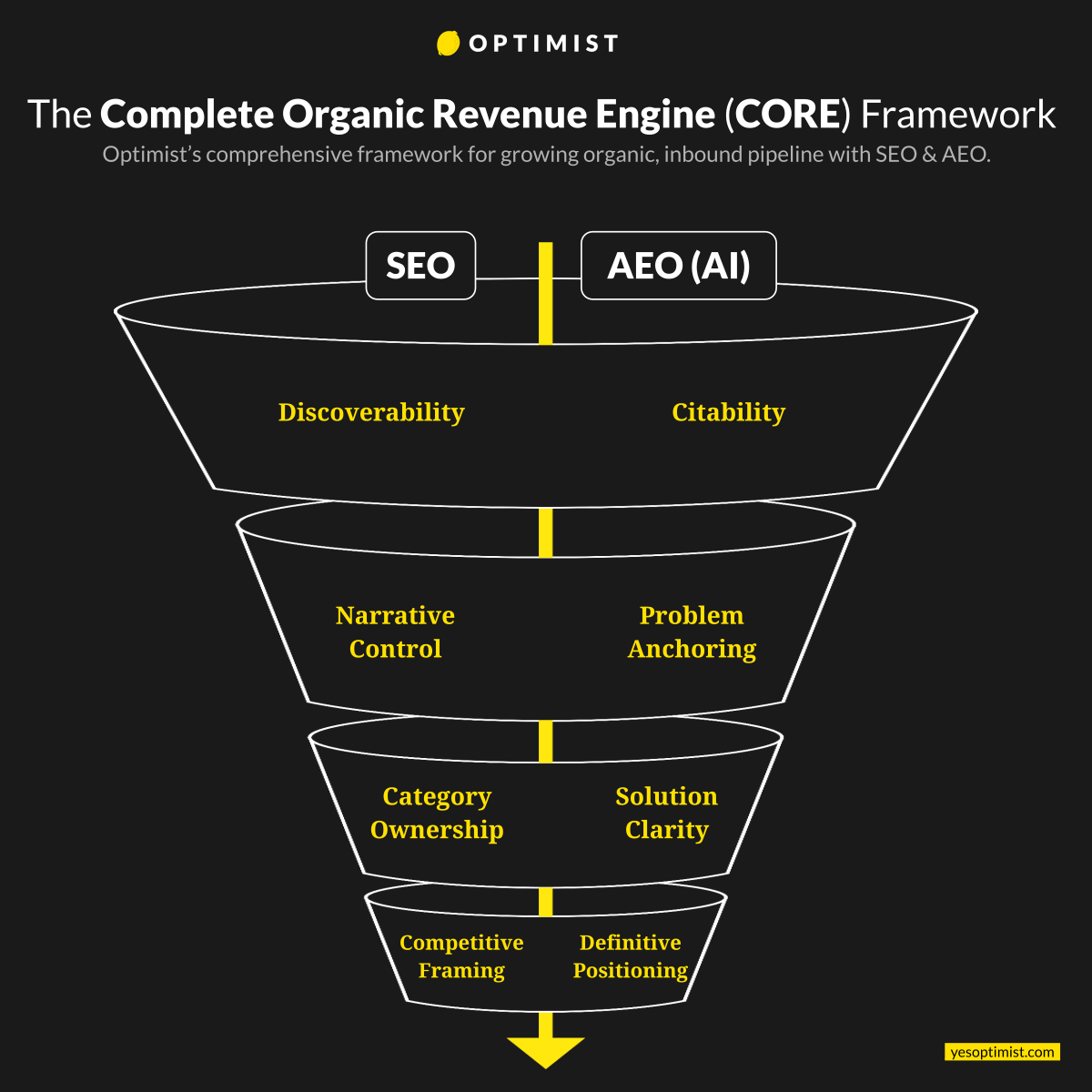
We follow a process that builds one map of every topic the buyer cares about, analyzes each topic through the SEO lens (search volume, ranking, page quality, pipeline value) and the AEO lens (brand mention rate, citation frequency, competitive presence in AI answers), and optimizes every page for both surfaces at once.
The CORE Framework is the natural evolution of our Strategy Canvas for 2026 organic and inbound buying behavior.
But, this also requires some more evolution in how we think about content marketing and how content fits into – and around – the real purchase journey.
Designing the Single Page to Carry the Full Narrative
One big shift with the rise of Dark Discovery (AI search and LLMs) is the collapse of the “guided purchase” funnel.
The classical content marketing model says a TOFU post hands off to a MOFU comparison page, which hands off to a BOFU pricing page, advancing one stage at a time along a path the brand controls.
That model assumes the buyer reads sequentially and that the brand sees the journey.
Neither assumption holds in 2026.
Buyers self-steer. They land on one page, then bounce to ChatGPT, LinkedIn, or a peer Slack.
The next time the brand sees them is in a deal-closed report or never.
Forrester’s 2026 buying survey of nearly 18,000 global business buyers found that the typical B2B buying decision now involves 13 internal stakeholders plus 9 external influencers, with GenAI searches as the starting point but most of the research and validation happening elsewhere. Gartner’s B2B Buying Journey research splits buyer time as 27% on independent online research, 22% on internal consensus-building, and only about 5–6% per supplier in a competitive set.
The strategic conclusion writes itself.
If buyers spend most of their time on surfaces the brand can’t see, the brand can’t depend on a guided multi-page sequence.
Every page has to carry the full narrative — problem, solution, product — and offer a genuine next step, regardless of which funnel stage it nominally targets.
This is the work Optimist did with Kubera, where full-funnel single-page narratives drove 43x product signups in 15 months. Each page named a pain point, mapped it to a solution category, connected the category to the product, and offered a trial signup. No page dead-ended at “subscribe to the newsletter.”
A B2B fintech client Optimist worked with built the same problem-to-product throughline across their content catalog and saw 8x LLM conversions in 8 months.
The AEO upside compounded because the same narrative completeness that closes the buyer is what gives an AI engine enough context to recommend the brand by name.
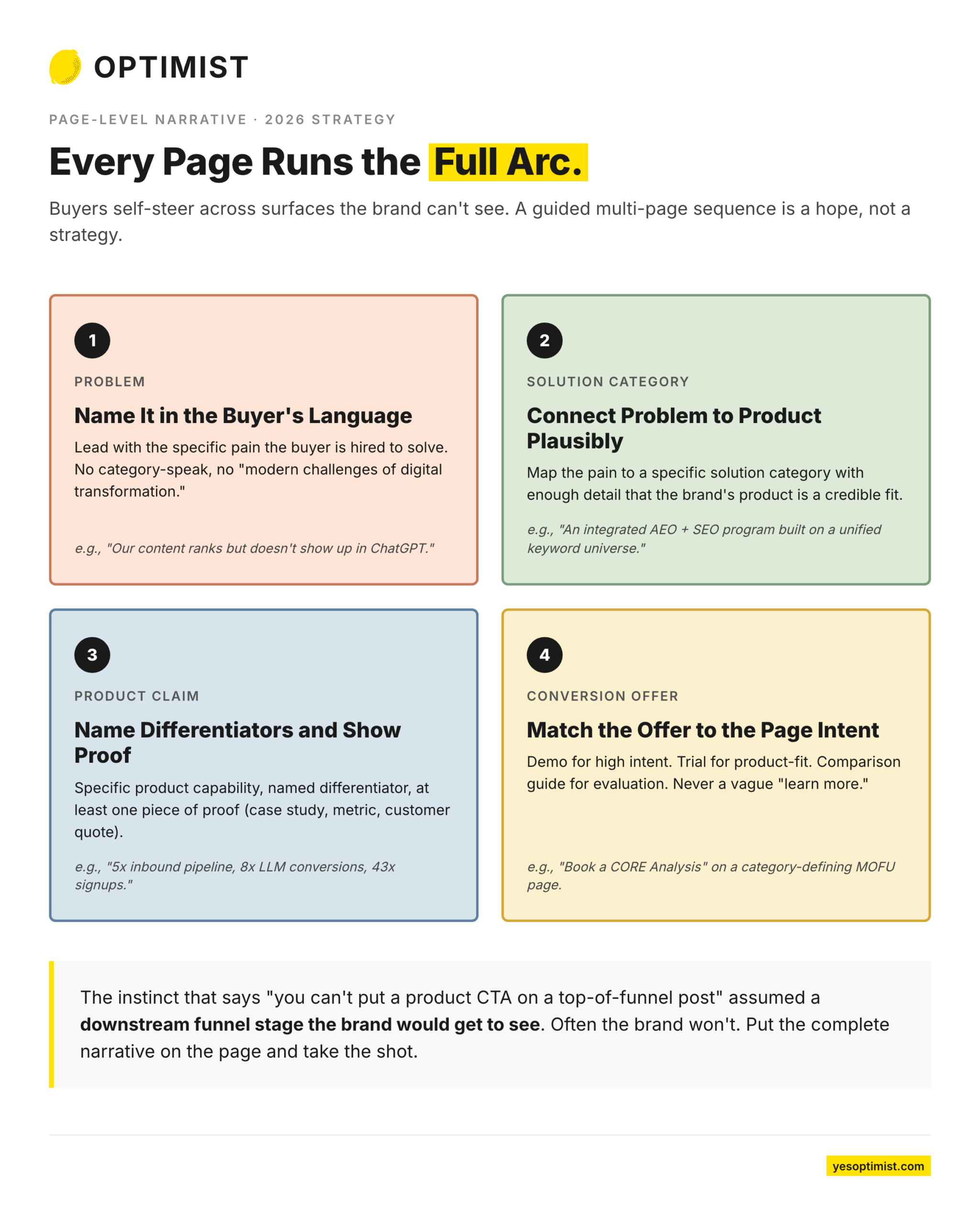
The practical implication for strategy design is that every brief commits to four things on every page.
- The problem the page names, written in the buyer’s own language.
- The solution category that solves it, with enough specificity that the connection to the product is plausible.
- The product-level claim, with named differentiators and at least one piece of proof.
- A real conversion offer, sized to the intent of the page. A demo for a high-intent page, a trial for a product-fit page, a comparison guide for an evaluation page. Never a vague “learn more.”
The instinct from a 2019 playbook says “you can’t put a product CTA on a top-of-funnel post.” That instinct assumed a downstream funnel stage the brand would get to see. But you might not get that opportunity to nurture a conversion down the line.
Put the complete narrative on the page and take the shot.
AEO Tactics That Don’t Fall Out of SEO
Most of the tactical playbook of the SEO era still apply to AEO.
But there are a handful of AEO tactics that don’t fall out of a standard SEO program — they’re the residual set of moves that, when added on top of solid SEO, produce the AI visibility lift that pipeline-led teams need:
- Entity disambiguation. AI engines need to know what your brand is, in plain terms, before they can recommend it. That means consistent category language on your homepage, in your G2 / Capterra / LinkedIn descriptions, in your founder’s bio, and in any third-party profile a model is likely to read. If your homepage says “AI-powered analytics platform” and your G2 profile says “workforce planning software,” ChatGPT will name two adjacent competitors and never you. Fix the inconsistency at the source.
- Cross-property messaging consistency. Same logic applied across every property the brand controls or influences. Audit and align in one pass.
- Content gap closure against AI prompt space. Build a list of the 50–100 priority buyer prompts and check which ones the brand isn’t mentioned in. The gaps are the content briefs.
- Citation-friendly content structure. Statistics, quotations, named studies, scannable answer-first paragraphs. The Princeton GEO research showed these tactics drove up to 40% visibility lift across tested AI engines.
- Third-party grounding. Most AI engines weight third-party mentions (G2, Reddit, podcasts, peer Slack channels) higher than the brand’s own site for trust signals. Earning the third-party layer is content-strategy work, not just PR.
These aren’t bolt-ons. They’re the deliberate work that bridges from “good SEO” to “actually mentioned by name in ChatGPT.”
What This Strategy Looks Like Wired Up
The framework above is the structure of a content marketing strategy that holds up to a 2026 buyer journey.
Most marketing teams I talk to can articulate what they want their content strategy to do.
Few can show, with data, where the current footprint is invisible to AI engines, miscategorized in Google, or failing to convert at the page level.
That’s where we come in.
When working with clients, we start each engagement with a process we call The CORE Analysis.
This is our process that surfaces the unified keyword universe with pipeline values attached, runs an AEO benchmark across the five major models, builds a combined opportunity matrix, and produces a sequenced roadmap ranked by revenue impact.
The deliverable is the strategy in a form the CFO will sign for and the content team can execute on Monday.
This whole process is built on the same framework that’s drivenover 10 years of SEO case studies for our clients and continues to deliver proven AEO results today.
Outcomes like:
- 49x growth in LLM referral revenue over 14 months for a B2B tech company
- 8x LLM conversions in 8 months for a fintech client
- 13x LLM-sourced revenue year over year for a retail/D2C brand
If the framework above describes the strategy you want to build, reach out for a free discovery session and let’s discuss your goals and how we can help you get there.
Book a strategy call with Optimist today.
Production credits:
- Content strategy by Emily Bauer
- Visual direction by Katy Flatt
- Editing by Brinda Gulati
- Design by Anabelle Pang
- Content production by Rizky Darmawan
- Content help from Tyler Hakes
- 2026 content revisions by Tyler Hakes
- Additional content from Daisy Quaker
Frequently Asked Questions About Content Marketing Strategy
What is a content marketing strategy?
A content marketing strategy is the decision layer that defines what pipeline content is supposed to produce, who it’s for, where it has to show up, and what counts as winning. It sits above the content plan (the calendar, the production schedule, the keyword list). A strategy commits to outcomes; a plan executes against them. Without the strategy layer, what gets called a “content strategy” is usually just an editorial calendar with strategic language pasted on top.
What are the 5 C’s of content marketing?
The 5 C’s of content marketing are commonly described as Clarity, Conciseness, Compelling, Credible, and Call-to-action. They function as an editorial quality checklist for individual pieces of content. A strategy operates one level above that, answering what pipeline the content is for, who it’s for, where it shows up, and what counts as winning. The 5 C’s help a writer polish a draft. They don’t help a VP of Marketing defend the program to a CFO.
What is the 70/20/10 rule for content?
The 70/20/10 rule for content allocates roughly 70% of content investment to proven, predictable formats (the topics and channels you already know produce pipeline), 20% to adjacent experiments that scale what’s working, and 10% to higher-risk bets that could open a new pipeline channel. It’s a portfolio-management heuristic. In a 2026 strategy, the 20% slice is where AEO experiments belong while AI visibility is still a moving target.
How is a content marketing strategy different in 2026?
A content marketing strategy in 2026 has to cover both Google search and AI answer engines as a unified visibility surface, because the overlap between what ranks in Google and what gets cited in ChatGPT, Perplexity, Gemini, or AI Overviews is small. The strategic implication is that AEO and SEO have to be designed together, every page has to carry a complete problem-to-solution-to-product narrative because buyers self-steer across surfaces the brand can’t see, and the measurement layer has to combine pipeline-stage metrics with AI-visibility metrics.
How do you measure if a content marketing strategy is working?
You measure a content marketing strategy by pipeline contribution, conversion economics, and AI visibility. Traffic stays in the dashboard as a diagnostic but doesn’t earn the KPI slot. Pipeline-stage metrics (visitor-to-lead, MQL-to-SQL, opportunity-to-close, pipeline value per page) prove the strategy is producing revenue. AEO metrics (brand mention rate across AI engines, citation frequency, share of voice in AI answers, AI-referred sessions and conversions) prove the program is gaining visibility on the surfaces buyers actually use. Track both. Report both at the same cadence.
What’s the difference between a content marketing strategy and a content plan?
A content marketing strategy is the decision layer. A content plan is the execution layer. The strategy commits to outcomes (pipeline contribution, ICP, visibility surface, what counts as winning). The plan sequences the moves that deliver them (the calendar, the briefs, the production pipeline). The strategy changes rarely. The plan changes constantly. Most “strategy documents” I review in B2B marketing engagements are plans dressed up in strategic language. They describe what will get published without committing to what it’s supposed to produce.
Should B2B SaaS companies invest in AEO before SEO is fully built out?
B2B SaaS companies should invest in AEO and SEO as one integrated program, under a framework like the Complete Organic Revenue Engine (CORE) Framework. The same content footprint that ranks in Google is the substrate AI engines pull from when generating answers. Sequencing AEO after SEO assumes the two surfaces will behave the same way once you get to the second one; they don’t. Designing for both at once is faster, cheaper, and produces more pipeline than building one and bolting the other on later.
