
Article Summary
Conversion content is content built to produce qualified pipeline, not traffic. Whether a piece converts is mostly decided before it’s written, by the search intent its topic targets.
In 2026 it also has to be visible across both Google and AI answer engines, because 51% of B2B software buyers now begin research in an AI chatbot more often than in Google.
Optimist builds conversion content programs for B2B technology companies, measured against pipeline rather than pageviews, with client results like Stampli’s 5X inbound pipeline growth.
Conversion content is content created to move a buyer toward a revenue action, a demo, a trial, or a sales conversation, rather than to earn awareness or traffic.
According to the Content Marketing Institute and MarketingProfs B2B content trends report, “creating content that prompts a desired action, conversion” is the single most-cited B2B content marketing challenge for 2026.
It’s named by 40% of marketers in a survey of 1,015 respondents, ahead of resource constraints at 39% and measuring content effectiveness at 33%. It’s the category’s number one named pain, and most teams aim the fix at the wrong layer.
In B2B marketing, whether a piece converts is mostly decided before it’s written, by the search intent it targets and by whether buyers can find it across Google and AI answer engines.
Most advice treats conversion content as a writing problem.
It’s a strategy problem first.
Sure, conversion content is persuasive, well-written copy with a strong call to action. That definition is reasonable as far as it goes, but it describes the surface and misses what decides whether a piece converts at all.
When a marketing team brings me a conversion problem, the brief almost always asks for sharper copy or a better CTA.
The fix is usually one level up, in the topics the content was built around.
Conversion Is Decided Before You Write a Word
A piece of content has a conversion ceiling the moment its topic is chosen.
The mechanism is search intent.
Buying-stage queries put an actively evaluating reader in front of the content.
Awareness-stage queries bring a reader who is learning.
Both are real audiences, but only one is near a buying decision.
Most “how to create content that converts” advice assumes the reader is already on a topic capable of converting, then jumps to copy, design, and CTA placement. It optimizes the last five percent while the topic choice that capped the result goes unexamined.
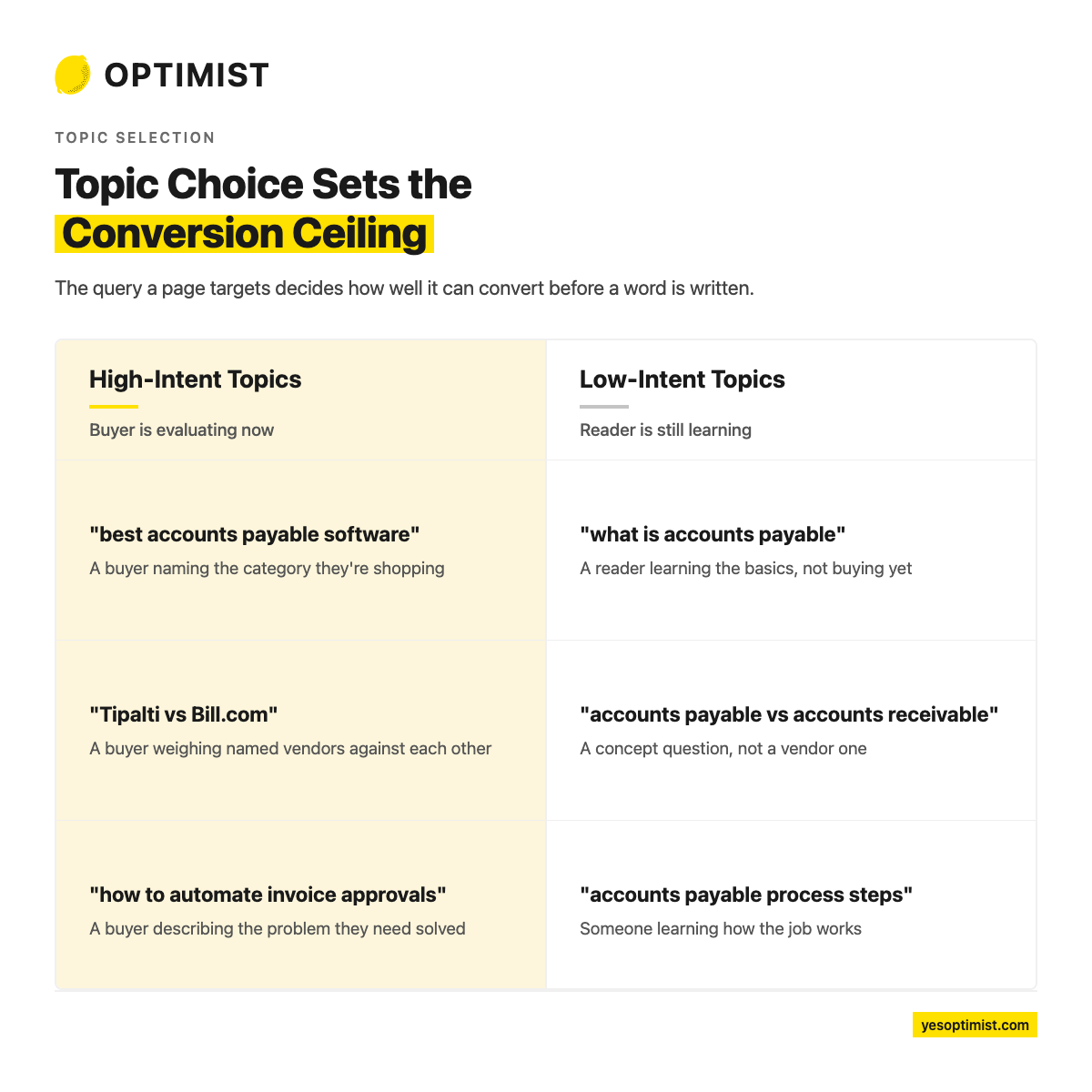
Two pages built by the same writer with the same care convert at different rates if one targets “best accounts payable software” and the other targets “what is accounts payable.” The first meets a buyer comparing vendors now. The second meets a reader months from a purchase (or never really in the market).
No editing closes that gap, because the query decided it.
A few months ago, I talked to a marketer at a B2B SaaS company in the restaurant payments space who described their problem with conversions from content.
They were getting tons of “leads” from a gated template.
They were people who “seem like an ICP fit, but they just don’t convert,” she told me.
The topics they were covering – and the template itself – attracted browsers. People in the market only for information, not solutions.
They fell into the trap of many B2B marketing leaders. They focused on creating content relevant to their ICP, but didn’t hone in on the search intent behind those queries or their proximity to any real purchase behavior.
Increasing conversions from content is a content marketing strategy problem.
Your strategy should be built to identify and target key topics that are closely aligned with real purchasing behavior, not just search volume or traffic.
A few examples:
- Category and “best [category]” queries: A buyer naming the category they’re shopping.
- Comparison and alternative queries: A buyer weighing named options against each other.
- Jobs-to-be-done queries: A buyer describing the problem they need solved.
What a Conversion Content Program Looks Like End to End
A conversion-focused content program runs five things as one connected discipline:
- Topic selection
- Product story
- Content structure
- CTA mapping
- Pipeline measurement
Optimist’s Complete Organic Revenue Engine (CORE) Framework is built on these foundations.
It’s wired to revenue and sales.
The Content Marketing Institute and MarketingProfs research found 45% of B2B marketers name sales alignment as a factor improving content effectiveness. But many teams struggle to figure out how to achieve that alignment in practice.
Start With Intent-Led Topic Selection
The first step decides the conversion ceiling, so it gets done first.
Select topics by buying intent, prioritizing the high-intent query families above, not by search volume or content-calendar habit.
Awareness-stage topics still have a job building reach and topical authority. But they aren’t where deals come from, and a conversion content program stays explicit about which pieces are built to convert and which are built to be found.
Blur that line and you get a busy content library and a flat pipeline.
Build the Product Into the Content Honestly
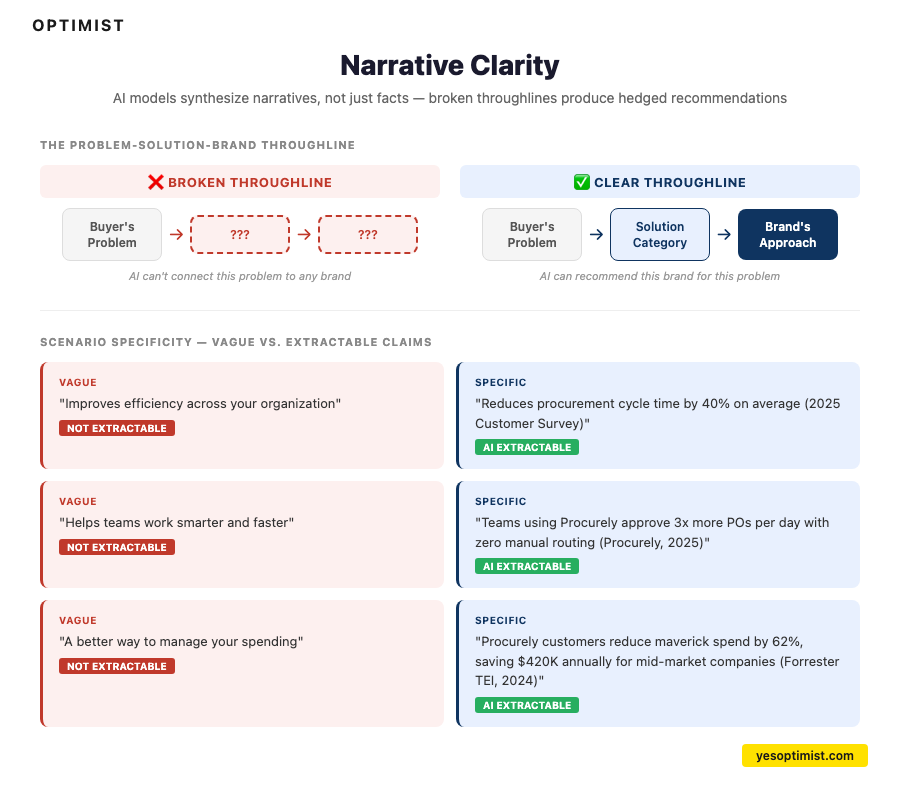
Conversion content names the product and shows how it solves the buyer’s problem.
Content that circles a problem and never names a solution trains both readers and AI models that the brand isn’t part of the answer.
The goal is the product shown inside a real job to be done, not a pitch bolted onto a generic article.
A piece on reconciling vendor invoices that walks the workflow and shows where a specific product removes the manual step builds a problem-to-solution-to-product throughline a reader and an AI model can both follow.
A piece that describes the problem and parks the product in a footer CTA doesn’t make the connection.
It’s also an entity signal. Associating the brand with a problem space is how AI models learn it belongs in the answer when a buyer describes that problem.
Structure Content for Readers and for AI Extraction
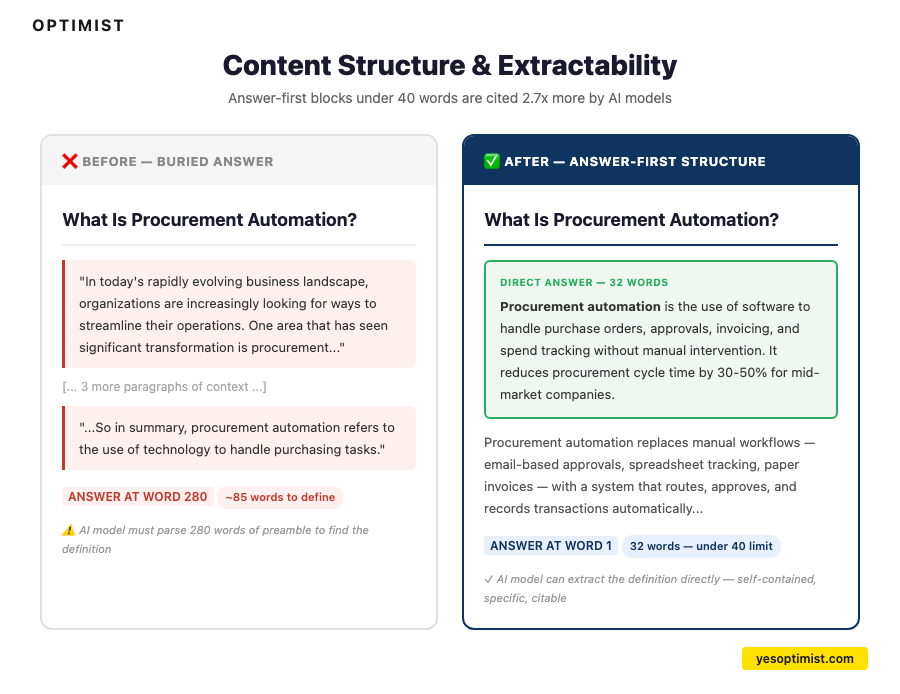
Structure conversion content so a human can scan it and an AI answer engine can extract it.
Content depth, entity clarity, and consistent messaging help anchor your product to the larger problem space and can help drive brand recommendations in AI answers.
Then layer the citation-driving structural work on top:
- Answer-first blocks: State the answer in the first sentence.
- FAQ sections: Use natural question phrasing.
- Schema markup: Label the content for machines.
- Content chunking: Make each section stand on its own.
Princeton-led GEO research by Aggarwal et al., published at ACM KDD 2024, found that generative engine optimization methods boost AI visibility by up to 40%, with the top three, citing sources, adding quotations, and adding statistics, driving a 30 to 40% relative lift.
Lead the Reader to the CTA (Journey Progression)
One of the biggest gaps I see that costs companies conversions is lack of journey progression.
Journey progression is a measurement of how well the content on the page actually moves the reader from their starting point in the buying journey to an actual point where it would make sense to take action.
Case in point: Imagine I write a “what is content marketing” article.
Ignoring the above reasons why I probably wouldn’t want to write this piece in the first place, my instinct might be to focus the entire article on addressing the query in question:
What is content marketing?
How does it work?
What are some examples?
But what about the CTA? How does providing this information actually move a reader toward the action I want them to take? I can’t just say, “now buy my stuff.”
In some cases, it might make sense to move a reader toward a more incremental conversion point like an ebook or an email list sign up.
But, in my experience, it’s better to complete the journey on the page — to connect the reader all the way to your business and establish how you help them, even if they’re not ready to make a decision today.
What is content marketing?
How does it work?
What are some examples?
Content marketing in-house vs an agency
Why do companies hire a content marketing agency?
What does a good content marketing agency look like?
What makes us a good content marketing agency?
Now buy my stuff.
Maybe not the most subtle sales pitch in history. But you can see how the general structure has laid out a path for the reader — from their starting point (learning about content marketing basics) to an ideal conversion point (understanding why content marketing agencies are important; and how our agency is unique).
Measure Against Pipeline, Not Traffic
Conversion content is judged against qualified pipeline and revenue, not pageviews, time on page, or social shares. That measurement standard is what separates a conversion content program from any other content program.
It’s Optimist’s standard because most of the category still reports on traffic, and pageviews can climb for a quarter while pipeline stays flat.
Most teams measure whether content was read, not whether it converted. Then teams optimize for these metrics without knowing how (or if) they translate into actual dollars.
I recently had a call with a marketing leader at a B2B software company who described retiring “organic traffic up” as a success metric. He said the team had “mistakenly measured just organic traffic” and needed to ask “how do we get organic traffic down the funnel.”
More content isn’t more conversion.
Among B2B marketers using AI to assist content creation, the Content Marketing Institute and MarketingProfs research found 87% say productivity improved, but only 58% say quality improved and just 39% say performance improved.
A conversion content program reports on pipeline-side measures instead:
- Qualified leads generated: Leads that match the ICP and clear the bar for sales.
- Pipeline created: Open opportunity value traced to content.
- Marketing-sourced revenue: Closed-won revenue attributed to a content-first touch.
(Plenty of teams can’t trace that last number cleanly yet. That’s the gap worth closing, not a reason to fall back to pageviews.)
Why the Model Is Easy to Understand and Hard to Run
The five-part model seems like common sense.
Running it as a standing discipline is where most content teams come up short, because it demands three capabilities most teams haven’t built:
- Real buying-intent keyword judgment: The discipline to pick topics by where the buyer is, not a volume-led calendar.
- Visibility across Google and AI answer engines: A program that influences how a brand shows up in ChatGPT and Perplexity, not just in search rankings.
- Pipeline measurement from content to revenue: Attribution wired from a published page to a closed deal.
Each one is its own job, and most content teams have maybe one of the three.
Picture a B2B software company that has run a blog-only content agency for more than a year and admits it doesn’t track reporting on SEO.
Topics go in, blogs come out, and there’s no feedback loop on rankings, traffic, or pipeline.
That’s content production, it isn’t a conversion content program. A team that treats conversion content as a landing page to write on request keeps producing content and keeps missing the discipline.
How Optimist Runs Conversion Content for B2B Companies
Conversion content is a strategy decision before it’s a writing one. Whether a page converts is mostly settled the moment its topic gets chosen. Pick a topic with no buying intent behind it, and no amount of copy editing or tactical optimization will rescue it. What decides the outcome happens upstream, in the strategy itself and the high-intent topics it commits to.
That upstream work is what Optimist does.
Optimist is an AEO and SEO consultancy that builds conversion content programs for B2B technology companies, setting the content strategy, choosing the high-intent topics, tracking visibility across Google and AI answer engines, and measuring the content against pipeline rather than traffic.
Our AEO and SEO case studies with clients shows the impact of conversion-focused content driven by a conversion-focused content strategy:
- Stampli: Grew 5X inbound pipeline by targeting high-intent keywords that drove sales leads rather than chasing volume
- Plytix: Content became the company’s number one driver of leads and pipeline.
- B2B technology company: Grew 49x LLM referral revenue over 14 months alongside 26x growth in LLM referral traffic, as its content catalog shifted from ranking in search to being recommended by AI answer engines.
Conversion problems get solved at the strategy level, in the topics you commit to before anything is written.
If your content isn’t producing pipeline, that’s the conversation worth having.
Book a call and Optimist will help you set the strategy and choose the topics that convert.
Frequently Asked Questions About Conversion Content
What is conversion content?
Conversion content is content built to produce a revenue action, a demo, a trial, or a sales conversation, rather than to earn traffic or awareness. In B2B, what decides whether it converts is the search intent and topic it targets, a choice made before the copy is written. Persuasive copy and a strong call to action matter, but they sit downstream of that topic decision.
What is the difference between conversion content and regular content?
Regular content is typically built for reach and awareness, while conversion content is built and measured to move buyers toward pipeline. The practical difference is upstream. Conversion content targets buying-intent queries, like category, comparison, and jobs-to-be-done searches, and is judged against qualified leads and revenue, not pageviews.
How do you measure whether content is converting?
You measure conversion content against qualified pipeline and revenue, not traffic, time on page, or engagement. Consumption metrics can climb while pipeline stays flat, so the reporting has to connect content to qualified leads, pipeline created, and marketing-sourced revenue, which usually means wiring attribution from the published page to the CRM.
Does conversion content need to be optimized for AI search?
Yes, conversion content needs to be optimized for AI search, because in 2026 content can’t convert a buyer who never encounters it, and B2B buyers research across both Google and AI answer engines. Being mentioned and recommended in AI answers is the primary outcome that moves pipeline. Citations, where an AI links to the brand’s content, are the supporting play.
What types of content convert best for B2B?
Content targeting high buying-intent queries converts best, including category and “best [category]” pages, comparison and alternative pages, and jobs-to-be-done content. Format matters less than intent. A comparison page and a blog post targeting the same buying-stage query both outconvert an awareness-stage piece, no matter how well written.
Is conversion content the same as conversion rate optimization (CRO)?
No, conversion content is not the same as conversion rate optimization. CRO optimizes how an existing page performs, through layout, copy tests, and friction removal, while conversion content is about which content gets built and what intent it targets. CRO works on the last step. Conversion content is decided upstream, where the conversion ceiling is set.
