
Article Summary
SEO for startups succeeds when it’s run as a sequenced strategy that maps the product to a focused set of topics.
It fails when treated as a checklist of on-page, off-page, and technical tasks.
The winning approach is a five-step sequence: Mapping topics, selecting high-intent keywords, building complete topic clusters, and writing the full problem-to-solution narrative on every page.
This strategy integrates SEO and AEO to generate pipeline and brand recommendations, rather than just traffic.
SEO for startups works when it’s run as a sequenced strategy that maps the product to a focused set of topics, targets buyer intent over raw search volume, and runs a complete problem-to-solution-to-product narrative on every page.
It fails when it’s treated as a checklist of on-page, off-page, and technical tasks to grind through.
That distinction is the whole game.
A startup with one or two marketing people and finite runway can’t out-execute a F500 competitor on task volume, and it shouldn’t try. It can pick the right topics, sequence the work, and make every page earn a conversion.
That’s a strategy problem.
A winnable one.
Why Startup SEO Fails Before the First Page Is Written
Most startup SEO programs are lost at the planning stage, not execution. The work gets scoped as a list of tasks, the keywords get picked by search volume, and the content gets published into a funnel that assumes a reader moves through three blog posts in order.
None of those assumptions survive contact with how B2B buyers research.
I see this across the early-stage clients I work with, and the tell shows up in how a founding team frames success. Seed and Series A teams often set the goal as a traffic number, something like 30,000 monthly visits by month three.
When the success metric is a visit count, the program gets built to hit it.
It chases high-volume keywords that only loosely connect to the product, publishes broad awareness content with no path to a commercial action, and spreads coverage thin.
Six months in, the founder is staring at a Google Analytics chart that’s up and to the right while the pipeline number hasn’t moved.
Hmm.
A startup that out-executes on tasks but picks the wrong topics still loses. A focused startup with the right topic map wins. The strategic decisions come first.
How to Build a Startup SEO Strategy
A startup SEO strategy is a sequence, and the order matters.
It runs from mapping the product to publishing content that converts. Keyword research feels like the natural starting point. But that’s actually the first mistake.
Step 1: Map the Product to a Set of Topics
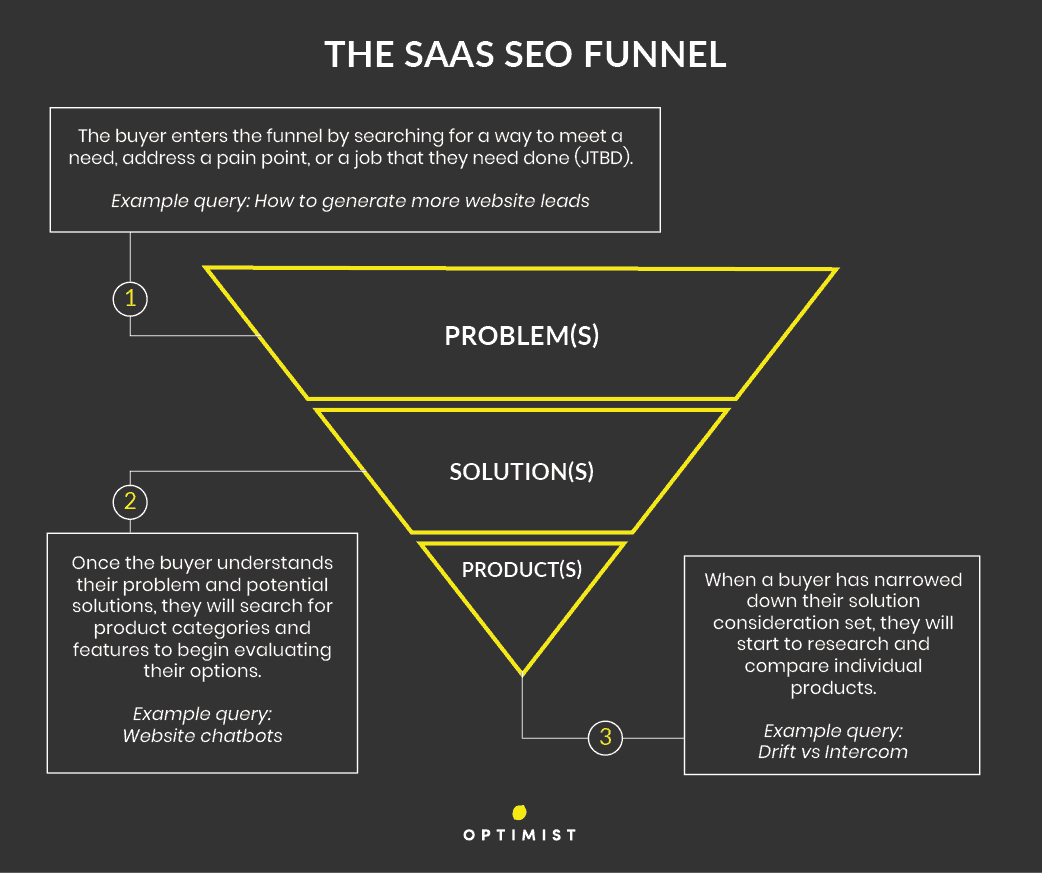
Before you touch a keyword tool, map your product to the topics your buyers care about.
A buyer evaluating a product like yours has a problem they’re trying to articulate, a solution category they’re weighing, and a set of comparison and decision questions they need answered. Each of those is a topic.
Name the handful of core topics where your product has a genuine right to be the answer.
Keyword research is downstream from this.
Once you know the topics, the keywords fall out of them. Start with keywords instead and you target terms with volume but no connection to your product. The SaaS SEO strategy guide covers the fuller topic-mapping treatment for software companies.
Technical founders especially tend to skip this step.
On a call last month, a co-founder at a seed-stage devtools startup asked me what click-through rate a number-one ranking pulls, so he could back into a traffic figure and decide whether SEO was worth the headcount.
It’s a reasonable instinct for an engineer, but not quite the right model.
SEO is a portfolio of clustered pages mapped to the topics a buyer moves through.
Say a startup sells project management software built specifically for distributed engineering teams.
The product maps to a few core topics:
- Managing engineering work across time zones
- Sprint planning for remote teams
- Engineering capacity planning
- Comparison space against general-purpose project tools
Those four topics, not “project management” as a head term, are where this startup competes.
This is the move behind Optimist’s startup work. Glide, a no-code app builder, grew product signups 14x in a year on content built around the specific topics its buyers researched, not the broad “no-code” head term it was never going to win early.
The topic map came first, and the keywords followed.
Step 2: Pick Keywords by Intent and Winnability, Not Volume
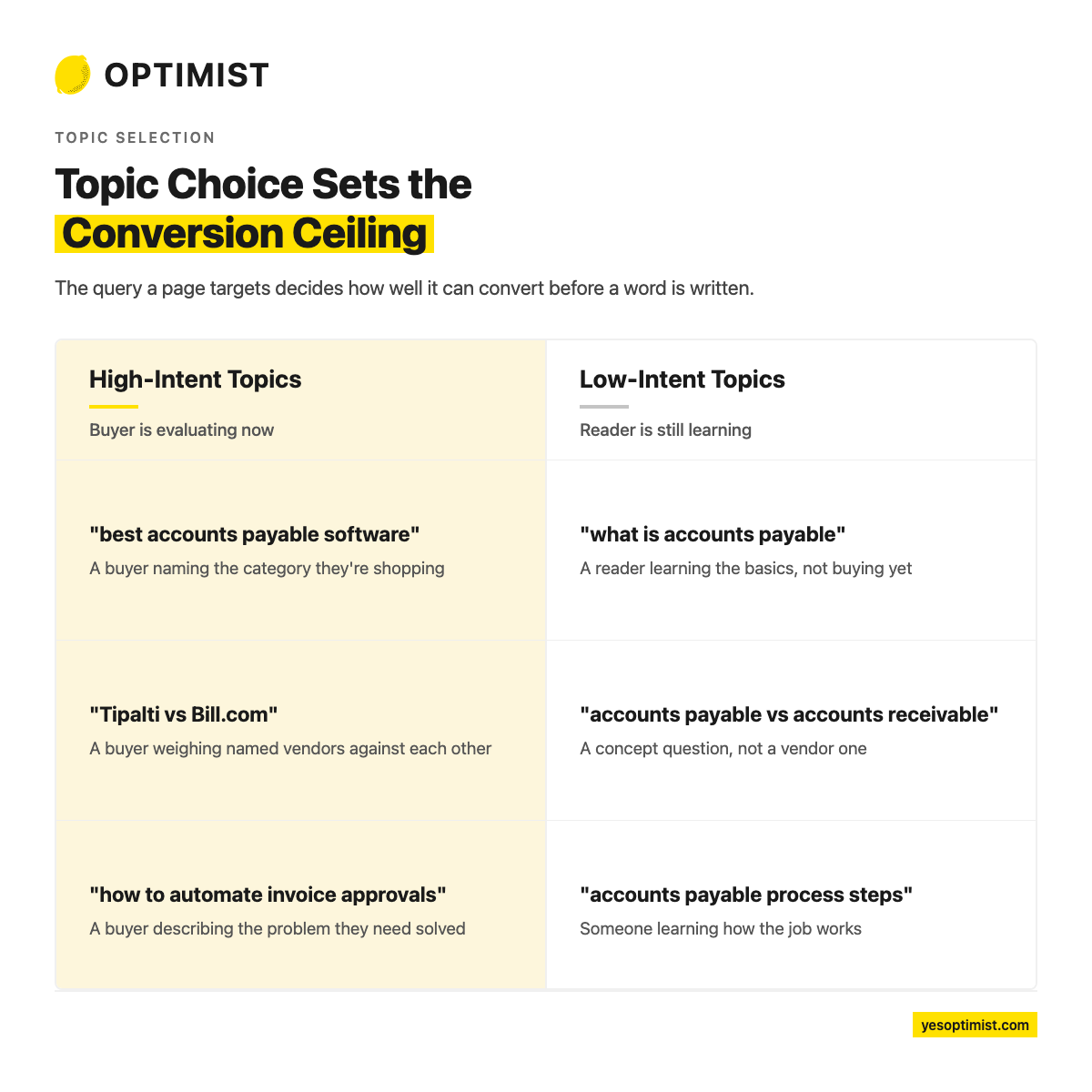
With topics mapped, choose keywords by two filters.
- How strong the buyer intent is
- How realistically your startup can rank
(Search volume is the third consideration, not the first.)
Buyer intent is the signal that the searcher is close to a decision.
A search like “sprint planning tool for distributed teams” comes from someone with a specific problem and a budget.
“What is project management” comes from a much larger crowd that mostly isn’t buying.
The keyword a 1 high-intent buyers search beats the keyword a hundred thousand curious people search.
This is the search-volume trap. Volume is the most visible number in every keyword tool, so it becomes the default sort. But a lower-volume, high-intent keyword isn’t a weak target. The most pipeline-relevant topics for a startup tend to look unimpressive in a volume column.
This is also the real 80/20 rule of startup SEO. A small set of high-intent topics produces most of the pipeline, and the long tail of high-volume awareness terms produces most of the traffic and almost none of it. Concentrate effort where the buyers are.
Winnability is the second filter. A seed-stage startup with a new domain isn’t going to outrank an established competitor for a broad head term in its first year. Eyeball page one for a term. If it’s stacked with competitors on deep domains, that’s a multi-year fight. If it’s thin or outdated pages, the topic is winnable now.
I watched this play out with a Series A devtools startup last year.
The team wanted the head term for its category, a keyword with real volume and a page one stacked with incumbents.
We mapped the topics instead and found a cluster of specific, lower-volume queries its buyers searched right before picking a tool.
Those pages ranked inside a quarter, and the leads they pulled were the ones already comparing options.
Those still didn’t win that head term — and totally okay.
Step 3: Build One Topic Cluster Completely Before Moving On
Pick one core topic and build the complete set of connected pages it needs before starting the next. For a resource-constrained startup, the topic cluster is the difference between owning something valuable and being thin everywhere.
You wouldn’t load your product with a bunch of one-off, disconnected features.
Same logic here.
A topic cluster is a hub page covering the core topic broadly, surrounded by interlinked supporting pages that each go deep on a specific facet.
For the distributed-engineering startup, the cluster on managing engineering work across time zones gets a hub page plus supporting pages on the facets buyers research, including an honest comparison of how general-purpose tools handle distributed teams.
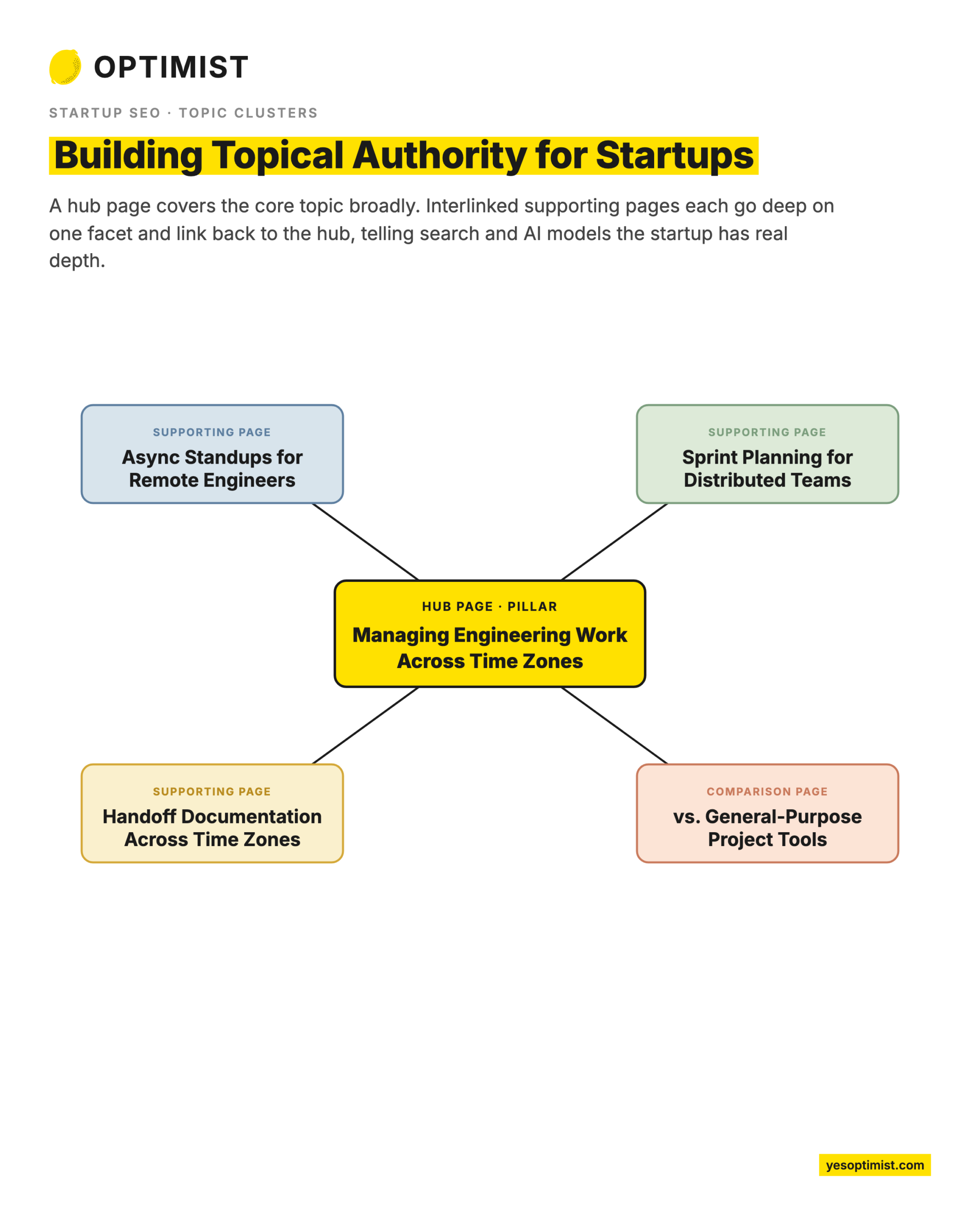
The cluster tells Google and AI models that your startup has real depth on the topic, not a single thin page. It also gives a buyer who lands anywhere in it a path to everything else they need.
Build clusters one at a time, because sequencing is what makes authority compound.
I see the alternative constantly. A startup with two marketing people opens five clusters at once because every topic feels urgent, and a year later all five are half-built and none rank.
The same team, told to finish one cluster first, has a ranking hub and three supporting pages going live every month.
Concentrated topic depth is what produced Optimist’s clearest startup outcome.
Kubera, a wealth-tracking product, grew product signups 43x in 15 months on an organic strategy built around owning a tight set of topics rather than spreading thin across the whole personal-finance category. That’s the difference focus makes at the startup stage.
Step 4: Write Every Page to Carry the Whole Story
Write every page to run the full narrative from problem to solution to product, and to offer a real next step. Not a partial story that names a problem and quits.
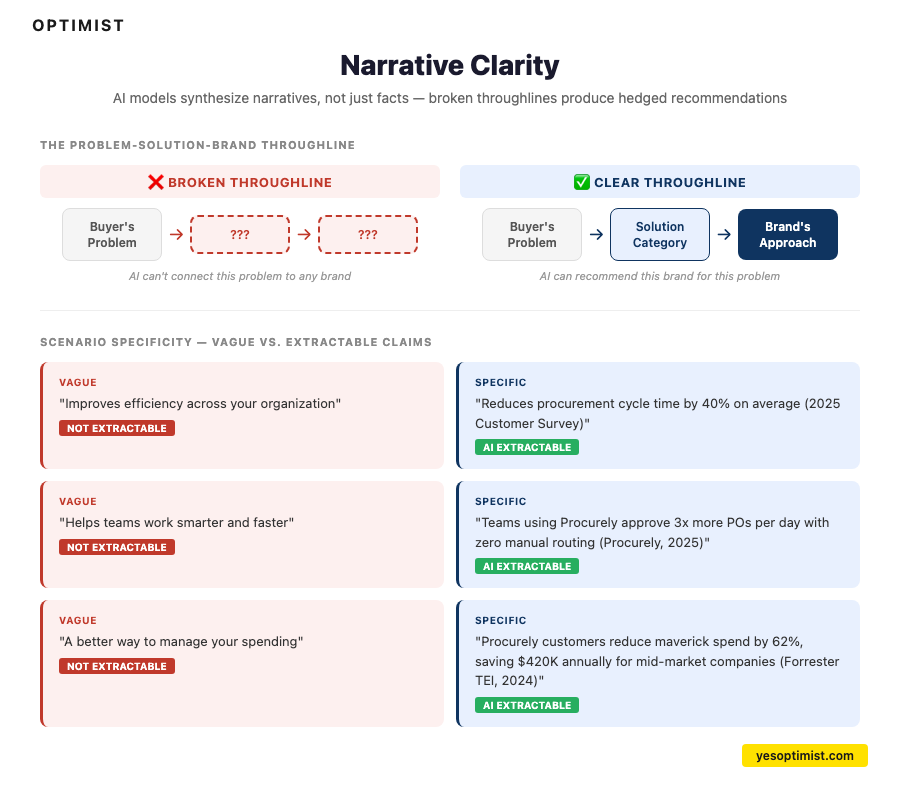
In our Complete Organic Revenue Engine (CORE) Framework, we call this Narrative Clarity.
It helps buyers and LLMs understand how your brand and product connect upstream to the actual problems, pain points, jobs to be done, and solution categories that drive the commercial discovery process.
This is also how a page earns AI visibility. A page that runs the complete narrative couples your brand tightly to the buyer’s problem, and that coupling is what makes AI models mention and recommend you. A page that only describes a problem gives the model nothing to attach a product to.
The classic content funnel assumes a reader enters at an awareness post, gets handed to a consideration page, then to a decision page, one stage at a time along a path you control.
That model stopped working.
B2B buyers self-steer, jumping between stages and building most of their shortlist on AI answer engines and peer channels you never see.
So the page is the unit of the funnel, not the path. A top-of-funnel article names the problem, connects it to the solution category, ties it to your product, and points to a genuine next step. It doesn’t dead-end at “learn more.”
Step 5: Build the On-Page and Technical Foundation
Once the strategy is set, the on-page and technical work is a checklist, and it should be treated as one.
Clean title tags with the keyword near the front, descriptive headings, fast pages, a logical URL structure, an XML sitemap, and crawlers that aren’t blocked.
None of it is optional, but it’s the floor, not the building.
One thing worth getting right is server-side rendering. Many AI crawlers don’t reliably execute JavaScript the way Google’s renderer does, so a page that builds its content client-side risks being read as near-empty by the answer engines you want to show up in. The safe move is to serve the content in the initial HTML.
I see this gap with a lot of early-stage sites I audit, because the startup shipped on a modern JS framework and nobody flagged that AI crawlers can’t read it.
Map the topics, pick for intent, build one cluster, complete the narrative, then ship the foundation. The order is the strategy.
How SEO and AEO Became One Strategy
Search visibility now spans Google and AI answer engines, and they should work as a single, integrated strategy for driving organic visibility and pipeline.
The behavior shift is already here. According to G2’s 2026 AI Search Insight Report, 51% of B2B software buyers now begin software research in an AI chatbot more often than in Google, and 69% chose a different vendor than they planned based on what an AI chatbot told them. Conductor’s 2026 benchmarks report found AI Overviews now trigger on 25% of Google searches, up from 13% in March 2025.
A startup that builds for Google rankings and treats “AI” as a tactic to bolt on later is building for half the landscape.
This isn’t a future consideration. The early-stage teams I talk to almost all use ChatGPT and Perplexity to research their own purchases, and once that habit gets named out loud, the room stops treating AI search as next year’s problem.
Answer engine optimization (AEO, also sometimes called GEO or AI SEO) is the discipline of getting your startup found and recommended in those AI-generated answers.
It produces two distinct outcomes, and the difference decides where a startup spends effort.
The first outcome is brand mentions and recommendations.
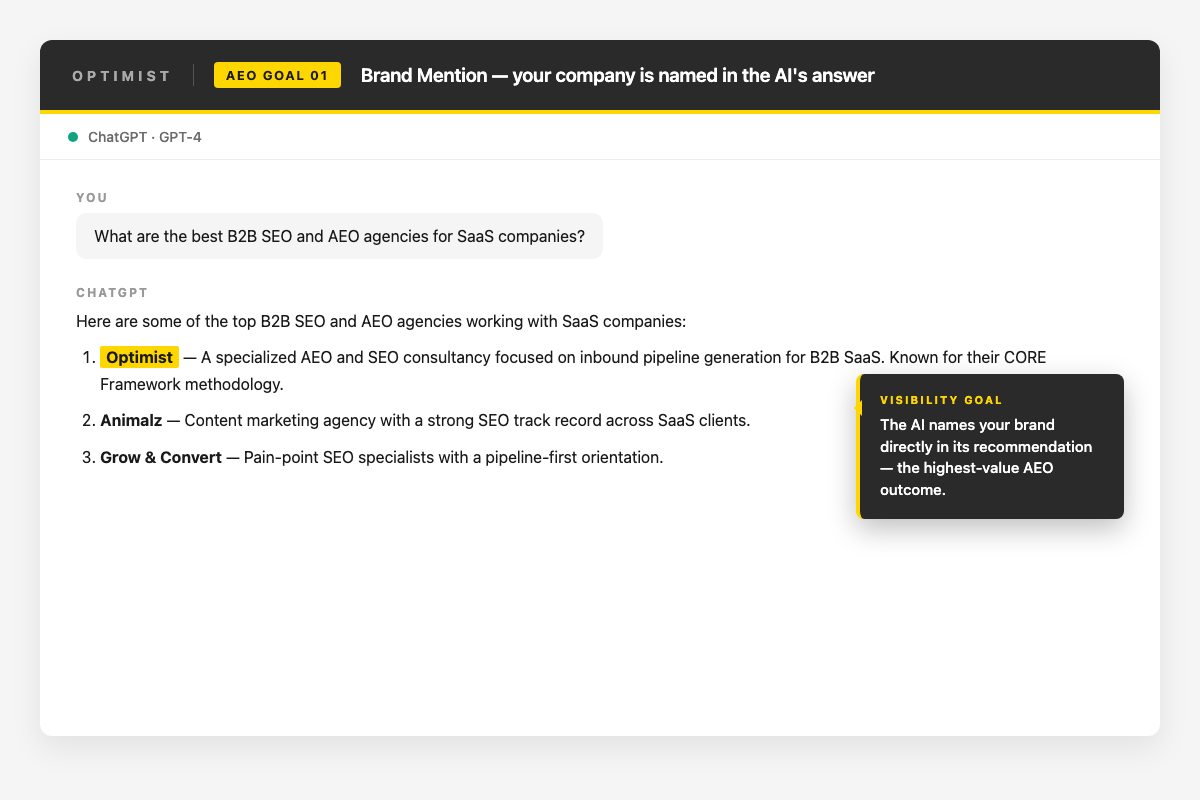
This is an AI model naming your startup when a buyer asks a purchase question like “what’s the best sprint planning tool for distributed teams.” Being recommended by name is what moves pipeline.
This critical form of AI visibility comes from filling content gaps, reducing entity ambiguity so models know what you are, and keeping your positioning consistent across your site and the broader web.
The second is citations.
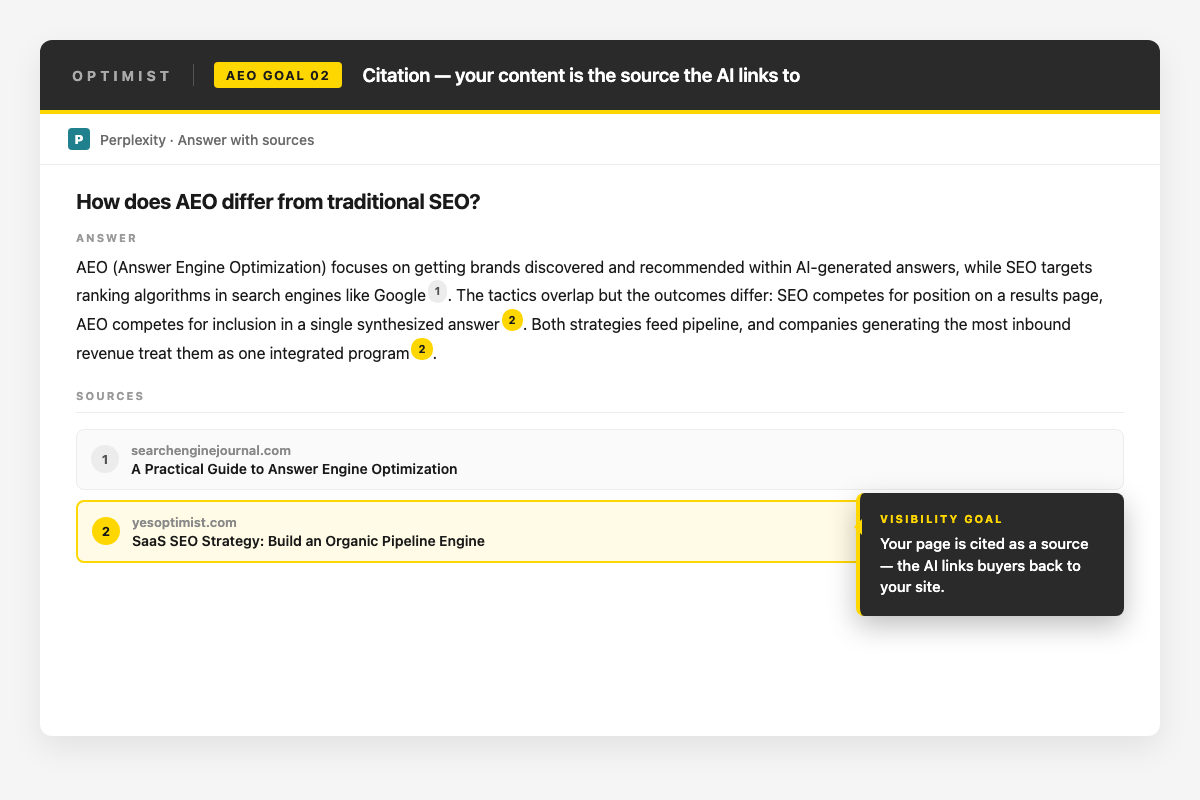
This is an AI model linking to your content as a source inside an answer. Citations build authority and support recommendations, but they don’t drive pipeline the way a recommendation does.
They come from structural work, like answer-first formatting, FAQs, schema, and chunking.
The short version:
- Brand mentions or recommendations are when an AI model names your startup as an answer, and it drives pipeline.
- Citations are when an AI model links your content as a source.
Understanding this distinction is critical because many AEO agencies and consultants fixate on citations as the primary AEO metric to track and chase. But, you can easily focus your effort on schema markup and driving citations while a competitor is the one actually getting recommended.
Another important caveat:
Ranking well in Google does not guarantee you show up in AI answers.
There’s a ton of debate about this out in the world. Whether “AEO is really just SEO” or whether AEO is just an expensive upsell.
It isn’t.
The SEO foundations play a critical role in AI visibility. But there are additional factors and considerations that drive your brand’s presence across AI surfaces that go beyond the standard SEO playbook.
One reason: AI models don’t search a buyer’s exact question. They break it into a set of narrower sub-queries (called “fan-out queries”) and pull from content that answers those. Conductor’s 2026 benchmarks found that pages ranking for fan-out sub-queries are 161% more likely to be cited in AI Overviews than pages targeting only the head term.
A startup’s page can rank in Google and still never get mentioned when a buyer asks ChatGPT the same thing.
But that’s also why this is one integrated strategy.
The topic clusters and intent-driven keyword work that win Google rankings are the same foundations that make your content extractable by AI models.
SEO isn’t a sunk cost in the AI era.
It’s the groundwork that AI search optimization layers onto, and a startup that builds them together gets both for close to the price of one.
Keys to a Successful SEO Strategy for Startups
The steps tell you what to do. The keys tell you what separates a startup SEO program that builds pipeline from one that burns runway.
Complete the Journey on Every Page
A buyer who lands on a page that ends at “read more” has been handed to a page they’ll probably never visit. That’s the cost the funnel model hides. Treat every page as the only one a buyer will read, and the dead-end stops being an option.
Deploy One Clear Narrative and Repeat It
Vague pages produce vague AI answers.
When a startup’s messaging shifts across its homepage, product page, and blog posts, AI models hedge, because they’re accurately reflecting the confusion in the source material. When I see an AI model give a muddled description of a startup, it’s usually reading three pages that each describe the company a little differently.
Pick one narrative connecting the problem to your solution to your product, and repeat it on every relevant page.
Avoid Search-Volume Traps
Volume is the easiest number in a keyword tool to over-weight.
Once topic mapping and intent are doing the selection work, volume becomes a tiebreaker, not a filter. If a keyword has volume but doesn’t sit near a buying decision, it isn’t a target, however big the number looks.
Focus on a Few Core Topics
A startup with a small team and finite runway wins by concentration, not coverage.
Pick the few core topics where the product has a genuine right to be the answer, and build each topic cluster to completion before opening the next. Authority doesn’t average across a wide surface. It compounds where it’s concentrated, the way Kubera’s 43x signup growth came from a tight set of topics.
Commit to a Reasonable Cadence (Avoid the AI Spam Trap)
Don’t use AI to firehose content onto your site.
The instinct to publish at scale is strong (every founder has done the math on what 200 AI-written pages a month could rank for), and it’s a documented way to get penalized. You can use AI to accelerate and augment your SEO strategy, but mass-produced AI slop won’t help you build a real brand that generates real inbound pipeline.
Google’s spam policies on scaled content abuse state that using generative AI to produce content at scale primarily to manipulate rankings violates policy, regardless of how it was made.
Hold a high quality bar at a consistent cadence, generally a maximum of 20 to 30 pages a month.
What Startup SEO Actually Costs and How Fast It Pays Back
Startup SEO is one of the highest-ROI channels available, but the payback is measured in months (not days or weeks).
According to First Page Sage’s analysis of B2B SaaS campaign data, SEO delivers a 702% three-year ROI with an average time-to-break-even of around seven months.
For a startup under runway pressure, that timeline is why strategy matters more, not less.
Seven months of focused work on the right topics compounds into a pipeline channel. The same seven months on keywords that don’t convert is runway gone.
The cost question usually comes down to three options:
- Hire a generalist marketer
- Hire an agency
- Work with a strategic partner
The generalist is one person trying to be a strategist, writer, editor, and technical SEO at once, and startup SEO needs all four. When I audit a startup that went that route, the gap is almost always strategy. The generalist was never given a topic map to work against or they don’t have expert-level understanding of SEO strategy, so the output is busy and unfocused.
The agency is where most of the regret lives. When I audit a startup that’s already worked with an SEO agency, I see a lot of the same setups. The blog has dozens of posts, traffic is up, and almost none of it touches a keyword a buyer searches near a purchase decision.
An agency paid to produce traffic produces traffic.
What a startup actually needs is a strategy built correctly and sequenced for a small team, which is a different purchase than headcount or task volume.
Whatever the spend, measure it against the right number. Track qualified leads, product signups, and opportunities sourced from organic, not the traffic line. That chart tells you whether the investment is working.
How Optimist Builds Startup SEO and AEO Strategy for Statups
Most founders who come to me about SEO want a strategist to set direction before anyone produces a page.
That’s the moment Optimist is built for
And it’s why early-stage teams choose it over a generalist hire or a cheap agency.
Optimist is an AEO and SEO consultancy that helps B2B technology companies build inbound engines for predictable pipeline.
Our approach treats SEO and AEO as one organic strategy.
We call it The Complete Organic Revenue Engine (CORE) Framework, which maps both search and AI visibility to every stage of the buyer journey.
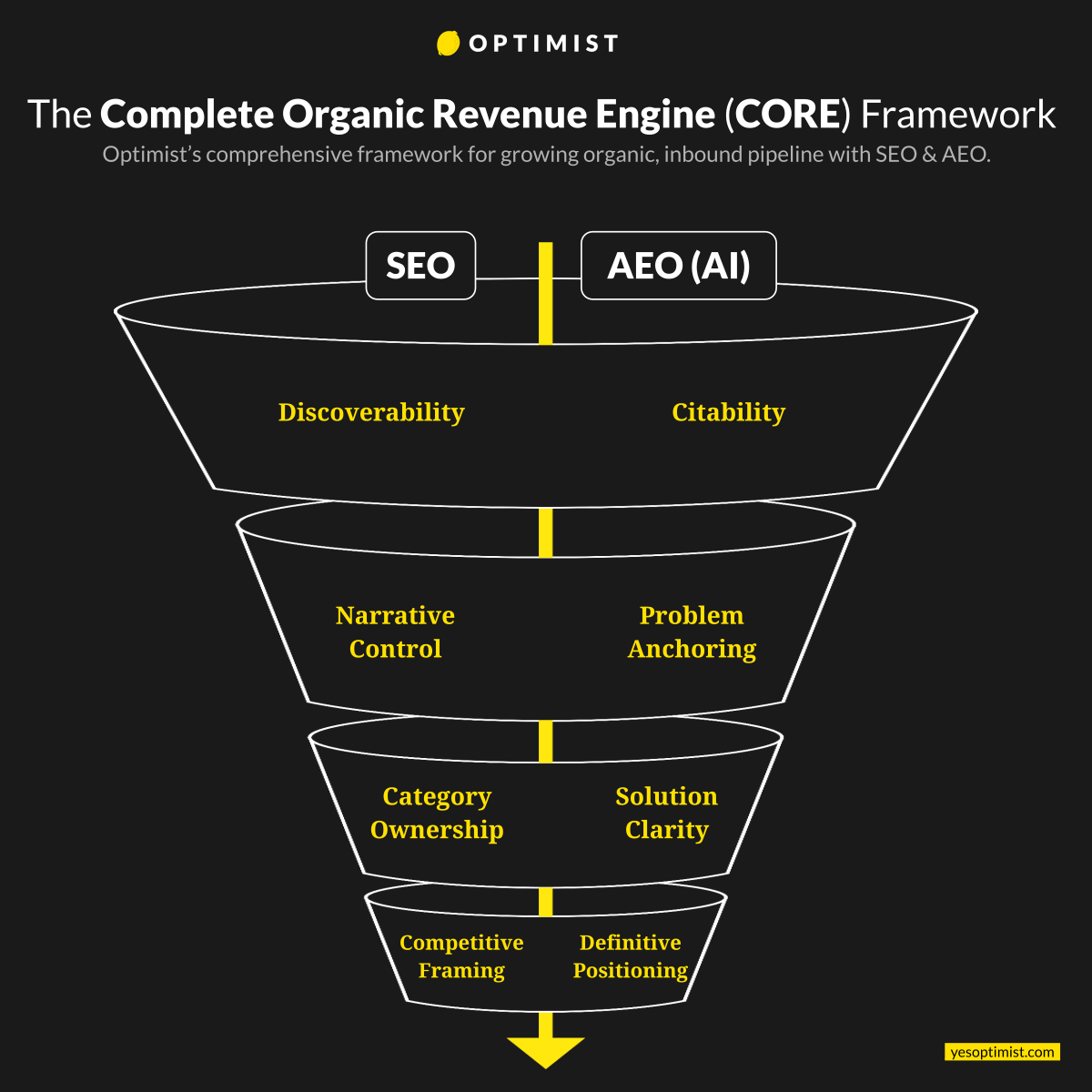
It maps the product to a topic universe, establishes the keyword foundation, sizes each topic by pipeline value, and benchmarks AI visibility across ChatGPT, Claude, Perplexity, Gemini, and AI Overviews.
The result is one prioritized roadmap, ranked by pipeline impact.
It tells a startup what to build, what to fix, and what to leave alone. Optimist also publishes its answer engine optimization methodology openly for teams that want to understand the work first.
This strategy is built on the same foundations we’ve used to drive massive growth for startups and established tech clients for over 10 years:
- Glide grew product signups 14x in a year through content
- Stampli grew inbound pipeline 5X, with a 400% lift in marketing-qualified leads
- HelloSign built an inbound engine that helped fuel a $230M acquisition by Dropbox
- A B2B technology client grew LLM referral revenue 49x over 14 months
These aren’t traffic numbers. They’re pipeline, signups, and revenue.
They’re the kind of results you need to build a real business.
Let’s Achieve Liftoff Together
Startup SEO is won or lost on strategy, not task volume.
A startup with a small team and finite runway can’t out-grind the hulking incumbent, but you don’t need to.
Map the product to a focused set of topics, pick keywords by intent over volume, build one topic cluster at a time, and run the full problem-to-solution-to-product narrative on every page.
That sequence separates a channel that builds pipeline from one that burns runway.
If you’re ready to build a startup SEO and AEO strategy that drives pipeline, get a clear and prioritized roadmap, and expert guidance that will help you build a world-class program that will put you on a path from Series A to IPO — let’s talk.
Book a free strategy call today to see how we can help you hit your growth goals.
Frequently Asked Questions About SEO for Startups
How Long Does SEO Take to Work for a Startup?
SEO typically takes around seven months to break even for a B2B startup, according to First Page Sage’s analysis of SaaS campaign data. Early ranking progress on lower-volume, high-intent keywords often shows sooner. That’s why I push founders to be precise about which topics they commit to first. Seven months on the right ones compounds into a channel, and the same time on the wrong ones is wasted runway.
Does SEO Still Matter for Startups in the AI Era?
Yes, SEO still matters for startups, and it matters more when paired with AEO. AI answer engines like ChatGPT and Perplexity now sit alongside Google in the buyer’s research process, but they pull from content that ranks for narrower fan-out sub-queries. SEO is the foundation that makes a startup’s content extractable by AI models, not a sunk cost in the AI era. The two compound, which is why I tell founders to stop treating AEO as a separate line item.
How Much Should a Startup Spend on SEO?
A startup should spend enough to get the strategy built correctly and run at a consistent cadence, which is a different question than headcount or task volume. The common options are a generalist hire, a cheap agency, or a strategic partner. The cheap-agency route often delivers traffic and no pipeline, so the real cost question is whether the spend buys a sequenced strategy focused on commercial intent. Optimist’s plans start at $2,500 a month, a unified SEO and AEO strategy for roughly the cost of one hire.
What Is the Difference Between SEO and AEO for Startups?
SEO gets a startup ranking in Google search results, and AEO gets it mentioned and recommended in AI-generated answers from tools like ChatGPT, Perplexity, and Gemini. They’re one organic strategy, not two. AEO produces two outcomes. Brand mentions and recommendations, which drive pipeline, and citations, which build authority. For a startup, the same topic clusters and intent-driven content win both channels, so build them together from the start.
Should a Startup Target High-Volume or Low-Volume Keywords?
A startup should generally target lower-volume keywords with high commercial intent, because those are the searches buyers make when they’re close to a decision. High-volume head terms bring a large crowd that mostly isn’t buying, and a new startup domain rarely outranks established competitors for them anyway. The longer, more specific queries inside a startup’s core topics are both higher-intent and more winnable.
