
Article Summary
The three-way choice between an SEO agency, an in-house SEO, and an SEO consultant usually collapses to one operational question: Who on your team has the hours to execute the plan next week? Agencies buy scope-and-hours, consultants close the strategy gap without adding execution, and one in-house SEO in 2026 is a bet that one hire can cover technical SEO, content, AEO, and pipeline measurement across a stack that keeps expanding.
Optimist runs both tracks: Advisory as the consultant-mode engagement, and Full-service for teams that need an end-to-end program.
The three-way choice between an SEO agency, an in-house SEO, and an SEO consultant usually collapses to one operational question every buyer already knows the answer to…
Who on your team has the hours to execute the plan next week?
Every other variable (cost, control, breadth of expertise, “ownership”) sits downstream. Answer this one question and the model choice practically makes itself.
The decision feels hard because most of the guides comparing these three options ignore the variable that actually decides which one fits.
They score agency, in-house, and consultant as fixed identities the buyer picks between, when in practice they’re three ways to allocate the same work (strategy, execution, and measurement) across some combination of your team’s hours and someone else’s.
So how much work can your team truly own?
What an SEO Agency Actually Sells You
An SEO agency is a team-in-a-box.
You sign a retainer, and behind it sits a strategist, a technical SEO, a content lead, a link-building or off-page specialist, someone handling reporting, and (increasingly) a specialist paying attention to AI answer engines.
The retainer buys you the collective hours of that team pointed at your account, usually on a monthly cadence with a defined scope.
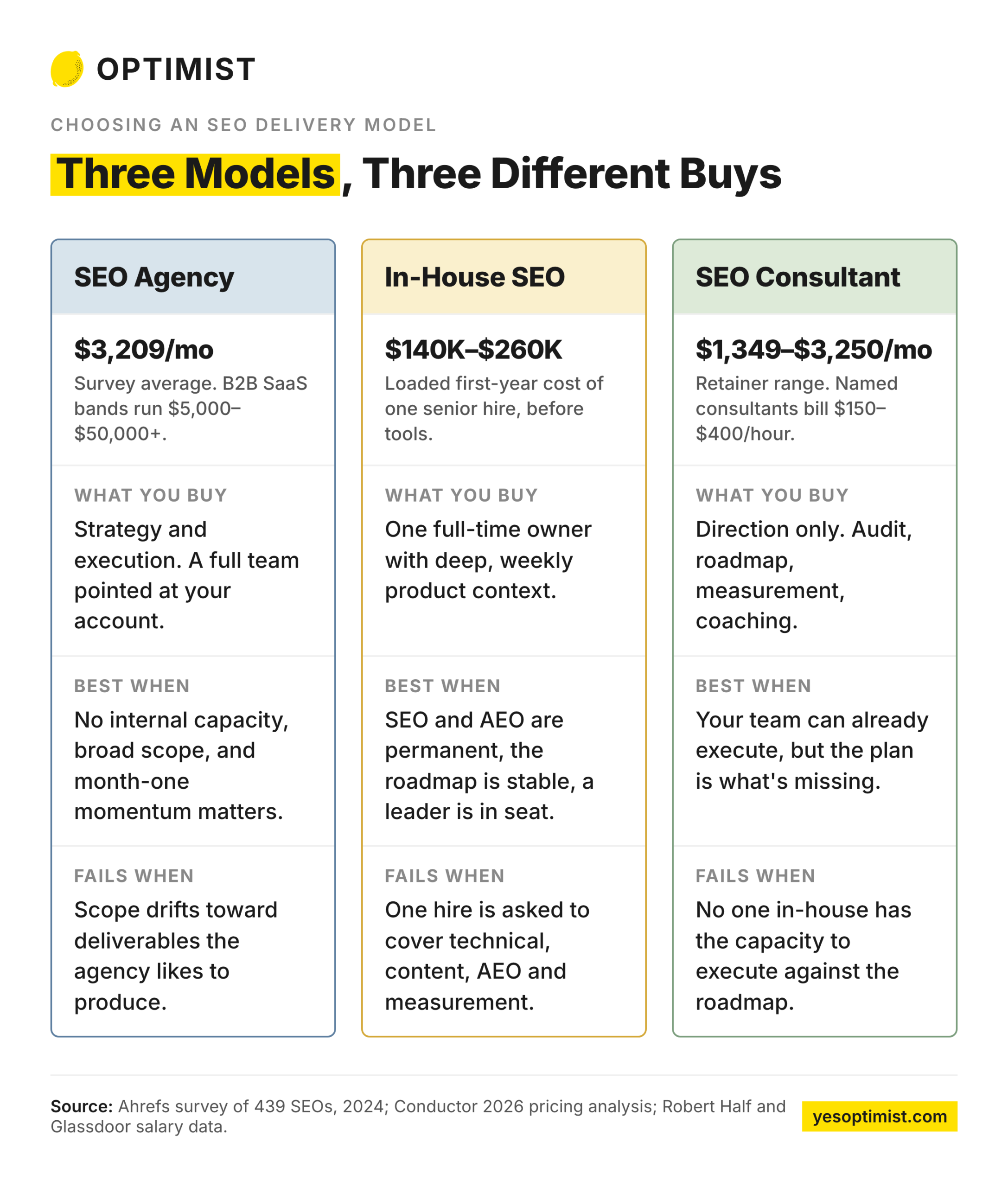
The Ahrefs SEO Pricing survey of 439 SEOs puts agency retainers at an average of $3,209/month, with 78.2% of respondents using a monthly retainer as the dominant model and per-project engagements averaging $9,507.
Conductor’s 2026 pricing analysis puts B2B retainer bands higher: $5,000–$50,000+/month for standard SaaS engagements, and $20,000–$100,000+/month at enterprise scale. The variance tracks scope more than it tracks agency quality.
When SEO Agencies Are the Best Fit
SEO agencies are usually the best fit when your team is small but the scope you need is broad (technical + content + AEO + reporting all at once), and there is no one internally who can absorb execution without dropping something else.
Getting a running start on multiple workstreams in month one is what the retainer buys you.
Why SEO Agencies May Not Be a Fit
Retainer scope has a bad habit of drifting toward the deliverables the agency knows how to produce, not the ones that move pipeline.
When I run a first audit for a new client, I regularly find they’ve been billed for eighteen months of “SEO content” that ranks respectably and sources zero closed-won revenue. I’ve seen pitches from agencies who led their deck with a 400% traffic increase that produced no pipeline. The ones reporting traffic almost never have the pipeline figure to fall back on.
The other honest trade-off: strategy tends to live inside the agency’s head, not yours. When the retainer ends, you lose the thinking, not just the hours.
What an In-House SEO Hire Actually Costs You
An in-house SEO is one person on your headcount, working full-time on your problem.
In 2018, that job was reasonably defined: Keyword research, on-page, link building, reporting.
In 2026, the job description is… a bit more complicated. It usually includes technical SEO, content strategy, AEO and AI-search visibility, entity and schema work, and measurement across an attribution stack that’s harder to trust every quarter.
Robert Half and Glassdoor put a senior SEO Manager base salary in the $107K–$194K range depending on market and specialization. Add benefits, employer taxes, and the standard 30–40% overhead multiplier, and the loaded first-year cost of a single hire lands roughly at $140K–$260K before you buy any tools.
One prospect on an intro call last quarter put the exact figure at “$147K total first-year cost for a senior digital marketer,” and that scope then had to cover strategy, execution, and reporting across the full stack.
Let’s just call it $200k per year.
Is it the right move? I wouldn’t be a marketer if I didn’t say, “it depends.”
When In-House SEO is a Good Fit
The company has arrived at a scale where SEO and AEO are a permanent line item, the roadmap is stable enough that a single person can own it end-to-end, and there is a marketing leader in the seat who can direct the work.
In-house SEO also fits deep-product SaaS categories where product knowledge changes weekly. An outside agency will always be a few sprints behind in that context.
The Weaknesses of Hiring SEO In-House
A single in-house SEO hire in 2026 is a bet that one person can cover technical, content, AEO, and pipeline measurement, a stack that’s expanded every year for a decade while headcount hasn’t.
What looks like underperformance in the in-house vs agency SEO comparison is almost always overload.
The in-house SEO gets pulled onto seven adjacent jobs (paid landing pages, email conversions, the Webflow migration, the new pricing page), and the SEO roadmap decays into a backlog nobody has clean time to run. It’s now the default outcome, not the exception.
Scope inflation really hits when we layer on the new world of AEO. Almost every B2B company I work with needs outside expertise for the AI-search side of the stack.
It’s too new and too specialized for one hire to cover from a cold start.
What an SEO Consultant Actually Delivers
An SEO consultant is a strategist, usually a solo operator with a specific POV, retained on a project or lightweight monthly basis.
The Ahrefs survey puts freelance and consultant retainer averages at $1,349–$3,250/month depending on tier, and hourly rates for named consultants sit in the $150–$400 range.
Deliverables are usually audit, strategy, roadmap, and ongoing measurement plus coaching, with execution left to the client’s team.
The right analogy: A consultant is closer to an auditor and a coach than an agency. They tell you what to build and how to sequence it. Your team runs it.
When Hiring an SEO Consultant is a Good Idea
Hire an SEO consultant if your team can execute (someone in-house is already producing content, shipping technical work, or working with a specialist agency for delivery), but the strategic direction is unclear, the measurement is untrustworthy, or nobody has time to think two quarters out.
A consultant closes the strategy gap without adding headcount or a full retainer.
Consultants are also helpful for navigating shifts and changes. For example, if your company has gone through a rebrand or a product pivot, you’ve noticed a shift in your inbound/organic performance, or you need to evolve your strategy from a focus on only SEO to AEO/GEO.
These inflection points are usually a good time to get an outside opinion from an expert who has navigated similar situations with other clients and can help you clarify the path forward.
The Weaknesses of Hiring an SEO Consultant
A roadmap nobody runs is about as valuable as no roadmap.
This is the trap hiding in the SEO consultant vs SEO agency comparison. If you don’t have someone who can (and will) actually do the work then hiring a consultant could be a distraction and a waste of money.
Consultants are judged, downstream, on the execution someone else did. The useful question about a consultant, then, isn’t “how good is the plan,” but “will my team have the hours to run it.”
I’ve watched sharp diagnostic work stall out this way three times in the past year.
The strategy was good but nobody carried it forward to execution.
The Variable That Decides the Model
The operative variable that decides how you should allocate resources against your SEO goal is your team’s execution capacity, right now — this quarter
How many hours does someone on your team have to actually ship SEO and AEO work while everything else on the roadmap also gets done? (Wishlist headcount and next year’s org chart don’t count.)
Once you’re honest about that factor, the decision becomes fairly straightforward:
- If our team has execution capacity, and the roadmap is what’s missing. A consultant fits. You’re not buying hours; you’re buying a defensible plan, a measurement baseline you trust, and an outside read on what to stop doing. The engagement is small, the leverage is high, and the failure mode (a plan nobody runs) doesn’t apply because your team can run it.
- If your team has partial capacity, so it can execute the work but the direction and briefs need to come from outside. A consultant on a heavier retainer, or a fractional strategist who ships living briefs into your team. Either works. The distinguishing feature: Someone outside is doing the thinking, and someone inside is doing the shipping.
- If your team has no execution capacity for this workstream and hiring in isn’t fast enough. An agency, or a hands-on install engagement. You’re buying hours and a running start, not just direction. This will save you from buying a smart plan that decays into an unrun backlog.
- If SEO and AEO are a permanent, deep-context line item and you’re at a scale that supports the headcount. In-house, with an honest read on what one hire cannot cover and outside specialist help for the parts that would overload them.
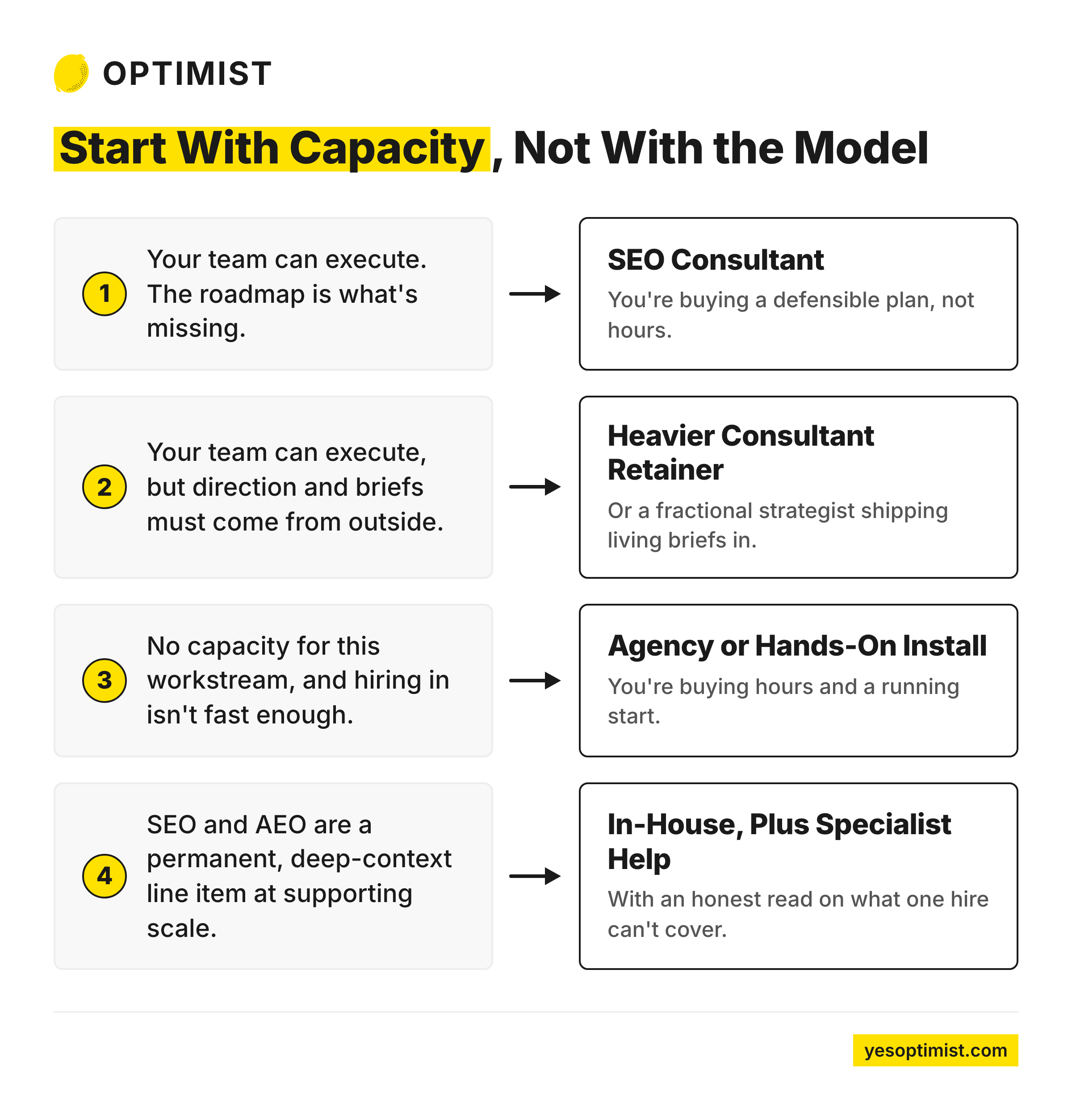
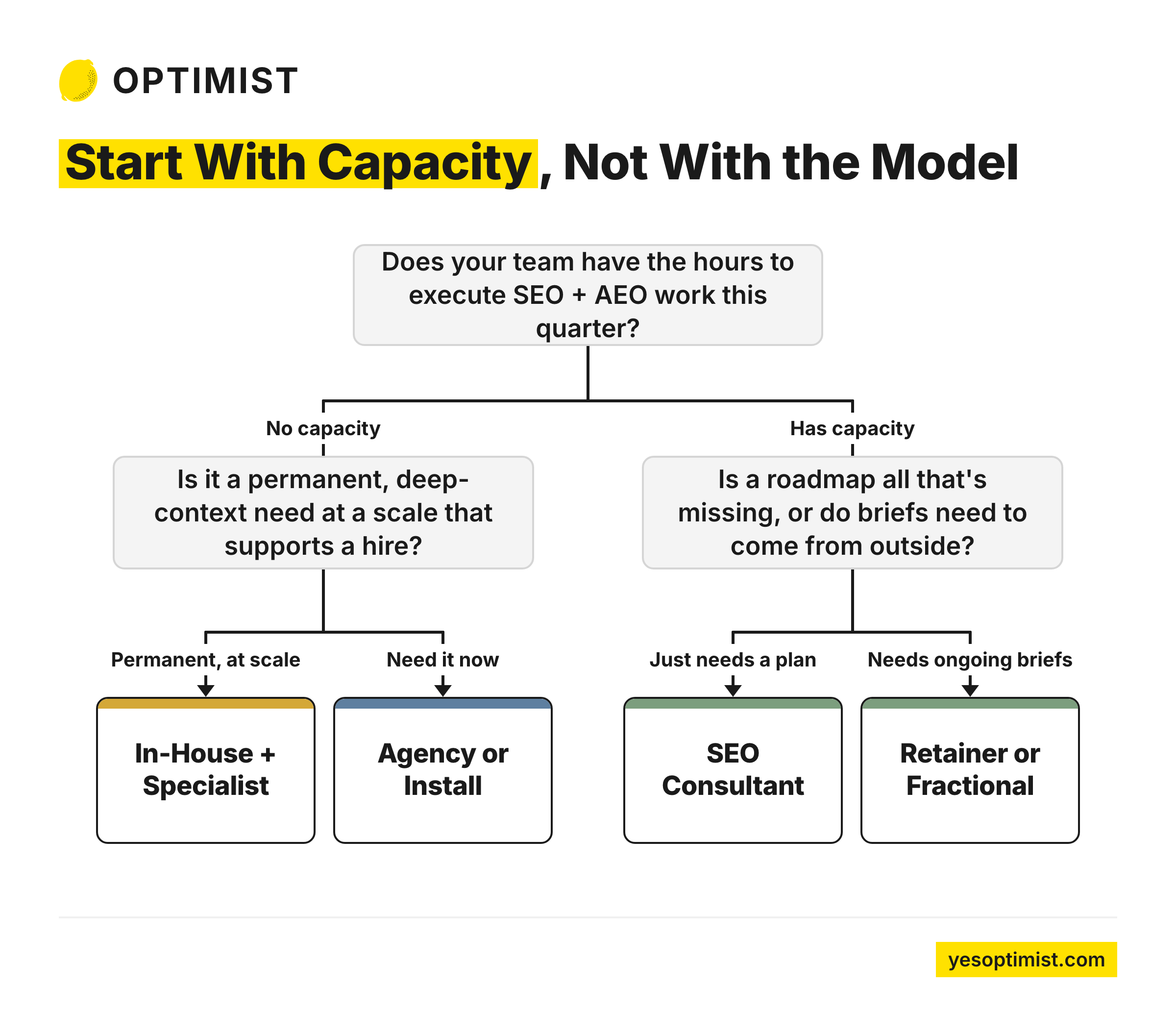
The three-way question collapses to one operational one.
Rather than approaching the question from the ideological framing (“we’re an agency company” or “we hire in-house”), the choice becomes situational.
Making the Right Choice Has Bigger Consequences than Ever
There’s a second reason the agency contracts vs in-house SEO specialist comparison is harder in 2026 than it was five years ago.
SEO isn’t the same job anymore.
The work of driving organic visibility and inbound pipeline has evolved and now includes a broader scope.
It changes the math in two concrete ways.
The Scope of “SEO” Now Includes Answer Engine Optimization
The 2018 stack was Google, some rank tracking, a link-building program, and reporting.
In 2026, the stack includes AI answer engines and answer engine optimization (AEO, often also called GEO).
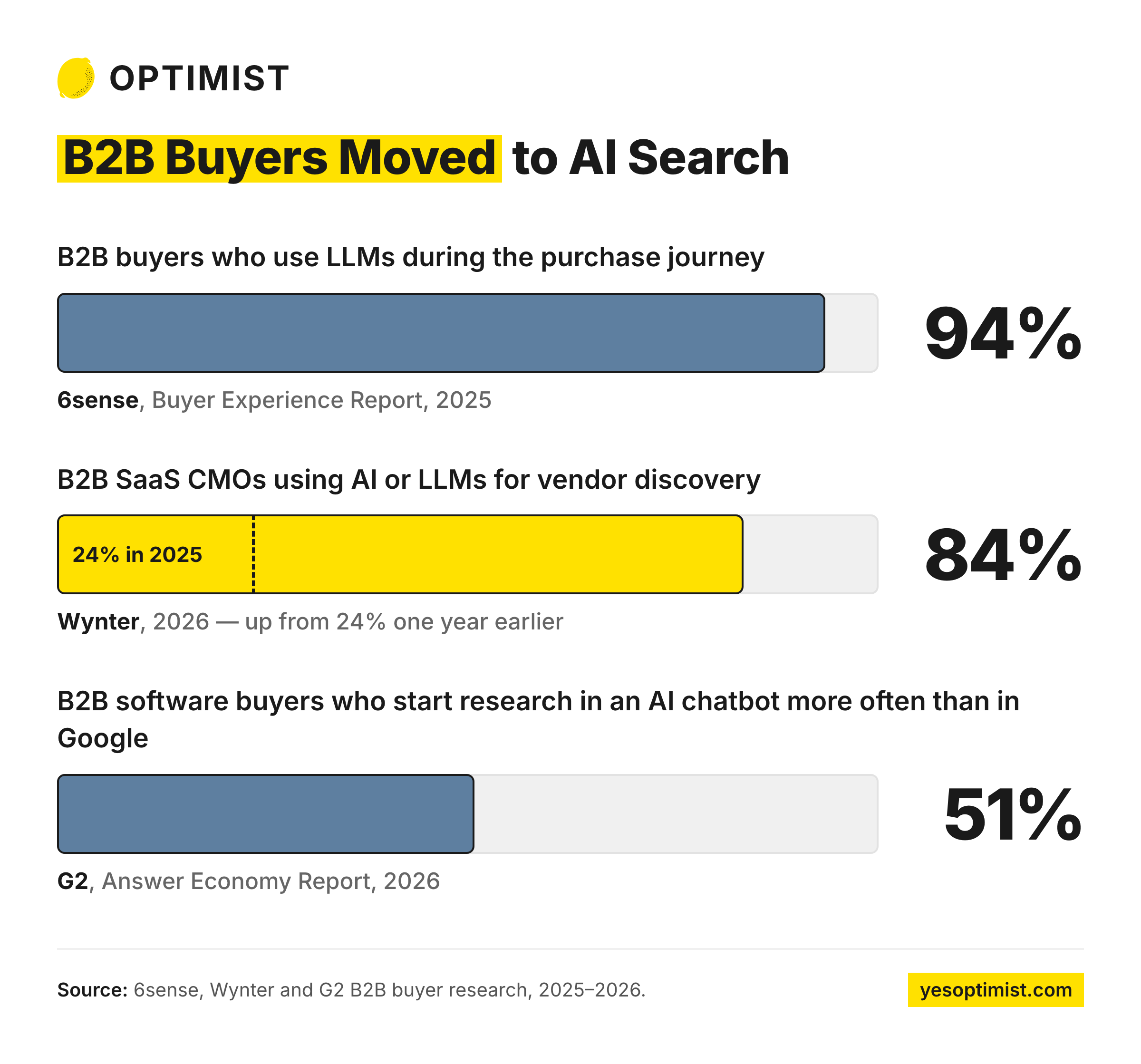
Over half of B2B software buyers begin software research in an AI chatbot more often than in Google, per G2’s Answer Economy 2026 report. And Wynter found that 84% of B2B SaaS CMOs now use AI or LLMs for vendor discovery, up from 24% in 2025.
In most orgs, whoever owns SEO is now tasked with owning AI visibility.
That introduces a whole new set of capabilities and expertise that should be baked into the decision about which SEO (slash AEO/GEO) agency or consultant you want to hire.
About half of the B2B audits I run in 2026 are running a program or working with a partner who is completely ignoring the AEO half of the stack. Those clients aren’t losing Google rank; they’re losing the mention economy, and neither their SEO agency nor their in-house hire had a mandate to cover it.
If you’re in the market for a partner to own organic visibility or steer the strategy, you almost certainly want to hire an agency or consultant who understands both.
SEO + AEO is a Big Lift
AEO belongs inside the same evaluation as SEO.
The two share a foundation but only partially overlap, and splitting them across vendors leaves the connective tissue unowned.
If you’re hiring one SEO in-house in 2026, you’re either explicitly hiring for AEO capability too (rare) or accepting that a specialist will need to plug the AEO gap outside the hire.
The delivery-model choice looks different than it did a decade ago.
The SEO consultant vs SEO agency debate used to be about depth versus breadth. Now it’s about how a delivery model handles a stack that keeps expanding.
Agencies handle scope inflation by adding specialists.
Consultants handle it by picking their lane and referring out adjacent work.
In-house handles it by overloading one hire until something breaks.
So it’s important to be realistic about the work involved in building, running, and maintaining an integrated SEO and AEO program. The job that may have made sense for a single hire 3 years ago likely requires additional support in today’s landscape.
Your Model Choice Isn’t a Permanent Identity
The split between “consultant” and “agency” doesn’t have to be a permanent commitment.
That’s actually one of the key reasons we built Optimist to offer both full-service SEO and SEO consulting services.
Some companies need an agency.
Other companies need a consultant.
And sometimes, clients start working with us in a full-service capacity and then we shift into an advisory role after they ultimately build their in-house program.
We built Optimist this way because we know that your team’s execution capacity changes. You might start off needing an advisor or consultant then find yourself six months in with the CMO leaving, headcount frozen, and no one to execute the briefs.
Advisory is our consulting tier, it includes:
- SEO and AEO performance analysis
- Content, website, and technical audits
- Strategic planning and roadmapping
- Measurement dashboard
- Monthly strategic coaching
- Content briefs and technical implementation plans
It’s built for teams that can execute based on the strategy and guidance.
Full-service is a done-for-you agency engagement, it includes all the same audit, analysis, reporting, and strategy work included in our Advisory tier, plus:
- Fully delivered content creation
- Website page content and copywriting
- Content/page refresh and optimization
- Technical implementation
- Off-site work
It’s the “SEO/AEO team in a box” that you’re probably imagining from an SEO agency.
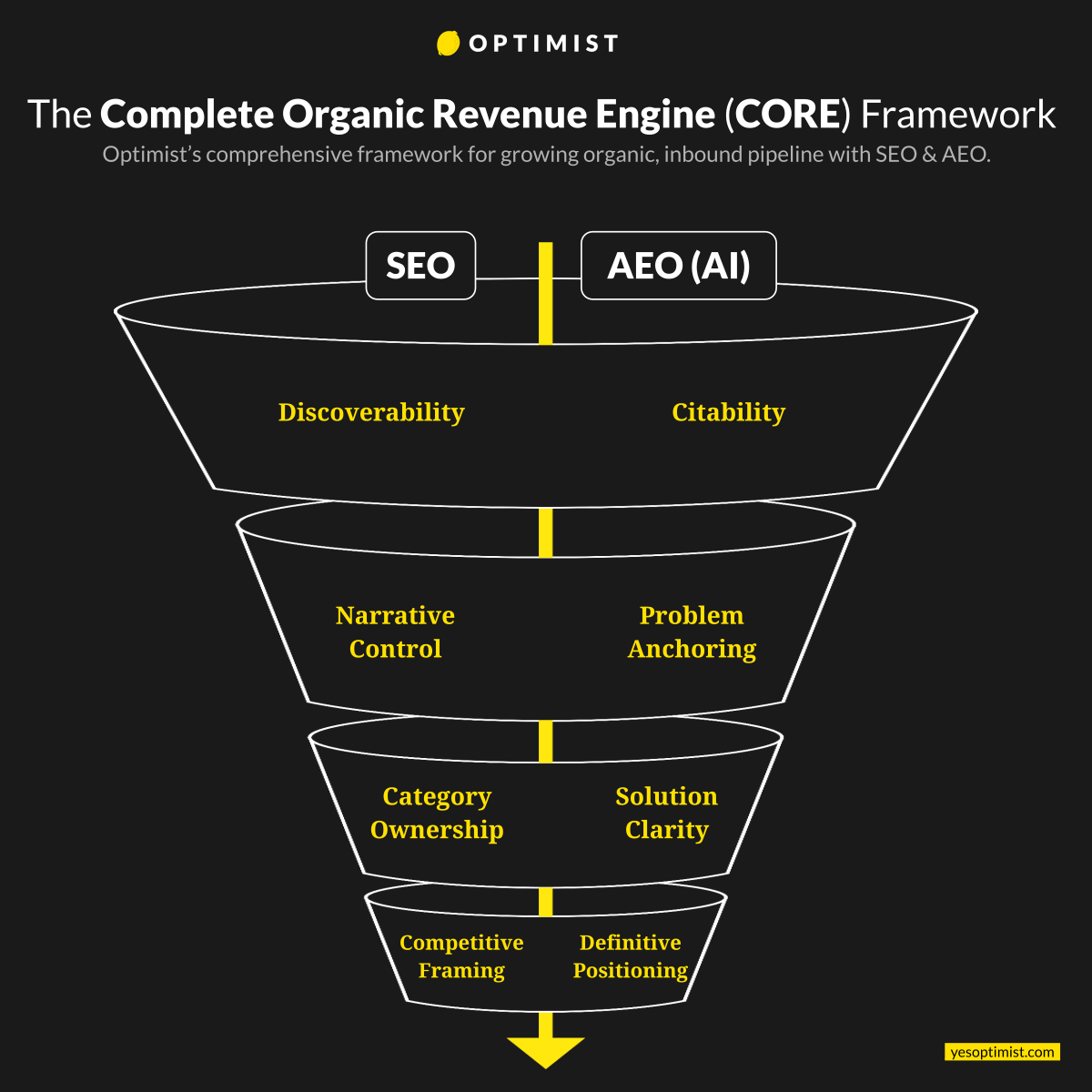
Optimist’s client work is all driven by our Complete Organic Revenue Engine (CORE) Framework that integrates SEO and AEO strategy to drive organic growth across search and AI surfaces.
It’s the methodology we’ve used to drive 10 years of SEO and AEO case studies, including:
- Stampli’s 5x pipeline increase
- Glide’s 14x product signups
- Kubera’s 43x product signups
- Plytix’s 5x inbound leads
- HelloSign’s $230M Dropbox acquisition
- 49x LLM referral revenue for a B2B tech client
- 8x LLM conversions in fintech
- 13x LLM-sourced revenue for a B2C retail brand
Each of these engagements (and our work with 100+ other clients) has been marked by one consistent factor.
Change.
Strategies evolve, algorithms update, business needs shift.
No matter the engagement shape, we work with clients as a strategic partner first and foremost to help navigate and align with those shifts and align effort and resources with the most important work.
Start with the Roadmap, then Pick the Engagement Model
Picking the right engagement model is really about your business needs.
When we work with clients, we always start by understanding the needs of the business, the shape of the opportunity, and the path to success.
That helps us guide clients to the right choice rather than telling them which path to pick.
So, if you’re looking for help with SEO and not sure which model is right for you, let’s have a conversation and figure it out together. Even if we’re not the right fit for your goals, we can help you better understand what the ideal fit will look like for you.
Schedule a free strategy goal to discuss your goals.
Frequently Asked Questions About SEO Delivery Models
What Is the Difference Between an SEO Agency and an SEO Consultant?
An SEO agency is a team-in-a-box you retain to run strategy AND execution on your account, usually on a monthly retainer with a defined scope. An SEO consultant is a strategist (often a solo operator) who runs audits, builds a roadmap, and coaches your team on measurement, but doesn’t execute the work. Agencies sell deliverables or hours plus direction. Consultants sell direction; the hours come from your team. The right choice depends on how much execution capacity you have internally, not on which model has a stronger brand.
When Should I Hire an SEO Agency vs an In-House SEO?
Hire an SEO agency when the scope is broad (technical + content + AEO + reporting all at once), the team is too small to absorb the workstream, and getting a running start on multiple pieces of work in month one matters more than long-term embedded knowledge. Hire in-house when SEO and AEO are a permanent line item, the roadmap is stable enough for one person to own it, deep product context matters weekly, and the company can carry the loaded first-year cost of usually $140K–$260K for a senior hire before tools. If the honest answer is “we can’t do the work internally and the roadmap is unclear,” an agency plus a strategic outside read together often beats either one solo.
I generally recommend the hybrid to teams still growing into an in-house SEO seat.
Is an SEO Consultant Cheaper Than an SEO Agency?
Usually yes at the sticker price. Ahrefs’ survey puts freelance and consultant retainer averages at $1,349–$3,250 per month vs $3,209 average for agencies, and per-project consultant engagements at $8,685 average vs $9,507 for agencies. The catch: a consultant only closes the strategy gap, not the execution gap. If your team can’t run the plan, the “cheaper” consultant engagement produces zero revenue and the agency engagement produces some.
Can I Hire an SEO Consultant and an SEO Agency at the Same Time?
Yes, many companies engage both an SEO consultant to manage and direct strategy plus an SEO agency that handles execution. In my experience, the pattern works when the two are aligned on scope from day one, with the consultant writing the briefs and the agency shipping them. It breaks when the two are competing to own the strategy, which is a fixable coordination problem, not a structural one. I see this arrangement most often at mid-market B2B SaaS companies six months after the marketing leader realizes their retainer has drifted off-strategy.
What About a Hybrid In-House Plus Agency SEO Model?
A hybrid model (one strong in-house SEO plus a specialist agency for depth) works when the in-house hire is senior enough to direct the agency, not just to receive its output, and when the scope split is clear. For example, in-house owns product-context work and coordination, and the agency owns technical depth and AEO or the agency drives strategy and the in-house person handles production and execution. It’s the arrangement most maturing marketing orgs land on. It fails when the in-house hire is junior and the agency fills the vacuum with retainer-friendly deliverables. Cost is higher than either pure option, and the payoff is depth on both halves of the stack.
How Does AEO Change the Agency vs In-House vs Consultant Decision?
Answer engine optimization changed the scope of “SEO” more than most job descriptions have caught up to. 51% of B2B software buyers now start research in an AI chatbot more often than in Google, per G2’s 2026 Answer Economy report. Any 2026 delivery-model comparison scored only on traditional-SEO deliverables is understating the actual job. The delivery-model choice now has to account for who’s owning AEO, not just SEO.
How Long Before an SEO Engagement Produces Pipeline?
For B2B SaaS, expect to see results within 1 to 3 months, with full pipeline impact landing in the 4-6 month window.
