
Article Summary
An SEO audit is a one-time diagnostic that produces a prioritized fix list; a monthly SEO retainer is ongoing execution against a defined scope.
The audit-vs-retainer choice is really about answering one question::
Does the team have hours to execute a plan next quarter?
For many B2B SaaS teams, the best fit option is a mixture between an audit, strategy, and ongoing guidance and measurement support — Optimist offers this package in our Advisory tier.
An SEO audit is a one-time diagnostic that produces a prioritized fix list. A monthly SEO retainer is ongoing execution against a defined scope. Both fit different situations.
The SEO audit vs. monthly SEO retainer choice usually collapses to just one question.
Does your team have the hours and expertise to execute a plan this quarter?
Answer this, and the audit-vs-retainer decision generally becomes pretty obvious.
SEO Audit vs. Retainer at a Glance
| Dimension | SEO Audit | Monthly SEO Retainer |
| Purpose | One-time diagnostic | Ongoing execution |
| Deliverable | Prioritized fix list + recommendations | Monthly specialist hours against a scope |
| Cost band (B2B) | $5,000–$15,000 (Ahrefs per-project averages: $2,348–$9,507) | $1,349–$3,250/mo average; $5,000–$50,000+/mo for B2B SaaS scopes |
| Time horizon | 2–6 week engagement | 6–12+ months |
| Fits when | Team can execute; direction is unclear or priorities have shifted | Team lacks weekly capacity for the work |
| Breaks when | Nobody owns the backlog; AEO out of scope | No pipeline measurement; scope defaults to activity |
What an SEO Audit Buys You
An SEO audit is a one-time diagnostic engagement. A specialist reviews the site’s technical health, on-page structure, content coverage, backlink profile, and (increasingly) AI-search visibility, then hands over a prioritized fix list plus a recommendation for what to do next.
Deliverable is a document and sometimes some additional guidance.
Execution comes from your team (or an existing partner).
Ahrefs’ 439-provider survey puts per-project engagements at an average of $9,507 for agencies, $8,685 for consultancies, and $2,348 for freelancers.
Most B2B buyers land somewhere between $5,000 and $15,000 for a properly scoped audit. Anything under $2,000 is closer to an automated tool run than a real diagnostic. Anything above $25,000 has usually crossed the line into a paid strategy engagement or suited for a big, complex site (or group of sites) that go beyond what an average expert is prepared to handle.
An audit fits when the team already has execution capacity but the direction is unclear.
You have a content producer, someone shipping technical fixes, and a leader who can direct the work. What’s missing is a defensible read on what to do and what to stop chasing.
A sharp audit closes that gap for a fixed fee.
It’s the treasure map, if you will.
Where audits break is downstream of the deliverable.
About half the B2B audits I run in 2026 come to us because they’ve been investing in SEO but they’re completely missing the answer engine optimization (AEO) half of the stack.
The metrics look strong on the search side while the actual dominant discovery surface (buyers in ChatGPT and Perplexity) is still a mystery.
The most recent one was a Series A B2B fintech whose $18K audit covered every 2019 category (schema, Core Web Vitals, internal linking, backlink profile) and never checked whether the brand surfaced in ChatGPT, AI Overviews, or Perplexity for category and product discovery prompts.
Were they being recommended in AI? They had no idea.
That’s the main reason they came to us.
Optimist’s B2B SEO audit framework scopes AEO into the audit.
We helped them see their SEO performance vs their AI search performance and understand how the two pieces worked together, where the gaps exist, and what they need to do to drive visibility across all surfaces.
Sometimes, prospects come to us for an audit but we quickly realize it won’t actually help them solve their problems.
That usually pops up when I ask one question: Who owns the backlog?
A plan nobody runs is indistinguishable from no plan at all.
What a Monthly SEO Retainer Buys You
A monthly SEO retainer is a recurring engagement, billed at a fixed monthly fee, that buys ongoing execution from an agency, consultant, or freelancer.
Standard scope covers technical SEO, content production, on-page optimization, link building, and reporting, with contracts often running 6 to 12 months. Retainers often bill $6,000–$12,000/mo, with some partners offering higher or lower pricing.
Ahrefs’ same 439-provider survey found 78.2% of SEOs charge a monthly retainer, making it the dominant pricing model. Average monthly retainer comes in at $3,209 for agencies, $3,250 for consultancies, and $1,349 for freelancers.
Conductor’s 2026 pricing analysis puts B2B retainer bands higher once you cross into SaaS-fit engagements. Standard scopes come in at $5,000–$50,000/mo, enterprise at $20,000–$100,000+/mo. The variance tracks scope more than agency quality.
A retainer fits when the team lacks the ongoing capacity to execute and needs someone doing the work month over month.
Recurring workstreams (content production, link acquisition, monthly technical monitoring) are the natural home for a retainer, because there’s a real week-to-week job to do.
But there’s also a downside. The monthly-invoice model rewards visible motion, and visible motion is easier to produce than pipeline.
When I run a first audit for a new client, I regularly find they’ve been billed for 18 months of “SEO content” that ranks respectably and sources zero closed-won revenue. Pipeline360’s 2026 research shows only 19.1% of B2B marketers track pipeline contribution from content as a performance metric.
A retainer without the right measurement quickly becomes a checklist.
Anyone hiring an agency or freelancer on a retainer should clarify the focus of the work, make sure reporting is aligned with the actual business goals, and keep their partner in sync with changes within the business.
The Big Shift in 2026
It doesn’t matter whether you buy an audit or a retainer if the scope of work isn’t aligned with the needs and realities of today.
Search has evolved – and whatever type of engagement you choose should align with that.
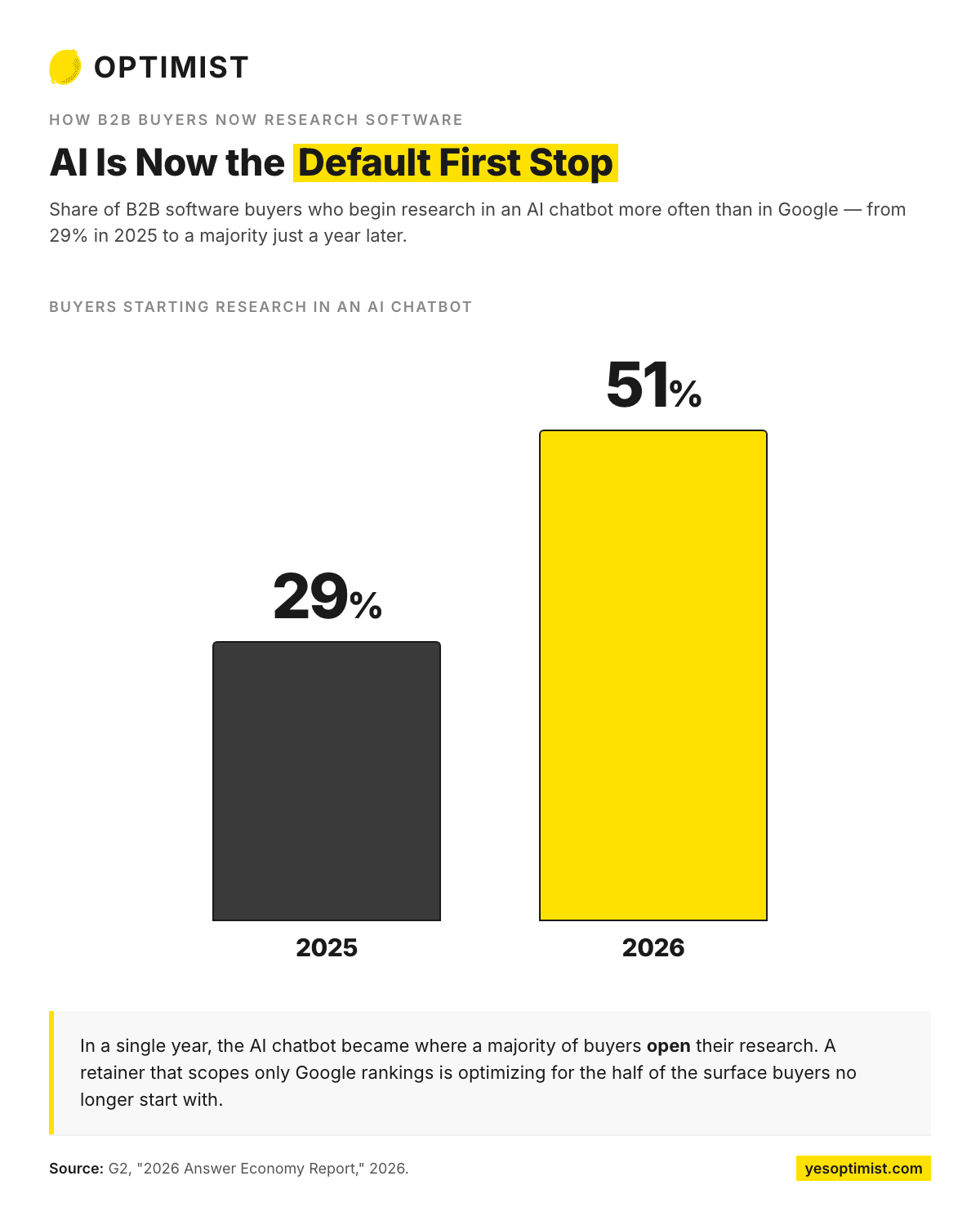
G2’s 2026 Answer Economy report found 51% of B2B software buyers now begin research in an AI chatbot more often than in Google, up from 29% 11 months earlier.
Wynter’s 2026 CMO survey of 101 B2B SaaS CMOs at $50M+ revenue found 84% now use AI or LLMs for vendor discovery, up from 24% in 2025.
An audit that stops at technical, on-page, and backlink coverage is auditing the site your buyers are no longer searching from. A retainer that doesn’t touch AEO in the monthly scope is executing against the same wrong map.
Choosing Between SEO Audit or Retainer: Two Questions
Both questions are things a buyer already knows the answer to, once someone asks them out loud.
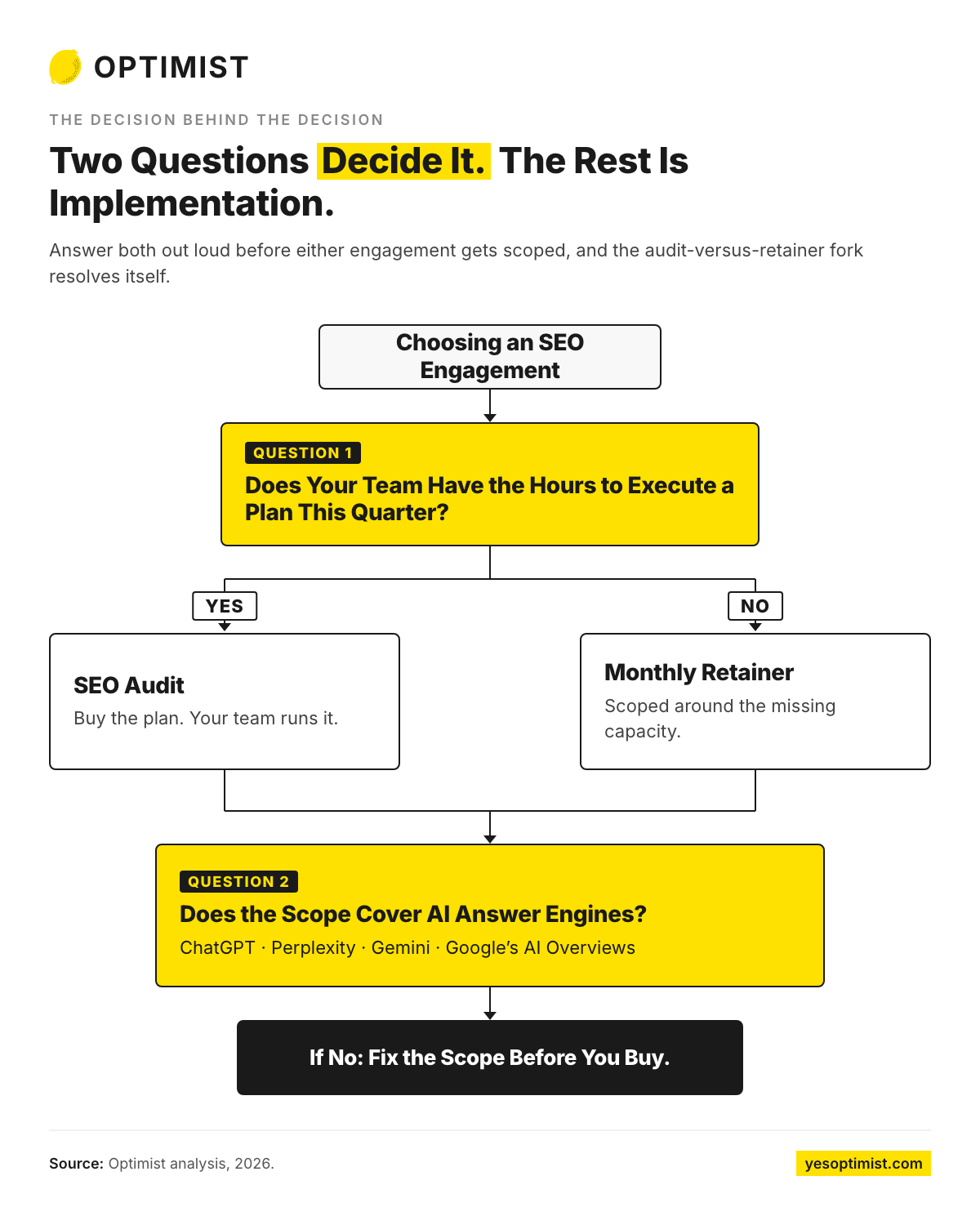
Does Your Team Have the Hours to Execute a Plan This Quarter?
Only committed available hours from someone who can ship SEO and AEO work while the rest of the roadmap also gets done.
(Wishlist headcount doesn’t count.)
If yes, an audit fits, because you’re buying a defensible plan you can run.
If not, an audit alone is a rented insight, and the retainer conversation should be scoped around the missing capacity.
Does the Scope Cover AI Answer Engines?
ChatGPT, Perplexity, Gemini, and Google’s AI Overviews are part of search and inbound discovery. Both audits and retainers should be scoped against both SEO and AEO inside the same organic engine with a shared strategy and including KPIs relevant to both.
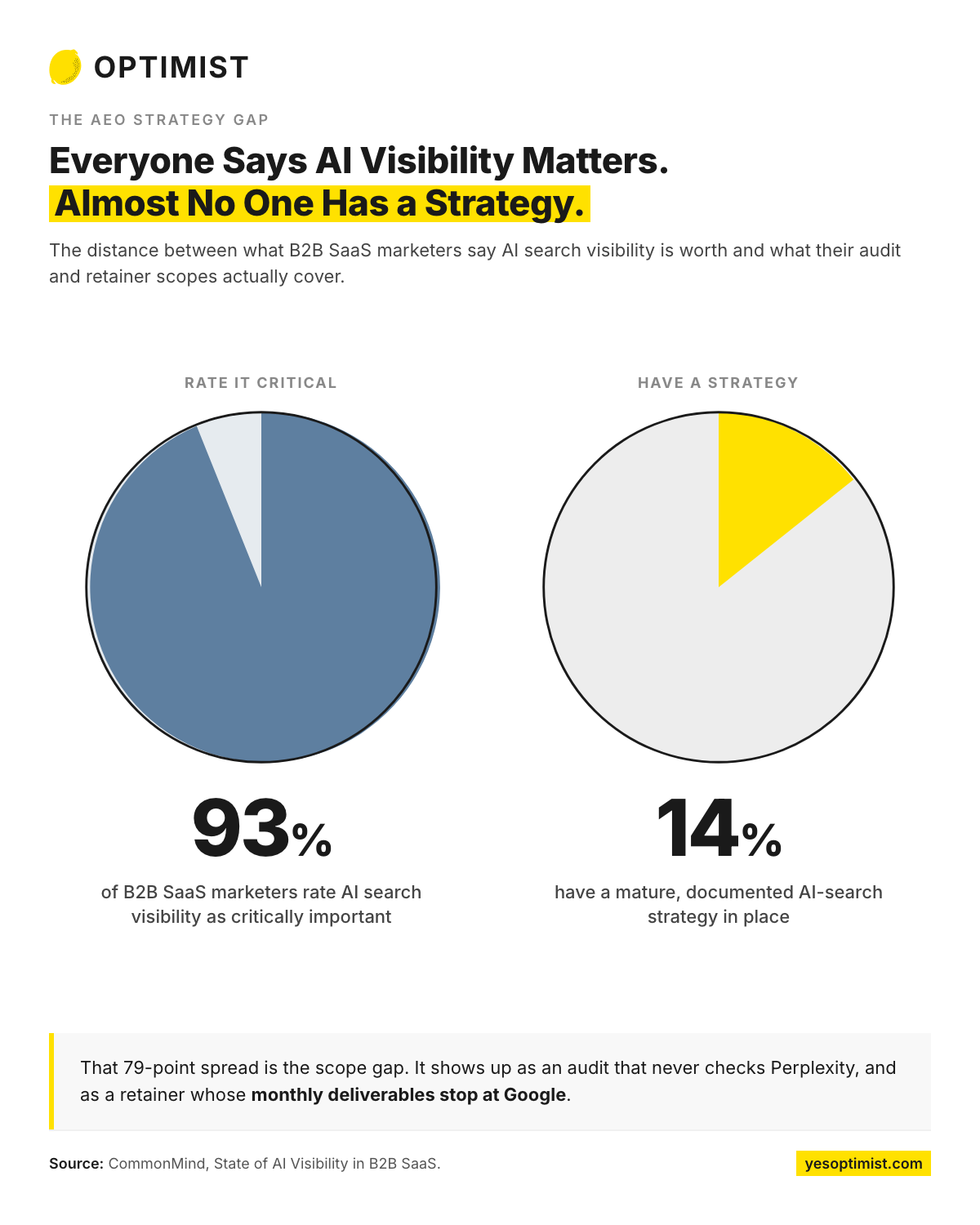
CommonMind’s State of AI Visibility report found 93% of B2B SaaS marketers rate AI search visibility as critically important, but only 14% have a documented mature strategy. That’s the gap between what the market says it needs and what most audit and retainer scopes still cover.
Any 2026 audit or retainer that treats AEO as separate from SEO is scoping for a search landscape that already changed.
Pipeline Is the Scoreboard for Both
Show me a case study where you increased pipeline or revenue, not just traffic.
The standard scorecard runs on what’s easy to count. Keyword rankings, organic sessions, pages produced, links acquired. Sometimes these metrics correlate with an increased pipeline, but not in every case.
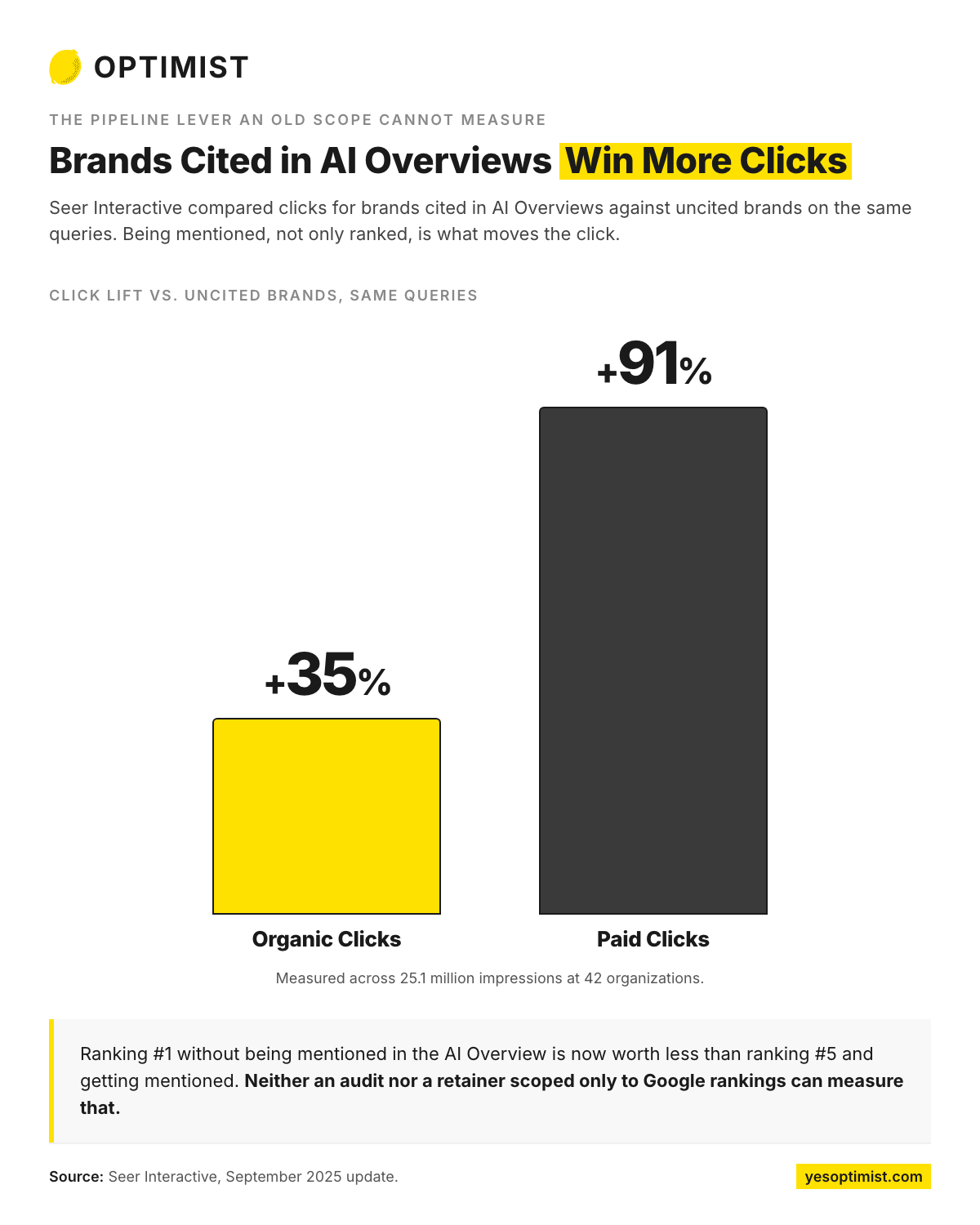
Seer Interactive’s September 2025 update measured brands cited in AI Overviews earning 35% more organic clicks and 91% more paid clicks than uncited brands on the same queries, across 25.1 million impressions at 42 organizations. Ranking #1 without being mentioned in the AI Overview is now worth less than ranking #5 and getting mentioned.
Realistically, it’s not about which of these is most valuable, though.
It’s about how changes in rankings and AI visibility align with or directly drive increases in actual business (leads, demo requests, sign ups, purchases).
Looking at things through a rankings-only lens leaves you without a clear view of the actual impact both in terms of AI visibility (which arguably already matters more than SEO rankings) and in terms of downstream business results generated by the work.
This is one of the key reasons we’ve always focused on connecting the dots and sharing actual business outcomes whenever possible.
Optimist’s case studies show the results:
- One B2B technology client saw a 49x LLM referral revenue growth over 14 months by building on an existing SEO foundation while shifting focus to the new mechanics of AI visibility
- Stampli grew inbound pipeline by 5x and saw a 400% MQL lift
- Kubera reached 43x product signups in 15 months
- Glide scaled inbound sign ups by 14x in a year
Every strategy is unique. But the moving parts, the strategic levers, and the north-star metrics follow similar patterns.
A Sharper Structure for a Series A B2B SaaS Team
Sometimes, for a Series A B2B SaaS with a marketing team of one to three, audits and retainers are both the wrong solution.
What your team might really need is a strategy plus ongoing guidance on the execution.
Confidence that the work you’re doing today will pay off, plus clear data that shows it’s working.
That’s why Optimist offers an Advisory tier.
We run the same Complete Organic Revenue Engine framework to build a comprehensive roadmap of the prioritized optimization work, technical projects, new content, and content updates that will drive the greatest impact.
Then we help your team execute it.
Our team provides ongoing support through content briefs, technical specs, and project plans so your team can ship fast. We provide custom reporting, AI visibility tracking, and an exec scorecard that leads with pipeline or other key business outcomes.
Get the Baseline Before You Buy
Whichever way you’re leaning — audit, retainer, or an advisory package — don’t buy anything until you see exactly where you stand and align on the goals of the engagement.
That means an honest baseline of your current organic and AI visibility aligned with pipeline, and what’s winnable over the next 24 months. Every decision that follows anchors to that number.
Optimist offers a free CORE Analysis that provides a baseline of where your B2B SaaS is sitting across Google and AI answer engines, how you compare vs competitors, and which moves you’ll need to make to capture more market share.
Request a free Organic Revenue Opportunity Report today.
Frequently Asked Questions About SEO Audits vs. Monthly SEO Retainers
What Is the Difference Between an SEO Audit and a Monthly SEO Retainer?
An SEO audit is a one-time diagnostic engagement that produces a prioritized fix list. A monthly SEO retainer is a recurring engagement, billed at a fixed monthly fee, that buys ongoing execution against a defined scope. Audits deliver a document your team runs. Retainers deliver hours of specialist work every month. Most B2B SaaS teams need both at different stages, sequenced properly. Diagnostic first, then execution scoped against what the diagnostic found.
How Much Does an SEO Audit Cost in 2026?
An SEO audit costs an average of $9,507 for agencies, $8,685 for consultancies, and $2,348 for freelancers per Ahrefs’ 439-provider survey, with most properly scoped B2B audits landing in the $5,000–$15,000 range. Under $2,000 is usually an automated tool run. Above $25,000 has crossed into paid strategy engagement territory.
How Much Does a Monthly SEO Retainer Cost?
A monthly SEO retainer costs $1,349 on average for freelancers, $3,209 for agencies, and $3,250 for consultancies per Ahrefs’ 439-provider poll. For B2B SaaS engagements, Conductor’s 2026 analysis puts standard retainers at $5,000–$50,000/mo and enterprise scopes at $20,000–$100,000+/mo. The number that matters is what the retainer should cost given the pipeline it’s meant to unlock, which is a per-business answer.
Do I Need an SEO Audit Before Signing a Monthly Retainer?
Yes, it’s usually advisable to get some kind of structured audit or diagnostic before signing on for a monthly retainer. Skipping the diagnostic and signing a retainer first is how most B2B SaaS teams end up 12 months into a contract billing for activity that doesn’t map to pipeline. A real audit (or a free diagnostic like Optimist’s Organic Revenue Opportunity Report) gives both sides a shared baseline before the retainer scope gets written, so the monthly work targets the actual pipeline opportunity.
How Often Should an SEO Audit Be Performed?
An SEO audit should be performed once a year at minimum, or whenever the business changes materially (new product launch, category pivot, major site migration, hiring or firing an agency). Running a fresh audit annually is only useful if the team executed against the previous one. If the last audit’s recommendations are still sitting in a document nobody opened, the real problem is execution capacity, and a second audit doesn’t solve it. Realistically though, many partners and platforms now offer “always-on” audits as part of their work. In other words, there’s continuous measurement happening across your website and your visibility to inform and update priorities rather than a one-time snapshot that turns stale after a few months.
Should a 2026 SEO Audit or Retainer Cover AEO?
Yes, any 2026 SEO audit or monthly retainer whose scope doesn’t cover answer engine optimization is auditing or executing against a search landscape that already changed. AEO belongs inside the audit scope and inside the retainer scope, as one organic engine spanning Google and AI answer engines. Buying it as a separate later purchase leaves the overlap unowned and produces two half-optimized programs.
What Should I Ask a Provider Before Buying an Audit or Retainer?
Ask any provider to walk you through a case study where they increased pipeline (not traffic); describe how they run AEO and SEO on one engine; name the measurement baseline they’ll set in the first 30 days; specify their “ignore this” list; and define what day-90 success looks like concretely. A provider who can answer those five directly is a different conversation than one who pivots to a deliverables-and-tenure pitch. That’s the shortlist I put in front of every prospect on a fresh audit before I take the engagement.
