
Article Summary
An SEO funnel maps organic content to the three stages of the buyer’s journey, but most teams build it as a relay of stage-isolated pages.
Buyers now self-steer and form shortlists inside AI answer engines, so every page has to run the full problem-to-solution-to-product narrative and take a real shot at converting.
The fix is one funnel across two surfaces, judged by pipeline movement, not traffic, which is what drove 43x product signups for Kubera and 49x LLM referral revenue growth for a B2B technology client.
An SEO funnel is a content system that maps organic content to each stage of the buyer’s journey, so search-driven discovery moves a buyer from first question to purchase decision.
It’s three stages:
- Top of funnel for a problem-aware buyer
- Middle of funnel for a solution-aware buyer
- Bottom of funnel for a decision-stage buyer
That model is right, but most teams treat the funnel as a relay, where a reader enters at one stage and gets handed forward through a sequence of pages the brand controls.
Buyers don’t behave that way.
They self-steer, jump between stages, and form most of a shortlist on surfaces no brand ever sees. The funnel still has three stages, but every page now has to run the whole journey on its own.
The SEO Funnel Is a Pipeline System, Not a Keyword Map
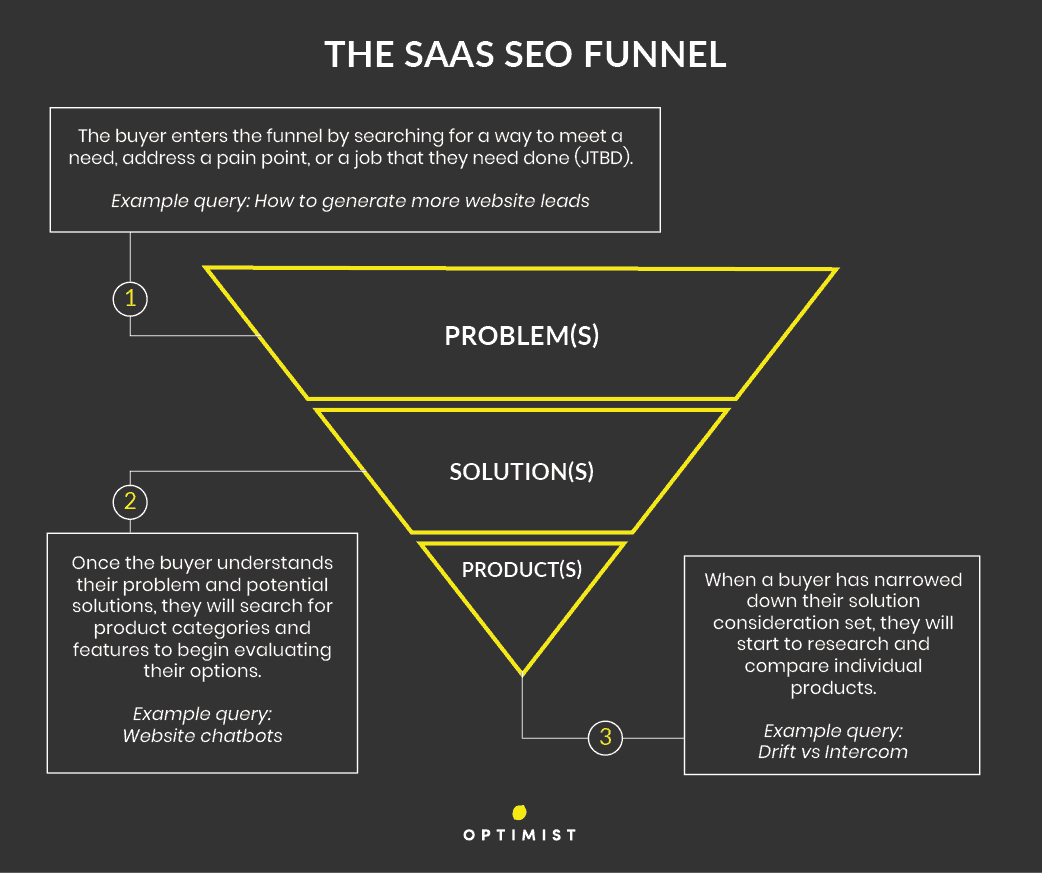
The most common way marketers build an SEO funnel is to map keywords to stages.
Informational keywords go on top, comparison keywords go in the middle, “[product] pricing” goes on the bottom.
Content gets produced against each keyword, and the funnel is declared built.
That produces a keyword map, not a funnel.
A funnel has one job, to move a buyer from where they enter to a purchase decision. A keyword map only proves you have a page for every search term. The test that separates them is whether the reader who lands on a page moves toward a decision, not whether the page ranks.
When I run a CORE Analysis for a B2B client (part of Optimist’s Complete Organic Revenue Engine (CORE) Framework), the pattern is usually the same. The company has strong top-of-funnel content that answers basic questions, strong bottom-of-funnel pages that beat up their competitors, and almost nothing in between.
For example, a Series B SaaS in the procurement category has an awareness article on slow approval cycles that ranks on page one and earns real traffic every month.
The only path forward on that page is a generic “Learn more” link in the footer.
Nothing connects the slow-approval problem to how you’d evaluate procurement software, and nothing names the product as the answer. It was built to name a problem and stop. The buyer who was one question away from a shortlist reads it, learns nothing about what to do next, and leaves.
This approach doesn’t drive pipeline.
Instead, you need a strategy where every page runs the full problem-to-solution-to-product narrative and takes a real shot at converting.
That full-funnel content strategy is what drove 43x product signups for Kubera in 15 months.
The Three Stages of the SEO Funnel
Each stage of your SEO funnel must meet the reader where they are and provide a complete narrative that connects the reader through to the point of conversion.
Because the buyer self-steers and may only ever see one page, the unit of the funnel is the single page, not the multi-page path. Each stage’s content is a chance to capture a buyer and carry them through problem, solution, product, and a genuine next step, all on the page they landed on.
This is also how content earns AI visibility.
A page that runs the full narrative couples the product tightly to the upstream problem the buyer is experiencing. That coupling earns problem anchoring and narrative control, both concepts in the CORE Framework, and it’s what makes AI engines surface and recommend the brand.
A page that only names a problem gives an AI engine nothing to connect a product to.
The exact deployment depends on the go-to-market motion.
A company won’t close a $1M software contract off a single top-of-funnel post, and high-ACV motions can still warrant gradual conversion points like a lead magnet or a nurture track. But the data on buying behavior shows that model weakening, so the default is the complete on-page narrative. That doesn’t mean hard-sell CTAs in every paragraph.
It means each page tells a complete story in the brand’s voice and offers a real next step.
Top of Funnel Meets a Problem-Aware Buyer
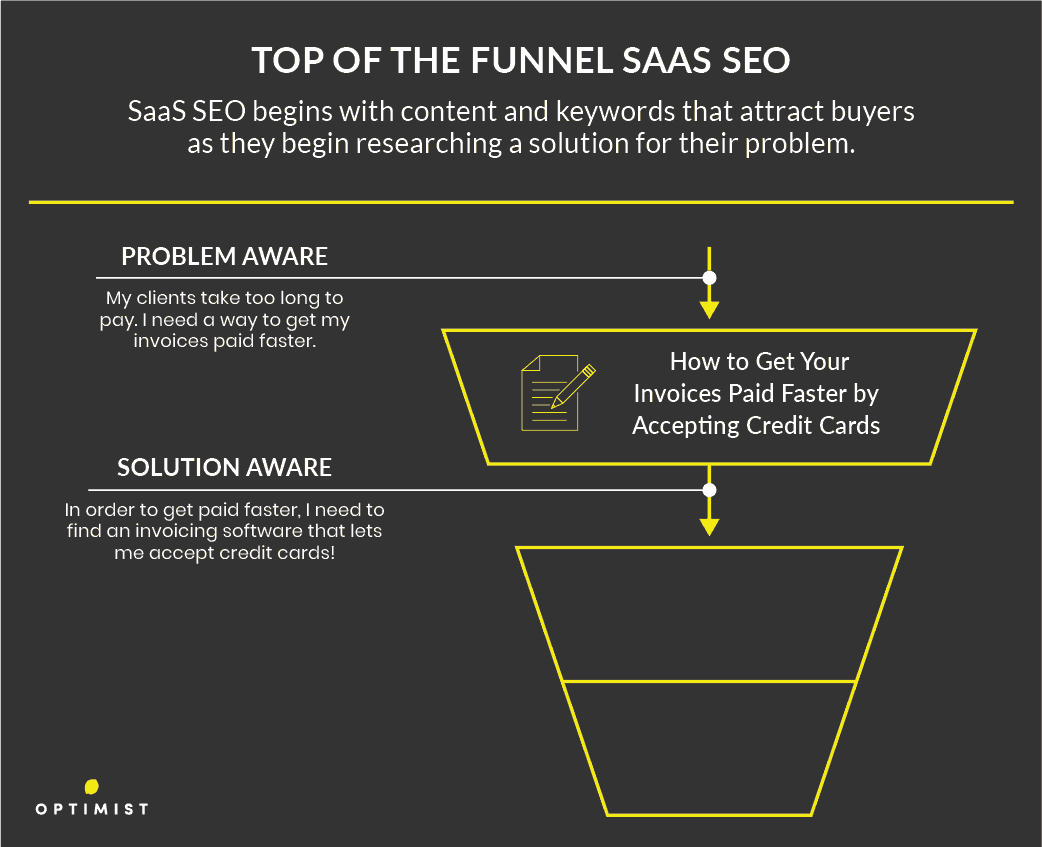
Top-of-funnel content meets a problem-aware buyer by naming a real problem clearly and carrying it through to the solution category and the product.
These are problem-phrased searches a buyer runs before they know solutions exist, queries like “why is our procurement cycle so slow.”
Someone searching that isn’t shopping for software yet. But they’re naming a pain.
The sharp distinction here is what counts as problem-aware. A topic is part of the funnel when it addresses a real problem or intent tied to actual buying behavior. Ranking for “best sales books” to sell a CRM brings the right reader to the site, but reading sales books doesn’t mean someone is in the market for a CRM.
Those topics are pre-funnel brand content.
They can fuel general brand awareness, but the reader isn’t entering a buying cycle, and a SaaS SEO strategy built on traffic like that produces visitors and no pipeline.
A top-of-funnel article that explains the problem and stops has done half its job.
The other half is connecting that problem to the solution category and the product, on the same page. The format that wins here is the diagnostic explainer:
- Names the problem
- Break it into its causes
- Name the category of solution that addresses each one
- Point to a genuine next step
Publish the diagnostic explainer for your buyer’s single most common problem first, because it’s the entry point most of the funnel hangs from.
Middle of Funnel Meets a Solution-Aware Buyer
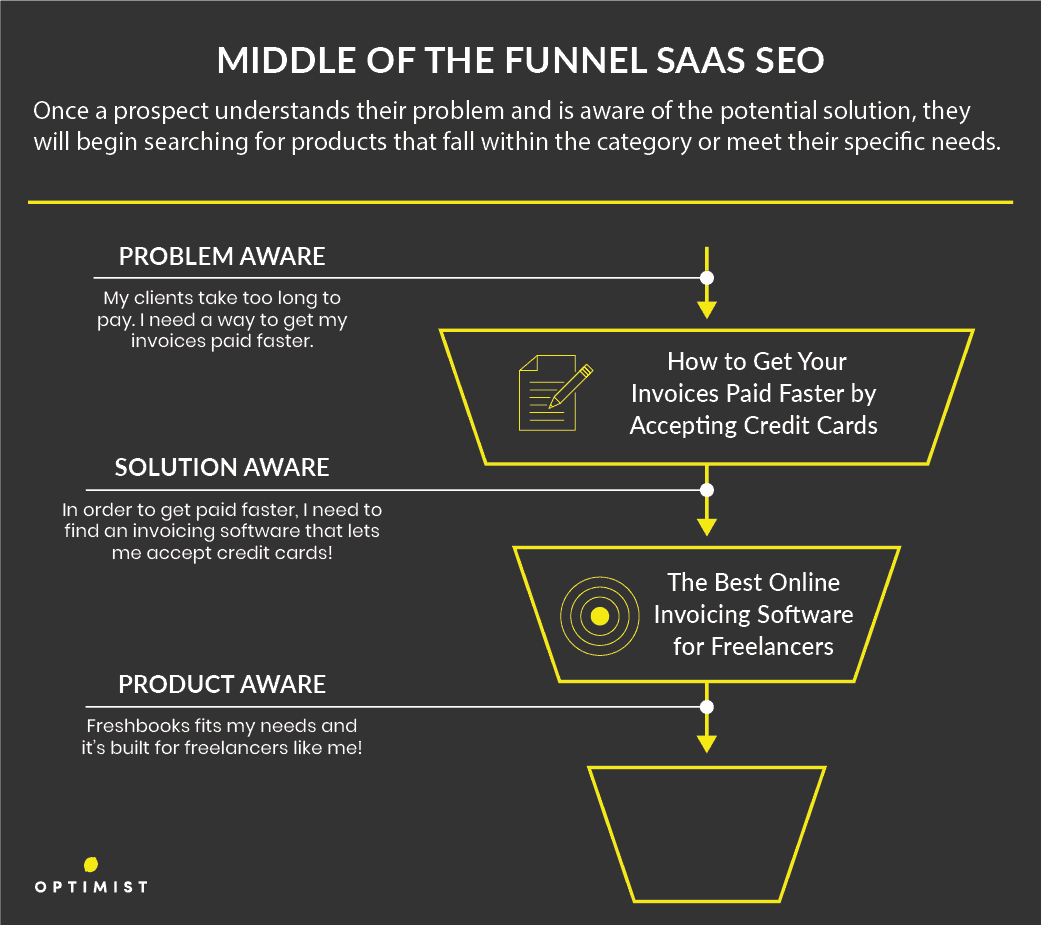
Middle-of-funnel content meets a solution-aware buyer by helping them evaluate the category, build a shortlist, and see where the product fits.
These are the “best X for Y,” “how to choose,” and buyer’s-guide searches a buyer runs while deciding whether the category fits.
This is the stage most B2B funnels are thinnest on, and it’s the most expensive gap to have.
A B2B marketing leader evaluating an SEO and AEO engagement told me they had “a messy half strategy in place” and weren’t sure it was working. That half-built shape almost always means awareness posts and product pages with nothing connecting them.
If your content isn’t there, a competitor’s is, and they frame the evaluation criteria in their favor.
The format that carries this stage is the criteria-led buyer’s guide, opening with the three or four decision criteria that separate good options from bad.
Done well, it runs the buyer from “this category might help” to “I have a shortlist, and this product is on it.”
Publish the buyer’s guide for your core category next, because it converts the awareness traffic you already earn.
Bottom of Funnel Meets a Decision-Stage Buyer
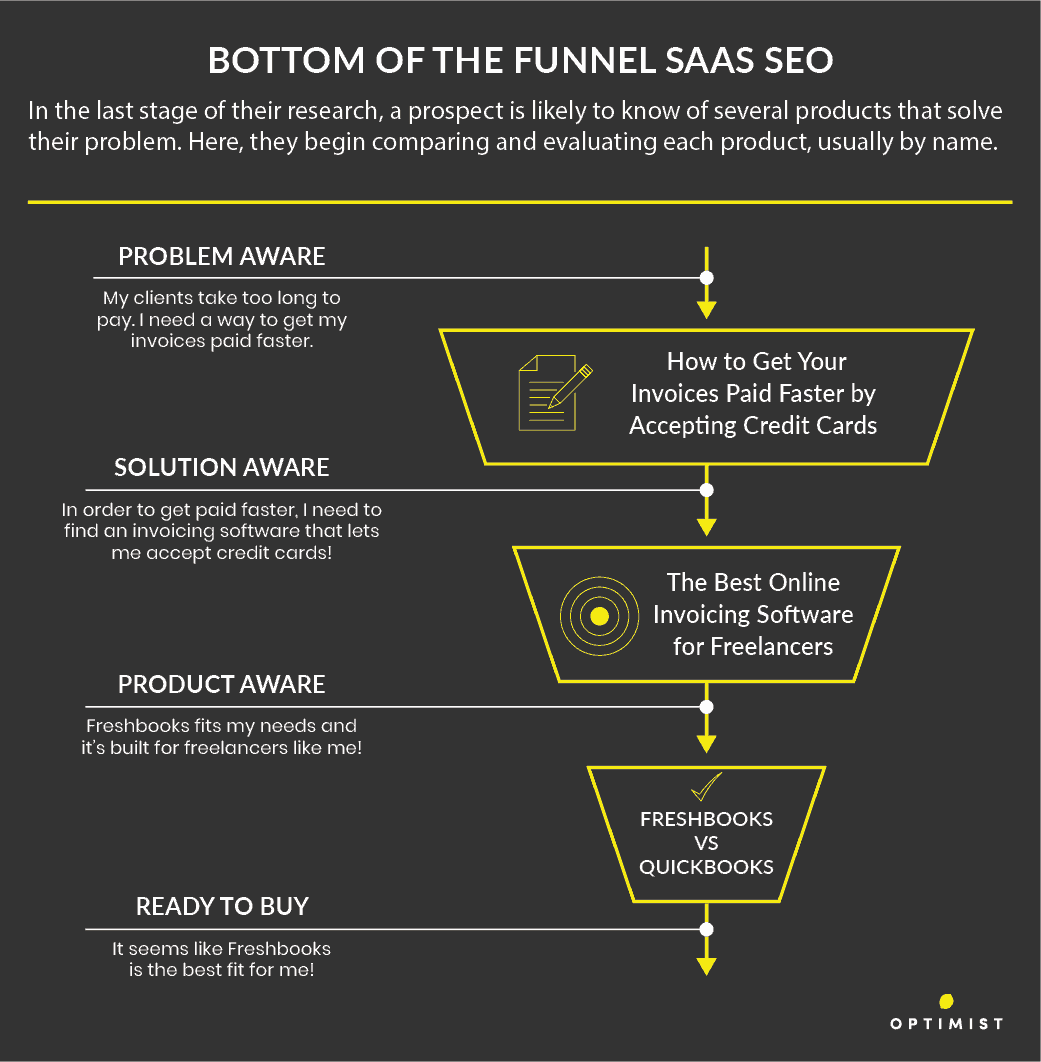
Bottom-of-funnel content meets a decision-stage buyer by making an honest case to someone who already has a shortlist.
These are the high-intent, low-volume searches that confirm a choice: Comparison pages, alternative pages, and “[product] pricing” or “[your product] vs [competitor]” queries. A buyer searching that is most of the way to a purchase.
The job here is to make the decision easy and land it on you, through honest comparison, specific proof, and clear answers to last-minute objections. The format that converts is the head-to-head comparison page that names trade-offs honestly, including the cases where a competitor is the better fit.
Bottom-of-funnel content converts at 10 to 15 times the rate of top of funnel, which is why a funnel that never builds the middle leaves most of its pipeline unrealized.
Publish a comparison page against your most-named competitor first, because that’s the search your closest-to-buying prospects are already running.
Each stage runs its own full narrative, but the stages still reinforce each other through internal links and a clear next step on every page.
AI Search Has Changed The Funnel
The traditional SEO funnel as we’ve known it is now structurally incomplete.
Much of the commercial discovery and evaluation happens inside AI answer engines, where a buyer never sees a ranked list of pages at all.
AI search is a surface buyers use across the funnel, and its weight sits in commercial discovery and evaluation, the moments where a buyer is forming a shortlist.
G2’s 2026 AI Search Insight Report, a survey of more than 1,000 B2B decision-makers, found that 51% of B2B software buyers now begin research in an AI chatbot more often than in Google, up from 29% in early 2025. Wynter’s 2026 survey of B2B SaaS CMOs found 84% use AI tools for vendor discovery, up from 24% a year earlier.
Inside ChatGPT, Perplexity, and Google’s AI Overviews, a buyer asks an AI tool to explain their problem, name the solution categories, and compare vendors, walking away with a shortlist before a single Google search. If your brand isn’t named and recommended in that conversation, the buyer builds a shortlist that never includes you.
The clearest sign of the problem is where brands do show up in AI answers.
The 2X 2026 AI Visibility Index, an analysis of 70 B2B companies, found that only 4.3% appear in early-stage, solution-exploration questions, the discovery and evaluation queries that decide a shortlist. The other 95.7% surface only in late-stage queries, when the buyer already knows who they’re looking for.
But, at that point, it’s too late.
Most buyers will never ask AI about your brand directly — because they never heard of you in the first place.
I see the same thing in nearly every CORE Analysis.
Take a mid-market SaaS in the resource-management category as an example.
I talked to them last year and they told me how they kept asking the five major AI engines to list the “best resource management software for distributed teams,” and the brand never appeared.
The same three competitors kept showing up.
They were simply invisible during the vendor discovery stage and our analysis was focused on understanding why that was happening and how we could fix it.
Capturing AI Discovery: How to Boost Brand Recommendations
When a buyer asks an AI answer engine to explain a problem or compare product options, what matters is whether your brand gets mentioned and recommended in the answer.
Don’t get distracted by chasing citations. Citations (reference links included in the response) can be valuable and they may correlate with increased recommendations.
But they aren’t as important as being named directly.
Answer engine optimization (AEO) work that increases mentions doesn’t necessarily increase citations (and vice versa).
This means, in order to capture AI discovery and drive organic pipeline, you should focus on the mechanics that drive AI surfaces and LLMs to recommend specific products or services in specific contexts.
Closing Content Gaps So AI Can Recommend You
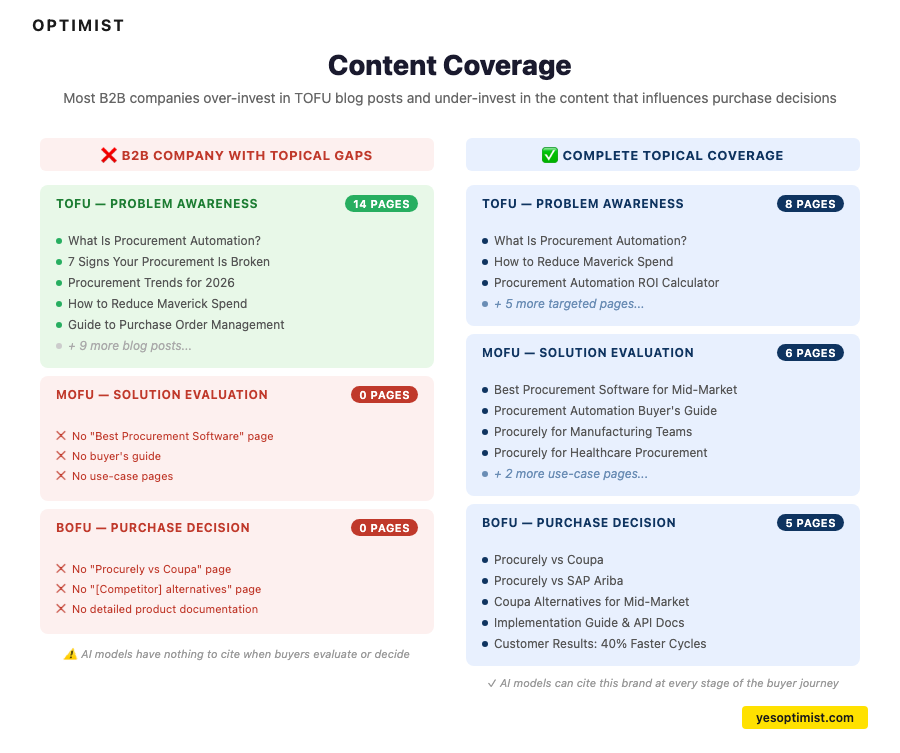
Content gaps are the first lever.
AI engines can only recommend a brand for a question if there’s content connecting that brand to that problem. If you cover your product but never the upstream problem a buyer asks about, the answer engines have nothing to associate you with at the discovery stage.
You might show up downstream, but at that point the buyer has already been introduced to your competitors with a more complete content library.
I ran a CORE Analysis recently for a B2B fintech with thorough product and integration pages but nothing on the upstream reconciliation problems its buyers were actually trying to solve.
Asked “how to speed up month-end close,” the AI engines named three competitors and never them. They had some “TOFU content” that addressed the pain point, but no content on the internet actually said, “we help customers solve this specific problem.”
So how would ChatGPT know?
This is the secret content gap a lot of teams don’t even realize they have.
Their content isn’t bad or weak. It’s just incomplete.
No single page connects the brand to the problem.
Closing those gaps is the same problem-to-solution-to-product content the funnel already requires.
Entity Disambiguation for AI Answer Engines
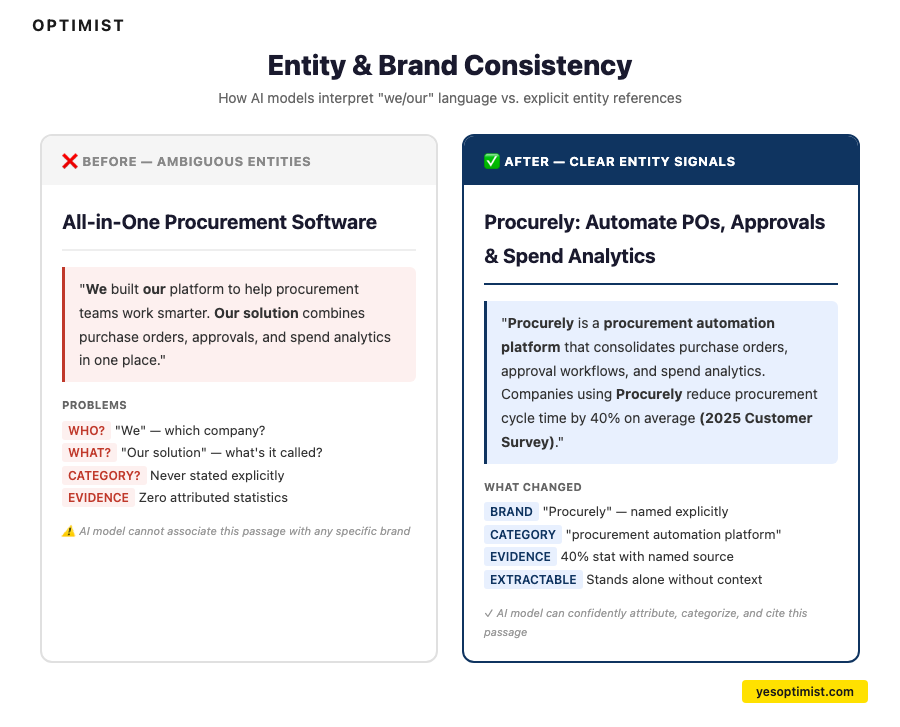
Entity disambiguation is the second lever that’s critical for driving AI brand recommendations.
AI engines build a model of what your company is and what category it belongs to.
If your positioning is vague or inconsistent, the engine can’t confidently place you, so it recommends competitors it understands better.
An engine that can’t categorize you won’t recommend you.
Messaging Consistency Across the Web
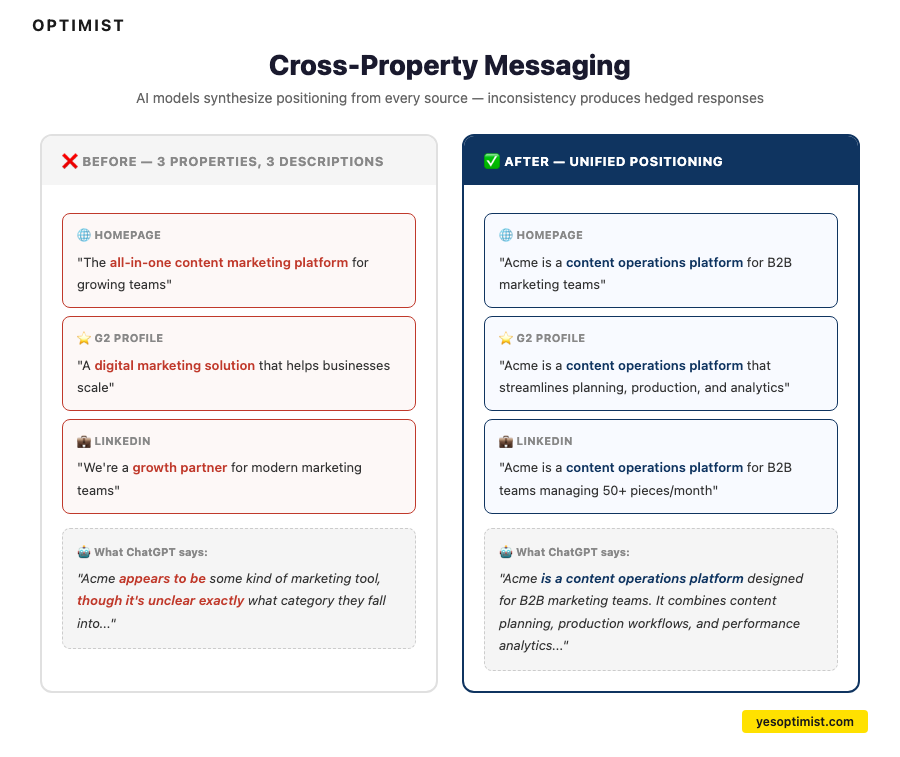
Messaging consistency is another lever.
AI engines synthesize a picture of your brand from every property where you appear. When those sources describe the brand differently, the LLM hedges and the brand doesn’t get named.
A brand that calls itself a “revenue platform” on its homepage, a “sales tool” on its G2 profile, and a “workflow solution” on LinkedIn gives the engine three answers to “what is this.”
When I run a brand-consistency audit for clients, the variance across surfaces is consistently wider than the leadership team expects.
This Is One Funnel, Not Two
The AI-search shift doesn’t mean SEO is dying.
Rebuilding the funnel for AI alone would break a funnel that’s still doing real work.
Google search hasn’t disappeared. Buyers still use it, especially for lower-funnel, high-intent searches where they’re confirming a shortlist, and SEO posts the strongest MQL-to-SQL conversion rate of any channel. The bottom of the SEO funnel still runs largely on traditional search.
What changed is that discovery and evaluation now span two surfaces instead of one.
So the modern SEO funnel is one funnel with two surfaces, not two competing programs.
Traditional search optimization and answer engine optimization are the same problem-to-solution-to-product content work, aimed at both places a buyer looks. Optimizing for both isn’t twice the work. The three stages and the pipeline metric still hold, but “be found across the funnel” now means be found in Google and be recommended in AI answers.
The unified version shows up in revenue.
This is the basis for Optimist’s Complete Organic Revenue Engine (CORE) Framework.
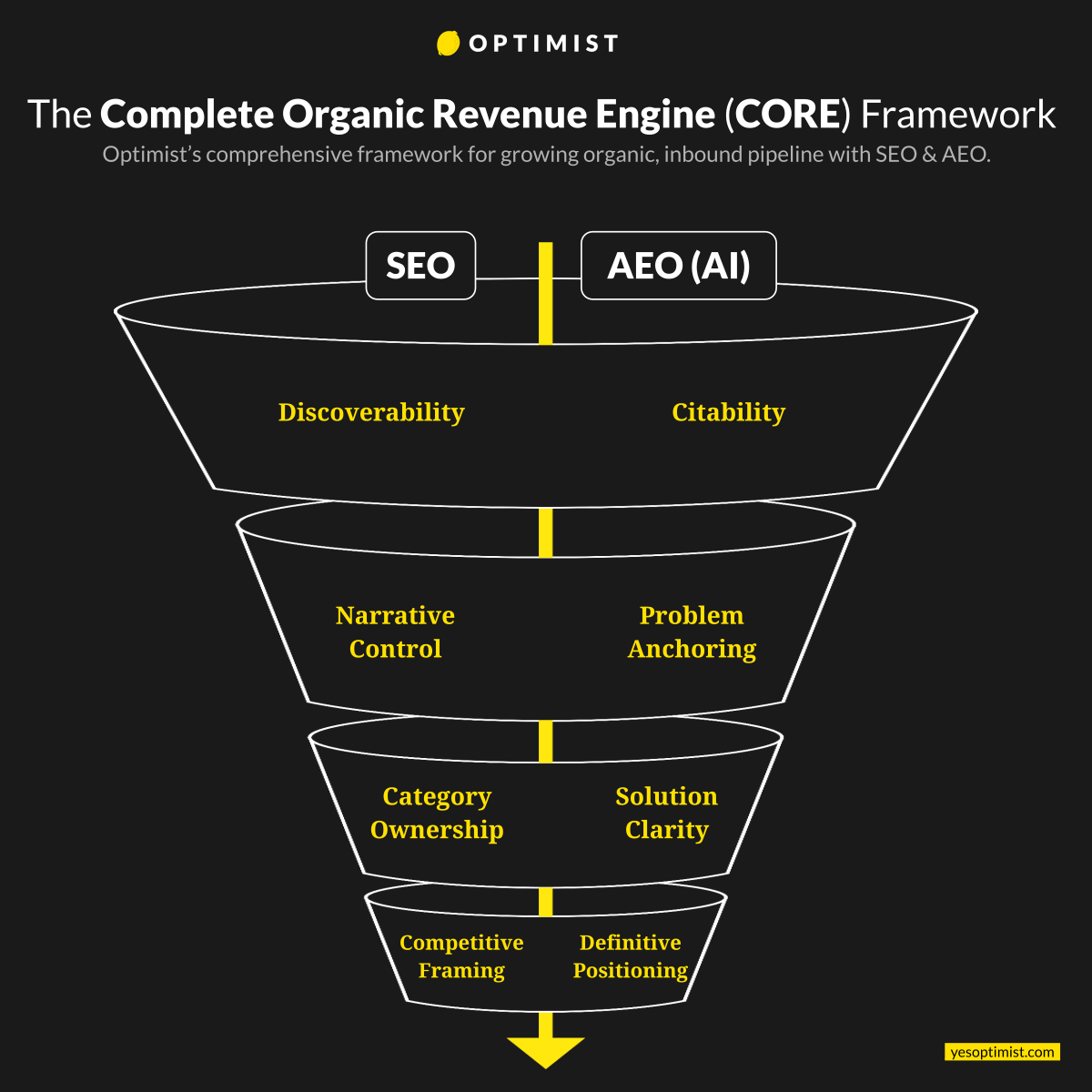
Our approach to building modern SEO funnels is an integration of SEO and AEO/GEO practices.
We focus on building a holistic, complete strategy
One B2B technology company shifted from ranking to being recommended by AI answer engines and saw 49x growth in LLM referral revenue over 14 months. A retail brand that became consistently recommended in its category contexts saw a 13x increase in LLM-sourced revenue year over year. Those are pipeline outcomes from one connected funnel, not a vanity-traffic story.
How to Find Where Your Funnel Is Losing Pipeline
Most marketing leaders can’t see where their own funnel loses pipeline.
The resource-management company from earlier is a clean example.
Its ranking dashboard looked healthy, so nobody on the marketing team knew the brand was absent from every early-stage AI answer in its category.
That’s where stepping back and taking a fresh look can unlock huge opportunities to recover missing SEO pipeline — often without even creating new pages.
A funnel audit has to answer two questions.
First, where do pages name a problem and fail to carry the buyer toward a decision.
Second, where is the brand missing from AI answers at the discovery and evaluation stages, so buyers build shortlists that never include you.
The first is answered by tracing what each page actually does for the reader who lands on it. The second is answered by measuring AI search visibility, benchmarking how often AI engines mention and recommend your brand against competitors across the questions your buyers actually ask.
The gap is rarely where the team expects it.
On a recent CORE Analysis for a B2B SaaS, the marketing lead was certain the problem was top-of-funnel volume and wanted more awareness posts.
The benchmark showed the opposite.
The awareness content ranked fine, but every awareness page dead-ended, so curious readers hit a product page with no evaluation content and bounced. The fix was rebuilding the awareness pages to carry the full narrative through to a shortlist.
A CORE Analysis answers both questions at once.
It produces a roadmap ranked by revenue impact, so the first thing you fix is the lost pipeline opportunity that’s costing you the most.
This is the same process we’ve used to drive major SEO outcomes for clients over the years, and it also drives our approach to AI search optimization that has delivered major AEO wins, like:
- 4,900% growth in LLM referral revenue for a B2B tech client in 14 months
- 8x LLM conversions in 8 months alongside 25x LLM referral traffic for a fintech client
- 13x LLM revenue growth for a retail company in 1 year
In other words, the process works.
Let’s Build a Funnel that Drives Revenue
You need an SEO funnel that systematically drives actual revenue and pipeline.
And because the buyer owns the journey now, self-steering across stages and across AI answer engines no brand controls, every page has to run the whole problem-to-solution-to-product narrative and take a real shot at converting.
We help B2B technology and SaaS companies architect their full-funnel strategy.
Our process is built on 10+ years growing traffic, conversions, and pipeline for over 100 clients including brands like ZoomInfo, Glide, Superhuman, Popmenu, Semrush, and many more.
If you’re ready to get a truly comprehensive strategy in place and build an SEO funnel that drives inbound leads and revenue for your business, let’s talk.
Book a call today to discuss your SEO and AEO goals.
Frequently Asked Questions About the SEO Funnel
What Is an SEO Funnel?
An SEO funnel is a content system that maps organic content to each stage of the buyer’s journey so search-driven discovery moves a buyer toward a purchase decision. It has three stages: top of funnel meets a problem-aware buyer, middle of funnel meets a solution-aware buyer, and bottom of funnel meets a decision-stage buyer. Unlike a keyword map, a funnel is judged by whether buyers move toward a decision, not by traffic at each stage.
What Are the Stages of an SEO Funnel?
The SEO funnel has three stages. Top of funnel (TOFU) meets problem-aware buyers with diagnostic explainers that name a real problem and connect it to the solution category. Middle of funnel (MOFU) meets solution-aware buyers with buyer’s guides and evaluation content. Bottom of funnel (BOFU) meets decision-stage buyers with comparison pages, alternative pages, and pricing content. Because buyers self-steer between stages, every page should run the full problem-to-solution-to-product narrative rather than rely on the reader progressing through pages in order.
How Is an SEO Funnel Different From a Marketing Funnel?
An SEO funnel is the organic-content layer of the broader marketing funnel. The marketing funnel describes the buyer’s full journey across all channels, including paid, email, and sales. The SEO funnel organizes search-driven and AI-search-driven content to move buyers through the problem, solution, and decision stages, spanning both Google and AI answer engines like ChatGPT and Perplexity.
Does AI Search Replace the SEO Funnel?
No, AI search doesn’t replace the SEO funnel. It changes where the funnel runs. Buyers still use Google, especially for high-intent bottom-of-funnel searches, and SEO still posts strong conversion to qualified pipeline. What changed is that a large share of commercial discovery and evaluation now happens inside AI answer engines. A modern SEO funnel is one funnel with two surfaces, where being recommended in AI answers and ranking in Google both capture buyers across the funnel.
How Do You Measure an SEO Funnel?
Measure an SEO funnel by movement toward pipeline, not by traffic at each stage. Track whether the pages buyers land on carry them toward a decision, by following internal-link click paths and stage-to-stage conversion. For the AI-search portion, track how often AI answer engines mention and recommend your brand against competitors for discovery- and evaluation-stage questions. A funnel can show healthy rankings while losing pipeline at every page that names a problem and stops, so the metric has to be movement, not volume.
