
Article Summary
Firing an SEO agency without running a diagnostic first resets the clock with a new vendor running the same playbook. “The agency isn’t working” actually means either the agency, strategy, or expectation is broken and your first goal should be to understand which is the real problem.
Whoever comes next has to answer for how the brand shows up in ChatGPT, Perplexity, Gemini, and Google AI Overviews as part of one program with SEO, not a bolt-on AEO service.
An outside baseline (like Optimist’s free CORE Analysis) helps you grade what the current agency was actually delivering and helps you understand your next move.
Most “we need a new agency” moments are “we need a new strategy” moments.
If you fire one agency without a clear idea of how the next one can build on the work that’s been done while refining the direction and focus, you reset the clock at month zero and might lose important traction.
Start by diagnosing why the current SEO agency isn’t working out.
This will give you a clear picture of what needs to change and then you can follow a simple four-step process to terminate the engagement:
- Review the contract
- Audit your asset ownership
- Revoke access in the right order
- Stage a structured transition
But let’s start by understanding what’s broken and how you can fix it with your next SEO partner.
When to Fire Your SEO Agency and When Not To
Firing your agency without answering the diagnostic question is what makes the next agency the same problem with a different logo.
There are three common problems hiding inside “the agency isn’t working.”
Only one of them is fixed by simply firing and replacing them with a similar team.
Ask yourself, in order:
- Does the agency have a specific written plan tied to pipeline, and can they answer month-over-month what moved and why? If no, agency is broken. If yes, keep going.
- Is the plan targeting the funnel stage that actually converts for your business, and does the content source qualified pipeline when the ranking lands? If no, strategy is broken. If yes, keep going.
- Are you inside a normal SEO ramp window (typically 5–7 months to first pipeline signal) or past it? If inside, expectation is broken. If past it, and the first two both check out, then agency is broken for you even if the work is technically competent, and the fit isn’t there.
The answers will help you see the problem more clearly.
The Agency is Broken
The team you hired isn’t doing the work well, isn’t running a defensible strategy, isn’t reporting anything you can act on.
Signals:
- Unclear on the plan
- No answer for what changed month-over-month
- Briefs that arrive late and thin
- “We’re building brand awareness” as the standing explanation for a lack of pipeline.
Termination is the right call when two things are true.
First, the diagnostic points to agency, meaning the team is running a broken process, not a broken plan on a broken clock.
Second, you’ve had at least one honest conversation with the account lead about the specific gap and given them a defined window to fix it. If the response was defensive, hand-wavy, or produced no course correction inside the window, you have your answer.
The Strategy is Broken
The team is executing competently against a plan that was wrong for the business, with the wrong keyword tier, the wrong buyer stage, or the wrong ratio of TOFU to MOFU to BOFU.
When I run a first audit for a new client, I regularly find they’ve been billed for eighteen months of “SEO content” that ranks respectably and sources zero closed-won revenue.
Simply firing the agency doesn’t fix this unless you carry that learning into the next engagement and find a partner who understands the business needs more clearly.
Otherwise, whoever comes next runs the same plan because that’s what they were hired to do, and eight months later the new team is on the same call, defending the same rankings against the same missing pipeline.
New agency, same plan, same clock.
Twelve months later you’re reading this article again.
If this is the case, it’s usually best to take your time to evaluate a new partner first. Have them help you diagnose deeper issues with the current strategy and reframe the work itself rather than just committing to a different set of hands pushing the same rock up the same hill.
The Expectation is Broken
The B2B SaaS median for first SEO results is about five months, with rankings starting to move around month two or three and full pipeline impact building in the four-to-six-month window.
Firing a team at month four for lack of results is probably premature.
That’s a problem with expectations.
If you signed six months ago and the numbers don’t yet reconcile to pipeline, you’re probably inside the normal ramp curve. The strategy might be right, but it hasn’t had enough time to start generating returns.
If it’s the expectation that’s broken, then no partner change will help. You’ll have to first fight whatever internal battle needs to take place to establish the simple truth – SEO takes time.
Any partner promising an immediate fix or offering to trade short-term wins for long-term success deserves a high level of scrutiny.
You No Longer Need “Just” an SEO Agency
One other possibility and one of the main reasons we’re seeing a lot of companies leave their SEO agency in 2026: They’re not helping you with AEO/GEO or AI search visibility.
“We have an agency that we work on SEO with,” a mid-market B2B marketer told me on a call earlier this year. “But AEO is something we need now.”
About half of the B2B audits I run in 2026 are missing the AEO half of the stack. Those teams aren’t losing Google rank but they’re losing the mention economy inside AI answers, and neither their SEO agency nor their in-house hire had a mandate to cover it.
My simple recommendation: Hire an AEO agency who can do both.
If your current agency isn’t measuring and helping improve your AI search performance along with traditional search, that’s a plenty-good reason to fire them and hire a new partner who will.
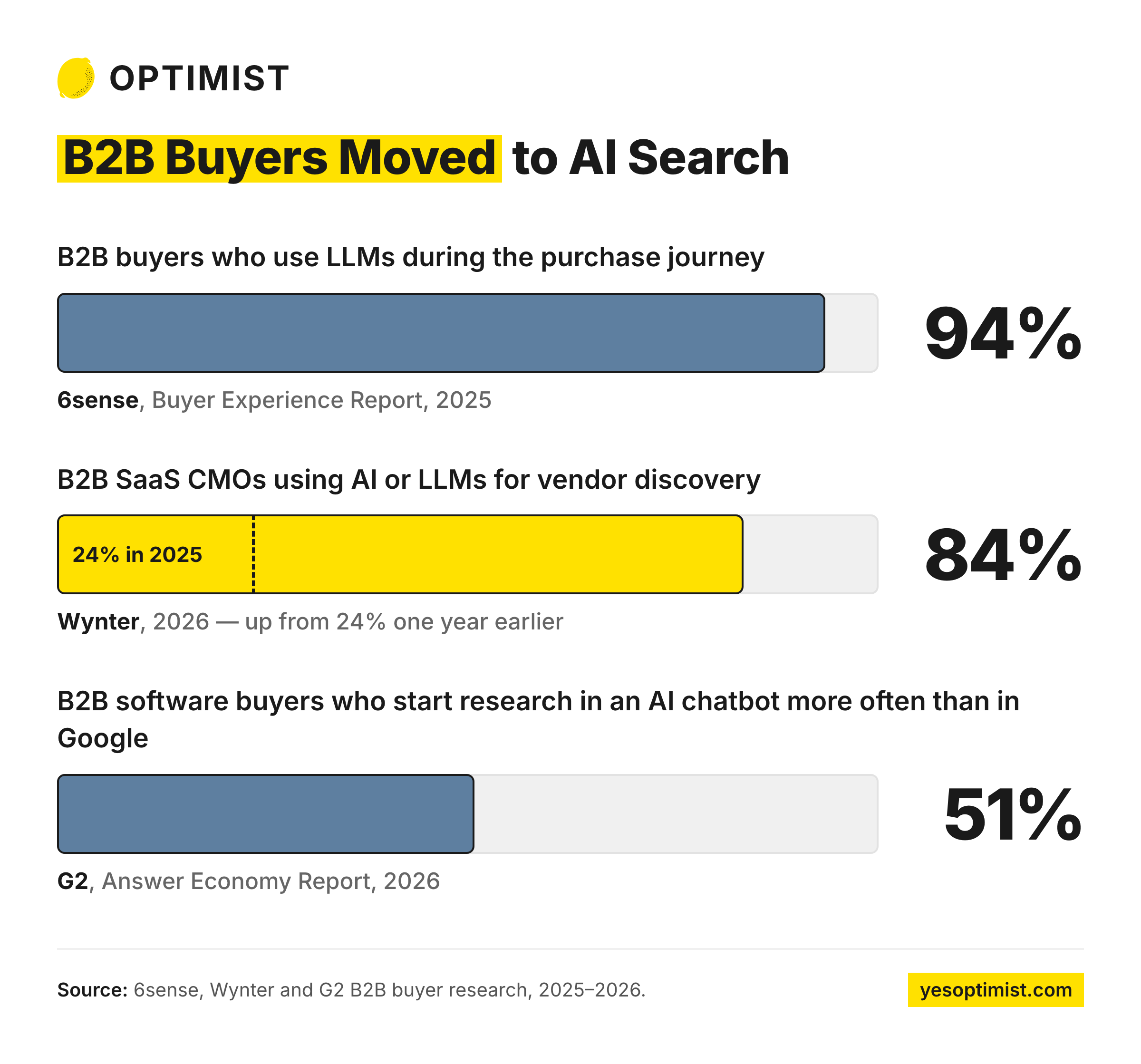
The data is not subtle:
- 51% of B2B software buyers begin research in an AI chatbot more often than in Google, up from 29% in April 2025 (G2’s Answer Economy 2026).
- 94% of B2B buyers use LLMs to navigate the purchase journey
- 94% of SaaS CMOs use AI for vendor discovery
You need to be visible in AI and you need a partner who will help drive that visibility.
The AI-search era has made “just hire another SEO agency” the wrong move regardless of why the last agency deserved to be fired. The worst scenario is an agency whose “AEO service” amounts to shipping FAQ schema and rewriting a few headings. That’s a citation-tactic bolt-on billed as strategy.
Whoever you hire next has to have an answer for how your brand shows up in AI answers, and that answer has to be part of the same program as SEO, not a bolt-on AEO service billed separately.
No matter which direction the arrow points, if it’s clear it’s time to fire them, here’s the sequence.
The Clean-Exit Sequence: How to Fire an SEO Agency (Step by Step)
Do these four things in order.
Step 1. Read the Contract Before You Say Anything
Pull the current agreement and locate three specific clauses: notice period, termination for convenience vs. termination for cause, and deliverables during the notice window.
Most SEO retainers include a 30-day notice on the client side; some legacy contracts run 60 or 90. A “termination for cause” clause typically requires you to name a specific breach and give a cure period, and that’s your leverage if the work has genuinely fallen out of spec.
Two things to watch for.
First, 12-month lock-in language that penalizes an early exit. This is a red flag on the way in, and if you’re stuck inside one, the negotiation is a business call, not an SEO call. Second, auto-renewal clauses with a short opt-out window (often 30 days before the anniversary date). A team firing an SEO agency two weeks past the auto-renewal cutoff has often signed themselves into another twelve months without noticing.
Do this before you send an email, before you tell the team, before you tell your CMO.
Step 2. Run the Asset Ownership Audit
This is the step every marketing leader learns the hard way, and the reason to run your SEO agency ownership audit before the termination call, not after. Half of what a bad agency built lives inside their tools, their reporting platforms, their tracking scripts, and their dashboards.
Their leaving takes it with them by default, even in an amicable exit.
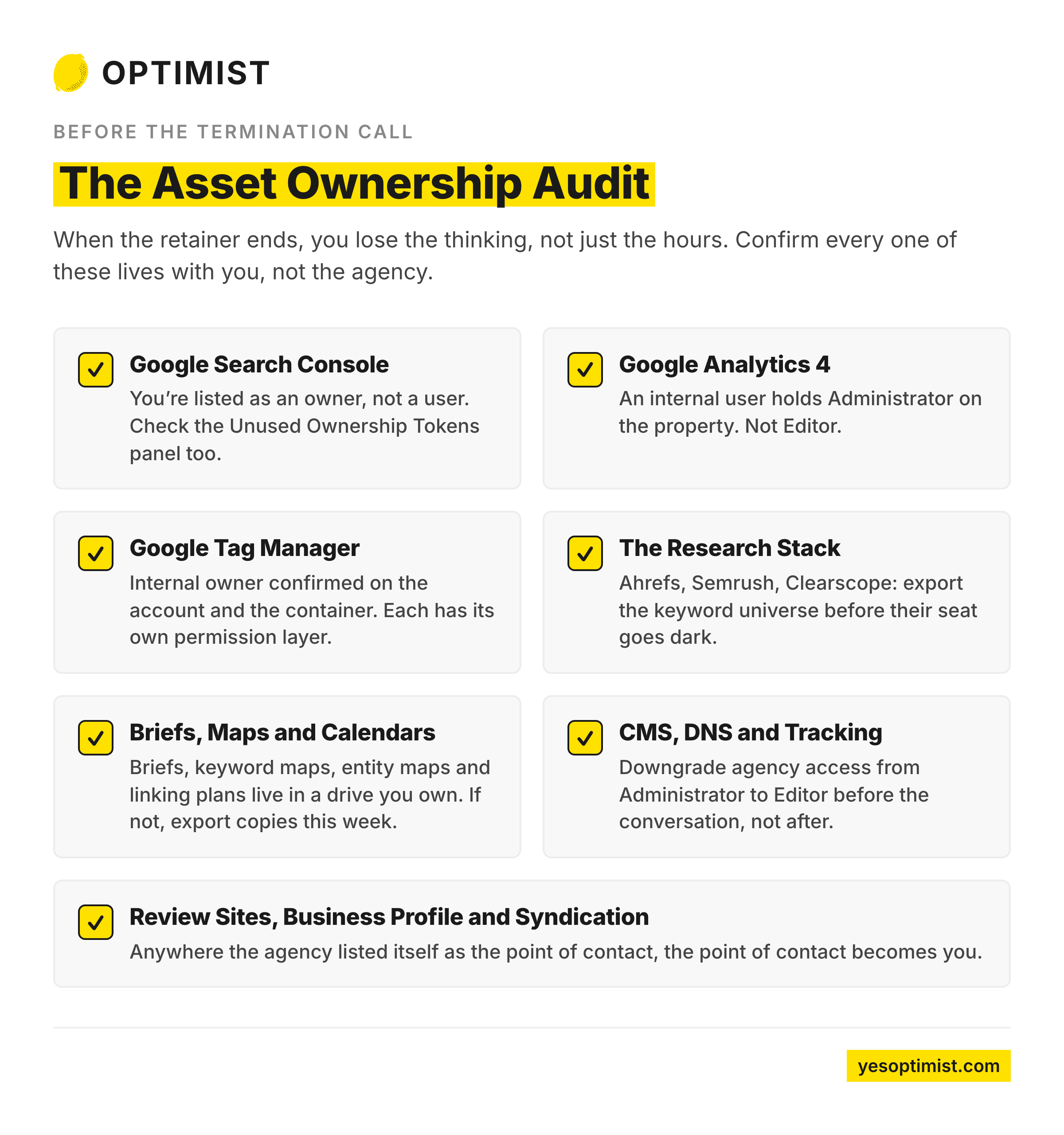
The audit needs to cover, at minimum:
- Google Search Console. You want to be listed as an owner (not user, not delegated owner). Per Google’s Search Console documentation, removing an agency’s access from the Users and Permissions panel is not the same as revoking ownership; check the Unused Ownership Tokens panel too.
- Google Analytics 4. You want at least one internal user with Administrator access on the property. Not “Editor.” Administrator.
- Google Tag Manager. The account and container both have their own permission layer. Confirm an internal owner on both.
- Ahrefs, Semrush, Screaming Frog, Clearscope, or whichever research stack the agency built the strategy inside. If the agency built you a keyword universe in Ahrefs and the seat is theirs, you lose the universe when they turn off the seat.
- Content briefs, keyword maps, editorial calendars, entity maps, internal linking plans. Confirm these live in a shared drive you own. If they don’t, get copies exported this week.
- WordPress or CMS admin, Cloudflare or DNS, and any tracking or schema injection layers. Downgrade the agency’s access from Administrator to Editor before the termination conversation.
- Third-party review-site listings, Google Business Profile, syndication accounts. Anywhere the agency listed itself as the point of contact.
The pattern to recognize is that the strategy tends to live inside the agency’s head and their tools, not yours. When the retainer ends, you lose the thinking, not just the hours. The ownership audit is what makes the thinking transferable.
Step 3. Sequence the Termination and the Access Change
The termination conversation happens after the audit, not before.
Two reasons:
First, an agency capable of holding a client hostage sometimes will, and you plan accordingly; if you announce termination while they still own the Search Console, you’re negotiating from a weaker position than you need to be.
Second, an amicable exit is easier when the access change looks like standard permission hygiene rather than a retaliation move.
Your SEO agency transition plan works like this:
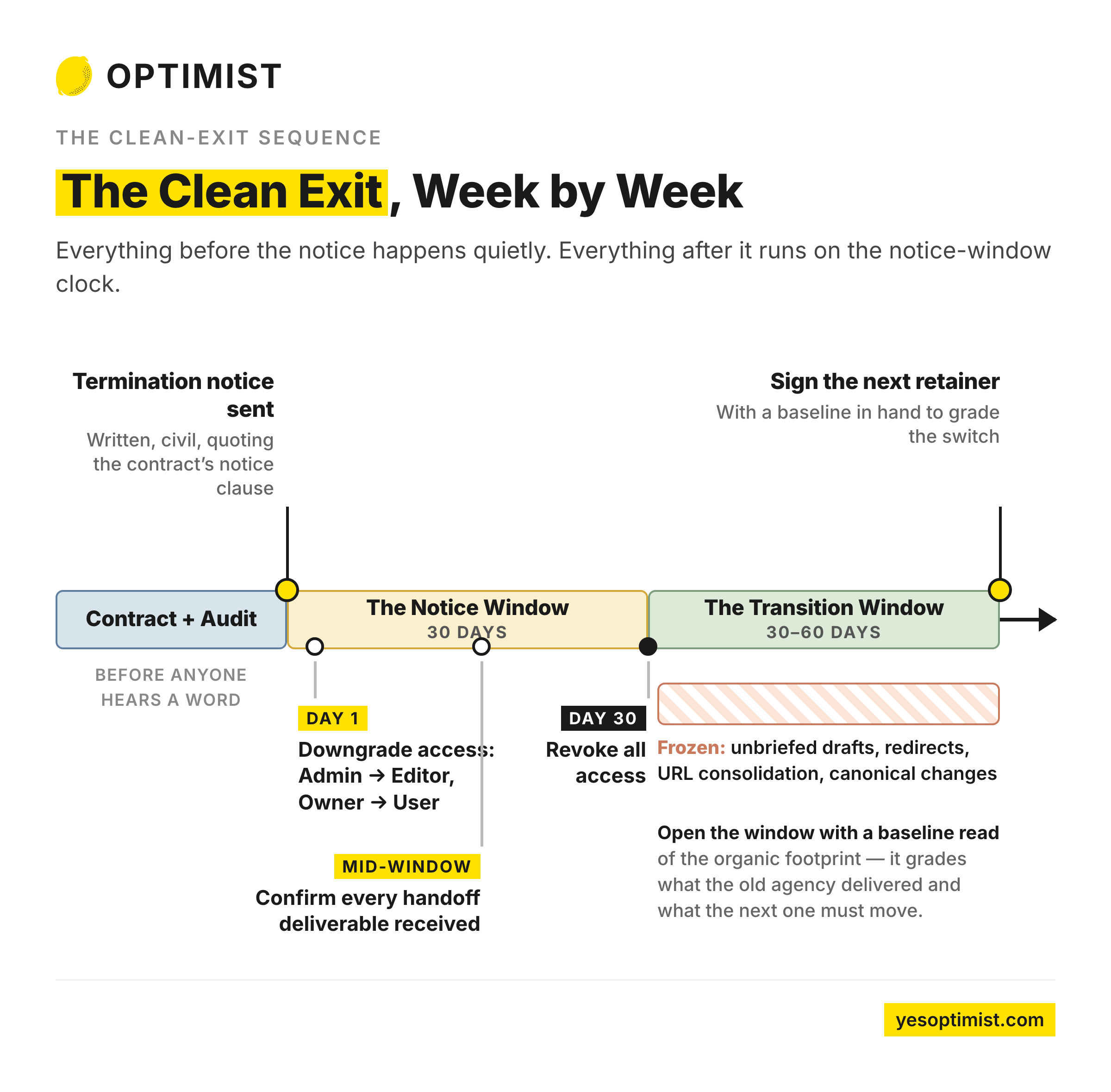
- Send a written termination notice that references the contract’s notice clause verbatim. Keep the tone civil; the ex-agency’s referral network is small.
- Ask for a transition-plan deliverable during the notice window: keyword universe export, editorial calendar handoff, entity map, current-state audit findings, and any custom research they’ve done. Most reputable agencies will hand this over cleanly.
- Downgrade access on day one of the notice window, not the last day. Move the agency from Administrator to Editor on WordPress and GA4; move from Owner to User on Search Console; move to view-only on GTM. This lets them finish the notice-period work without giving them the ability to break anything they built.
- Confirm receipt of all handoff assets before the notice period ends. Do not close the notice window with missing deliverables; you rarely get them back afterward.
- Revoke all access on the final day of the notice window.
That order (audit, notice, downgrade, deliverables, revoke) is how to change SEO agencies without losing rankings or your grip on the assets.
Step 4. Stage the Transition Before You Sign the Next Retainer
Do not fire your current agency on a Friday and interview replacements on Monday.
The 30-to-60-day window between them is where your organic footprint is most exposed, and it’s also where the smartest hiring decisions get made.
During the window, freeze publishing on any content the outgoing agency was drafting but hasn’t yet published, unless the piece has already been briefed to your internal standard. Keep on-page and technical SEO stable.
Don’t ship redirects, don’t consolidate URLs, don’t change canonicals.
Instrument a baseline read of your organic footprint before the transition so you can measure whether the switch cost you anything.
Who to Hire Next: What to Look for in an SEO Agency
The bar for the replacement, in order: brand mentions and recommendations across ChatGPT, Perplexity, Gemini, and Google AI Overviews as the primary AEO outcome; entity clarity across the website and the broader web as the primary lever; citations and schema as secondary structural work that supports the mentions play. If a candidate agency’s first slide is “AEO = FAQ schema,” you have your answer. AEO belongs inside SEO as one program, not two invoices.
The proof that “one program” produces pipeline: Stampli grew inbound pipeline 5x across a seven-year engagement spanning Series B through Series D. A B2B technology client Optimist worked with saw 49x LLM referral revenue growth in 14 months. A retail (B2C/D2C) client saw 13x LLM-sourced revenue year-over-year.
And a demand you can put on any candidate replacement, verbatim: “Show me a case study where you increased pipeline, not traffic.”
Get an Outside Baseline Before You Sign Anywhere New
The smartest move between the fire and the hire isn’t more agency interviews.
It’s an outside baseline. It’s a diagnostic on your current organic footprint that tells you what pipeline is contestable in your category, where the gaps are, and what a real strategy would target. Paid or free, a diagnostic is always a smaller commitment than a retainer, and it’s what separates finding a partner upgrade from a repeated mistake.
We offer a free analysis that sizes up the addressable organic demand within your category, looks at your current visibility across Google organic and AI answer engines, and provides key gaps and opportunities to help you drive more pipeline from organic channels.
It’s the outside baseline you can use to grade both what your current agency was actually delivering and what a replacement should be expected to move.
Firing without one turns a bad engagement into a bad pattern.
Schedule a call to discuss your goals and get a free expert analysis.
That’s the move.
Frequently Asked Questions About Firing an SEO Company
How much notice do I need to give my SEO agency?
Most SEO retainer contracts include a 30-day notice period on the client side; some legacy contracts run 60 or 90 days. Pull the actual agreement and locate the notice clause verbatim before you plan the exit. If the contract doesn’t specify, 30 days is standard practice and reasonable to offer in writing. In my experience, auto-renewal clauses trip clients up more often than notice periods; check for one, and check its opt-out window.
How do I end an SEO contract without losing my rankings?
To end an SEO contract without losing your rankings, freeze publishing on drafts that haven’t been briefed to your internal standard, keep on-page and technical SEO stable through the transition window (no redirects, no URL consolidation, no canonical changes), and complete the asset ownership audit before you send the notice. Rankings rarely collapse from a clean termination; they collapse from access loss, agency-plan content that continues publishing without a strategy behind it, or technical changes shipped during the handoff window. The four-step exit sequence in this article is designed to protect the rankings you have while you decide what strategy to build next.
What if my SEO agency owns my Google Search Console account?
If your SEO agency owns your Google Search Console account, you have more control than the agency’s account structure implies. Per Google Search Console’s ownership documentation, a verified owner proves ownership via an HTML file, DNS record, or Google Analytics / Tag Manager link, and that verification token lives on your site. You can remove the agency’s verification file (or DNS record) from your own property to invalidate their claim, then verify yourself as owner. The Users and Permissions panel and the Unused Ownership Tokens panel are separate; you need to check both. If the agency is a verified owner, the token removal is the extra step.
Should I tell my SEO agency I’m switching before I’ve hired the next one?
No. Complete the diagnostic, the ownership audit, and ideally the outside baseline before you begin replacement interviews or announce the change. I’ve seen this go wrong when a team fires the current agency to signal urgency to a replacement, then negotiates from weakness against every candidate on the shortlist. The stronger position is to know exactly what pipeline is contestable in your category before you sit down with the next vendor.
How do I know if my SEO agency is bad or if the strategy is just wrong?
To tell whether your SEO agency is bad or the strategy is just wrong, look at whether the agency has a specific written plan tied to pipeline outcomes and can defend month-over-month what moved and why. A team that produces content, ships rankings, and cannot connect either to qualified pipeline is either running a broken plan (strategy failure) or reporting against the wrong metric (expectation failure). A team that can’t tell you what specifically shifted last month is more likely running a broken process (agency failure). Only the third pattern is fixed by firing.
What should I look for in a replacement SEO agency in 2026?
Ask any candidate replacement for two things. First, a case study where they increased pipeline, not traffic. Pipeline as the scoreboard is the disqualifier that filters out most vanity-metric agencies fast. Second, a written explanation of how they run AEO and SEO as one program, including how the brand shows up in ChatGPT, Perplexity, Gemini, and Google AI Overviews, and what levers they use to move that. A vendor whose first answer is “we ship FAQ schema” is running a citation-tactic bolt-on. A vendor whose first answer names entity clarity, messaging consistency, and content gaps as the brand-mention levers understands the actual play. The best B2B SEO agencies all pass both of those tests.
